
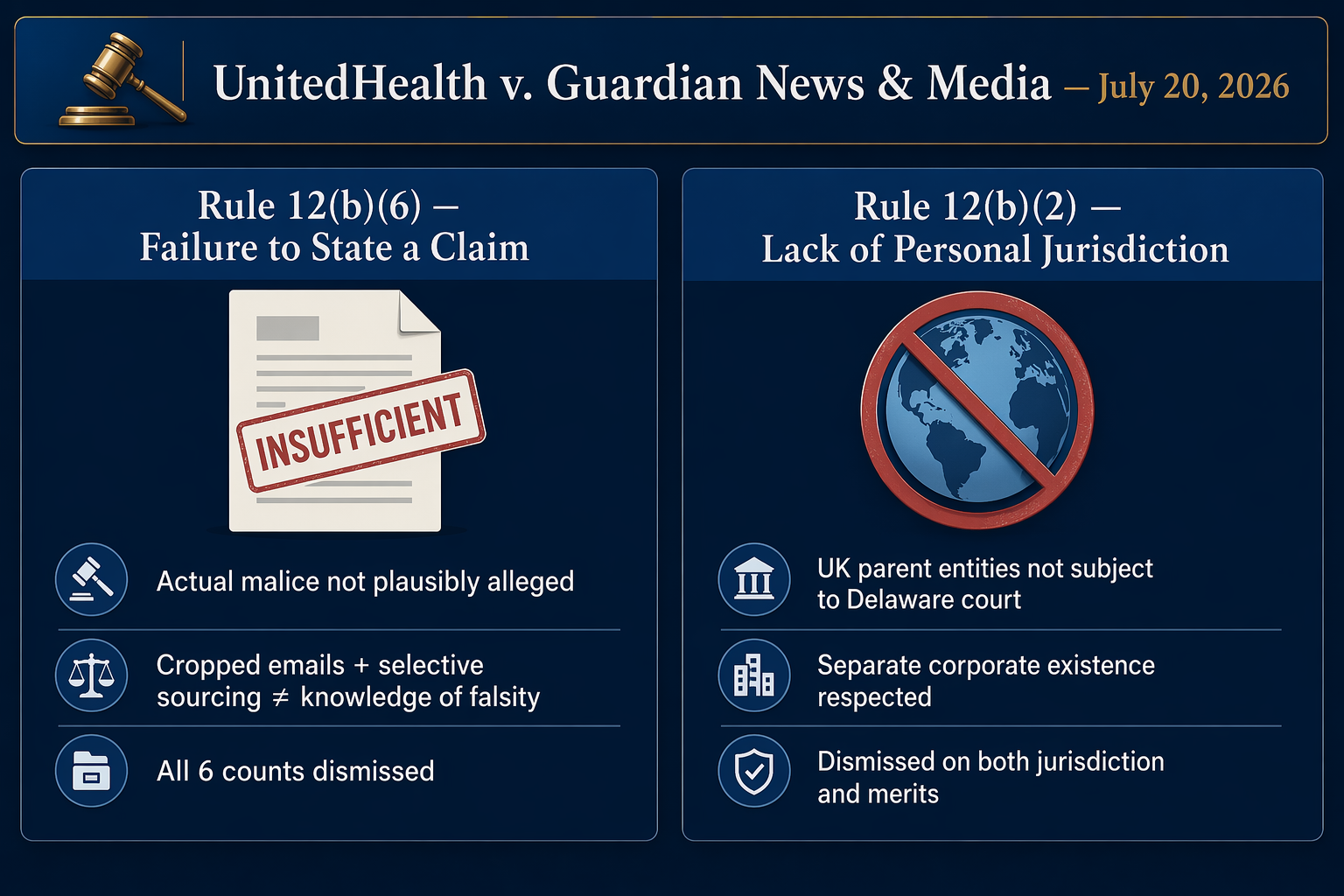
On July 20, 2026, Delaware Superior Court Judge Calvin L. Scott Jr. dismissed all six counts in UnitedHealth Group v. Guardian News & Media LLC et al., No. N25C-06-042, ending UnitedHealth’s defamation case against The Guardian at the pleading stage as to every defendant then before the court.[1] Guardian US prevailed on Rule 12(b)(6), while the UK parent entities prevailed on personal jurisdiction grounds under Rule 12(b)(2) and, alternatively, on the merits.[1]
That is the clean result. The more important legal point is narrower: the court did not hold that The Guardian’s nursing-home reporting was true, complete, or immune from criticism. At Rule 12(b)(6), the court accepted UnitedHealth’s factual allegations as true and still concluded that the complaint did not plausibly plead actual malice.[1] For a public-figure corporate plaintiff, that distinction is the case.
One publication caveat belongs near the front: the available dismissal coverage reports the outcome and attributes reasoning to Judge Scott’s opinion, but the full Delaware Superior Court opinion should be checked directly on the docket before relying on specific language from the ruling.[1] The same caution applies to prejudice. Available reporting does not confirm whether the dismissal was with or without prejudice, and that omission matters because it affects whether UnitedHealth may attempt to amend or otherwise revive the claims in the trial court.
How The Case Reached The Pleading Stage
The lawsuit followed The Guardian’s May 21, 2025 investigation, headlined “Revealed: UnitedHealth secretly paid nursing homes to reduce hospital transfers.” The article reported on alleged payment arrangements involving nursing homes and reduced hospital transfers, a subject that sits squarely in public-concern territory because it implicates health care, elder care, insurer incentives, and patient consequences.[2]
UnitedHealth answered publicly the same day. Its statement disputed the article’s account and defended the company’s practices, framing The Guardian’s reporting as inaccurate and misleading rather than merely unfavorable.[3] By June 2025, the dispute had moved from corporate response to litigation: UnitedHealth filed suit in Delaware Superior Court, and Bloomberg Law identified the case as UnitedHealth Group v. Guardian News & Media LLC et al., No. N25C-06-042.[4]
The complaint’s public framing also carried the atmosphere of the moment. Semafor reported that UnitedHealth accused The Guardian of trying to “capitalize” on the killing of UnitedHealthcare CEO Brian Thompson, giving the case a sharper reputational and political edge than an ordinary corporate defamation complaint.[5] That atmosphere helps explain the stakes, but it did not lower the pleading burden.
| Issue | What mattered at dismissal |
|---|---|
| Rule 12(b)(6) | The court accepted UnitedHealth’s factual allegations as true but found the complaint did not plausibly allege actual malice. |
| Actual malice | Allegations about cropped emails, selective sourcing, and narrative choices did not plausibly show knowledge of falsity or reckless disregard. |
| Rule 12(b)(2) | The UK parent entities were dismissed for lack of personal jurisdiction and also on merits grounds. |
| Prejudice | Available reporting does not clarify whether the dismissal was with or without prejudice. |
Rule 12(b)(6) Made UnitedHealth’s Own Allegations Do The Work
A Rule 12(b)(6) dismissal asks whether the complaint states a legally viable claim, not whether the defendant has proved the disputed reporting correct. In this posture, factual allegations are taken as true and reasonable inferences are drawn for the plaintiff. That makes the dismissal more significant, not less: UnitedHealth received the benefit of its pleaded facts and still failed to cross the plausibility line on actual malice.[1]
Because UnitedHealth is a publicly traded Fortune 50 company treated as a public figure for purposes of the dispute, it had to plausibly allege actual malice: that the defendants published the challenged statements with knowledge of falsity or reckless disregard for truth.[1] Negligence, aggressive editing, one-sidedness, or an allegedly damaging interpretive frame does not, without more, satisfy that standard.
That is where many corporate complaints become weakest. They describe the harm in detail, emphasize the plaintiff’s stature, identify what the publication allegedly omitted, and then ask the court to infer constitutional fault from the intensity of the editorial choices. Judge Scott’s ruling, as reported, refused that shortcut.[1]
Why The Actual Malice Allegations Failed
UnitedHealth’s theory focused on the way The Guardian allegedly used materials: cropped emails, selective sourcing, and narrative choices that, in UnitedHealth’s view, made the reporting false or misleading.[1] Those are familiar allegations in modern media defamation litigation. They can matter. But they are not magic words.
A cropped document may support actual malice if the omitted portion directly contradicts the published gist and the complaint plausibly alleges that the publisher recognized that contradiction. Selective sourcing may matter if the pleaded facts show that the publisher deliberately avoided obvious truth or relied on sources it knew were unreliable in a way that made the challenged statements probably false. A sharply framed narrative may matter if the publication’s asserted implication cannot be reconciled with what the publisher knew.
The reported ruling indicates that UnitedHealth did not plead that kind of bridge between editorial conduct and subjective awareness of probable falsity.[1] The complaint attacked the presentation of the reporting, but the court found that the alleged defects did not plausibly establish knowledge of falsity or reckless disregard. That is a pleading failure, not an evidentiary loss after discovery.
This matters for both sides. For publishers, the ruling is a reminder that source-based reporting on a matter of public concern remains defensible at the threshold when the complaint cannot plead facts showing actual malice. For plaintiffs, it is a warning that an allegedly incomplete account must be tied to the defendant’s state of mind. The missing allegation is not “the article hurt us.” It is “the publisher knew, or strongly suspected, that the challenged statement was false.”
The distinction also keeps the decision from becoming a proxy verdict on the nursing-home story itself. A dismissal on actual malice pleading grounds can protect the publication from litigation without judicially endorsing every editorial choice in the underlying article. That is how pleading doctrine is supposed to work when constitutional fault is an element of the claim.
Cropped Emails And Selective Sources Are Starting Points, Not Endpoints
The phrase “cropped emails” sounds damaging because it suggests a reader did not see the whole record. But defamation doctrine asks a more exacting question: what did the omitted material show, and what did the publisher understand it to show at the time of publication? If the omitted context merely supports the plaintiff’s preferred interpretation, or creates a factual dispute about fairness, it does not automatically plead actual malice.
The same is true of source selection. Investigative reporting almost always involves choices about which documents, former employees, internal communications, corporate responses, and expert views deserve space. A complaint that says the journalist chose the wrong sources still has to allege why those choices made it plausible that the journalist knew the resulting statement was false or entertained serious doubts about it.
UnitedHealth’s pre-suit statement gave The Guardian and the public the company’s position, but a publisher’s refusal to adopt a subject’s denial is not itself actual malice.[3] Public figures often dispute investigative reporting before publication or immediately after it. If denial alone supplied actual malice, the standard would collapse into a right of reply backed by discovery.
The UK Parent Entities’ Dismissal Was Not A Footnote
The personal jurisdiction ruling deserves separate attention. According to the available dismissal coverage, the UK parent entities moved under Rule 12(b)(2) for lack of personal jurisdiction and alternatively under Rule 12(b)(6); Judge Scott dismissed them on both jurisdictional and merits grounds.[1]
For multinational media organizations, that part of the ruling matters because corporate structure can become a litigation target. Plaintiffs often name parent entities to increase pressure, broaden perceived recovery sources, or complicate defense coordination. A court still needs a jurisdictional basis for each defendant. The presence of a related US publisher does not automatically bring foreign parent entities into a state court.
The alternative merits dismissal also reduces the practical ambiguity. If a jurisdictional ruling alone had removed the UK entities, the same substantive claims might have remained alive against the US defendant. Here, the reported outcome was broader: all six counts were dismissed against all defendants, with the actual malice pleading failure doing central work in the case as a whole.[1]
The available reporting does not support a broader conclusion about all foreign media parents, all Delaware filings, or all publication-related jurisdiction disputes. The safer lesson is case-specific and useful: media defendants should contest personal jurisdiction early when the complaint relies on corporate affiliation rather than defendant-specific forum contacts, and they should not treat that argument as secondary merely because a merits motion is also strong.
The Broader Defamation Climate Explains The Stakes, Not The Holding
UnitedHealth did not bring this case in a quiet reputational environment. Bloomberg Law reported in February 2025 that UnitedHealth had hired Clare Locke, a prominent defamation firm, in connection with social media posts, reflecting a wider effort to counter public claims about the company after a period of intense scrutiny.[6] The Guardian lawsuit later placed that same adversarial posture into conventional media litigation.
There is also a broader 2025-2026 pattern of high-profile media defamation defendants using early motions to test whether complaints plausibly plead constitutional fault. Benesch Law’s June 2026 trend analysis identifies important defamation decisions and emerging themes, including the continued role of Rule 12(b)(6) in significant media cases.[7] UnitedHealth v. Guardian fits that landscape, but it should not be oversold as a doctrinal break.
The decision applied settled actual malice principles in an unusually high-stakes setting. A Fortune 50 plaintiff, sophisticated counsel, intense public controversy, and a damaging article can make a case expensive and consequential. They do not substitute for plausible allegations that the publisher knew the challenged reporting was false or recklessly disregarded that possibility.
Practical Consequences For Media Defense Counsel
The dismissal offers several practical lessons for media defendants facing corporate defamation threats, especially when the plaintiff has resources, public pressure, and a pre-suit communications strategy.
- Frame the motion around the plaintiff’s own pleading. The strongest point in this ruling is that UnitedHealth’s allegations were accepted as true and still did not plausibly plead actual malice.[1]
- Separate falsity arguments from actual malice. A complaint may allege that a story was wrong, incomplete, or misleading; the dispositive question for a public-figure plaintiff is whether it alleges the required state of mind.
- Use the reporting record carefully. Source basis, documentary grounding, and public-concern subject matter can help show why the complaint’s inference of actual malice is implausible, but the motion should avoid sounding like a trial brief on truth.
- Move early on personal jurisdiction for foreign affiliates. Parent-subsidiary relationships should not be allowed to stand in for defendant-specific forum contacts.
- Preserve the procedural caveats. Counsel still need to verify the full opinion and the prejudice ruling before treating the dismissal as finally limiting amendment options.
For publishers, the ruling also underscores the value of maintaining a record that shows how a contested investigation was built: documents reviewed, sources evaluated, subject responses sought or considered, and editorial choices made for reasons other than hostility to the subject. Those facts may never need to be proved if the complaint fails at the threshold, but they shape the plausibility analysis.
For corporate plaintiffs, the lesson is less comfortable. A large market presence, a serious reputational injury, and an aggressive denial can explain why a company sues. They do not plead actual malice. If the challenged reporting concerns a public issue and the plaintiff is a public figure, the complaint must connect the alleged editorial defect to knowledge of falsity or reckless disregard with facts rather than adjectives.
What Remains Uncertain
Two uncertainties should remain attached to any legal analysis published at this stage. First, the full Delaware Superior Court opinion should be reviewed directly before quoting Judge Scott or relying on exact formulations attributed to the court, because currently available quotations and descriptions come through news coverage rather than the docket itself.[1]
Second, the prejudice issue is unresolved in the available materials. A dismissal with prejudice would have a different procedural meaning from a dismissal without prejudice or with leave to amend. Until that point is confirmed, the safest formulation is that all six counts were dismissed at the pleading stage, not that UnitedHealth is definitively barred from any further attempt to plead the claims.
The decision does not settle the truth of The Guardian’s underlying nursing-home reporting, and it does not announce a new First Amendment regime. It is a disciplined application of actual malice pleading rules to a high-stakes corporate defamation case, with a meaningful jurisdictional ruling for foreign media parents. That is why the legal analysis begins and ends with pleading sufficiency, not with a victory lap for either side.
References
- UnitedHealth Defamation Suit Against The Guardian Investigative Report Dismissed, Yahoo Finance / TheWrap, July 20-21, 2026.
- Revealed: UnitedHealth secretly paid nursing homes to reduce hospital transfers, The Guardian, May 21, 2025.
- Statement regarding May 21 article in The Guardian, UnitedHealth Group, May 21, 2025.
- UnitedHealth Hits Guardian With Suit Over Nursing Home Article, Bloomberg Law, June 2025.
- UnitedHealthcare lawsuit accuses Guardian of trying to 'capitalize' on CEO Brian Thompson's killing, Semafor, June 4, 2025.
- UnitedHealth Hires Defamation Firm Over Social Media Posts, Bloomberg Law, February 2025.
- A Defining Year For Defamation: Key Decisions And Emerging Trends, Benesch Law, June 2026.
Comments
Join the discussion with an anonymous comment.