
The first legal impact of the USFWS blanket rule revocation is narrower than the headline suggests: currently listed threatened species did not lose their take protections overnight. The July 17, 2026 Department of the Interior announcement says the U.S. Fish and Wildlife Service has finalized a rule eliminating the blanket 4(d) rule at 50 C.F.R. § 17.31 and § 17.71, ending the automatic extension of endangered-species take prohibitions to newly listed threatened species going forward.[1]
That distinction matters for every compliance calendar already built around an existing threatened listing. If a species is currently listed as threatened and protected by the prior blanket rule, the July 2026 action does not, by itself, create a new permission to take that species. The rule is prospective. The harder work begins with future threatened listings, where FWS can no longer rely on the old regulatory default and must decide, species by species, which prohibitions and exceptions belong in a 4(d) rule.
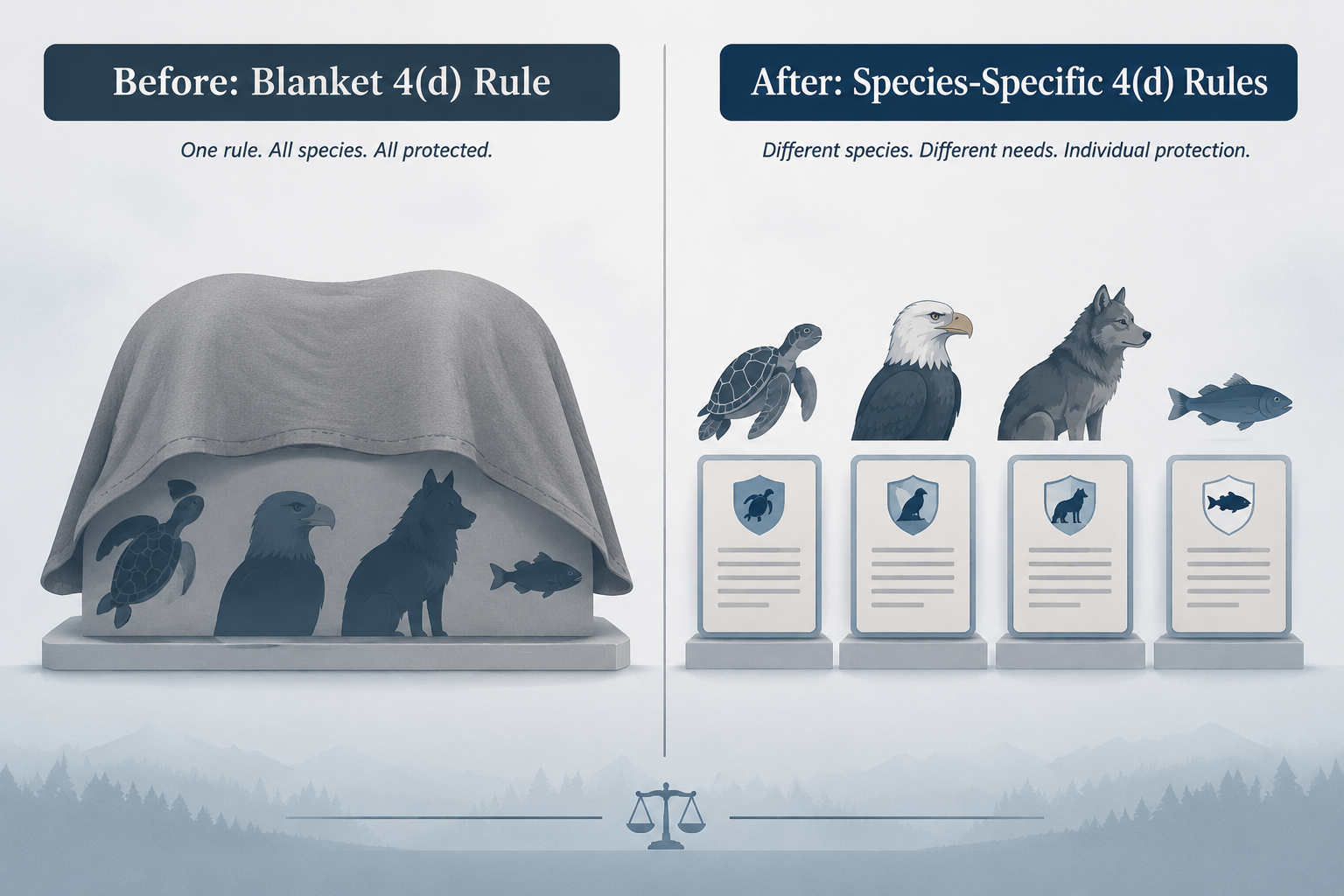
What Changed, In Operational Terms
Section 9 of the Endangered Species Act prohibits “take” of endangered species. For threatened species, Congress gave the wildlife agencies a different tool: ESA Section 4(d), which allows the agency to issue regulations it deems necessary and advisable for conservation. For decades, FWS used a blanket regulation to extend endangered-level take prohibitions to threatened species unless a species-specific rule said otherwise. The July 2026 rule removes that default for future FWS threatened listings.[1]
The practical consequence is a shift from automatic coverage to drafting obligation. When FWS lists a species as threatened after this change, the agency must decide whether to issue a species-specific 4(d) rule and what that rule should prohibit, allow, or condition. Some future rules may closely resemble the old blanket protection. Others may be narrower, include tailored exceptions, or take longer to finalize.
| Question | Legal Effect After the July 2026 Rule |
|---|---|
| Are currently listed threatened species immediately stripped of take protections? | No. The rule is prospective and does not automatically remove existing protections. |
| Does the old FWS blanket 4(d) rule continue for new threatened listings? | No. FWS eliminated the default at 50 C.F.R. § 17.31 and § 17.71 for newly listed threatened species going forward. |
| What replaces the default? | Species-specific 4(d) rules, if FWS determines they are appropriate for the species. |
| What should practitioners watch first? | Federal Register publication, effective-date language, new listing packages, and any proposed or final species-specific 4(d) rules. |
As of July 19, 2026, the rule was only two days old, and the Federal Register text had not yet been docketed in the reviewed materials. That is not a technicality. Counsel advising on an active project should verify the published text, the effective date, any transition language, and the exact amendments to the Code of Federal Regulations before treating the announcement as the final compliance instrument.
Why FWS Says Species-Specific Rules Are Now Required
FWS has framed the revocation as a statutory-interpretation decision in the wake of Loper Bright Enterprises v. Raimondo, not merely as a preference for more flexible permitting. In the 2025 proposal materials, the agency said species-specific 4(d) rules reflect the “best reading of the statute,” and legal analysis of the proposal noted that FWS was moving away from the older Chevron-era premise that the blanket rule was at least a permissible construction of the ESA.[2][3]
The agency also points to the National Marine Fisheries Service as a comparator. NMFS has long used species-specific rules for marine threatened species rather than an FWS-style blanket rule, which gives FWS a ready example for the argument that the ESA does not require automatic endangered-level protections for every threatened species.[2]
That argument may be serious, but it is not self-proving. Loper Bright removed Chevron deference; it did not turn every new agency reading into the single correct reading of a statute. The post-Chevron posture can make FWS’s defense more direct because the agency is no longer asking a court to accept any reasonable interpretation. It also makes the defense more exposed because the court must decide statutory meaning without the old Chevron cushion.
The Reversal History Will Matter in Litigation
The July 2026 revocation is not the first turn of this wheel. FWS revoked the blanket 4(d) rule in 2019, the Biden administration reinstated it in 2024, and the second Trump administration has now revoked it again in 2026, this time expressly leaning into Loper Bright and the “best reading” theory.[2][4]
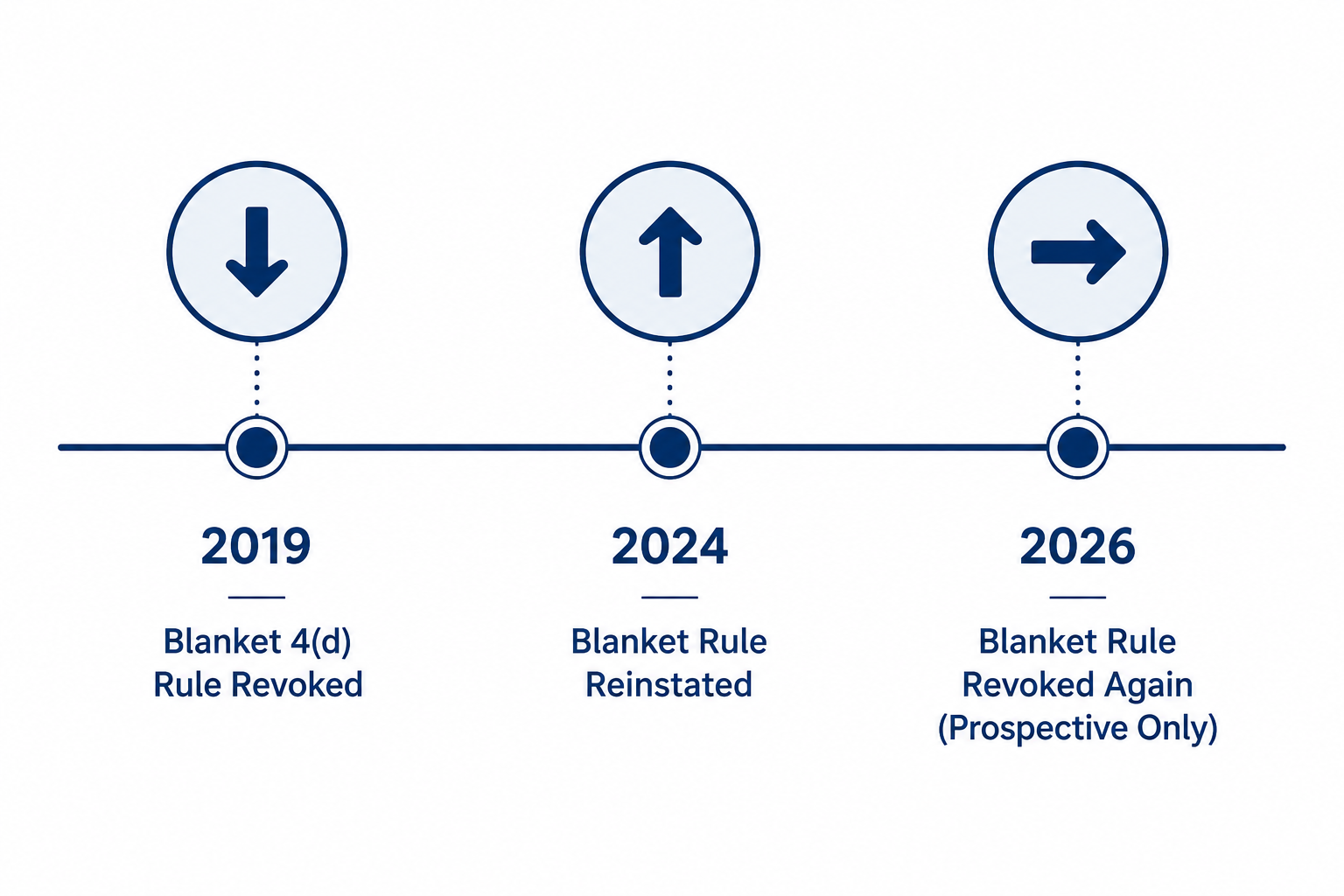
That compact history is more than administrative trivia. Reversals are allowed, but the Administrative Procedure Act requires an agency to give a reasoned explanation, address important aspects of the problem, and account for reliance interests where they are meaningfully raised. A reviewing court will not need to decide whether the 2024 policy was wiser than the 2026 policy. It will need to decide whether FWS adequately explained why the statute, the record, and the agency’s current judgment support another reversal.
Likely litigation theories are not difficult to anticipate: arbitrary-and-capricious reversal, failure to address reliance interests, and conflict with the ESA’s remedial conservation purpose. The Harvard Environmental & Energy Law Program’s ESA regulatory tracker identifies the blanket-rule rollback as part of a broader set of ESA regulatory changes likely to draw legal challenge, and related ESA rules have already moved quickly into court.[4][5]
The 97% Statistic Explains the Politics, Not the Whole Legal Record
The DOI announcement quotes Secretary Doug Burgum’s argument that nearly 97% of species ever listed under the ESA remain on the list, using that figure to criticize the prior approach and emphasize recovery rather than indefinite listing.[1] The number will appear in briefing, comments, and client alerts because it is simple and rhetorically useful.
It should not be asked to do more work than it can bear. A species remaining listed does not, by itself, show that take protections failed or that a blanket rule impeded recovery. Listed species may remain on the list because recovery is biologically slow, recovery planning is under-resourced, habitat conditions remain degraded, or delisting standards are deliberately demanding. The 97% figure supports the administration’s public rationale; it does not resolve the statutory question or the adequacy of the rulemaking record.
The Bottleneck Is Species-Specific Drafting
For practitioners, the most consequential word in the new regime may be “specific.” A species-specific 4(d) rule requires more than replacing a blanket citation with a species name. The agency has to identify the threats to the species, decide which forms of take should be prohibited, determine whether exceptions for activities such as habitat management or routine land-use practices are appropriate, and build an administrative record that can survive review.
The Wildlife Society has raised the capacity concern directly, warning that FWS may lack the resources to develop timely and legally defensible species-specific 4(d) rules for each new threatened listing.[6] That concern is more concrete than the usual “uncertainty” language that follows any regulatory change. If the agency cannot produce rules at the pace listings require, the legal effect may appear as delayed protections, uneven regulatory coverage, and more vulnerable records rather than as a dramatic one-day drop in protection.
The capacity issue also cuts both ways for regulated parties. A project proponent may welcome a narrower species-specific rule, but a delayed or contested 4(d) rule can complicate project planning. A compliance team needs to know whether take is prohibited, whether an exception applies, whether an incidental take permit is needed, and whether the operative rule is likely to remain stable long enough to support investment decisions. The absence of a blanket default does not automatically produce clarity.
Nearby ESA Rules Add Litigation Weather
The blanket-rule revocation is part of a broader ESA reset, but it should not be collapsed into every other change. DOI and the wildlife agencies have also advanced rules involving the regulatory definition of “harm” and critical habitat exclusions.[4] Two lawsuits challenging the rescission of the “harm” definition were filed on July 14, 2026, before the July 17 blanket-rule announcement.[5]
Those companion fights matter because they shape the judicial environment in which the blanket-rule revocation will be tested. Courts may see a series of related ESA reversals, each with its own record and statutory theory. Agencies may see compressed briefing calendars and overlapping administrative records. Regulated parties may see multiple moving pieces affecting the same project even when only one rule is directly relevant to a particular species.
What to Watch Before Changing Compliance Assumptions
The safest near-term posture is neither to ignore the revocation nor to treat it as a universal deregulation event. The operative questions are tied to dates, species, and documents.
- Check Federal Register publication: confirm the final regulatory text, effective date, transition provisions, and any explanation of how existing threatened-species protections are preserved or replaced.
- Separate current from future listings: do not revise advice for an already listed threatened species unless the governing 4(d) protection has actually changed.
- Track new threatened listing packages: future listings will require close review of any proposed or final species-specific 4(d) rule, including exceptions that may affect ordinary operations.
- Preserve permitting assumptions in writing: if a project schedule depends on the absence, scope, or timing of a 4(d) rule, document the assumption and revisit it as the record develops.
- Watch early APA challenges: the first serious decisions may clarify how courts treat FWS’s Loper Bright rationale, reversal explanation, and handling of reliance interests.
A useful hypothetical shows the difference. If FWS lists a terrestrial species as threatened after the effective date, the old blanket rule no longer automatically supplies endangered-level take prohibitions. Counsel would need to examine the listing package and any species-specific 4(d) rule rather than assume the default prohibition applies. By contrast, for a species already listed as threatened under the prior regime, the July 2026 announcement alone is not enough to advise that take prohibitions have disappeared.
The formal legal change is prospective and relatively narrow in immediate effect. Its larger impact will likely be determined by whether FWS has the capacity to write timely, defensible species-specific rules and whether courts accept the agency’s post-Loper Bright explanation for reading the ESA to reject the old blanket approach.
References
- Trump Administration Finalizes Endangered Species Act Regulation Reform, Department of the Interior, July 17, 2026
- Reversing Course for Endangered Species Act, Holland & Knight, Nov. 21, 2025
- Administration Revises Endangered Species Act Regulations to Strengthen, U.S. Fish and Wildlife Service, Nov. 19, 2025
- Endangered Species Act Regulations, Harvard Environmental & Energy Law Program
- Trump administration sued over Endangered Species Act changes, NPR, July 14, 2026
- How will ESA rollback impact threatened species?, The Wildlife Society
Comments
Join the discussion with an anonymous comment.