
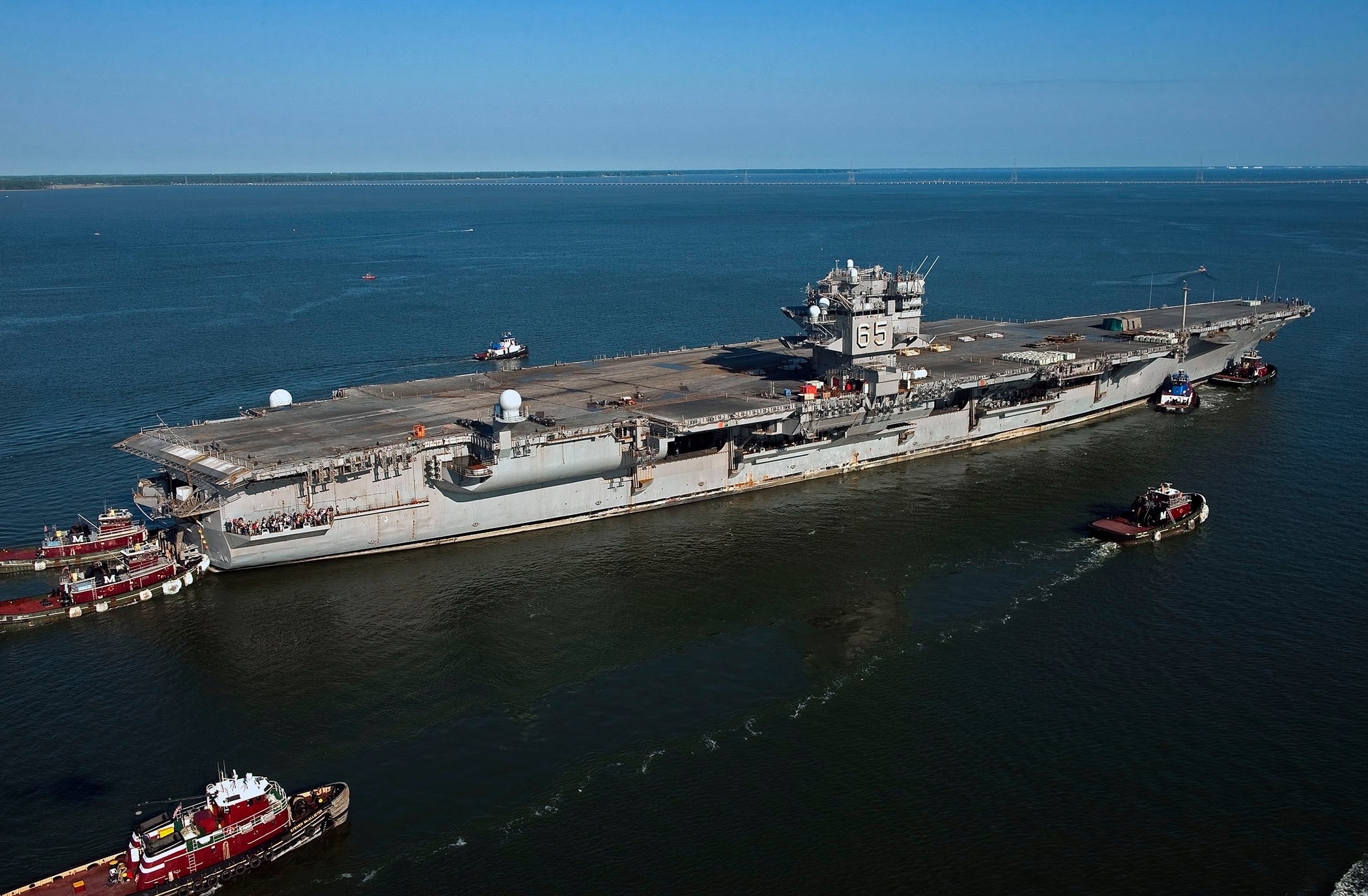
As of Q3 2026, the legal dispute over the USS Enterprise contract is doing two things at once. The case is still on the Federal Circuit docket after a March 18, 2026 notice of appeal, while the Navy has already re-awarded the commercial dismantlement contract at $418.5 million.[1][2] At the same time, USS Nimitz arrived at Naval Station Norfolk in July 2026 ahead of a reported March 2027 decommissioning date.[3] That overlap is the point. Enterprise is no longer only the disposal problem for a one-off first nuclear carrier; it is the procedural test arriving just before the Nimitz-class retirement sequence begins to press on the same legal framework.

The contract number and the protest docket are therefore not side details. They are the visible edge of a larger handoff: from government-controlled naval nuclear work to a commercial dismantlement model that must withstand bid protest scrutiny, environmental review, congressional oversight, and a still-unsettled division of regulatory authority.
The headline contract figures need to stay in their own lanes. The Navy’s earlier commercial path was reported as a $537 million award, and the later re-award was reported at $418.5 million.[2][4] Those are procurement events. They are not the same thing as the Navy’s planning comparison, developed in FY2019 dollars, that estimated commercial dismantlement and disposal at $554 million to $696 million, compared with $1.1 billion to $1.4 billion for public shipyard dismantlement and disposal.[5] Treating those numbers as interchangeable makes the savings case look cleaner than the record supports.
The Unresolved Authority Question
The most important document for understanding why Enterprise matters is not the contract announcement. It is GAO-18-523, the Government Accountability Office’s August 2018 report on aircraft carrier dismantlement and disposal options. GAO documented a disagreement between Naval Reactors, a joint Department of Energy and Navy organization, and the Nuclear Regulatory Commission over which agency had regulatory authority for commercial dismantlement of nuclear-powered warships.[5]
That disagreement is easy to blur if both institutions are described merely as federal nuclear regulators. They are not interchangeable for this purpose. Naval Reactors has long exercised authority over naval nuclear propulsion matters. The NRC regulates civilian nuclear materials and licensed commercial nuclear activity. Enterprise forces the awkward question created when naval nuclear material, removed from a warship disposal setting, enters a commercial dismantlement environment.
GAO did not resolve the dispute. It reported that the two institutions disagreed, and it treated that disagreement as a reason additional oversight was warranted before the Navy used commercial dismantlement for a nuclear-powered aircraft carrier.[5] That is a narrower conclusion than saying the commercial path is unlawful, unsafe, or impossible. It is also more consequential. A disposal model can survive engineering complexity and still fail as a repeatable legal template if the authority trail remains vulnerable.
The uncertainty is not academic. Commercial dismantlement requires someone to decide what standards apply, who enforces them, how nuclear components and contaminated materials are handled once the work leaves the familiar naval shipyard setting, and what must be shown in the environmental record. If the responsible agencies are not aligned on jurisdiction, later disputes can migrate into procurement, environmental litigation, appropriations oversight, or future contract terms.
Congress Turned The Regulatory Gap Into A Reporting Requirement
Congress responded through the FY2019 National Defense Authorization Act by requiring the Navy to report on the regulatory framework applicable to dismantling and disposing of Enterprise.[5] That requirement matters because it moved the question from interagency disagreement into a statutory oversight channel. The Navy could not simply choose a cheaper disposal route and leave the authority question as an internal assumption.
The reporting requirement then fed into the Navy’s environmental process. The final environmental impact statement and Record of Decision selected a commercial dismantlement and disposal path for Enterprise, with the cost comparison doing substantial work in the decision record.[5] The legal durability of that selection depends not only on the dollar savings, but on whether the regulatory framework described to Congress and used in the environmental review is sufficiently stable to support repeated use.
| Figure | What It Measures | Why It Should Not Be Blended |
|---|---|---|
| $554 million to $696 million | Navy estimate for commercial dismantlement and disposal in FY2019 dollars | Planning estimate tied to the environmental and oversight record, not a final contract price |
| $1.1 billion to $1.4 billion | Navy estimate for public shipyard dismantlement and disposal in FY2019 dollars | Baseline used for the projected savings comparison |
| $537 million | Reported original commercial contract award | Procurement award figure reported later under different assumptions and timing |
| $418.5 million | Reported re-awarded commercial contract | Current reported contract action, not the original FY2019 planning estimate |
The savings case is still important. A commercial estimate of $554 million to $696 million against a public shipyard estimate of $1.1 billion to $1.4 billion supports the roughly $1 billion savings narrative often attached to the Enterprise model.[5] But that narrative is only as useful as its assumptions. FY2019-dollar planning ranges answer a different question than whether the Navy’s actual procurement process, contractor selection, and regulatory allocation can survive review.
That distinction should discipline how legal professionals read the later contract history. A lower re-award value does not, by itself, prove the regulatory model is settled. A protest or appeal does not, by itself, disprove the savings analysis. The hard question is whether the Navy has created a process that can be used again when the next retired nuclear carrier is not a singular historical artifact but the first member of a class entering the disposal pipeline.
The Procurement Dispute Now Carries More Than Procurement Weight
The Court of Federal Claims proceedings arose from the Enterprise dismantlement procurement, including a dispute tied to a Procurement Integrated Enterprise Environment, or PIEE, submission glitch. Law360 reported that the court ruled against a challenge premised on that glitch, and the CourtListener docket reflects the case activity in the Court of Federal Claims.[1][6] On March 18, 2026, a notice of appeal was filed at the Federal Circuit, docketed as No. 2026-1560.[1]
There is a temptation to treat the PIEE issue as narrow electronic-filing housekeeping. That would miss why the appeal matters in this setting. Submission systems, deadline enforcement, solicitation terms, and corrective action decisions are the machinery by which an agency makes its chosen regulatory and environmental strategy executable. When the underlying project is unprecedented, procedural defects become more than vendor complaints; they can affect whether the template looks clean enough to reuse.
The Navy’s re-award at $418.5 million adds another layer without ending the appeal story. As of mid-July 2026, the available materials do not show that the Federal Circuit appeal has been formally closed.[1][2] That is the posture legal professionals should keep separate: an agency may move forward with a re-award while appellate questions remain unresolved, but the existence of a new award does not automatically erase the precedential significance of the procurement challenge.
Nor should the appeal be asked to do too much. The known docket status supports attention, not prediction. The Federal Circuit may resolve procurement questions without clarifying the NRC/Naval Reactors boundary. It may address procedural issues in a way that helps future procurements without validating every premise of commercial nuclear warship dismantlement. The appeal is part of the operating template, not the whole template.
Nimitz Makes The Enterprise Model Less Theoretical
Enterprise can still be described, briefly, as the first nuclear-powered aircraft carrier. That fact explains why the disposal project has attracted attention, but it does not explain why the legal dispute now matters. The stronger reason is USS Nimitz. Forbes reported that Nimitz arrived at Norfolk in July 2026 and is scheduled for decommissioning in March 2027.[3] The official Navy inactivation schedule should still be watched for verification, but the reported timing is close enough to make Enterprise a live precedent problem rather than a retrospective one.
If the Enterprise commercial dismantlement model is treated as successful, future Nimitz-class retirements may inherit its regulatory premises, contract structure, and environmental reasoning. If the model remains procedurally unsettled, each later carrier could reopen the same questions under greater schedule pressure. The law does not need a dramatic failure to become costly; repeated ambiguity is enough.
That is why the GAO report still sits at the center of the matter. The report’s unresolved jurisdictional disagreement preceded the FY2019 NDAA requirement, the environmental decision record, the cost comparison, the original award, the Court of Federal Claims proceedings, the Federal Circuit appeal, and the re-award.[5] Each later step may be procedurally proper on its own terms while still depending on a regulatory allocation that deserves direct attention before the next carrier arrives in the same posture.
What Legal Professionals Should Track
The practical watchlist is narrow. First, the Federal Circuit appeal status matters because it may shape how much confidence future contracting officers can place in the Enterprise procurement path. The issue is not whether every later carrier contract will repeat the same facts; it is whether the first commercial nuclear carrier dismantlement procurement leaves behind clean procedural ground.
Second, any authoritative clarification of NRC and Naval Reactors roles would matter more than another generalized assurance that the work will be regulated. The GAO-documented disagreement is specific. Future records should be read for who claims authority, over which materials and activities, at which stage of dismantlement, and under what legal instrument.
Third, the Nimitz timeline needs official confirmation as decommissioning approaches. A reported March 2027 decommissioning date increases the urgency, but legal planning should distinguish media reporting from formal Navy scheduling documents.[3]
Fourth, the next Nimitz-class retirement records should show whether the Navy treats Enterprise as a settled model or rebuilds the regulatory explanation from the ground up. Quiet repetition may be the real precedent. If future records adopt the Enterprise framework without re-litigating the jurisdictional premise, the practical legal effect of this dispute will extend well beyond the first hull.
References
- Case docket, CourtListener, 1:25-cv-01336
- USS Enterprise contract re-award coverage, AL.com, July 2026
- USS Nimitz arrival and decommissioning timeline coverage, Forbes, July 2026
- USS Enterprise dismantlement contract award coverage, Naval News, June 2025
- Aircraft Carrier Dismantlement and Disposal: Options Warrant Additional Oversight, Government Accountability Office, August 2018
- COFC ruling coverage on PIEE submission glitch, Law360
Comments
Join the discussion with an anonymous comment.