
Section 108 did not die when the Take Care of America's Veterans Act was pulled from the House floor on July 16, 2026. It was delayed until September after backlash over proposed sleep apnea and tinnitus rating cuts, which means the immediate vote is off the calendar but the legal problem remains alive.[1]
The problem is not simply that Congress is considering a lower rating for future veterans with sleep apnea or tinnitus. Rating schedules age. Medical criteria change. VA disability law has never promised that every diagnostic code will remain frozen because a prior generation of veterans built claims around it. The sharper issue is institutional: Section 108 would move a service-connected disability rating reduction out of VA's evidence-based regulatory process and into a spending package as a budget offset.
That matters because the proposed savings are not incidental. Veterans groups and Senate Democrats have described Section 108 as producing roughly $57 billion to $60 billion in savings to help finance a broader package with more than 60 provisions, including the Major Richard Star Act.[2][3] The categories are large enough to make that math possible: tinnitus is reported as the most common service-connected disability, affecting 3.6 million veterans, and more than 763,000 veterans receive compensation for sleep apnea.[4][2]

A 15-group veterans coalition put the precedent objection plainly: "Section 108 would, for the first time, write the reduction of a service-connected disability rating directly into law to fund other spending. That is a dangerous precedent, not a budget line. If it stands, any rating, for any condition, can be cut whenever Washington needs an offset."[5][4] Advocacy language is not a substitute for legal analysis, but here it identifies the correct fault line. The legal implications of the veterans benefits bill sleep apnea cuts are not limited to one diagnosis. They concern who controls the rating system, by what procedure, and with what future constraints.
The Ordinary Route Runs Through VA, Not an Offset Table
The disability rating system is not just a grid of percentages. Under 38 U.S.C. § 1155, VA is charged with adopting and applying a schedule of ratings based, functionally, on average impairment in earning capacity. That schedule, the Veterans Affairs Schedule for Rating Disabilities, is where medical concepts become legal consequences: a symptom pattern, test result, diagnosis, or treatment history is translated into a percentage that determines monthly compensation.
That architecture does not make VA infallible. Anyone who reads proposed rules, Board remands, and Court of Appeals for Veterans Claims decisions knows how often the agency's reasoning requires correction. But the structure matters. When VA revises rating criteria, it is expected to proceed through a medical and administrative record: proposed rulemaking, stated rationale, public notice, comments, responses, implementation guidance, adjudication, and eventually judicial review in particular cases.
Sleep apnea and tinnitus were already inside that machinery. VA issued a notice of proposed rulemaking in February 2022, followed by a supplemental proposal in September 2024. VFW General Counsel John Muckelbauer later wrote that the process had drawn more than 2,600 public comments, and American Legion comments addressed the same rulemaking under RIN 2900-AQ72.[6][7] That comment figure should be read with a source limitation: it is cited in VFW's op-ed and has not been independently verified here against the Federal Register docket. But even with that caution, the procedural point is straightforward. VA had not completed its own rulemaking before Congress attempted to legislate the result.
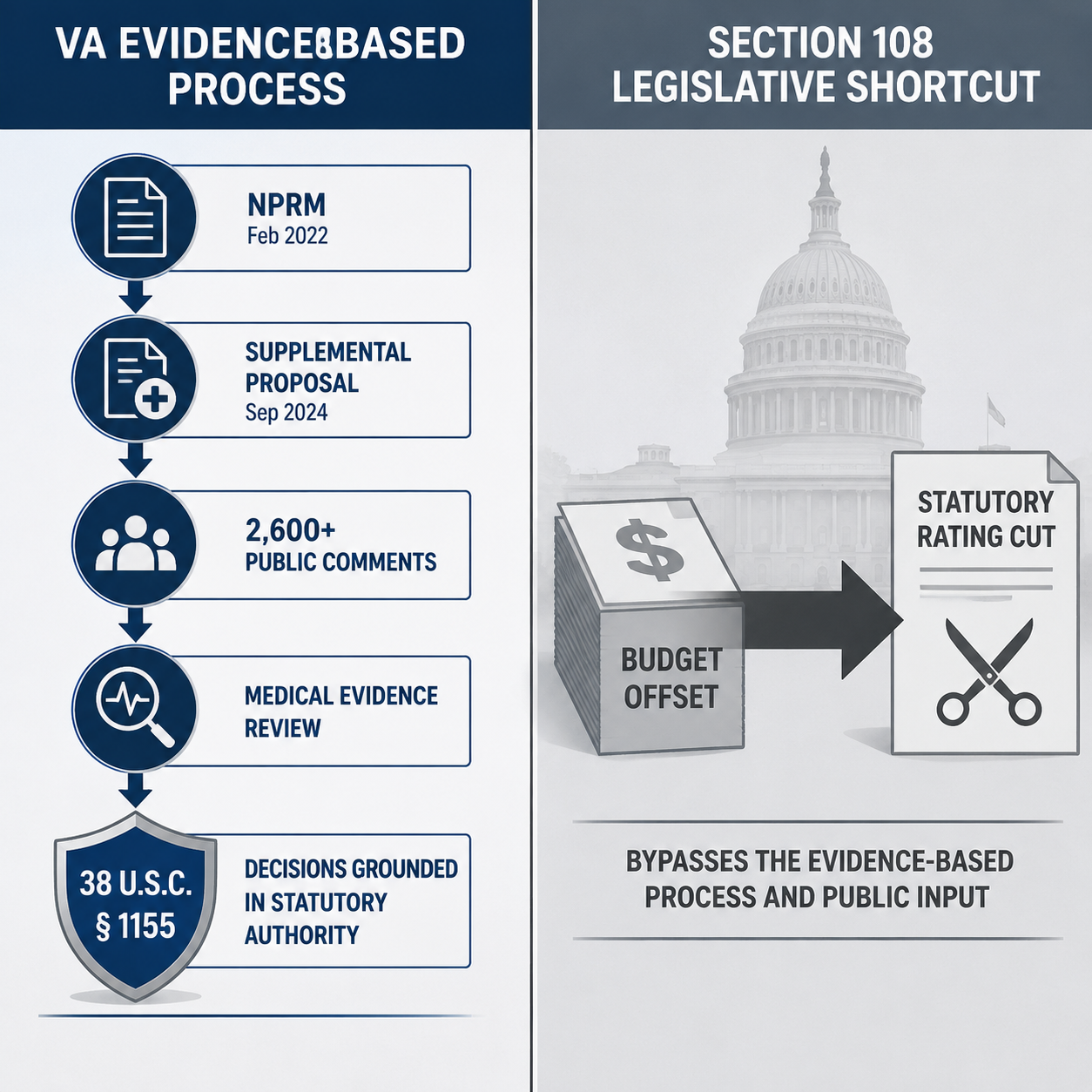
That is not a technical detour. Public comments are where veterans describe how a proposed rule will function outside the agency's medical abstractions. Veterans service organizations test VA's assumptions. Clinicians and advocates identify implementation problems. Lawyers preserve issues that later become litigation. The agency must decide what to do with that record. Congress can, of course, legislate in the field of veterans benefits. But when it codifies a rating cut before the agency process has run its course, it changes the role of that process from decision-making channel to optional background noise.
| VA rating revision route | Section 108 route |
|---|---|
| VA proposes changes under its rating-schedule authority | Congress places the rating reduction in a benefits package |
| Medical rationale and administrative record are exposed to public comment | Savings are used to help finance other provisions |
| Veterans, VSOs, clinicians, and advocates comment before the agency finalizes criteria | The key legal details depend on enacted statutory language |
| Disputes later arise through VA adjudication and judicial review | Disputes may begin with statutory interpretation, grandfathering, and implementation questions |
The Package Politics Are Real, but They Do Not Answer the Legal Question
The Take Care of America's Veterans Act is not a one-line attack on disability compensation. It is a large veterans package, and some organizations have urged Congress to pass it because of provisions they consider overdue. Military.com reported that 23 veterans organizations supported passage of the broader 60-provision package, while at least 15 groups opposed Section 108 or demanded its removal.[8][4][5] That split matters because it keeps the analysis honest. The veterans community is not monolithic, and reasonable advocates can disagree about whether a flawed offset should sink or delay a larger bill.
But package dynamics do not cure the structural defect. A good provision does not become a source of rating authority for an unrelated medical condition. Nor does the political popularity of the Major Richard Star Act answer whether Congress should finance that package by writing a service-connected rating reduction directly into statute.
The bill text could not be directly reviewed here from the Congress.gov PDF. For that reason, this analysis relies on official summaries and veterans service organization interpretations from DAV, VFW, American Legion-linked advocacy materials, Common Defense, Senate Democrats, and related reporting. The final legal exposure would depend on the enacted language, including effective dates, transition provisions, any preserved-rating clauses, and VA's implementing instructions. That caveat is not cosmetic. In veterans benefits law, a few words in a savings clause can decide whether a veteran is protected, exposed on reevaluation, or forced into years of litigation over the difference.
Why the Unfinished Rulemaking Matters
If VA had finished a properly supported rule revising sleep apnea and tinnitus criteria, veterans and advocates could still challenge the substance. They could argue that the medical record was thin, that the agency ignored comments, that the final rule departed from the proposal, or that implementation violated existing protections. That would be a familiar fight. Not easy, not necessarily successful, but legally recognizable.
Section 108 changes the fight. It asks Congress to decide the rating outcome while the agency process is unfinished, and it does so in a fiscal posture. The cut is not presented only as a medical modernization of the VASRD. It is also presented as a pay-for. That dual function matters because budget scoring rewards breadth and volume. High-prevalence conditions become attractive not because they are medically simplest, but because the compensation base is large enough to generate savings.
That is why the population figures carry legal weight. The 3.6 million tinnitus figure and the 763,000-plus sleep apnea compensation figure do not prove the current ratings are medically correct.[4][2] They show why these conditions are vulnerable to legislative offset logic. A rare condition cannot finance a large package. A common one can.
Muckelbauer's June 2026 op-ed framed the professional objection in terms that veterans law practitioners will recognize: disability ratings should be "determined by medical expertise and evidence," not by "political compromise whenever Congress needs to offset the cost of a new initiative."[6] That is not an argument that VA's existing schedule is sacred. It is an argument that the body assigned to build the rating record should not be bypassed because Congress found a budget gap.
The February 2026 Rescission Makes the Shortcut Harder to Defend
The procedural contrast became sharper in February 2026, when VA Secretary Doug Collins rescinded a similar medication-based interim final rule after backlash, saying, "Veterans spoke, and VA listened."[9] That episode is important for what it demonstrates about institutional accountability. The agency route drew criticism, and the agency withdrew. Veterans, VSOs, and lawmakers could identify the actor responsible for the change and the actor responsible for rescinding it.
When substantially similar rating consequences reappear through legislation, the procedural safeguards look different. A statute is harder to unwind than a withdrawn agency rule. The debate is compressed into package negotiations. Members may support the bill for unrelated provisions. Committee explanations and advocacy summaries may become the practical guide until VA issues implementation guidance. The veteran who later receives an adverse decision is left to argue over statutory text, transition rules, and agency application rather than the adequacy of the original medical rulemaking record.
That is why process is not a lawyer's distraction from the human stakes. Process is where the human stakes are supposed to enter before the rule hardens.
Where the Litigation Questions Would Start
If Section 108 or a similar provision is enacted, the first disputes are unlikely to arrive as a clean constitutional test case about congressional power. They are more likely to arrive in the ordinary untidy form of veterans benefits litigation: a rating decision, a reevaluation, a disagreement about an effective date, a veteran told that grandfathering does less than they understood it to do.
Several questions would matter immediately:
- Who is protected by any grandfathering language: only veterans already rated, veterans with pending claims, veterans with intent-to-file dates, or veterans who can prove symptoms began before the effective date?
- Whether a protected rating remains protected after a future reevaluation, claim for increase, secondary-condition claim, or combined-rating review.
- Whether VA implementation guidance narrows or expands the statutory transition rule.
- How adjudicators treat veterans whose claims were delayed by VA error before the statutory change took effect.
- Whether veterans can raise reliance-interest or due process arguments when compensation expectations were built under the prior schedule.
None of those questions can be resolved from press releases. They depend on enacted language and later VA action. But they are foreseeable because veterans benefits law is full of transition rules that looked clear in the abstract and became contested when applied to pending claims, staged ratings, protected ratings, and reopened records.
Cushman v. Shinseki would inevitably appear in that conversation, but it should be handled carefully. The Federal Circuit held that veterans benefits are a property interest protected by the Fifth Amendment, which makes the case relevant whenever the government changes or denies benefits through defective procedure.[10] It does not automatically answer whether Congress may prospectively revise statutory rating criteria. A court would have to confront the difference between an administrative deprivation under existing law and a legislative change to the law itself. That is a serious distinction, not a footnote.
The due process frame also overlaps with broader concerns about automation, fraud review, and transparency in benefits adjudication. Veterans already face systems where the stated rule and the practical screening mechanism can diverge; that problem is visible in related debates over VA AI fraud detection and disability benefits. Section 108 would add a different kind of opacity: not machine-driven screening, but statutory compression of medical-rating policy into fiscal legislation.
Grandfathering Is Not a Magic Word
Supporters of a rating change may point to grandfathering as the answer to reliance concerns. Sometimes it is. A clear savings clause can protect existing beneficiaries, reduce disruption, and confine a new rule to future claims. But grandfathering has to be read, not assumed.
The hard cases are rarely the veteran whose rating has been stable for years and is expressly named in the protection. The hard cases are the veteran diagnosed before enactment but not yet rated; the veteran with a pending appeal; the veteran whose sleep apnea was treated with a device before the effective date but whose claim is granted after it; the veteran whose tinnitus rating is protected until a later review raises a new issue. If Congress writes the protection broadly, many of those fights shrink. If it writes narrowly, VA adjudicators and courts will inherit them.
This is where statutory architecture becomes concrete. A veteran does not experience a savings clause as an abstract compromise. They experience it as a monthly deposit, a combined rating, access to ancillary benefits, or the difference between a manageable appeal and years of uncertainty.
The Precedent Reaches Beyond Sleep Apnea
There is a legitimate debate about whether existing sleep apnea criteria, tinnitus ratings, or medication-based rating approaches reflect current medical understanding. That debate belongs in the open, with the medical record exposed, comments answered, and implementation rules tested. The objection to Section 108 is that it changes the terrain before that debate is complete.
Once Congress demonstrates that a high-volume service-connected condition can be used as a pay-for, the limiting principle becomes political rather than legal. Today the conditions are sleep apnea and tinnitus because the numbers are large and the proposed savings are useful. A future package could look to musculoskeletal ratings, mental health criteria, neurological conditions, or any other category with enough beneficiaries to move a score.
The September delay gives Congress time to remove, revise, or defend the provision. It does not erase the precedent question. If Section 108 is enacted in its reported form, the future legal fight will not be only about whether veterans with sleep apnea or tinnitus receive a lower rating. It will be about whether service-connected disability compensation remains anchored in medical-administrative standards, or becomes a recurring legislative offset whenever a veterans package needs financing.
References
- Vets bill shelved after backlash against sleep apnea, tinnitus cuts, Yahoo News, July 16, 2026.
- DAV condemns congressional proposal to cut disability benefits for 1.5 million veterans, DAV.
- 47 Senate Democrats letter to VA Secretary Collins, Sen. Blumenthal.
- 15 Military Groups Warn That TCAVA Will Burden 1.5M Future Veterans With $57B, Military.com.
- Veterans Coalition Demands Removal of TCAVA Section 108, Common Defense.
- Congress Can't Do Its Own Job, VFW, June 22, 2026.
- TCAVA advocacy page, The American Legion.
- 23 Veterans Organizations 'Urge' Congress to Pass 60-Provision Bill Package, Military.com.
- Military.com reporting on VA rescission of medication-based rating reduction interim final rule, Military.com, February 2026.
- Cushman v. Shinseki, U.S. Court of Appeals for the Federal Circuit.
Comments
Join the discussion with an anonymous comment.