
A VIP passenger removed from a flight for “security reasons” may have reputational leverage, a publicist, and a plausible damages story. Those facts do not create an automatic compensation right. The first legal move is to separate passenger-rights compensation from litigation-based recovery. In the United States, denied boarding compensation under DOT oversales rules is aimed at bumping from oversold flights, not removals based on safety or security judgments. DOT’s public guidance describes bumping compensation in the oversales context under 14 CFR Part 250; it does not turn a captain’s or carrier’s security refusal into a cash-compensation event.[1]
The same correction is needed under EU261. Article 2(j) excludes from “denied boarding” a refusal to carry a passenger where there are reasonable grounds, including security, health, safety, or inadequate travel documentation. Recital 14 also treats security risks as extraordinary circumstances when genuinely established. The result is a compensation vacuum, not because the passenger has no grievance, but because the ordinary compensation scheme was not built to price every exclusion from the aircraft.
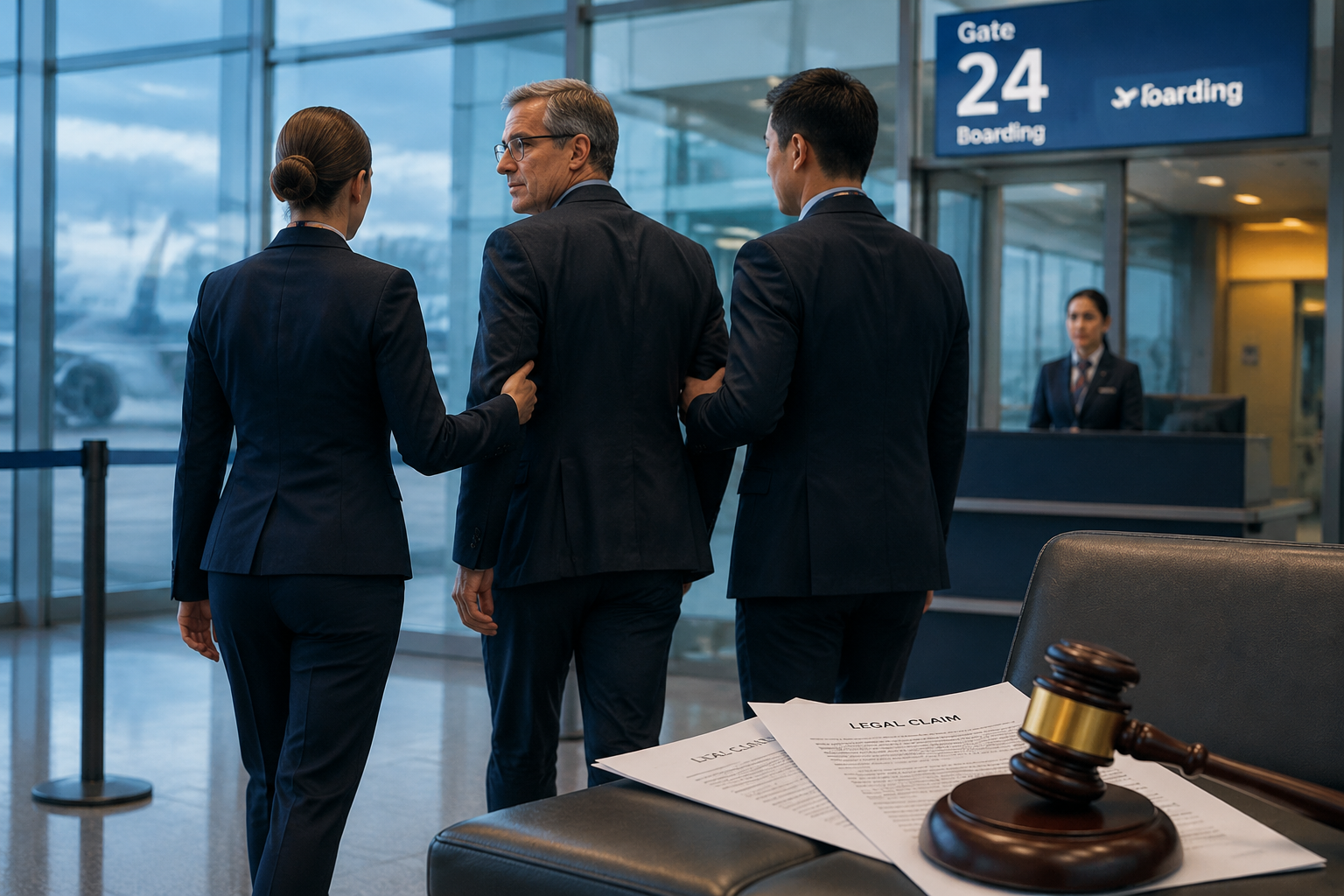
That distinction matters because passengers often describe the disruption in the vocabulary of cancellation, bumping, or denied boarding. The legal file should be sorted differently. Was this an oversale? A cancellation? A denied boarding within EU261? Or a refusal to transport because the airline decided the passenger was, or might be, inimical to safety? The answer controls whether the case starts in an administrative compensation regime or in litigation over the carrier’s stated reason.
The Security Exception Usually Defeats Routine Compensation
U.S. law gives air carriers unusually broad discretion at the moment of refusal. Under 49 USC § 44902(b), an air carrier may refuse to transport a passenger or property if the carrier decides that the passenger or property “is, or might be, inimical to safety.” Kreindler’s survey of the case law treats that language as the statutory center of gravity in security-based refusal cases, including Williams, Cerqueira, Eid, and Adamsons.[2]
The word “decides” does a great deal of work. It points courts toward what the carrier knew when the decision was made, not toward a later reconstruction built after pleadings, press coverage, or internal investigation. It also explains why routine compensation claims are a poor fit. Compensation regimes generally ask whether a qualifying disruption occurred. Security-refusal litigation asks whether the carrier’s decision was legally protected.
For a high-profile passenger, that can be a frustrating answer. A VIP may lose a business opportunity, miss a public appearance, or suffer a reputational injury when staff members remove them in view of other passengers. Those losses may matter in a damages case. They do not by themselves convert a security removal into DOT bumping compensation or EU261 denied boarding compensation.
| Claim Framing | What It Usually Requires | Security-Removal Problem |
|---|---|---|
| DOT denied boarding compensation | Oversale bumping under 14 CFR Part 250 | Security removals are outside the ordinary oversales compensation framework |
| EU261 denied boarding compensation | Denied boarding without excluded reasonable grounds | Article 2(j) excludes refusals based on reasonable security, health, safety, or documentation grounds |
| Tort or contract damages | Actionable misconduct, breach, or legally insufficient refusal | Depends heavily on governing standard of review and facts known at the time |
| Discrimination claim | Protected-class discrimination or pretextual use of security rationale | Security language does not necessarily bar the claim |
The Real Fight Is the Standard of Review
Once ordinary compensation drops out, the case turns on review of the carrier’s security judgment. That is where forum becomes more than a procedural footnote. Kreindler identifies a split among federal appellate courts over how closely courts should review a carrier’s decision to refuse transport under § 44902(b).[2]
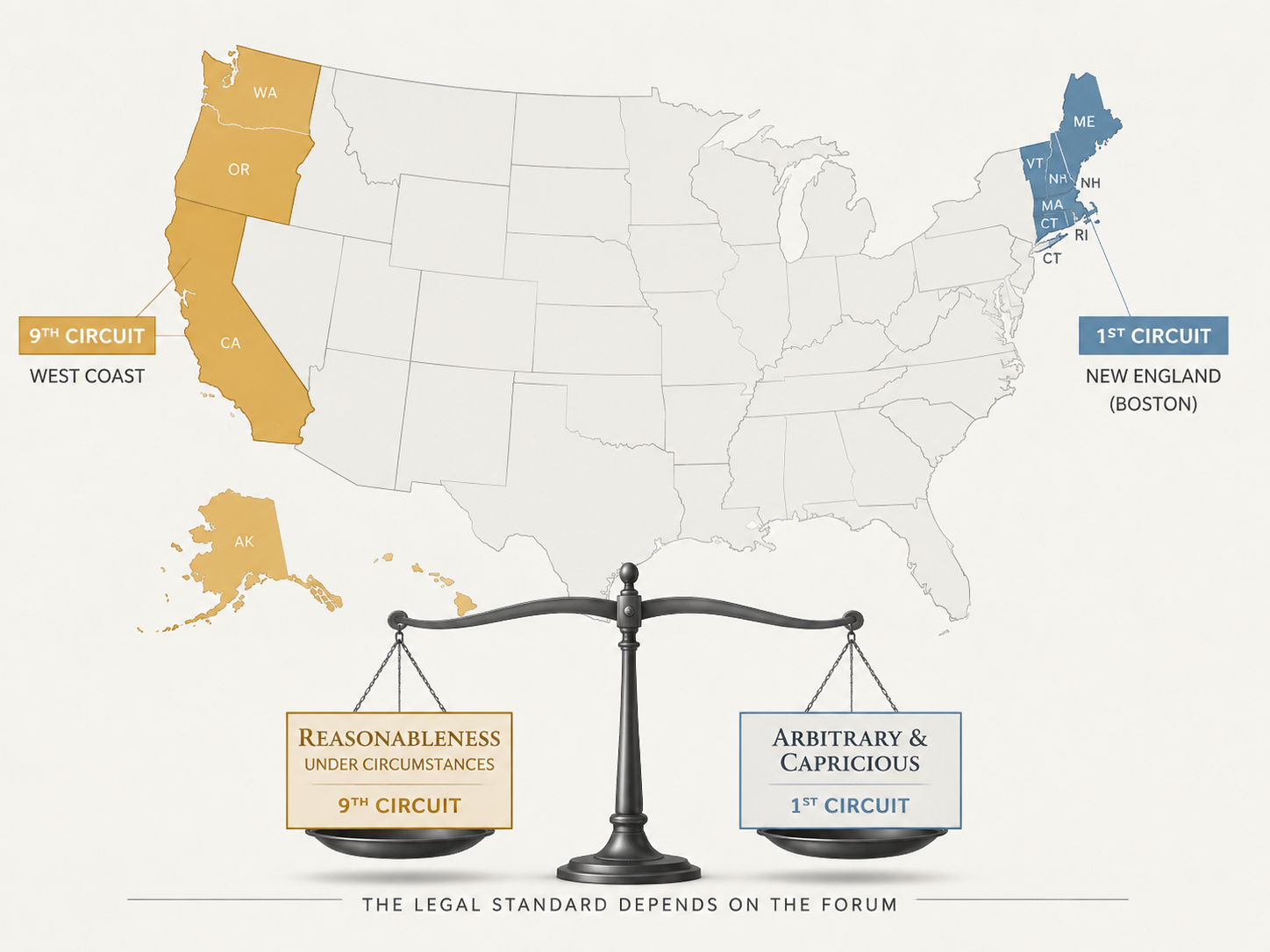
The more deferential line asks whether the airline acted arbitrarily or capriciously. In that framing, the carrier does not need to prove that the passenger actually posed a danger. The question is closer to whether the decision, based on the information available at the time, fell within a protected zone of safety discretion. The 1st Circuit’s Cerqueira decision is the important modern reference point for that approach, and Kreindler places it in the same conversation as Williams and Adamsons.[2]
The 9th Circuit’s Eid approach is more searching. Kreindler describes it as a reasonableness-under-the-circumstances standard, rather than a purely arbitrary-and-capricious review. That difference is not academic. A passenger trying to show pretext, selective enforcement, or reliance on stale or distorted information has more room to work when the court examines whether the refusal was reasonable under the circumstances actually confronting the airline.[2]
The practical consequence is that the same incident can look legally different depending on where the case is litigated. In a deferential forum, the airline’s contemporaneous security file may carry the day unless it is thin, inconsistent, or infected by impermissible motives. In a more searching forum, the passenger may press harder on what the crew was told, whether the gate agent escalated accurately, whether a supervisor reviewed the allegation, and whether the stated safety concern fits the conduct actually observed.
Cerqueira is often attractive to plaintiffs because of the reported trial result: a federal jury awarded $400,000 after airline staff allegedly treated the passenger as a security threat.[3] That figure should be used carefully. The appellate decision is more important for the governing legal standard than for the damages number, because the reported award comes from the trial-level account while the appellate authority confirms how the security-refusal decision is reviewed.
For counsel, the first document request is not aimed at proving the passenger was harmless in hindsight. It is aimed at reconstructing the decision chain. Who first used security language? What conduct was reported? Was the report based on direct observation or secondhand characterization? Did the captain receive the underlying facts or a conclusion? Was the passenger given any chance to respond before the label hardened? A VIP status dispute dressed up as a threat assessment is a different case from a genuine real-time safety concern, but the difference has to be proved from records, witnesses, and timing.
Security Language Does Not Erase Discrimination Claims
The strongest plaintiff-side cases are rarely built on inconvenience alone. They are built on pretext. A carrier may have broad discretion to remove a passenger who might be inimical to safety, but that discretion is not a license to select a passenger for a prohibited reason and then launder the decision through security terminology.
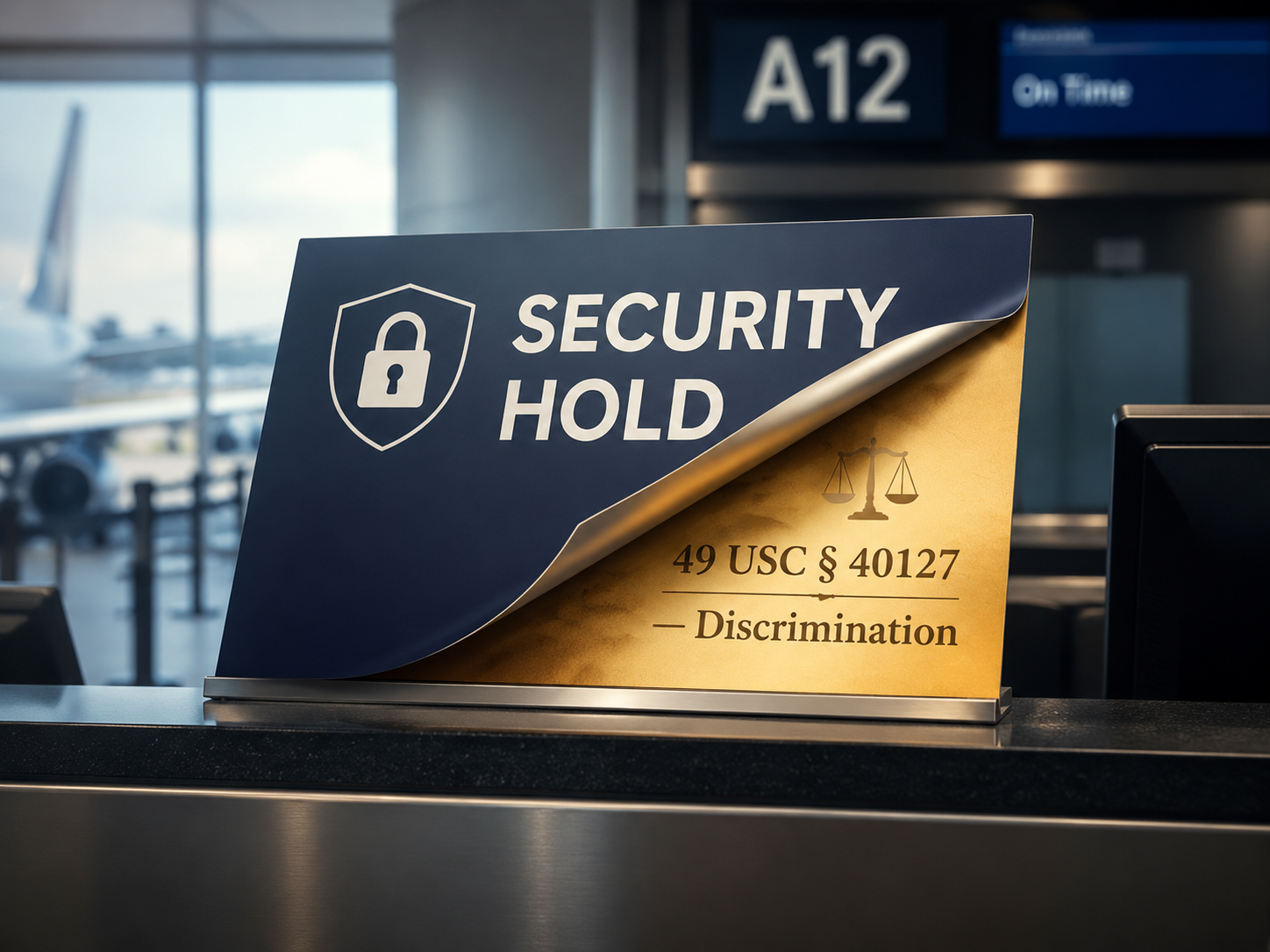
That is why 49 USC § 40127 matters. The statute prohibits air carriers and foreign air carriers from subjecting a person in air transportation to discrimination on the basis of race, color, national origin, religion, sex, or ancestry. The security exception and the discrimination prohibition operate in the same factual space, but they answer different questions. One asks whether the carrier could refuse transport for safety. The other asks whether the passenger was treated differently for a prohibited reason.
Recent airline-removal lawsuits illustrate why the distinction matters. In May 2024, eight Black men sued American Airlines after they were removed from a Phoenix flight, alleging racial discrimination in the removal decision.[4] A separate lawsuit by Teresa Hudson Jordan alleged that Delta removed her from first class under circumstances she characterized as discriminatory.[5] These are pleadings and reported disputes, not proof of a general industry frequency. Their legal significance is narrower and more useful: when plaintiffs can plausibly allege that security or cabin-management language was pretextual, the case does not end merely because airline personnel invoked safety.
For VIP clients, this can cut both ways. Celebrity or executive status may explain why a removal produced unusual downstream harm, but it may also distract from the claim that matters. The viable question is not whether the airline embarrassed an important person. It is whether the airline’s stated reason is supported by contemporaneous facts, applied consistently, and free from prohibited discrimination.
The Policy Updates Do Not Create a New Compensation Lane
Two recent policy developments are worth noting because they prevent overstatement. In the United States, the Department of Transportation withdrew its Airline Passenger Rights advance notice of proposed rulemaking in November 2025.[6] Whatever one thought that rulemaking might eventually have done for passenger cash remedies, its withdrawal removes any near-term federal move toward a broader compensation mandate for cases such as security-based removals.
In Europe, reporting on the June 2026 provisional EU261 reform agreement describes preservation of the familiar €250 to €600 compensation bands, subject to the important caveat that the reform was not yet formally adopted.[7] Even if those bands remain, they do not override the basic point: genuine refusals on reasonable security grounds sit outside the ordinary denied-boarding compensation definition.
The policy landscape therefore leaves counsel with a less marketable but more accurate answer. A removed VIP passenger should not be promised statutory compensation just because the incident was costly or humiliating. The stronger route, if there is one, is a damages theory that attacks the security rationale itself or pleads discrimination that survives the carrier’s safety defense.
What a Viable Case Usually Needs
A viable case begins with the incident record, not the passenger’s status. The most important evidence is usually close to the gate: agent notes, captain communications, security reports, passenger-service entries, crew statements, body-camera or terminal footage if available, and the sequence between the alleged conduct and the refusal to transport.
- If the record shows a contemporaneous, specific safety concern, routine compensation is unlikely and damages claims face the carrier’s statutory discretion.
- If the record shows vague conclusions without observed facts, the applicable circuit’s review standard becomes central.
- If the record shows shifting explanations, selective enforcement, or differential treatment, pretext and discrimination theories become more important than passenger-rights compensation.
- If the harm is purely inconvenience or reputational embarrassment without an actionable legal theory, VIP status will not fill the gap.
Airlines, for their part, should assume that post-incident polish will be read against the rougher contemporaneous file. A clean litigation explanation cannot repair a decision record that never identified who perceived the threat, what the passenger did, why lesser steps were rejected, or why similarly situated passengers were treated differently. The more serious the security label, the more important it is that the file show actual security reasoning rather than customer-service irritation translated into legal immunity.
So the answer is neither “yes, VIP passengers get compensation” nor “no, security ends everything.” Genuine security removals generally defeat ordinary U.S. and EU compensation claims. But damages may remain available where the governing forum permits closer review, the contemporaneous facts do not support the stated rationale, or discrimination claims expose security language as pretext.
References
- Bumping & Oversales, U.S. Department of Transportation, https://www.transportation.gov/individuals/aviation-consumer-protection/bumping-oversales
- The Standard of Care for Airlines to Remove or Refuse to Board Passengers, Kreindler & Kreindler, https://www.kreindler.com/articles/standard-care-airlines-remove-refuse-board-passengers
- Passenger awarded $400,000 in airline security-threat case, NewsOn6
- Eight Black men sue American Airlines after removal from Phoenix flight, Houston Public Media/NPR
- Teresa Hudson Jordan Delta first-class removal lawsuit, Travel Noire
- Airline Passenger Rights; Withdrawal, Federal Register, November 17, 2025, https://www.federalregister.gov/documents/2025/11/17/2025-20042/airline-passenger-rights-withdrawal
- June 2026 EU261 provisional reform agreement preserving €250–€600 compensation bands, SkyRefund
Comments
Join the discussion with an anonymous comment.