
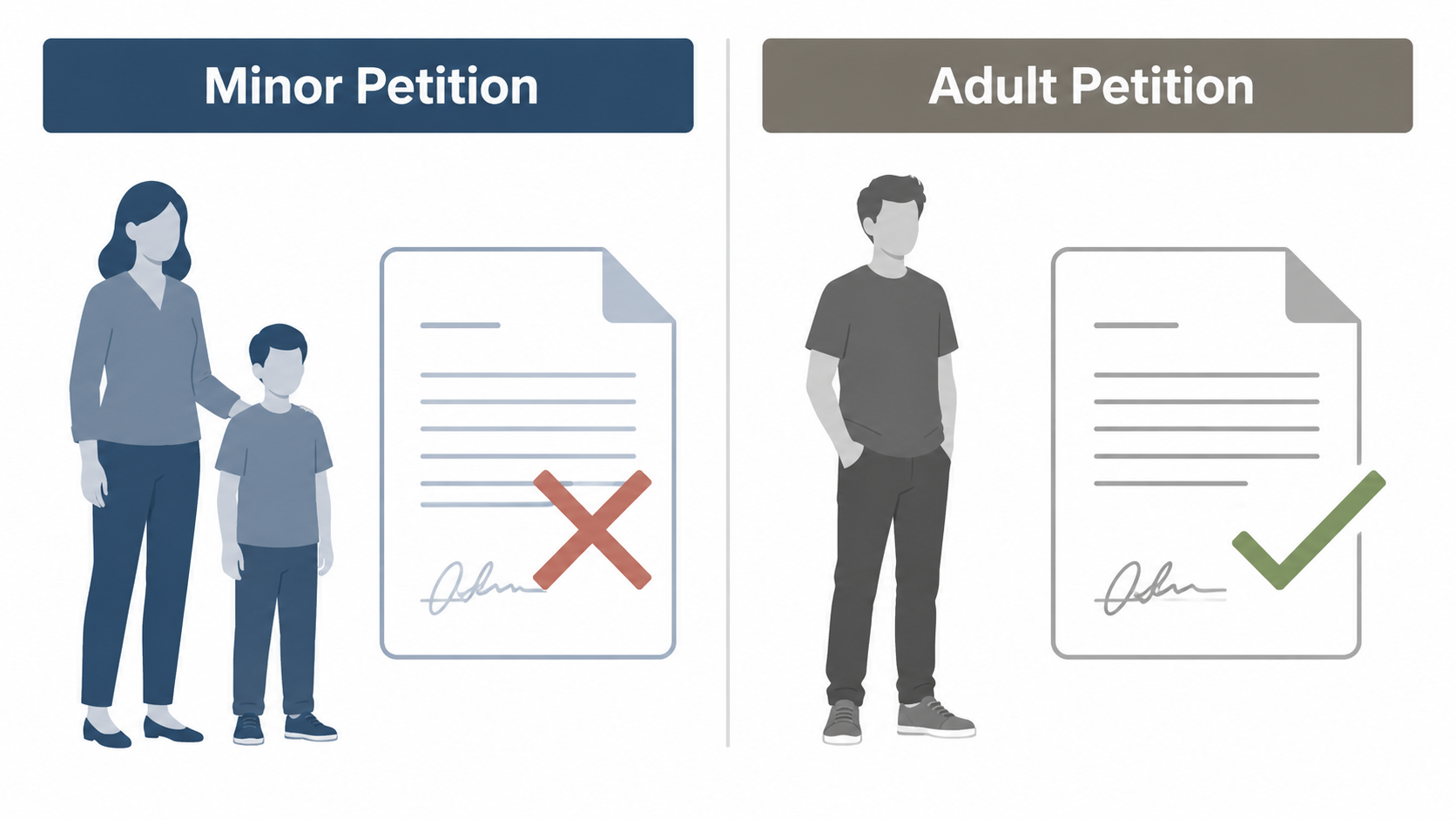
Vivienne Jolie signed her California name change petition on July 12, 2026, the day she turned 18, and filed it in Los Angeles Superior Court on July 21. That birthday matters more procedurally than the surname: an adult petitioner may file on their own behalf, while a petition for a person under 18 is filed by a parent, guardian, near relative, or guardian ad litem under California Code of Civil Procedure §1276(a)(1).[1][2]
For attorneys, paralegals, and legal operations teams fielding client questions about Vivienne Jolie’s name-change filing, the useful lesson is not a celebrity recap. It is the adult California name change sequence: prepare and file the petition in the proper county, publish the Order to Show Cause unless an exception applies, clear any hearing or no-objection procedure, then obtain the decree and certified copies. This article is informational, not legal advice, and belongs in the news-and-analysis category because the public filing is only the entry point for the procedure.

The Birthday Changed the Petition Posture
A California adult name change petition starts with capacity. Once Vivienne turned 18, she no longer needed the minor-petition framework that would have put a parent or other authorized adult in the filing role. Under CCP §1276(a)(1), a person seeking a name change files a verified petition in the superior court of the county where that person resides; for a person under 18, the statute specifies who may file on the minor’s behalf.[2]
That distinction affects intake before anyone gets to a courthouse counter. The file should identify the petitioner’s residence county, the requested name, the current legal name, and the reason for the request. Page Six reported that Vivienne’s court documents listed the reason as “personal,” which is a useful reminder that name change petitions often carry private motives. It is not, by itself, evidence of any broader family-law finding.[3]
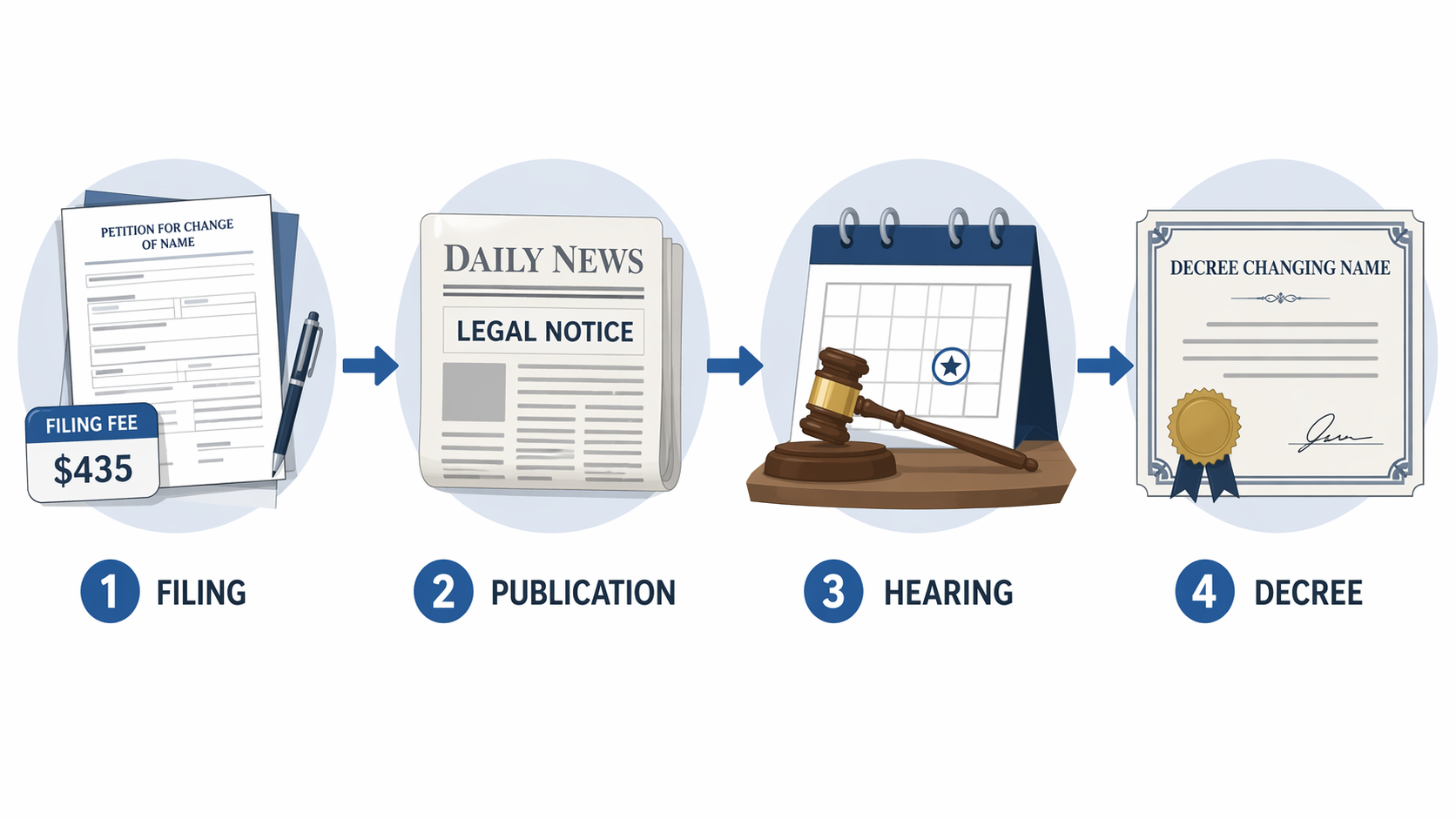
California’s court self-help materials direct adult petitioners to use the Judicial Council name change forms, including Petition for Change of Name (NC-100), Attachment to Petition for Change of Name (NC-110), and Order to Show Cause for Change of Name (NC-120). They also place the filing fee in the $435 to $450 range, while noting that a person who cannot afford the court filing fee may ask for a fee waiver.[4]
| Stage | Core action | What Vivienne’s filing illustrates |
|---|---|---|
| Filing | File NC-100, NC-110, and NC-120 in the superior court for the petitioner’s county of residence. | She signed as an adult on July 12, 2026 and filed in Los Angeles Superior Court on July 21. |
| Publication | Publish the Order to Show Cause once a week for four consecutive weeks unless a statutory exception applies. | The adult petition still has a publication step; adulthood changes capacity, not the default notice requirement. |
| Hearing or review | Track the court date and any objections; some matters may proceed without a traditional contested hearing if no objection is filed. | Her hearing was reported as scheduled for Nov. 2, 2026. |
| Decree and copies | Obtain the signed decree and certified copies for agencies and records updates. | The name is not practically usable across institutions until the petitioner has certified proof. |
Filing: Forms, Residence, and Fees Come First
The adult petition should be built around the county-of-residence requirement. Filing in the wrong county is the kind of preventable mistake that can cost a petitioner time before the merits of the request are ever reviewed. The statutory filing rule points the petition to the superior court in the county where the person whose name is being changed resides.[2]
For a routine adult petition, the core California forms are NC-100, NC-110, and NC-120. NC-100 opens the petition. NC-110 supplies the individual attachment information for the person whose name is changing. NC-120 becomes the Order to Show Cause, the document that sets up the notice and hearing process. The California Courts Self-Help Guide identifies these forms for adult name changes and explains the basic filing path.[4]
The fee point should be handled carefully in client communications. The California Courts Self-Help Guide describes a filing fee range of $435 to $450, and practice guides in the family-law space report the same range.[4][5] That is not a safe quote for every counter on every future date. Before giving a client a total, staff should check the current superior court fee schedule, any local filing surcharge, and whether the client wants fee-waiver paperwork prepared at the same time.
The capacity issue also affects how the petition is described. If the petitioner is 18 or older, the filing is not a parent’s request to change a child’s name. If the person is under 18, the filing belongs in the minor framework and will be signed by an authorized adult. Vivienne’s July 12 signature date cleanly separates her case from a minor-name-change posture because it falls on her 18th birthday.[1][2]
Publication Is the Step Clients Underestimate
After filing, the Order to Show Cause does not simply sit in the file. California Code of Civil Procedure §1277 requires the order to be published in a newspaper of general circulation once a week for four successive weeks, unless the case qualifies for an exception.[6] This is the notice step that often surprises petitioners who thought the court filing fee was the main cost.
The publication task is operationally simple but easy to mishandle. Someone must identify an approved newspaper, send the correct order for publication, confirm the run dates, obtain proof of publication, and make sure that proof reaches the court in time. If the notice is not published correctly, the hearing date can become unusable even when the petition itself was properly prepared.
The cost is separate from the court’s filing fee. California Courts tells petitioners that a fee waiver can waive court fees but does not waive the newspaper publication charge.[4] BBC News reported a roughly $130 publication cost from a comparable California name-change filer, but that figure is only one reported example. Newspaper rates vary, and an approved publication in one county is not a price guarantee in another.[7]
There are narrow publication exceptions. California practice materials identify domestic violence restraining order and witness-protection contexts among the situations where publication may be avoided or handled differently.[8] Those exceptions should be screened deliberately rather than mentioned as a casual workaround. In an ordinary adult petition, staff should assume publication is required until the facts and statutory basis say otherwise.
This is where a procedure team earns its keep. The petitioner may experience the case as a private identity matter; the court file treats it as a public notice process unless an exception applies. The office calendar should track not only the hearing date but also the four weekly publication dates, the proof-of-publication deadline, and any local rule about filing or lodging that proof.
Hearing Dates and Objections
People reported that Vivienne’s hearing was set for Nov. 2, 2026, after the July 21 filing in Los Angeles Superior Court.[1] That is longer than the roughly six-week scheduling pattern described in some California name-change practice guidance, and it is a good caution against promising a uniform timeline.[5] Court calendars, local procedures, publication timing, and objection handling all matter.
In a clean adult petition, the hearing stage is usually less drafting-intensive than the front end. The staff task is to confirm that the Order to Show Cause was published correctly, that proof of publication is in the file, and that no objection requires additional preparation. If an objection is filed, the matter may need a more substantive appearance and client counseling about the specific issue raised.
The court’s ability to approve the petition does not turn on public interest in the family. It turns on compliance with the statutory and local process, any required disclosures, notice, and the absence or resolution of valid objections. That is why anonymous commentary around family dynamics should stay outside the procedural analysis unless it appears in a filed, relevant court record.
The Decree Is the Usable Product
If the court grants the petition, the decree is the legal instrument the petitioner needs for the next round of identity updates. The signed order matters, but the practical document for government agencies, schools, banks, licensing bodies, and record custodians is usually a certified copy.
Practice guidance reports a $40 certified-copy cost for California name change orders.[5] As with filing and publication fees, that number should be checked against the current court schedule before it goes into an engagement letter, cost estimate, or client email. If a petitioner will need multiple records updated quickly, the copy count should be discussed before the final court visit.
Where the Jolie-Pitt Filings Fit Procedurally
The Jolie-Pitt filings are useful as procedural contrasts only after the adult workflow is clear. USA TODAY reported that Shiloh’s name change was granted in August 2024, and that Zahara’s publication ran from June 16 through July 7, 2026 in the Los Angeles Daily Journal.[9] People reported the July 2026 filing and Nov. 2 hearing date for Vivienne.[1]
| Person | Reported procedural status | Procedure point |
|---|---|---|
| Shiloh | Name change granted in August 2024. | Completed petition and decree process. |
| Maddox | Filed in May 2026 with a hearing reported for Sept. 14, 2026. | Illustrates a pending petition with a later hearing date. |
| Zahara | Filed in June 2026 with publication reported from June 16 to July 7, 2026 and a hearing reported for Sept. 28, 2026. | Shows the four-week publication step in the public record. |
| Vivienne | Signed July 12, 2026, filed July 21, 2026, with hearing reported for Nov. 2, 2026. | Shows adult filing capacity after turning 18. |
| Knox | No petition reported in the materials reviewed. | No procedural conclusion should be drawn. |
The comparison should not be stretched into a family-law narrative that the filings themselves do not prove. BBC News quoted estrangement expert Dr. Becca Bland on the psychological function that surname changes can have for some people, including marking separation or reclaiming identity, but that is a general observation rather than a court finding about any one Jolie-Pitt child.[7]
A Practical File Checklist
- Confirm adult capacity or, for a minor, identify the authorized filing adult under CCP §1276(a)(1).
- Confirm the petitioner’s county of residence before selecting the superior court.
- Prepare NC-100, NC-110, and NC-120, plus any fee-waiver forms if needed.
- Verify the current court filing fee, local filing requirements, and accepted submission method.
- Arrange publication of the Order to Show Cause once a week for four consecutive weeks unless a narrow exception applies.
- Track proof of publication, objection deadlines, hearing procedures, decree issuance, and certified-copy needs.
Vivienne Jolie’s petition is procedurally clean as a teaching example because the filing date follows the capacity date. The rest of the file still depends on the unglamorous pieces that decide whether an adult California name change moves: the right court, the right forms, accurate fees, proper publication, a tracked hearing date, and certified proof of the decree. Before relying on any public example, verify the current local rules, fee schedules, approved newspapers, publication rates, and hearing procedures for the specific California court handling the petition.
References
- Vivienne Jolie Files to Legally Drop Brad Pitt’s Last Name, People
- California Code of Civil Procedure §1276, Justia
- Vivienne Jolie Drops Brad Pitt’s Last Name in Legal Name Change Filing, Page Six
- Change Your Name as an Adult, California Courts Self-Help Guide
- How to Legally Change Your Name in California, Lewitt Hackman
- California Code of Civil Procedure §1277, Justia
- Why Angelina Jolie and Brad Pitt's Children Are Changing Their Names, BBC News
- California Name Change Guide, California Family Law Attorneys
- Angelina Jolie and Brad Pitt's Daughter Zahara Seeks Name Change, USA TODAY
Comments
Join the discussion with an anonymous comment.