
The Vivienne Jolie name change filing starts with a small set of reported facts, not with the divorce file. Multiple outlets say they reviewed Los Angeles Superior Court documents showing that Vivienne Marcheline Jolie-Pitt petitioned to become Vivienne Marcheline Jolie, listed the reason as “personal,” and did so on or near July 12, 2026, the day she turned 18. PEOPLE reports a November 2, 2026 hearing date; other contemporaneous coverage has described the hearing timeline slightly differently, with an earlier October 30 date later moved to November 2. The publicly available source set for this article does not include the original petition PDF, so the document details should be treated as reported descriptions of court records, not as a direct reproduction of the filing.[1]
That restraint matters because the filing is legally ordinary even though the caption is not. A California adult name change petition can carry family history, public attention, and private consequence at the same time, but the court’s procedural question is narrower: has an adult petitioner properly asked for a new legal name under the name change statutes, and is there a legally sufficient reason to deny it?

What the reported petition actually says
The reported name change is precise: Vivienne would retain “Marcheline” and remove “Pitt,” changing from Vivienne Marcheline Jolie-Pitt to Vivienne Marcheline Jolie. Marcheline is also the name of Angelina Jolie’s late mother, Marcheline Bertrand, but the filing detail that matters legally is simpler than the symbolism attached to it: the middle name remains, the surname changes, and the stated reason is “personal.”[1]
A one-word reason is not much of a window into a family. It is, however, a recognizable answer on a name change petition. Courts do not need a memoir to process an adult name change request. They need a petition, notice, a hearing path, and the absence of statutory problems such as fraud, evasion of debts, or interference with law enforcement obligations.
The timing is the part that changes the legal frame. Filing on or near an eighteenth birthday means the court is not handling a parent’s request to change a minor child’s name. It is handling an adult’s request to change her own name. That difference is not cosmetic. It controls whose consent matters, what notice is required, and what kind of objection could have legal force.
The adult name change path is mostly paperwork, notice, and a short hearing
California’s adult name change process begins with the petitioner completing the name change forms, including Form NC-100, filing them with the court, paying the filing fee unless a fee waiver applies, and obtaining an Order to Show Cause. The California Courts Self-Help Guide lists a $435 filing fee for this process, while noting that fee waivers may be available for eligible petitioners.[2]
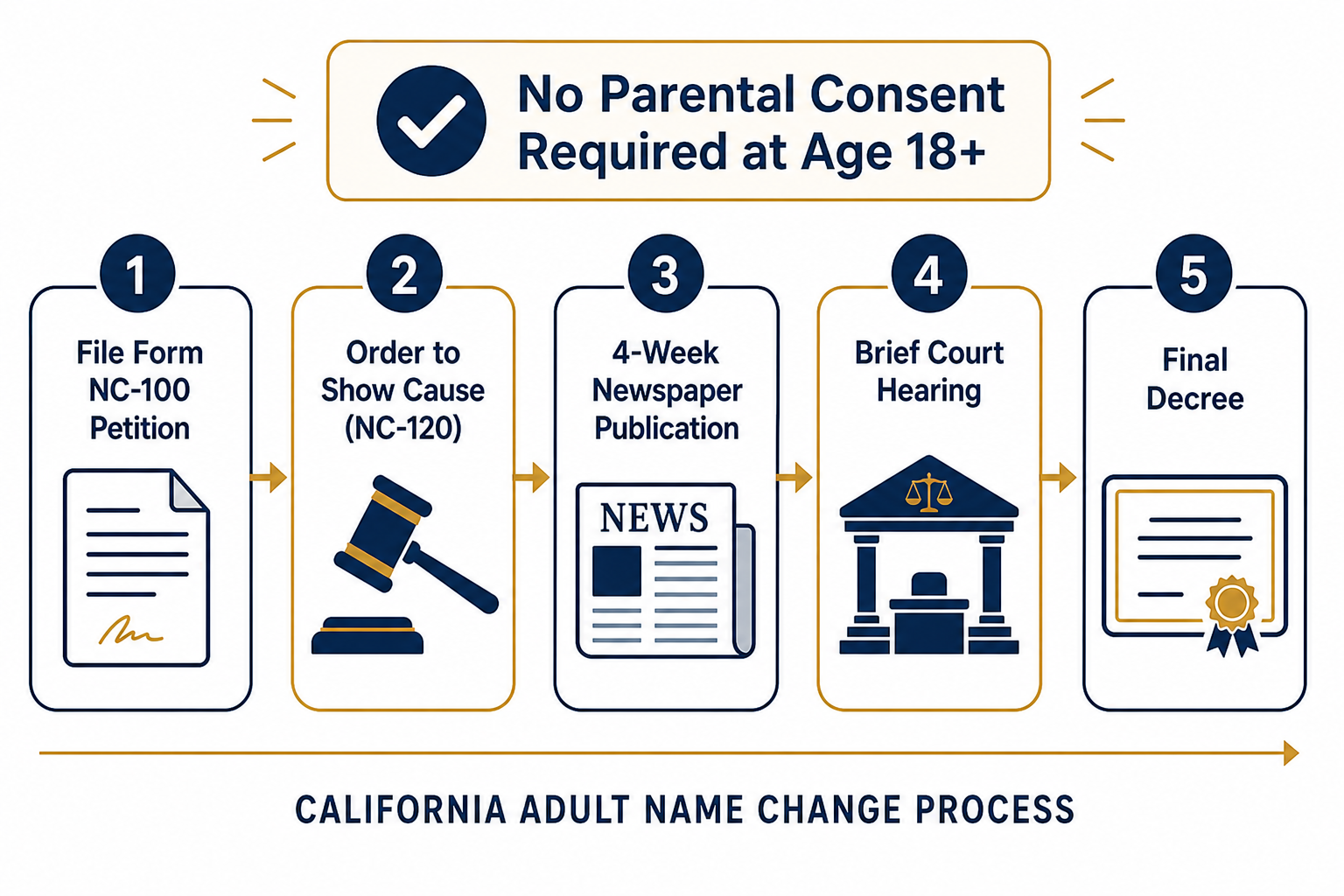
After filing, the court issues an Order to Show Cause, commonly associated with Form NC-120, setting out the proposed name change and the hearing information. In ordinary adult name change matters, the petitioner must publish the Order to Show Cause in a newspaper once a week for four consecutive weeks unless a statutory exception applies. The publication step often looks dramatic when the petitioner is famous. Procedurally, it is a notice device.[2]
| Stage | What it does in an adult petition |
|---|---|
| NC-100 petition | Identifies the current name, proposed name, petitioner, and reason for the request. |
| Filing fee or fee waiver | Starts the case in superior court; California Courts lists the filing fee as $435 unless waived. |
| Order to Show Cause | Sets the public notice and hearing framework for the proposed change. |
| Newspaper publication | Provides public notice for four consecutive weeks unless an exception applies. |
| Hearing and decree | Allows the court to grant the name change if no legally sufficient bar appears. |
The hearing is usually brief when the paperwork is complete and no legally meaningful objection exists. A court is not convening a family-history trial simply because the requested name has emotional significance outside the courthouse. In an adult petition, the judge’s attention stays on the statutory function of the proceeding: whether the requested change should be granted under the name change law.
This is why claims that a parent can “fight” the filing tend to blur two different things. A parent may be hurt, angry, estranged, or publicly quoted through unnamed sources. None of that is the same as having veto power over an adult child’s petition. A certified family law specialist quoted by Us Weekly put the practical point directly: “the parent doesn’t get any veto power,” and “the court’s not going to care about the impact on the parents” in an adult name change proceeding.[3]
Turning 18 removes parental consent from the case
For minors, a name change can raise notice and consent issues involving parents or guardians. For an adult petitioner, that framework falls away. Once the petitioner is 18, the adult files on her own behalf. The law does not ask whether a parent agrees with the choice, feels wounded by it, or would prefer the prior surname to remain in place.
That does not mean adult name changes are automatic in every circumstance. Courts can deny or delay petitions where the name change would facilitate fraud, evade legal obligations, mislead others, or interfere with criminal justice requirements. Those are objections about misuse of the legal identity system. They are not objections about family disappointment.
On the reported facts, Vivienne’s petition appears to sit in the ordinary adult category: a newly adult petitioner, a completed name change request, a stated personal reason, and a future hearing date. Nothing in the reported filing details suggests that the court is being asked to adjudicate parenting conduct, alienation allegations, or the moral meaning of a surname.[1]
The custody case does not travel into adulthood in the same form
The Jolie-Pitt family history explains why the filing drew immediate attention, but it does not convert the petition into a custody matter. California Family Code section 3022 provides that custody orders terminate when a child reaches 18. Reporting focused on the Jolie-Pitt litigation has described the twins’ July 12, 2026 birthday as the point when any remaining custody orders ended by operation of law, without a new motion or hearing.[4]
That legal consequence is easy to understate because it is not theatrical. No one has to win a final custody skirmish for the court’s authority over custody to expire. The child becomes an adult, and the custody order no longer governs that person’s legal status in the same way. The name change petition then proceeds under the adult name change statutes, not as an extension of a parenting-time dispute.
For practitioners, this is the clean procedural dividing line. A high-conflict family history may explain why a client wants a new name, why reporters are watching the docket, or why relatives comment through surrogates. It does not supply a parent with standing to block an adult petition. If the objection is really that the parent dislikes the message of the new surname, it is not the kind of objection the adult name change proceeding is built to resolve.
What an objection would have to be about
An adult name change objection has to point toward a legal defect, not merely an emotional injury. A useful way to test the difference is to ask what the court would be asked to prevent. Preventing fraud, debt evasion, identity confusion in a legally relevant setting, or avoidance of statutory duties belongs inside the proceeding. Preventing an adult from communicating distance from a parent through a surname does not.
This is also where unattributed claims about “parental alienation” lose their legal force. Such claims may be made in public commentary, and they may matter in other contexts if properly pleaded, supported, and relevant. But in a standard adult name change proceeding, the court is not deciding whether one parent influenced a newly adult child’s feelings toward another parent. The petitioner’s legal capacity is the operative fact.
There is a difference between saying an allegation is unproven and saying it is impossible. The careful point is narrower: the current reported petition details do not make those allegations part of the name change analysis. Unless an objection connects to a recognized legal bar, it remains commentary around the case rather than a reason for the court to deny the requested decree.
The sibling pattern is context, not proof
Vivienne’s filing did not appear in a vacuum. Shiloh Jolie was granted a request to drop “Pitt” from her last name in August 2024, after turning 18 earlier that year.[5] Other reporting has described Maddox filing on May 28, 2026, with a September 14, 2026 hearing, and Zahara filing on June 9, 2026, with a September 28, 2026 hearing.[4]
That pattern is relevant in the ordinary journalistic sense: it explains why a new Jolie-Pitt name change petition becomes news. It is less useful as legal evidence about Vivienne’s reason. Shiloh’s attorney told PEOPLE that Shiloh “did not take this decision lightly” and that the decision followed “painful events,” a statement that understandably shaped public coverage of that separate filing.[6] It should not be silently imported into Vivienne’s petition, where the reported reason is simply “personal.”[1]
The newspaper-publication coverage around Shiloh’s petition offers another example of how routine procedure can look like celebrity theater. The Hollywood Reporter explained that Shiloh’s proposed name change appeared in the Los Angeles Times because California requires publication of the Order to Show Cause for four consecutive weeks in ordinary name change proceedings.[7] The public notice is not a special announcement to the entertainment press. It is part of the statutory machinery.
The practical takeaway from the filing
Vivienne’s petition shows what changes when a family-law child becomes a civil-procedure adult. The name on the petition is still attached to a famous and long-running family dispute, but the governing legal frame is no longer custody. It is an adult name change request under California procedure.
That frame produces a plain result. The court can require proper forms, filing, publication, and a hearing. It can consider legally relevant objections. It does not need parental consent, does not weigh a parent’s hurt as a veto, and does not decide press speculation about loyalty. On the reported facts, the filing is procedurally straightforward because adulthood changes who gets to ask, who gets to object, and what the court is there to decide.
References
- Vivienne Jolie-Pitt Files Petition to Drop 'Pitt' From Her Last Name (Exclusive) — PEOPLE
- Start the name change process — California Courts Self-Help Guide — California Courts Self-Help Guide
- Brad Pitt Can't Legally Stop Son Maddox's Last Name Change — Us Weekly
- Brad Pitt Kids Drop Surname as Custody Orders End at 18 (2026) — divorce.law
- Shiloh Jolie granted request to drop dad Brad Pitt's last name — USA Today
- Shiloh Jolie Made Decision to Change Last Name After 'Painful Events' — PEOPLE
- Why Shiloh Jolie-Pitt Announced Proposed Name Change in Newspaper — The Hollywood Reporter
Comments
Join the discussion with an anonymous comment.