
Last reviewed: July 19, 2026. This article is informational legal analysis, not legal advice.
The legal requirements for voter roll non-citizen checks start with a collision that federal law has never reduced to a clean operating manual. Federal law prohibits non-citizens from voting in federal elections, while federal registration law limits how states may demand proof of citizenship from applicants and how they may remove existing registrants. At the same time, federal election administration law pushes states toward centralized voter databases and identity verification systems. The result is not a single rule. It is a stack of partly overlapping commands: IIRIRA supplies the eligibility prohibition, the NVRA governs registration and list maintenance, and HAVA requires statewide computerized registration lists and verification infrastructure.[1]
That distinction matters before any state announces that it has “found” non-citizens on the rolls. A citizenship eligibility rule is not the same thing as a documentary proof-of-citizenship requirement. A registration-form rule is not the same thing as a list-maintenance program. A database flag is not the same thing as a lawful removal. Most current disputes sit in the space between those sentences.
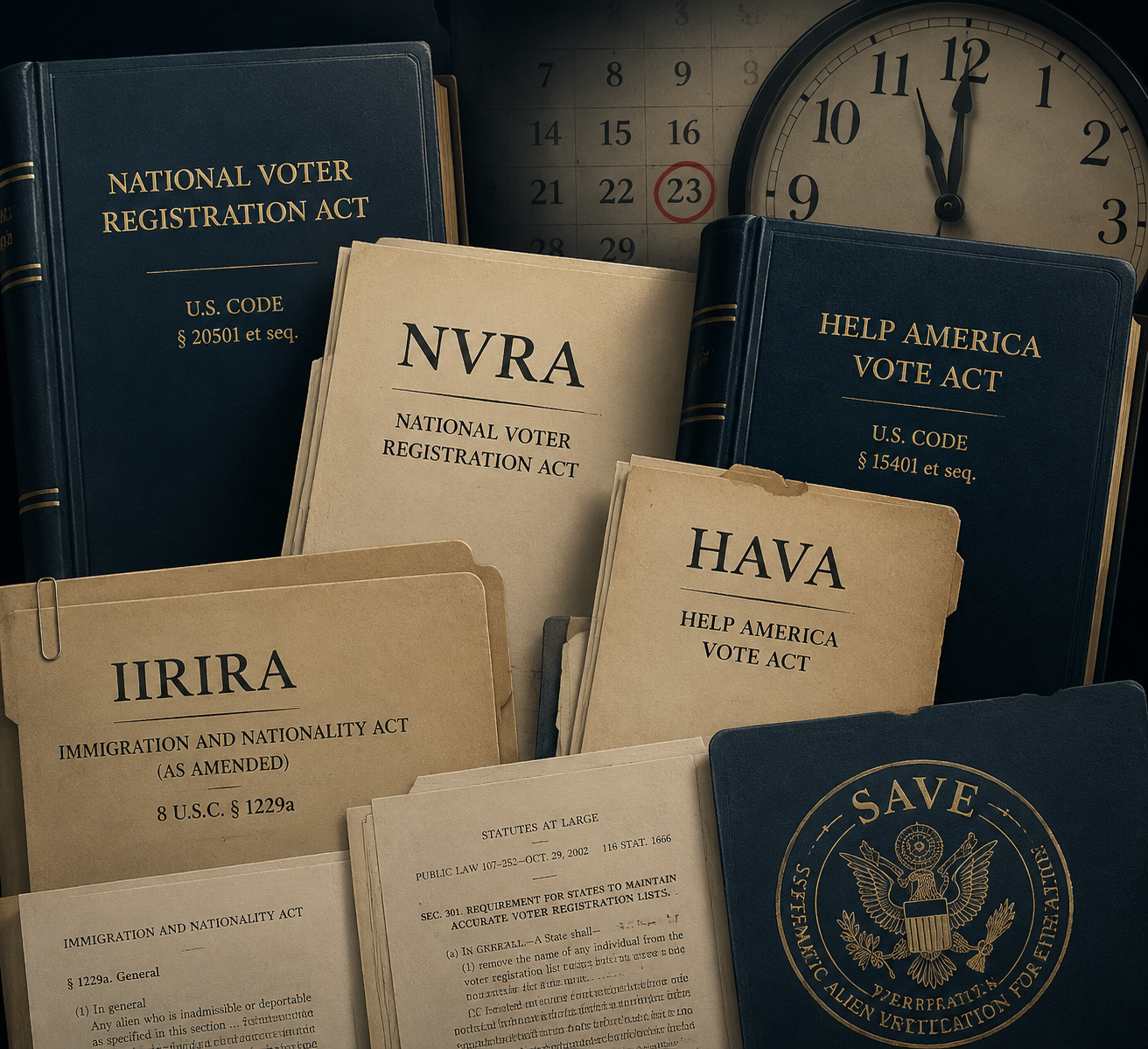
The Federal Map: Eligibility, Registration, Databases, and Removals
The federal statutes answer different questions. Confusion follows when one statute is used to do another statute’s work.
| Legal source | What it principally controls | What it does not settle |
|---|---|---|
| IIRIRA § 611 | The federal prohibition on non-citizen voting in federal elections | The evidence and process a state must use before treating a registered voter as removable |
| NVRA §§ 8 and 9 | Voter registration rules and list-maintenance obligations, including limits on removals close to federal elections | A non-citizen-specific notice, cure, or adjudication procedure comparable to the statute’s change-of-address process |
| HAVA § 303 | Computerized statewide voter registration lists and identity verification infrastructure | A conclusive citizenship-verification system for voter roll removals |
| SAVE | A federal status-verification channel used by states to check immigration or citizenship-related information | A definitive determination that a person is a non-citizen or is ineligible to vote |
The NVRA is the statute that does most of the practical work once a person is on the voter list. Section 8 requires states to conduct a general program that makes a reasonable effort to remove ineligible voters, including those who have died or changed residence, while preserving eligible voters’ access. The statute also restricts systematic removals within 90 days of a federal election. But the statute does not define a “reasonable effort” for non-citizenship review, does not identify a minimum evidentiary threshold for a non-citizen flag, and does not give non-citizenship cases the same detailed procedural track it gives change-of-address cases.[1][2]
That omission is not a small drafting inconvenience. Change-of-address maintenance has a statutory architecture: notice, waiting periods, voter inactivity rules, and timing limits. Non-citizen checks usually begin somewhere else: a motor vehicle record, a jury record, a SAVE query, a state database comparison, or an applicant’s missing document. Federal law tells states that non-citizens may not vote in federal elections. It does not hand county offices a federal adjudication form labeled “confirmed non-citizen registrant.”
The NVRA Does Not Ban List Maintenance, but It Does Control the Machinery
A state does not violate the NVRA merely by checking whether registered voters remain eligible. The harder question is what happens after a check produces a possible non-citizen match. The NVRA’s “reasonable effort” language gives states room to maintain accurate lists, but it leaves the most contested operational questions unanswered: how reliable the source data must be, who gets notice, what evidence rebuts the flag, how long a voter has to respond, and whether the process is individualized or systematic.[2]
Husted v. A. Philip Randolph Institute adds pressure on that point because the Supreme Court did not impose a freestanding minimum quantum of evidence before a voter may be removed under the NVRA framework. That does not mean any weak database match is sufficient in every context. It means the protection has to be found in the statutory procedure being used, constitutional constraints, state law, or the factual adequacy of the state’s own process rather than in a simple federal evidentiary floor.[2]
Mi Familia Vota v. Fontes, decided by the Ninth Circuit in 2025, is important for the same reason. It is not merely another case name in the voting-law record. It reflects the way list-maintenance disputes often turn less on the abstract legitimacy of maintaining accurate rolls than on the procedure used to move from suspicion to consequence.[2]
For administrators, that is the unsatisfying but accurate answer: the NVRA expects list maintenance, constrains removals, and leaves non-citizen-specific process underdeveloped. For voters, it means the practical protection may depend heavily on state implementation choices unless a court finds those choices inconsistent with federal law or constitutional guarantees.
Proof-of-Citizenship Laws Are a Different Legal Problem
Documentary proof-of-citizenship laws are often discussed alongside voter roll checks, but they operate at a different point in the system. A DPOC rule usually controls what an applicant must produce to register or to receive a full ballot. A list-maintenance program controls what the state does with someone already registered. The same citizenship concern may animate both, but the legal analysis is not interchangeable.
The Kansas litigation remains the cleanest warning against treating documentary requirements as costless. In Fish v. Schwab, the Tenth Circuit struck down Kansas’s SAFE Act proof-of-citizenship requirement. The record described roughly 31,000 eligible citizens blocked from registering, about 12% of applicants, while Kansas identified 39 non-citizens, a rate described as .002%; the court characterized the number of non-citizens as “statistically indistinguishable from zero.”[3]
The point is not that a state may never ask citizenship questions. The point is that a documentary rule can create a large eligibility bottleneck while producing very small confirmed non-citizen findings. That mismatch is especially relevant when the state’s chosen proof system has predictable friction: naturalized citizens without documents at hand, voters whose names changed after marriage or divorce, older voters with inconsistent records, and applicants who do not understand that a missing paper can convert an eligibility question into a registration failure.
The current state landscape is fragmented. Six states with election-day registration or no registration — New Hampshire, Wyoming, Idaho, Minnesota, Wisconsin, and North Dakota — are treated as exempt from the NVRA’s DPOC prohibition for federal elections. Active or recent DPOC states for the 2026 cycle include Arizona, New Hampshire, South Dakota, Utah, and Wyoming, while Louisiana enacted a 2024 law that had not been implemented. Arizona remains the main example of a bifurcated system, in which voters may be treated differently for federal and state election eligibility depending on proof-of-citizenship status.[3]
Bifurcation may sound like a neat legal compromise until a county has to administer it. It requires poll books, ballot styles, voter notices, database coding, and staff training to preserve the distinction between a federal-only voter and a voter eligible for the full ballot. A legal distinction that cannot be administered cleanly becomes a litigation exhibit.
SAVE Is Permitted as a Verification Channel, Not a Removal Order
SAVE is now central to state non-citizen voter verification because there is no general federal database of citizens. States use SAVE to query immigration or citizenship-related records, and its use has expanded to at least 22 states. But the legal risk sits in the second half of the sentence: SAVE can return information that requires interpretation, and USCIS caveats mean the response should not be treated as a definitive finding of non-citizenship.[2]
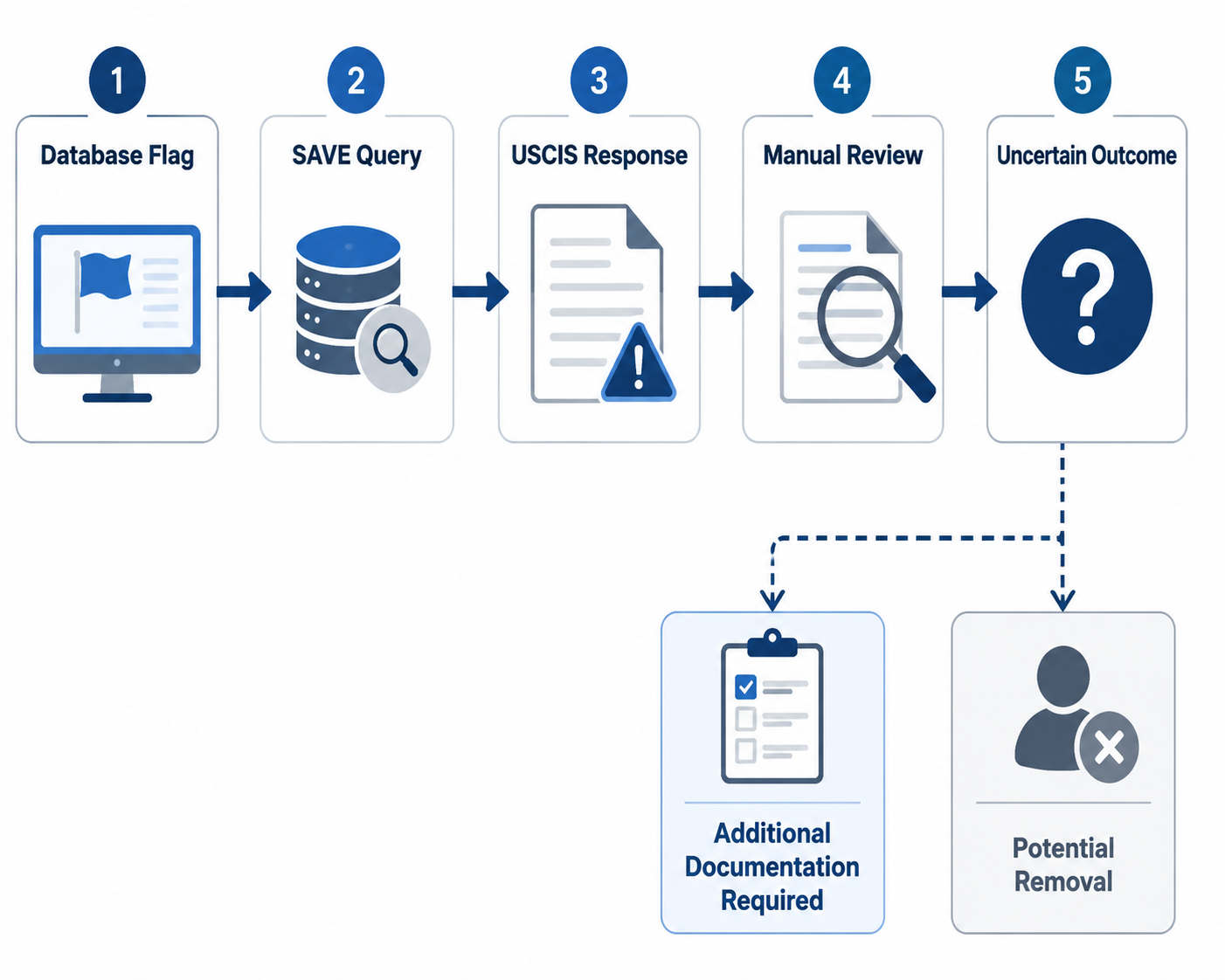
The practical flow is more conditional than many public announcements suggest. A state or county may begin with a database flag. It may submit a SAVE query. The response may require additional verification or manual review. The voter may need notice and an opportunity to provide documentation. Only after those steps can an office responsibly decide whether the information supports ineligibility, and even then the removal procedure must fit the NVRA, state law, and constitutional constraints.
The caution is not theoretical. The Bipartisan Policy Center report notes that SAVE cannot definitively determine whether an individual is a non-citizen and that about 20% of cases require additional manual review. It also flags data-sharing concerns because DHS’s System of Records Notice permits sharing with DHS components for law-enforcement or immigration purposes, without a statutory firewall comparable to HAVA § 303’s Help America Vote Verification system.[2]
North Carolina’s April 2026 memorandum of agreement with federal authorities illustrates the more careful version of SAVE use: the State Board announced that it would check voter rolls to identify and remove non-U.S. citizens and described due-process rules as part of the process. That phrasing matters. It presents SAVE as an input into review, not as the final adjudicator.[4]
Other state examples show why the distinction between “flagged” and “confirmed” should be non-negotiable. Texas initially flagged 2,724 possible non-citizens, but later review showed many were citizens. Utah conducted a broad review of roughly 2 million voters and found 27 confirmed non-citizens. Those numbers do not prove every state review will be flawed or trivial. They do show that the denominator, the data source, and the confirmation standard control the meaning of the announcement.[2]
The 90-Day Quiet Period Is the Live Wire for 2026
The NVRA’s 90-day quiet period is where the 2026 calendar turns a technical question into litigation risk. Section 8(c)(2) restricts systematic removals from voter rolls within 90 days of a federal election. The unresolved question is whether recurring SAVE-based non-citizen reviews are “systematic” removals subject to that limit, or whether they are individualized eligibility determinations that may continue closer to Election Day.[1][2]
The answer may depend on design. A one-off adjudication based on a voter’s own records does not look like a statewide batch process. A monthly database comparison run against a broad class of registrants looks much more systematic. A SAVE query that follows an individualized lead may be treated differently from a SAVE program that begins with a bulk data pull. The statute does not say where that line falls.
That ambiguity is already being litigated and monitored in states using recurring list-maintenance checks. Reporting on Arizona has described the tension between election-security arguments and voting-rights objections in the context of voter roll maintenance and the 90-day NVRA period.[6]
For a county office, the operational problem is blunt. If officials stop checks before the 90-day window, they may be accused of leaving ineligible registrants on the rolls. If they continue a broad automated review into the quiet period, they may be accused of conducting a prohibited systematic removal program. If they continue reviewing but delay removals, they must decide how to code the voter, what notice to send, and what to do if the voter appears to cast a ballot.
New Hampshire Shows How Documentation Rules Become Voter-Access Cases
New Hampshire’s HB 1569 is a useful 2026 pressure point because it moved the dispute from abstract eligibility to real voters at the registration desk. A federal judge blocked the law on May 28, 2026, finding it unconstitutional. Campaign Legal Center reported that at least 96 voters were turned away in March 2025 town elections, including married women whose documents did not match their current names.[5]
That example does not resolve the legality of every proof-of-citizenship law. It does identify the predictable failure mode. A rule designed around documentary certainty can collide with ordinary life events: marriage, name changes, misplaced naturalization papers, inconsistent agency records, or a birth certificate that does not match a current ID. The legal question then shifts from whether citizenship is a valid qualification to whether the state’s chosen proof mechanism burdens eligible voters without adequate justification or cure.
What Evidence Is Enough?
Federal law does not provide a simple evidence ladder for non-citizen voter roll checks. The hierarchy a careful office would want — database flag, corroborating source, voter notice, documentation review, final determination, appeal or restoration path — is easier to describe than to locate in one statute. The NVRA supplies list-maintenance commands and timing limits. HAVA supplies database infrastructure. SAVE supplies a verification channel with caveats. Constitutional law supplies due-process and equal-protection constraints. State law then adds its own proof rules, deadlines, and voter-status categories.
The weakest approach is to treat a stale or partial agency record as a fact. Motor vehicle data may reflect a person’s status when a license was issued, not after naturalization. A non-match may reflect a name variation rather than ineligibility. A SAVE response may require manual review. A voter who cannot produce a document immediately may still be a citizen. Those are not rhetorical cautions; they are the ordinary defects of administrative data.
The stronger approach is procedural: define the source of the flag, require corroboration before adverse action, notify the voter in usable language, give a realistic cure path, distinguish inactive coding from removal, preserve federal-only status where required, and document the basis for the final decision. That does not immunize a program from suit. It at least aligns the record with the legal question a court is likely to ask: how did the state move from possible mismatch to loss of registration or ballot access?
The Empirical Baseline Still Matters, but It Does Not End the Legal Analysis
Studies and policy analyses generally describe non-citizen voting in U.S. elections as extraordinarily rare or de minimis.[8][9][10] That baseline matters because burdens are judged against evidence. A program that blocks tens of thousands of eligible applicants while confirming only a tiny number of ineligible voters presents a different legal record from one that uses narrow, reliable evidence and a strong cure process.
But rarity is not a repeal of IIRIRA. Non-citizens remain barred from voting in federal elections. States may pursue accurate voter rolls. The legal question is not whether eligibility matters. It is whether the state’s method is authorized, sufficiently reliable, timely under the NVRA, and accompanied by procedures that prevent eligible voters from bearing the cost of administrative uncertainty.
Executive Order 14399 Adds Another Unsettled Layer
Executive Order 14399, titled “Ensuring Citizenship Verification and Integrity in Federal Elections,” was issued in March 2026 and introduced new federal citizenship-verification requirements that had not yet been legally tested as of this review date.[7] Its significance is less that it resolves the NVRA-SAVE problem than that it adds federal pressure in a field already divided among statutory text, agency caveats, state proof laws, and pending litigation.
If the order is implemented through agency conditions, forms, database access rules, or enforcement priorities, the next disputes are likely to ask familiar questions in a new posture: whether the federal government may require additional citizenship documentation, whether those requirements conflict with the NVRA’s federal-form framework, and whether states can rely on federal direction when the underlying voter-removal procedure remains constrained by the NVRA.
Where the Law Stands Before the Midterms
As of July 19, 2026, the narrow conclusion is this: federal law permits and sometimes expects voter list maintenance, and it plainly bars non-citizens from voting in federal elections. But SAVE-based non-citizen checks sit in an unresolved zone. The evidentiary signal is not conclusive, the NVRA does not contain a non-citizen-specific removal procedure, the 90-day quiet-period question remains unsettled for recurring database reviews, and state DPOC experiments continue to generate litigation over eligible voters who cannot satisfy documentary rules at the moment the state demands them.
That is enough ambiguity to make timing matter. A state that announces a large flagged population without explaining review, confirmation, notice, and remedy is not describing a completed legal process. A state that ignores citizenship eligibility is also not reading the whole statute book. The hard work is in the middle: separating flags from findings, checks from removals, and eligibility rules from proof systems before the 2026 federal-election calendar leaves less room to correct mistakes.
References
- National Voter Registration Act of 1993 (NVRA), U.S. Department of Justice, https://www.justice.gov/crt/national-voter-registration-act-1993-nvra
- Modernizing Voter List Maintenance: An Evidence-Based Framework for Access and Integrity, Bipartisan Policy Center, November 2025, https://bipartisanpolicy.org/report/modernizing-voter-list-maintenance-an-evidence-based-framework-for-access-and-integrity/
- States Are Already Enacting Harmful SAVE Act Policies Requiring Proof of Citizenship to Vote, Brennan Center for Justice, https://www.brennancenter.org/our-work/research-reports/states-already-enacting-harmful-save-act-policies-requiring-proof
- State Board to Check Voter Rolls to Identify, Remove Non-US Citizens, North Carolina State Board of Elections, April 16, 2026, https://www.ncsbe.gov/news/press-releases/2026/04/16/state-board-check-voter-rolls-identify-remove-non-us-citizens
- Inside the Effort to Purge Eligible Voters Ahead of the 2026 Midterms, Campaign Legal Center, https://campaignlegal.org/update/inside-effort-purge-eligible-voters-ahead-2026-midterms
- Election security vs. voting rights: Voter roll list maintenance, Votebeat, September 4, 2025, https://www.votebeat.org/arizona/2025/09/04/election-security-vs-voting-rights-voter-roll-list-maintenance/
- Ensuring Citizenship Verification and Integrity in Federal Elections, The White House, March 2026, https://www.whitehouse.gov/presidential-actions/2026/03/ensuring-citizenship-verification-and-integrity-in-federal-elections/
- Voting by Noncitizens Is a Non-Issue, Fair Elections Center, https://fairelectionscenter.org/voting-by-noncitizens-is-a-non-issue/
- Noncitizen Voting Analysis Update, Center for Election Innovation & Research, https://electioninnovation.org/research/noncitizen-analysis-update/
- Noncitizen Voting in U.S. Elections, Migration Policy Institute, https://www.migrationpolicy.org/explainer/noncitizen-voting-us-elections
Comments
Join the discussion with an anonymous comment.