
The Missing Federal Record Is Now Part of the Case
The most important change for cruise-ship norovirus liability in 2026 is not a new maritime negligence rule, a newly dangerous shipboard pathogen, or a visible spike in filings. It is the quieter loss of a fact-finding layer. In April 2025, the Department of Health and Human Services eliminated the full-time civilian staff of the CDC Vessel Sanitation Program, including the program epidemiologist who led cruise outbreak response, according to CBS News. The same report noted that VSP is funded through cruise-line fees rather than taxpayer appropriations, a detail that makes the cuts harder to explain as an ordinary federal budget tradeoff.[1]
That staffing change matters in litigation because VSP was not merely a public-health notice board. Its inspections, outbreak investigations, and public documentation supplied a record neither plaintiffs nor cruise lines fully controlled. When that record existed, plaintiffs could use it to test whether a ship had notice of a recurring sanitation or illness problem. Defendants could use it to show a history of inspection compliance, timely reporting, and cooperation with federal officials. Once the civilian investigative and epidemiological function is removed, both sides are left leaning harder on the cruise line’s own reports, medical logs, cleaning records, passenger questionnaires, and whatever documentary trail survived the voyage.
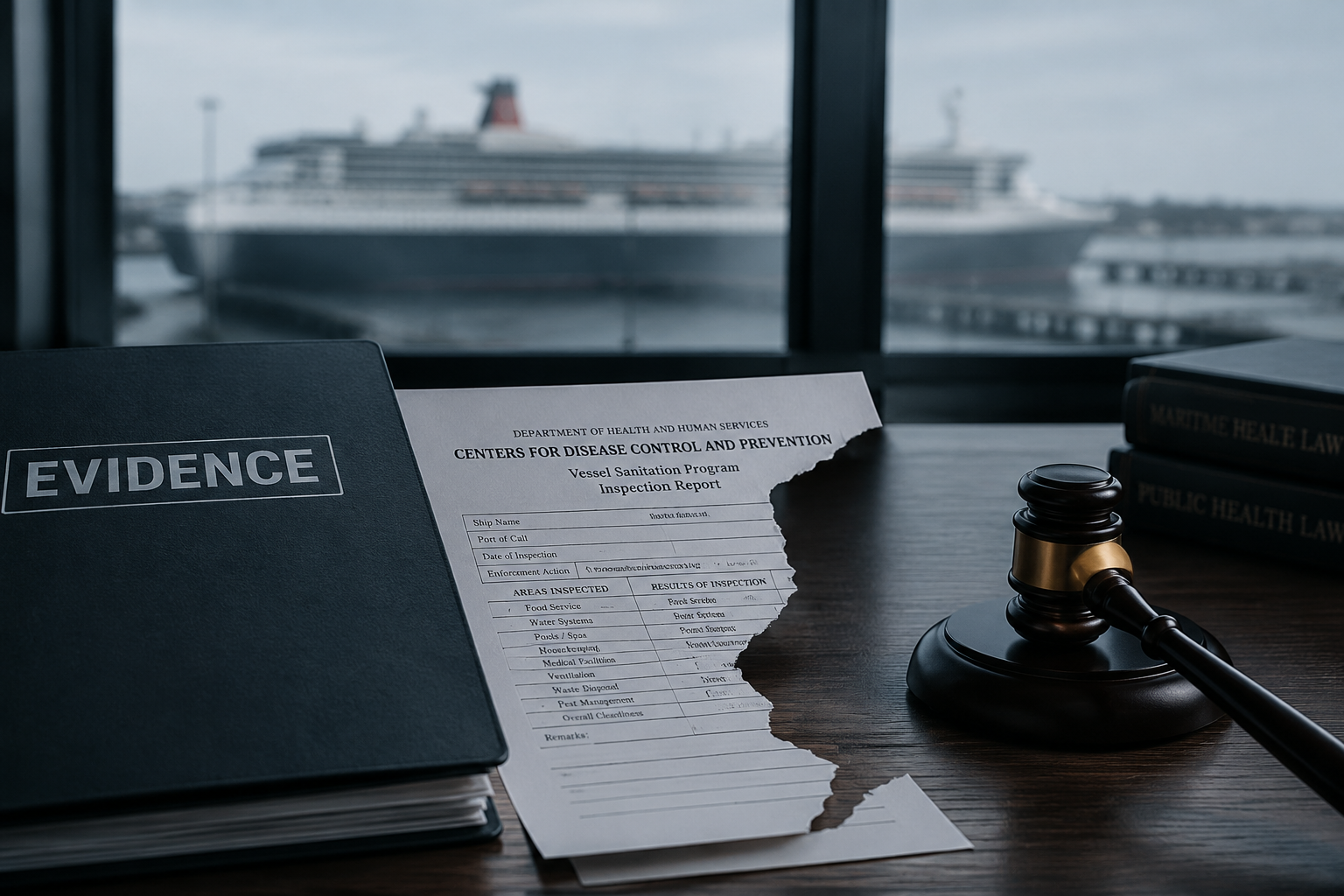
The public numbers now create a tempting but dangerous shortcut. As of mid-July 2026, the CDC had posted eight gastrointestinal outbreaks: five norovirus, two E. coli, and one of unknown etiology. Food Poison Journal compared that with 18 posted outbreaks in 2024 and 14 in 2023, while warning that fewer posted investigations may reflect diminished investigative capacity rather than fewer illnesses.[2] That is the central evidentiary problem. A smaller list may describe a safer year, a thinner surveillance apparatus, or some mixture of both.
The staffing numbers have also been reported with some variation. CBS described the elimination of all full-time civilian VSP employees and a program left with commissioned officers; AP described four full-time CDC staff, including scientists; Food Poison Journal described a drop from about two dozen people to roughly a dozen U.S. Public Health Service officers.[1][2][3] For litigation purposes, the exact headcount is less decisive than the institutional function removed. The civilian investigative staff that generated independent outbreak documentation is no longer operating as it did before April 2025.
What VSP Used to Supply
In a cruise gastrointestinal outbreak case, the useful record is rarely one document. It is the relationship among records: when the first passenger reported symptoms, how the ship classified the illness, when the threshold for reporting was reached, what cleaning measures were logged, whether food or water sources were examined, what crew illnesses were disclosed, and whether outside investigators tested the ship’s account against observed conditions. VSP’s value was that it could connect those points through a federal process.
That process affected both sides of the caption. A plaintiff arguing constructive knowledge could point to prior VSP inspection deficiencies, earlier voyage outbreaks, or CDC outbreak findings to show the operator knew or should have known of a condition requiring stronger precautions. A cruise line could point to acceptable inspection scores, documented corrective action, and a federal record showing that the operator reported illness and implemented response measures. The federal layer did not decide liability, but it reduced the amount of arguing about whether the underlying record was real, complete, and independently observed.
The loss is especially important because the CDC list was never a complete map of cruise illness. It covers voyages within VSP jurisdiction, generally those involving both U.S. and foreign ports, and posted outbreaks depend on reporting thresholds, including the 3% passenger or crew illness trigger. Even before the cuts, the list did not capture every shipboard norovirus incident. After the cuts, the same list still looks authoritative on a docket or in a demand letter, but its silence carries less weight.
Why the 2026 Outbreak List Is Harder to Read
The posted 2026 outbreaks still matter. They give dates, vessel names, passenger and crew counts, reported symptom percentages, causative agents where identified, and basic response measures. But the list now has to be read with an asterisk larger than usual: the agency publishing it has lost personnel who helped investigate and validate the events behind the entries.
Some entries look like the familiar VSP record. On Caribbean Princess, for a voyage from April 28 to May 11, 2026, the CDC reported 145 of 3,116 passengers, or 4.7%, and 15 crew members with gastrointestinal illness.[4] On Ruby Princess in June 2026, the CDC reported 107 of 3,032 passengers, or 3.5%, with symptoms.[5] Rotterdam, sailing from December 28, 2025 to January 9, 2026, was reported by the New York Post as the first norovirus outbreak of 2026, with 85 of 2,593 passengers, or 3.3%, affected.[6]
Those figures are useful, but they are not the same as a fully staffed field investigation. They tell counsel that an outbreak crossed the posting threshold and that the CDC received reportable data. They do not, by themselves, establish why transmission occurred, whether the operator’s cleaning response was adequate, whether earlier warning signs were missed, or whether a food, water, surface, passenger-to-passenger, or crew-related pathway was most plausible.
That distinction cuts against both overconfident plaintiff and defense narratives. A plaintiff cannot simply treat every posted norovirus entry as proof of negligent sanitation. Norovirus spreads efficiently in closed settings, and AP cited norovirus expert Lee-Ann Jaykus of North Carolina State University for the point that less than 1% of the estimated 19 million to 21 million annual U.S. norovirus illnesses are linked to cruises.[3] At the same time, a cruise line cannot fairly present a lower 2026 posted count as proof that ships have become safer when the decline coincides with the reduction of the federal workforce responsible for the posted record.
The Sea Bird Cluster Sharpens the Notice Question
The National Geographic Sea Bird entries are the kind of facts that make the evidence gap concrete. The CDC posted three consecutive gastrointestinal outbreaks on the Lindblad vessel in 2026: May 26 to 31, June 25 to 30, and July 10 to 15. On the July voyage, 18 of 62 passengers reported symptoms, a 29% passenger illness rate.[7]
A 29% symptom report on a small vessel should not be flattened into the same category as a 3% threshold event on a large ship. The denominator is smaller, the social and physical environment is different, and the practical consequences for passengers are more concentrated. In a litigation file, the repeated-voyage pattern would immediately invite questions about carryover contamination, crew illness, turnaround cleaning, isolation practices, passenger screening, and whether prior voyages supplied enough notice to require stronger measures before the July sailing.
The legal importance is not that repeated outbreaks automatically prove liability. They do not. The importance is that repeated outbreaks change the evidentiary burden each side has to meet. Plaintiffs would want to know what the operator learned after the first and second events, what changed before the third, and whether those changes were reasonable. Defendants would want a reliable record showing prompt reporting, escalation, disinfection, medical response, and cooperation. In earlier years, VSP’s investigative apparatus could have supplied a more independent version of that chronology. In 2026, the parties are more likely to fight over the operator’s own chronology.
E. coli Points to a Different Kind of Missing Investigation
The 2026 list also includes two E. coli outbreaks, one on Seven Seas Mariner in January and one on Oceania Insignia in April, according to the CDC outbreak listings.[8] That is a narrower but important signal. Norovirus cases often raise questions about person-to-person transmission and environmental persistence. E. coli more readily directs attention to food-source contamination, supplier records, galley controls, cold-chain practices, and testing decisions.
Those are precisely the questions that benefit from field capacity. A food-source outbreak investigation may require interviewing passengers, comparing meal exposures, reviewing preparation logs, obtaining samples, and coordinating with other public-health entities. If that work is thinner, later litigation inherits the gaps. The parties can still subpoena records and retain experts, but private discovery often begins months after the relevant food, surfaces, samples, and memories have disappeared.
Constructive Knowledge Becomes More Contested
Constructive knowledge is where the weakened federal record may have the most practical effect. A plaintiff usually has to show more than illness after a cruise. The case needs a route from symptoms to breach: prior similar events, inadequate response, unreasonable delay, ignored sanitation issues, or some other fact showing the operator knew or should have known of the risk and failed to act reasonably.
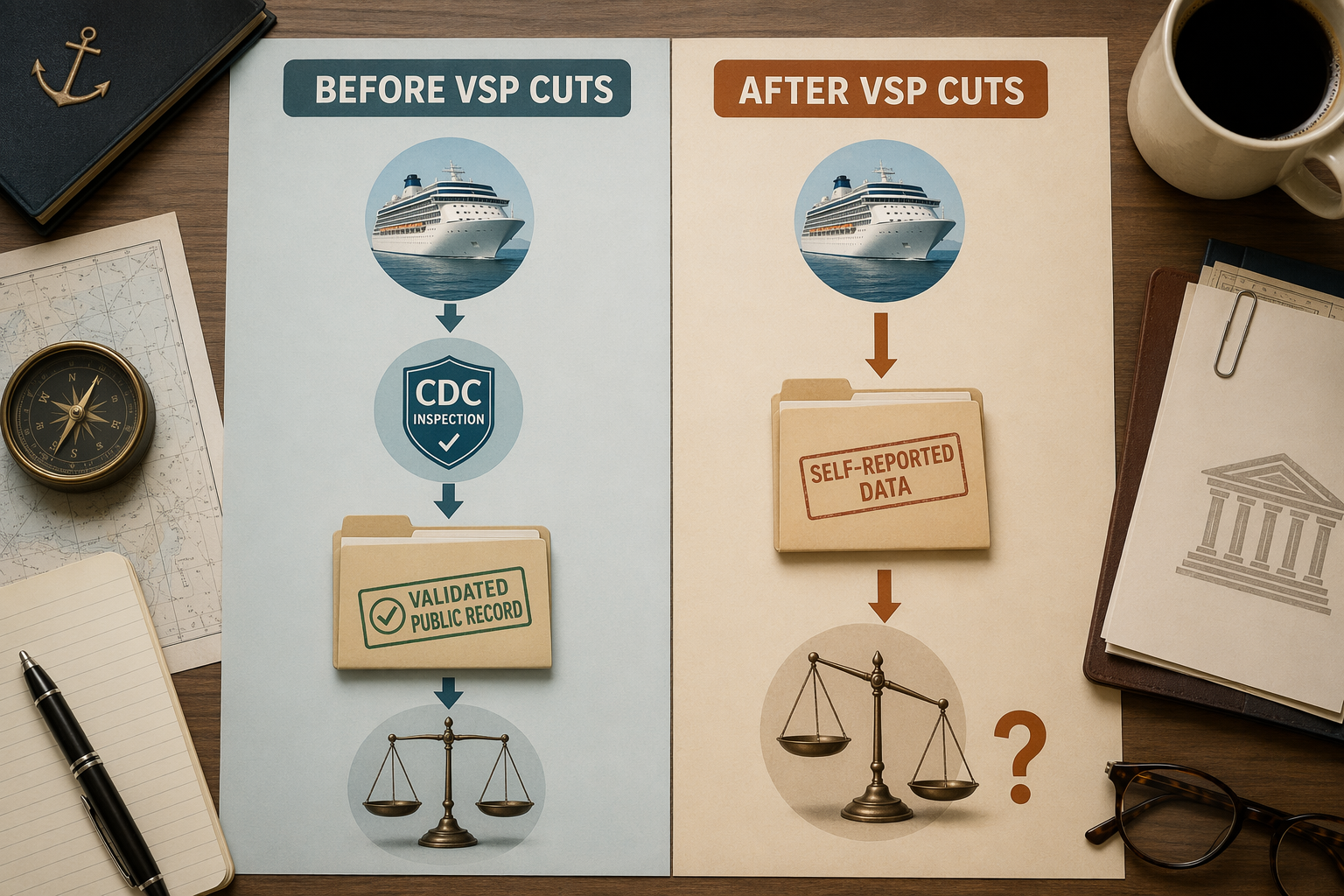
Before the VSP cuts, prior inspection reports and outbreak investigations could help define what the operator knew and when. A plaintiff could use that record to argue that notice was not speculative. A defendant could use the same record to show the prior issue was corrected, unrelated, or investigated without findings supporting negligence. The point was not that CDC documents automatically resolved the case. The point was that they narrowed the universe of plausible factual disputes.
Without that validation layer, generalized norovirus data becomes more tempting and more dangerous. Counsel may want to argue foreseeability from broader U.S. trends, including strain prevalence, seasonal activity, or public-health warnings. But unless the data is cruise-specific and tied to the vessel, itinerary, crew, prior voyages, or operational choices at issue, it may show background risk rather than constructive knowledge. Courts and opposing experts are likely to press that distinction.
Defendants face a parallel problem. A cruise line can still produce sanitation plans, illness logs, crew training records, cleaning protocols, and correspondence. But records generated and preserved by the defendant carry a different evidentiary posture from records generated or validated by an outside regulator. The more the defense depends on self-reported data, the more plaintiffs will probe who entered it, who reviewed it, what was omitted, whether thresholds were applied consistently, and whether the ship had incentives to classify or time reports in a favorable way.
The Lower Posted Count Is Not a Safe Defense Exhibit
The year-over-year comparison is likely to appear in disputes because it is simple: eight posted GI outbreaks by mid-July 2026, compared with 18 in 2024 and 14 in 2023.[2] But simplicity is not reliability. The comparison does not measure all shipboard illness. It does not include voyages outside VSP jurisdiction. It does not show unreported sub-threshold clusters. And in 2026, it sits on top of a staffing rupture.
A defense presentation that treats the lower number as proof of improved safety invites a predictable response: fewer investigators may mean fewer investigations. A plaintiff presentation that treats the continued existence of posted outbreaks as proof of systemic cruise negligence invites the opposite response: cruises account for a small fraction of overall U.S. norovirus illness, and an outbreak entry does not itself establish breach.[3] The stronger use of the 2026 count is more limited. It shows that the public record remains active, but less able to perform its old validating function.
Former CDC division director Erik Svendsen, who was fired in the cuts, told CBS that the layoffs would “put them back many months before they're really functional again.”[1] That quote is not proof that any particular 2026 investigation was mishandled. It is evidence that the program’s operational capacity changed at the same moment counsel are being asked to rely on its public outputs.
What This Changes in Case Evaluation
For plaintiffs, the immediate effect is not an easier path to liability. It is a harder path to independent proof. They may have more room to challenge cruise-line self-reporting, but less access to a federal investigative record that could have confirmed timing, scope, causation clues, or repeat problems. That makes early preservation demands, passenger witness development, medical documentation, and shipboard record requests more important, while also making some cases weaker if they depend on speculation that a robust VSP investigation might have resolved.
For defendants, the reduced VSP presence does not simply remove oversight risk. It also removes a credibility anchor. A cruise line may still comply with sanitation standards and may still respond appropriately to illness. But if the record is mostly internal, the defense has to prove the reliability of the recordkeeper as well as the reasonableness of the response. In-house counsel evaluating exposure in 2026 should treat documentation quality as part of the liability analysis, not as an administrative afterthought.
The effect is most acute in repeat-voyage scenarios, high-percentage small-vessel outbreaks, suspected food-source events, and cases where the outbreak count sits just above or below the reporting threshold. Those are the files where an independent investigator’s notes, sampling decisions, and interviews might have made the difference between a plausible negligence theory and a cluster of unfortunate but legally unproven illnesses.
The Narrow 2026 Litigation Takeaway
Cruise norovirus risk should not be inflated into a public-health panic story. The available evidence still supports proportionality: cruises represent a very small share of U.S. norovirus illness.[3] But proportionality does not answer the litigation question raised by a 29% passenger symptom rate on a small vessel, repeated outbreaks across consecutive voyages, or unusual bacterial outbreaks that may require deeper source investigation.
The better conclusion is narrower. In 2026, norovirus liability on cruise ships has not become categorically easier or harder to prove. The material change is that both sides now litigate around a weakened federal fact-finding layer. Self-reported cruise-line data will carry more weight, face more attack, and require more corroboration. The absence of independent validation is no longer background noise. It is part of the risk analysis.
References
- CDC's cruise ship inspectors laid off amid bad year for outbreaks, CBS News.
- Cruise Ships in 2026: What the CDC's Outbreak List Does — and Doesn't — Tell You, Food Poison Journal.
- How cruise ship passengers can stay safe from the latest version of norovirus, AP News.
- Caribbean Princess, May 2026, CDC Vessel Sanitation Program.
- Ruby Princess, June 2026, CDC Vessel Sanitation Program.
- First norovirus outbreak of 2026 infects 90 people on cruise ship: CDC, New York Post.
- National Geographic Sea Bird, July 2026, CDC Vessel Sanitation Program.
- Cruise Ship Outbreak Updates, CDC Vessel Sanitation Program.
Comments
Join the discussion with an anonymous comment.