
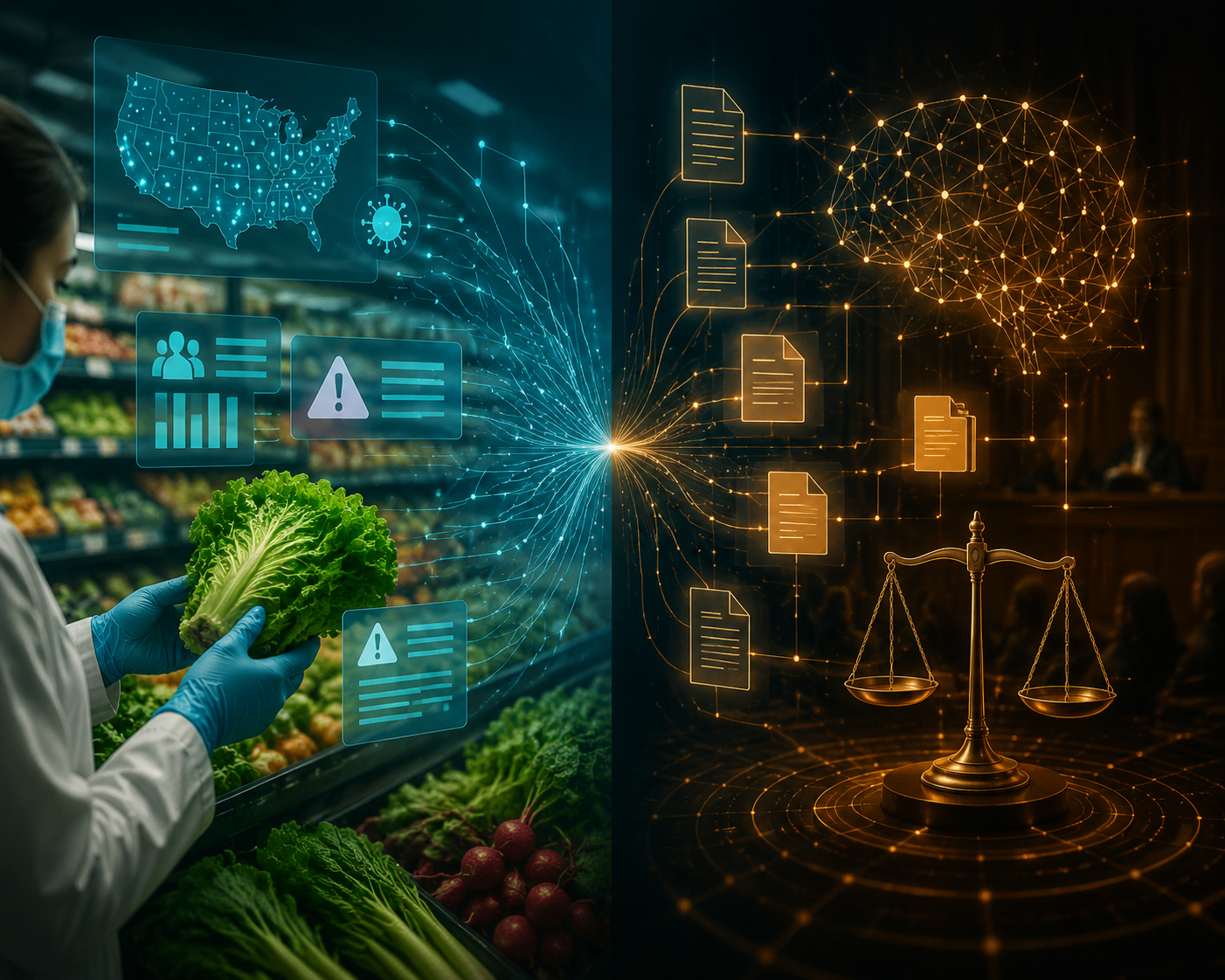
The legal story around the Walmart lettuce recall did not begin with a polished complaint or a completed epidemiology file. It began in the messier place where modern food cases now begin: a CDC health alert, a retailer recall page, a supplier notice, state-level counts that did not line up neatly, and lawyers trying to decide which records could become legally usable before the outbreak stopped moving.
As of July 20, 2026, the Cyclospora outbreak had reached nearly 7,000 reported cases across 34 states, with more than 141 hospitalizations, while a Walmart/Taylor Farms recall covered products distributed in 27 states.[1] Michigan’s reported 5,002 cases were especially important, but they also illustrate the counting problem: that figure included probable cases, while CDC confirmed counts used a narrower method.[1] In a mass tort file, that distinction is not academic. It changes how intake teams label records, how lawyers describe exposure, and how defense teams test whether a claimant belongs in the case at all.
The first lawsuit, Ayyad v. Pacific Bells, was filed on July 16, 2026, within 48 hours of CDC’s July 14 Health Alert Network advisory.[2] That speed is impressive only if the back office is invisible. If it is visible, it means claimant forms, purchase locations, symptom dates, medical visits, product names, franchise relationships, recall notices, and duplicate leads are all landing at once, before anyone can pretend the file is tidy.
The Recall Notice Became a Data Problem Before It Became a Courtroom Problem
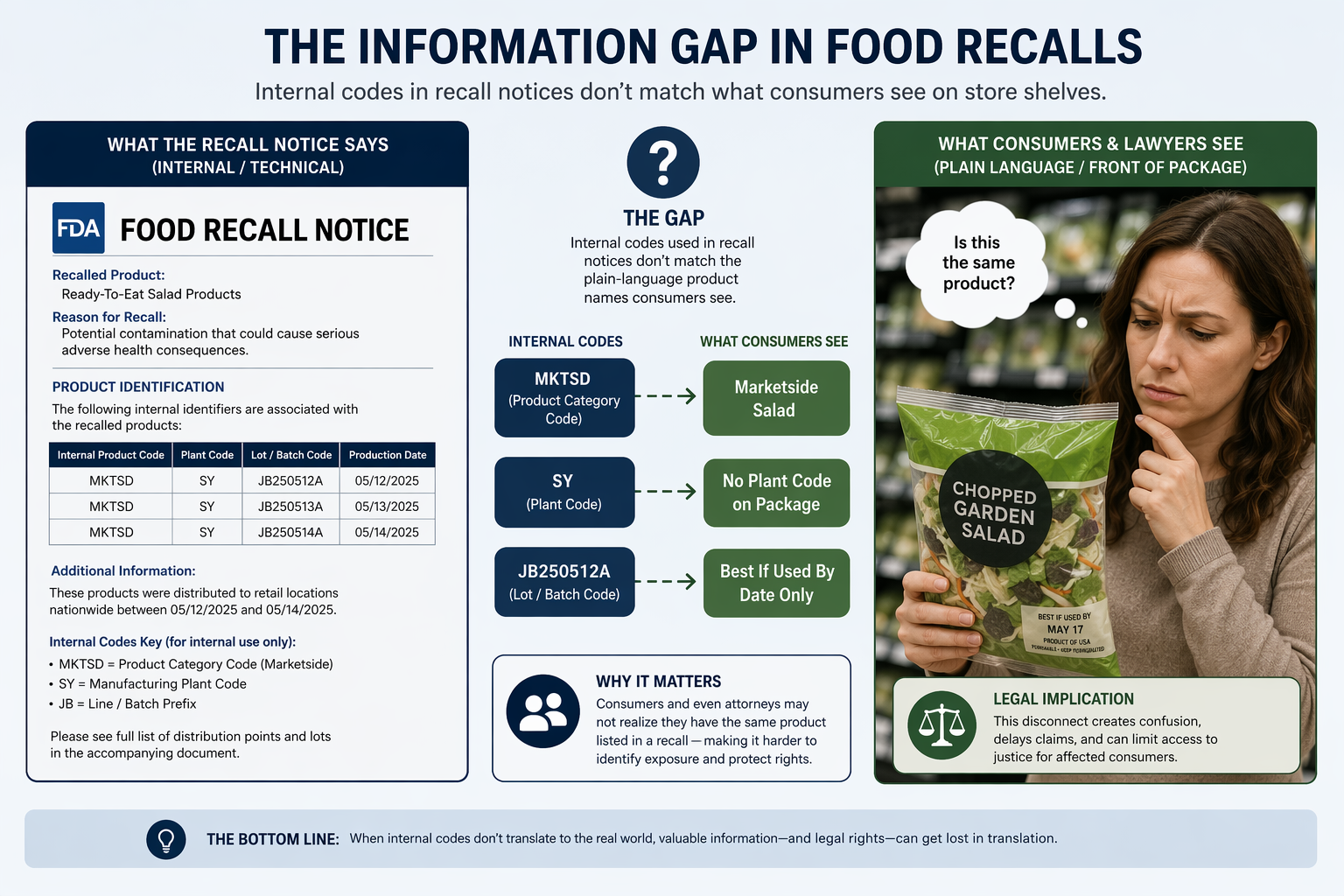
The Taylor Farms recall notice did not give consumers a clean grocery-shelf vocabulary. It used internal codes such as “MKTSD,” “SY,” and “JB,” with Consumer Reports identifying the plain-language gap this created for shoppers trying to determine whether their lettuce was part of the recall.[3][4] Walmart’s role, based on the materials reviewed here, was as the retailer that recalled Marketside products; no lawsuit specifically naming Walmart as a defendant had been identified at research time.[3]
That is exactly where a modern food-poisoning case stops being a simple public notice and becomes an operational build. A shopper may remember buying “bagged lettuce at Walmart.” The recall record may say “MKTSD.” A receipt may show a short product description. A complaint form may say “salad mix.” A lawyer needs enough product specificity to file without overstating the evidence, and a defense team needs the same specificity to challenge claims that do not match the recalled universe.
AI-assisted product matching is useful here, but not because it magically proves exposure. Its practical value is narrower and more defensible: it can line up recall codes, retailer product names, receipt text, claimant descriptions, and intake answers so that a human reviewer can see where the match is strong, weak, or missing. The mistake is treating that match score as a fact instead of a lead.
Surveillance and Intake Are No Longer Waiting for the Case to Mature
AI surveillance tools are already built for the front end of this kind of matter. Darrow AI and Rain Intelligence scan FDA alerts, CDC outbreak notices, and social media to identify potential class action opportunities before traditional referral pipelines fully activate.[5] That does not mean the tools know which claims are meritorious. It means they can surface the signal early enough for a firm to build an intake workflow while the public-health record is still changing.
That timing matters in the Cyclospora litigation because claimant volume appeared almost immediately. Ron Simon & Associates reported representing hundreds of claimants within 48 hours of filing its first lawsuit.[6] At that scale, the intake problem is not just answering the phone. It is deciding which information must be captured in the first pass so the file can survive later review.
| Intake field | Why it matters in a Cyclospora lettuce case |
|---|---|
| Purchase location | Connects the claimant to a retailer, restaurant, franchise, or distribution path. |
| Product description | Helps translate consumer language into recall codes, brand names, and supplier records. |
| Date of purchase and consumption | Anchors the symptom timeline against advisory dates, recall dates, and known exposure windows. |
| Symptoms and treatment | Separates general concern from documented illness and identifies medical-record needs. |
| Household duplicates | Prevents repeated leads, merged identities, and inflated claimant counts. |
| Proof of purchase | Shows whether the file rests on a receipt, loyalty-card record, photo, memory, or no purchase proof. |
This is where legal AI has become ordinary in ways that are easy to understate. A model can cluster similar intake narratives, flag missing purchase data, normalize store names, extract dates from uploaded medical records, identify duplicate claimants, and route stronger product matches for attorney review. None of those tasks is glamorous. All of them determine whether a large food case becomes reviewable or collapses into spreadsheet folklore.
The surveillance layer also has to compensate for public-health data gaps. CDC’s July 2025 decision to make Cyclospora reporting optional under FoodNet weakened surveillance, making state dashboards, local reporting, news accounts, and other public signals more important to cross-reference.[1] AI tools can help scan that broader field, but they cannot erase the quality difference between confirmed, probable, self-reported, and rumored illness. The label has to travel with the data.
The Product-Specific Proof Problem Drives Both Sides
Food recall litigation often sounds broad in public language: consumers bought contaminated lettuce, or they ate at a restaurant supplied by a recalled producer. The pleadings burden is narrower. Ward v. J.M. Smucker, McLean v. Walmart, and Catalano v. Grimmway all underscore a practical rule that matters long before trial: plaintiffs must plausibly allege that their specific purchased product was connected to the alleged contamination.[7]
That pressure turns product matching into more than clerical cleanup. On the plaintiff side, AI review can help locate receipts, loyalty records, photographs, medical notes, and intake statements that support a plausible connection. On the defense side, the same kind of review can identify claimants whose purchases fall outside the recalled product line, geography, date range, or supplier path. The same workflow can strengthen one file and remove another.
There is a difference between a claimant who bought a recalled Marketside product, a claimant who ate lettuce at a Taco Bell franchise, and a claimant who simply lived in a state with elevated Cyclospora reports. The documents may eventually connect those facts, or they may not. AI can speed the sorting, but the legal consequence still depends on traceable evidence.
For earlier coverage of the filings themselves, the site’s report on Taylor Farms Cyclospora legal claims tracks the early-litigation phase. The AI question sits one layer underneath that public sequence: how each piece of claimant information becomes structured enough to be challenged, relied on, or discarded.
Discovery Is Where the Historical Record Gets Expensive
Taylor Farms’ prior outbreak history gives the discovery phase its own weight. The company has been associated in reporting with prior foodborne illness events, including a 2013 Cyclospora outbreak, a 2015 E. coli outbreak, and a 2024 E. coli matter involving McDonald’s.[2] That history should not be treated as a shortcut to liability in the 2026 outbreak. It does, however, show why the document universe can become large quickly.
In discovery, lawyers will not just ask for a recall notice. They may seek supplier communications, lot-tracking records, sanitation logs, prior corrective actions, customer complaints, internal incident reports, quality-assurance audits, insurer communications, and communications with retailers or regulators. The question becomes who can build a reliable chronology without spending months manually reading the same kind of document in five different systems.
AI review tools are well suited to first-pass organization of that material. They can group near-duplicate documents, identify recurring issue terms, surface communications around key dates, and help reviewers distinguish a sanitation discussion from a customer-service exchange. In a food case, that is not just efficiency. It affects whether lawyers can see sequence: complaint, investigation, recall decision, retailer notice, public advisory, and litigation hold.
The boundary is just as important. A model-generated chronology is not a chronology until someone checks the source documents, date fields, time zones, custodians, and document families. Food litigation is full of records that look similar but mean different things: production date, best-by date, ship date, pull date, recall date, advisory date. Date discipline is not a formatting preference. It is how the case avoids inventing its own sequence.
Defense AI Is About More Than Discovery Review
The defense-side AI story is not simply “use cheaper document review.” Cozen O’Connor’s March 2026 framework describes AI-powered recall management tools that monitor consumer complaints, model risk, administer refund programs, and help companies design post-recall programs that may defeat Article III standing challenges.[7] That framework predates the July 2026 Cyclospora outbreak, but it maps directly onto the pressure points a retailer, supplier, or restaurant chain faces after a recall.
Complaint monitoring can show whether consumer reports cluster around a product, store region, date, or symptom pattern. Risk modeling can help estimate which claims are likely to become litigated and which are likely to remain customer-service matters. Refund administration can create records showing who was notified, who received compensation, and whether a consumer still has an injury sufficient to sue. These systems are not neutral just because they are administrative. They shape the standing record.
For plaintiffs, that means the defense database may become a discovery target. For defendants, it means the database has to be built as if someone else will one day read the assumptions. If an AI-assisted refund program misclassifies a product code or excludes a group of consumers because of a bad mapping rule, the error is not confined to customer service. It can affect settlement posture, standing arguments, and the credibility of the recall response.
The Reliability Test Arrives After the Tool Has Already Been Useful
The easy AI article starts with hallucinations and never leaves the warning label. That misses the harder problem. In a case like the 2026 Cyclospora outbreak, AI can be genuinely useful across surveillance, intake, product matching, discovery, complaint monitoring, risk modeling, and settlement administration. The risk is not that the tools are useless. The risk is that their useful outputs begin to feel verified before anyone has done the verification.
The February 2026 Duane Morris incident is a clean example of where that leads. AI-hallucinated case citations prompted sanctions and delayed a class-action settlement.[8] The immediate failure involved legal citations, not lettuce, lot codes, or Cyclospora counts. But the operational lesson travels: a false output that moves downstream can become a court problem, a client problem, or a settlement problem long after the person who generated it has moved on.
In a food-poisoning mass tort, the hallucination may not look like a fake case citation. It may be a claimant assigned to the wrong product family, a probable state case treated as a CDC-confirmed case, a retailer named as though it were already a defendant, a best-by date treated as a purchase date, or a franchise relationship flattened into a single corporate actor. These errors are less theatrical than fabricated precedent. They may be more likely to survive into ordinary work product because they look like data cleanup.
Verification Has to Be Built Into the Workflow
The control system for AI in this setting is not a general instruction to “review outputs.” It has to attach verification to the point where the output will be used. If an intake model flags a strong product match, the reviewer needs the receipt, recall code, product label, or claimant statement that supports it. If a surveillance model combines sources, the dashboard needs to preserve whether the count is confirmed, probable, self-reported, or simply reported by a third party. If a discovery model builds a chronology, every key date needs a source document.
- Product matches should show the source fields that produced the match, not just a confidence score.
- Outbreak counts should carry an as-of date and the counting method used by the source.
- Claimant records should preserve uncertainty instead of forcing every file into yes-or-no eligibility too early.
- Discovery chronologies should link each event to a document, custodian, and date field.
- Refund and recall databases should record mapping rules, exclusions, and later corrections.
That kind of verification is slower than a demo. It is also what lets a firm use AI without outsourcing judgment to a system that cannot bear the consequence of being wrong. The person whose claim is rejected, the company whose defense is distorted, and the court asked to approve a settlement all depend on the same thing: a record that can be traced back to facts outside the model.
The July 2026 Cyclospora outbreak is still moving as of July 20, 2026, so its litigation record is not settled.[1] What it already shows is enough for legal operations teams to take seriously. AI has become operational across the food-poisoning litigation lifecycle, but every phase that accelerates also creates a new place where unverified data can harden into legal action.
References
- Cyclospora Outbreak Investigation, CDC, July 2026, https://www.cdc.gov/cyclosporiasis/outbreaks/07-26/index.html
- The Cyclospora Outbreak Now Has Two Names on It: Taylor Farms and Taco Bell — Both Have Been Here Before, and So Have I, Marler Blog, https://www.marlerblog.com/case-news/the-cyclospora-outbreak-now-has-two-names-on-it-taylor-farms-and-taco-bell-both-have-been-here-before-and-so-have-i/
- Recalls, Walmart, https://corporate.walmart.com/recalls
- Taylor Farms Pulls Mexican Lettuce Linked to Cyclospora Parasite, Consumer Reports, https://www.consumerreports.org/health/food-recalls/taylor-farms-pulls-mexican-lettuce-linked-to-cyclospora-para-a7871344748/
- How AI Could Detect the Next Class Action: ‘The Numbers Are Just Massive’, Law.com, June 23, 2025, https://www.law.com/2025/06/23/how-ai-could-detect-the-next-class-action-the-numbers-are-just-massive/
- Cyclospora Outbreak 2026, Ron Simon & Associates, https://www.ronsimonassociates.com/outbreaks/cyclospora-outbreak-2026/
- The Continuing Rise of Post-Recall Consumer Class Actions, Cozen O’Connor, March 2026, https://www.cozen.com/news-resources/publications/2026/the-continuing-rise-of-post-recall-consumer-class-actions
- AI-Hallucinated Case Citations Prompt Sanctions and Delay Class Action Settlement, Duane Morris Class Action Defense Blog, February 3, 2026, https://blogs.duanemorris.com/classactiondefense/2026/02/03/ai-hallucinated-case-citations-prompt-sanctions-and-delay-class-action-settlement/
Comments
Join the discussion with an anonymous comment.