
The Walmart self-checkout fraud lawsuit landscape is not one lawsuit, and it is not really about whether customers like scanning their own groceries. The harder legal problem begins when a missed scan, a camera feed, a receipt check, a weight sensor, or a store-level loss-prevention workflow turns an ordinary checkout lane into evidence. At that point the question changes: who carries the cost when the system is wrong?
Lesleigh Nurse’s Alabama case is the place to start because it shows the full collision. Nurse said a self-checkout scanner froze while she was checking out at Walmart. She maintained that she had tried to pay, yet she was later accused of shoplifting, arrested, and pursued through Walmart’s civil demand process. A jury awarded her $2.1 million in damages in 2021 after finding in her favor on claims that included false arrest and malicious prosecution, although Walmart said it would appeal the verdict.[1]
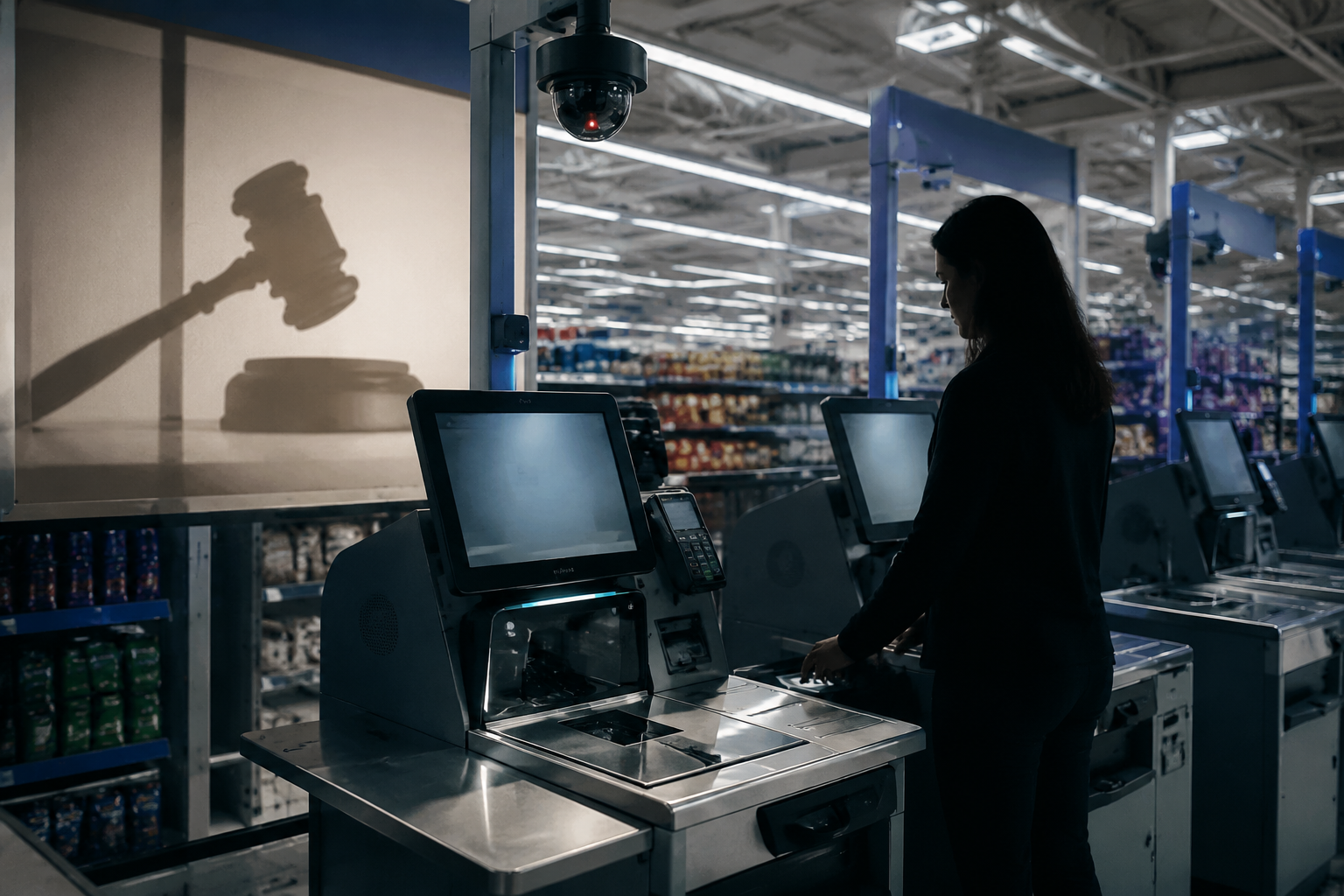
The verdict is large enough to attract easy headlines, but the procedural detail matters more than the number. Nurse’s case was a trial result, not a final appellate rule. The broader civil-demand figures often cited from the trial also require care: CBS 42 reported expert testimony that Walmart had charged about 1.4 million people with criminal theft and collected more than $300 million through civil demand letters over a two-year period. That is expert testimony reported from litigation, not a Walmart disclosure.[2]
Still, the case explains why self-checkout litigation has moved beyond annoyance with kiosks. A technical failure or ambiguous scan is not just a customer service event if the store treats it as theft, detains the customer, sends a demand letter, or contributes to an arrest record. The legal exposure is produced by the stack: scanner, camera, receipt data, employee intervention, police referral, and post-incident collection practice.
The Scanner-Glitch Pattern Has Not Stayed in the Past
A new complaint from Charlotte keeps the false-imprisonment theory current. In 2026, Brianna Jones sued a Walmart store over a self-checkout incident in which she alleges that a scanner malfunction led to her being accused of stealing. According to Queen City News, Jones says she asked for help after the scanner failed, left after being told she could go, and was later arrested in front of her children.[3]
That complaint is not proof that Walmart did what Jones alleges. It is an early-stage lawsuit, and the available reporting does not supply a merits ruling or a substantive Walmart response. But it matters because it appears to repeat the same operational sequence that made Nurse’s case legally potent: a checkout malfunction, a customer who says she tried to resolve it, a later theft accusation, and consequences that extend well beyond the store exit.
For lawyers assessing automated retail risk, that sequence is more useful than broad claims that self-checkout is “broken.” A broken kiosk is a maintenance issue. A broken kiosk followed by detention, arrest, and civil recovery demands is a litigation system.
Five Legal Theories Are Testing the Same Checkout Surface
The current Walmart self-checkout docket is best understood as a set of distinct theories, not one generalized complaint about automation. They overlap at the kiosk, but they attack different conduct.
| Claim category | What the theory targets | Current posture from available sources |
|---|---|---|
| False imprisonment and wrongful detention | Accusations, detention, arrest, malicious prosecution, and civil demand practices after alleged missed scans | Nurse produced a $2.1 million trial verdict on appeal; Jones is a new 2026 complaint |
| Biometric privacy | Alleged facial-feature capture or employee fingerprint systems without required consent | Customer-facing California claims remain pending; Illinois employee BIPA claims settled |
| Consumer overcharging | Pricing and weight discrepancies for certain weighted goods and bagged citrus | A $45 million class settlement was reached with no admission of wrongdoing |
| Wage-and-hour theory | The argument that customers doing self-checkout perform unpaid labor for the retailer | A reported claim by Deborah Russell was dismissed |
| Discrimination | Alleged unequal targeting or false accusation tied to protected status | Available sourcing supports narrow treatment rather than broad conclusions |
The point is not that all five theories are equally strong. They are not. False-imprisonment claims have the clearest factual drama and the most developed public record. Biometric claims may become more important because they move the dispute from shoplifting control into statutory consent and data collection. Overcharging is substantial but more contained. Wage theory has already shown its outer edge. Discrimination allegations require careful pleading and better facts than the public record usually provides.
False Imprisonment Turns Automation Error Into Human Consequence
Self-checkout false-imprisonment claims are not built merely on the existence of cameras or scanners. They turn on the store’s response after ambiguity appears. Did an employee stop the customer? Was the customer free to leave? Did the store involve police? Did Walmart continue pursuing the matter after facts emerged that undermined intent? Did a civil demand letter add pressure after the criminal process had begun?
Nurse’s case became significant because the jury could see the distance between an alleged checkout failure and the later machinery of accusation. CBS News reported that Nurse said she was trying to pay for items when the scanner froze. She left after being told the transaction would be suspended and later received a warrant for shoplifting. A local court dismissed the criminal charge, but Walmart’s civil demand process continued before the civil case produced the $2.1 million verdict.[1]
That order of events is why the case remains useful even with the appeal caveat. The relevant legal question is not whether retailers may investigate theft. They may. The question is what process is required before a retailer converts a checkout irregularity into a criminal accusation and then uses that accusation to demand money.
The expert testimony reported by CBS 42 gives the civil-demand issue scale, but only within its evidentiary limits. The testimony described roughly 1.4 million criminal-theft charges and more than $300 million collected through civil demand letters over two years. Those figures should be treated as a litigation assertion presented through an expert, not a settled empirical account of Walmart’s national practices.[2]
Jones’s 2026 complaint, if the allegations survive testing, would put fresh pressure on the same failure point: when a self-checkout system generates uncertainty, the human enforcement layer decides whether the incident remains a payment problem or becomes a criminal event. That is where legal departments should be looking. The risk is not only the machine’s error rate; it is the store’s confidence after the machine stops being reliable.
Biometric Claims Move the Dispute From Theft Control to Consent
The biometric cases matter because they change the object of the lawsuit. The customer is no longer arguing only that the store misread conduct at checkout. The customer is arguing that the checkout process itself collected or used identifying bodily information under conditions the law does not permit.
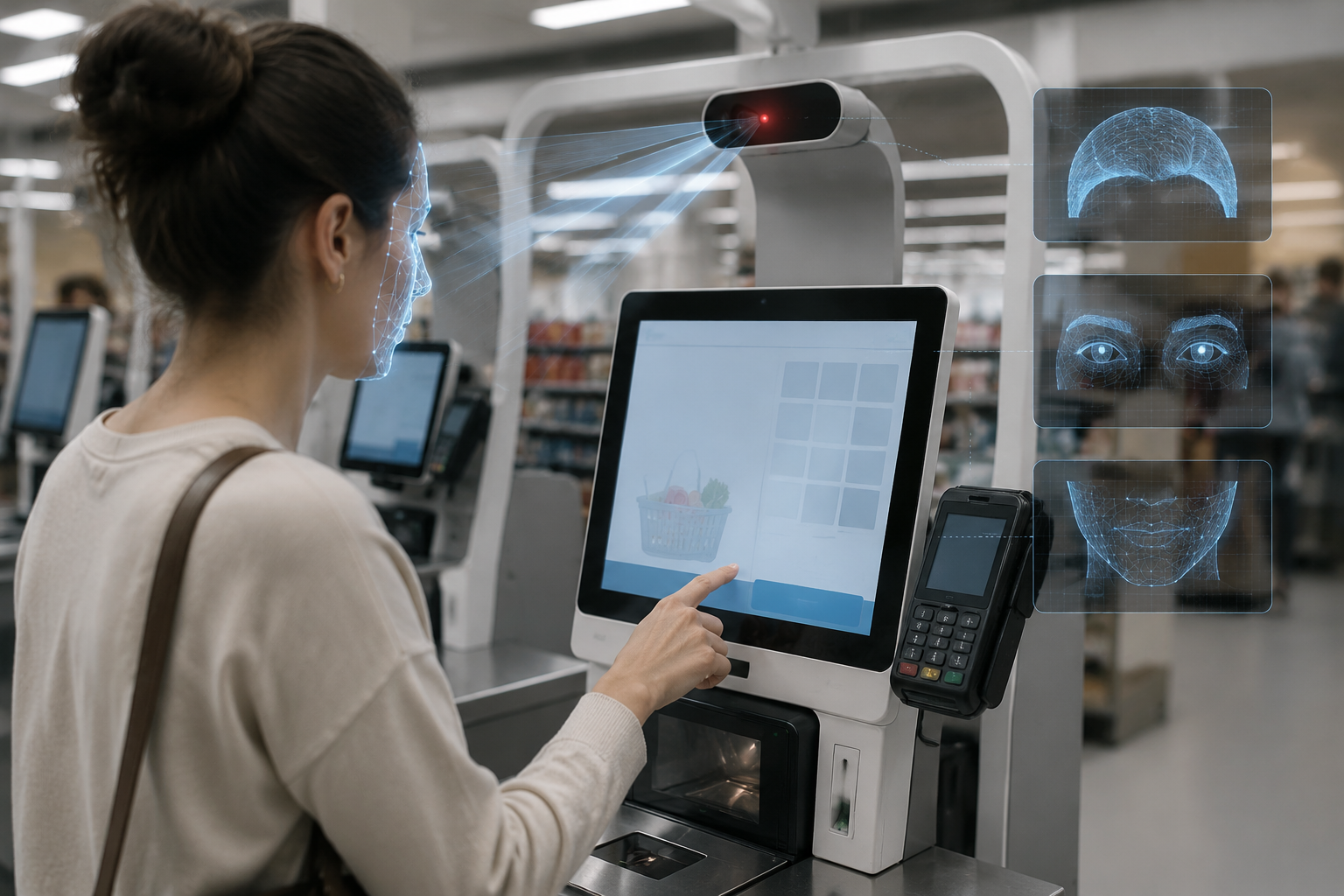
One California theory uses the Song-Beverly Credit Card Act. Inside Privacy, published by Covington, described a lawsuit alleging that Walmart’s self-checkout cameras captured data such as eye color, hair color, and facial features as a condition of paying by credit card. The claim is notable because Song-Beverly is typically associated with restrictions on requesting personal identification information during credit card transactions, and the lawsuit attempts to apply that framework to video capture at checkout.[4]
ClassAction.org separately reported customer-facing allegations that Walmart illegally captures biometric data through self-checkout kiosk video cameras. Those allegations should not be overstated: the available materials do not show that a court has ruled that Walmart’s self-checkout cameras violate the Song-Beverly Act or any biometric statute. The point for compliance review is that plaintiffs are treating the camera as part of the payment bargain, not as neutral store architecture.[5]
Employee biometric litigation shows an adjacent, cleaner statutory path. Walmart agreed to a $10 million settlement in Illinois litigation involving employee fingerprint scanning under the state’s Biometric Information Privacy Act, while the customer-facing biometric claims remain separate and pending.[5] A fingerprint timekeeping system is not the same technology or legal theory as a self-checkout camera, but both disputes ask whether retail convenience systems collected biometric identifiers without satisfying statutory consent requirements.
That distinction matters. The employee BIPA settlement does not prove liability for customer self-checkout cameras. It does show that biometric rules can turn routine retail infrastructure into statutory exposure where notice, consent, retention, and data-use practices are weak or undocumented.
Overcharging Claims Are Substantial, but More Contained
The consumer overcharging settlement belongs in the landscape, but it should not be confused with false arrest or biometric surveillance. ABC News reported that Walmart agreed to a $45 million settlement covering claims involving certain weighted groceries and bagged citrus purchased between 2018 and 2024. Walmart denied wrongdoing, and the claim deadline passed in June 2024.[6]
This theory targets pricing and measurement rather than enforcement. The alleged injury is economic: the customer paid more than the correct amount for eligible goods. It still fits the automated-checkout risk map because self-checkout depends on the integrity of item databases, scale systems, barcodes, and price presentation. But the remedy posture is different. It is a class settlement, not a detention case, and it does not establish an admission that Walmart overcharged shoppers.
The Unpaid-Labor Theory Shows the Boundary of Creative Pleading
The wage-and-hour version of the self-checkout lawsuit has intuitive appeal for frustrated shoppers: if the customer scans, bags, and troubleshoots the transaction, why is the customer not doing work for the retailer? Courts still need a legal employment relationship, not a mood.
The U.S. Sun reported that Deborah Russell sued Walmart over self-checkout on the theory that customers were effectively performing unpaid work, but her claim failed because she could not establish the kind of employment relationship needed to support the argument.[7]
That dismissal is useful because it marks the outer boundary of the litigation ecosystem. Self-checkout can create legal exposure, but not every transfer of effort from employee to customer becomes compensable labor. A retailer may design an irritating process without thereby hiring everyone who uses it.
Discrimination Claims Need Better Facts Than the Kiosk Alone
Discrimination allegations around self-checkout are serious, but the public record is thinner than the false-imprisonment and biometric materials. Kelley Ferraro describes Walmart discrimination litigation involving false accusation, but the available sourcing does not justify broad conclusions about Walmart-wide discriminatory self-checkout enforcement.[8]
The legally relevant question is whether the store’s surveillance, intervention, detention, or police-referral decisions are applied differently based on protected characteristics. A kiosk does not discriminate by itself in the way a decisionmaker can. But a system that flags shoppers, directs employee attention, or escalates to loss prevention can create a record of unequal treatment if the underlying choices are uneven.
Theft Pressure Is Real, but It Does Not Answer the Liability Question
Retailers are not imagining loss pressure. Consumer survey and industry-estimate materials show why self-checkout remains a management problem. LendingTree reported in October 2025, based on a survey of 2,050 U.S. consumers, that 27% of self-checkout users admitted stealing from self-checkout.[9] Capital One Shopping Research’s 2026 statistics likewise describe self-checkout theft as a material retail concern, though those figures are not Walmart-specific proof.[10]
Store-level data can be more concrete, but still narrow. Kiosk Marketplace reported that after a Walmart in Shrewsbury, Missouri removed self-checkout, police calls connected to the store dropped from 509 to 183 and arrests dropped from 108 to 49, based on local government presentation data. PEOPLE reported the same broad decrease in shoplifting after the store made that change.[11][12]
Those numbers help explain why stores experiment with removing or restricting self-checkout. They do not prove that self-checkout caused all prior police calls, and they do not resolve what process is due before a customer is detained or accused. Actual theft pressure and wrongful-accusation liability can exist at the same time. Compliance programs that treat one as a complete answer to the other are asking for bad facts.
Legislatures Are Starting to Treat Self-Checkout as a Regulated Workplace and Safety Issue
The 2026 legislative horizon is still unsettled. USA Today reported that, as of April 2026, seven states had self-checkout bills in committee: California, Connecticut, Massachusetts, New York, Ohio, Rhode Island, and Washington. No state had enacted those bills at the time of the report.[13]
That posture is easy to misread. Pending bills do not establish a new compliance regime yet. They do show that lawmakers are now treating self-checkout as more than a store-design preference. The policy concerns include staffing, theft, customer safety, employee safety, and the allocation of responsibility when checkout automation requires human enforcement.
For legal and compliance teams, the useful lesson is not to predict which bill passes first. It is to inventory the decisions already being made at the kiosk: what the camera captures, what the software flags, what employees are trained to do, when police are called, how civil demands are reviewed, how pricing errors are corrected, and who has authority to stop an accusation before it becomes a record.
The 2026 Risk Horizon
Walmart’s self-checkout litigation does not yet produce a single doctrinal answer. Nurse is a powerful plaintiff verdict, but it remains subject to appellate caution. Jones is an active complaint, not an adjudicated fact pattern. The Song-Beverly and customer biometric theories are pending and untested. The overcharging matter settled without admission. The wage theory, at least as reported in Russell’s case, failed. Discrimination claims require more specific proof than generalized concern about surveillance.
What the cases do show is acceleration in the kinds of legal exposure created when automated checkout becomes transaction infrastructure and enforcement infrastructure at the same time. A retailer can automate scanning, payment, video monitoring, exception alerts, and civil recovery workflows. It cannot automate away the procedural burden of being wrong.
References
- Woman falsely arrested for shoplifting at Walmart is awarded $2.1 million in damages, CBS News
- Alabama woman who won $2.1 million against Walmart out to clear her name, CBS 42
- Woman sues Charlotte Walmart over self-checkout incident, Queen City News
- Lawsuit Alleges That Self-Checkout Videos Violate the Song-Beverly Act, Inside Privacy / Covington
- Class Action Lawsuit: Walmart Illegally Captures Biometric Data Through Self-Check-Out Kiosk Video Cameras, ClassAction.org
- How Walmart shoppers can qualify for cash from $45 million settlement, ABC News
- I sued Walmart over self-checkout - but a crucial flaw in my argument lost my legal battle, The U.S. Sun
- Walmart Discrimination Lawsuit: False Accusation, Kelley Ferraro LLC
- More Consumers Stealing From Self-Checkout, LendingTree
- Self Checkout Adoption & Theft Statistics (2026): Latest Data, Capital One Shopping Research
- Walmart reverses course on self-checkout following spike in theft, police calls, Kiosk Marketplace
- This Walmart Store Has Seen a Huge Decrease in Shoplifting After Making 1 Major Change, PEOPLE
- These states want to pass stricter self-checkout laws. See list, USA Today
Comments
Join the discussion with an anonymous comment.