
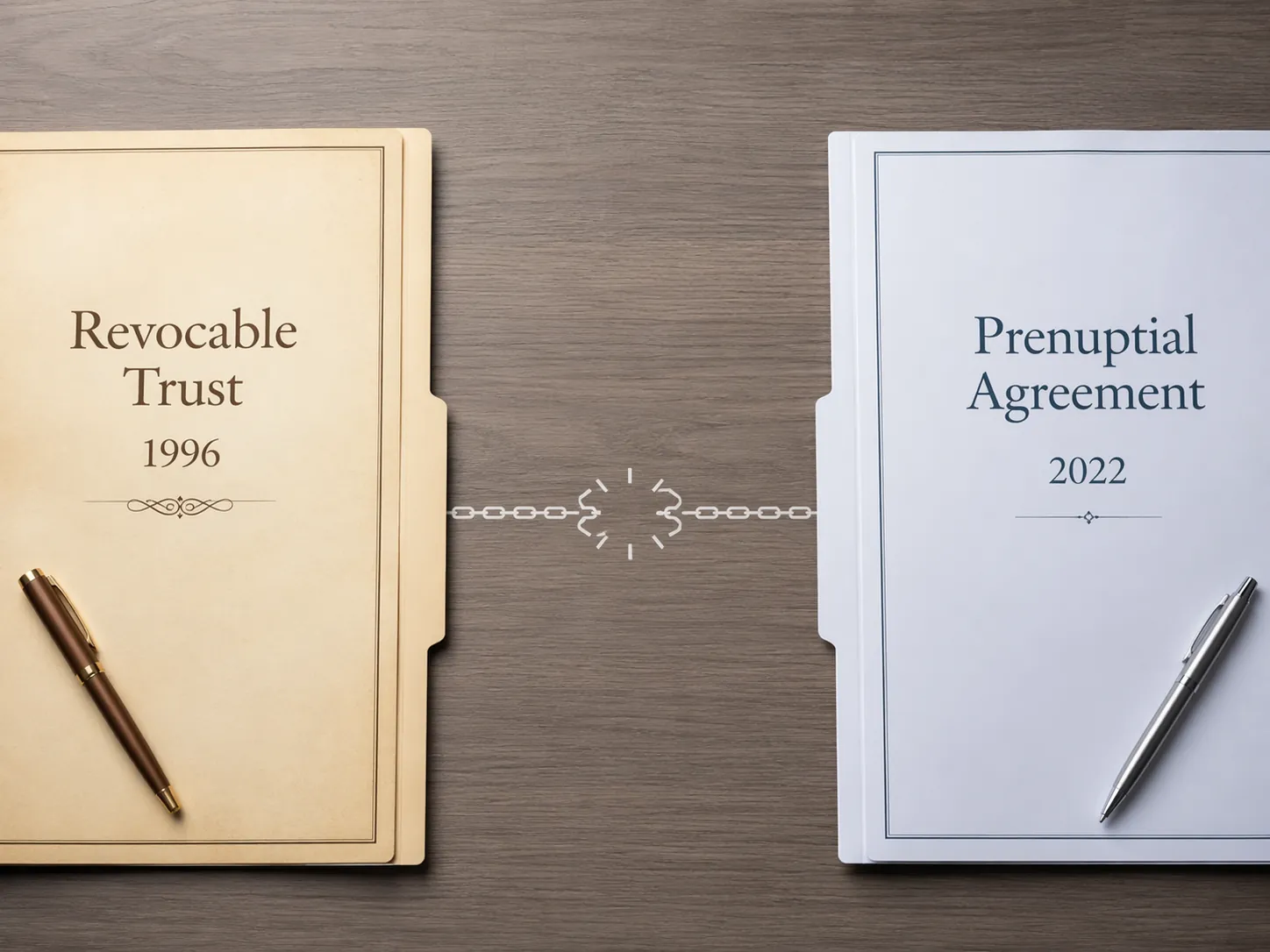
The most important document in the Tenisha Warner estate lawsuit may not be the newly filed complaint. It is the older paper underneath it: a revocable trust reportedly created in 1996, when Malcolm-Jamal Warner was 26, unmarried, and childless, that still directed trust distributions after a later life that included a daughter, marriage, a marital agreement, career earnings, and a family home.[1][2]
That is the part practitioners should sit with before moving to the dollar figure. A trust can be beautifully drafted for the client who signs it and still become dangerous if everyone continues treating it as current after the client’s life has plainly outgrown it. In the Warner matter, the reported 1996 distribution scheme left 70% to his mother, Pamela Warner, 15% to his father, Robert Warner Jr., and 15% to his half-sister, Collage.[1] The plan was not reported to have been amended before Warner’s death in 2025, despite later facts that would normally trigger a full estate-plan review: the birth of a daughter in 2017, a 2022 prenuptial agreement, and a household with obligations outside the original trust design.[1][2]

The lawsuit, filed on July 20, 2026, is still at an early stage. Public reporting describes Tenisha Warner’s claims and the trust structure, but no full defense position has been publicly tested in court. Pamela Warner has reportedly made an Instagram statement, but responsive pleadings and factual defenses have not yet supplied the other side of the file.[1][2] That matters. The useful reading is not “who is right” but how a familiar planning gap became expensive enough, and public enough, to require litigation.
The Old Trust Did Not Fail Loudly
Stale estate plans rarely announce themselves as defective. They sit in binders, appear complete, and remain legally operative until someone has to administer them. That is why the Warner trust is a useful case file. The reported document was not obsolete because a celebrity later had a more complicated life. It was obsolete because ordinary life events—child, spouse, home, compensation arrangements, beneficiary designations, and contractual promises—were apparently allowed to accumulate around it without being reconciled with it.
For practitioners, the warning is not simply “review estate plans more often.” That advice is correct but too soft. The sharper question is whether the review system treats certain events as mandatory coordination events. A client’s marriage, the birth or adoption of a child, a prenuptial agreement, a home purchase, a material increase in earnings, or a change in intended fiduciaries should not produce a polite reminder buried in a client newsletter. It should produce a document-by-document audit.
| Event | Why it matters to the estate plan |
|---|---|
| Child enters the family | Trust distributions, guardianship planning, education funding, and beneficiary designations may need revision. |
| Prenuptial or postnuptial agreement is signed | Contractual promises must be matched to trust terms, beneficiary forms, liquidity, and claims procedure. |
| Trustee or beneficiary has a financial stake in disputed claims | Administration decisions may become harder to defend even before misconduct is alleged. |
| Client says an update is almost complete | Unexecuted drafts and intentions generally do not replace operative documents. |
The first mistake, then, is not that Warner once created a trust favoring his mother. A 26-year-old unmarried client may have good reasons to do that. The mistake is allowing that design to remain the governing architecture for a different household decades later.
A Prenup Can Create Claims the Trust Was Never Built to Pay
The prenuptial agreement is where the case becomes more than a stale-trust story. Public reports say the May 2022 agreement required $1 million in life insurance, a $5,000 monthly chief-of-staff salary, anniversary payments of $16,000 per year, Roth IRA funding, and college funds for the child. Tenisha Warner reportedly claims $195,000 in unpaid salary arrears, $50,542.46 in anniversary payments, and $30,500 in Roth IRA funding, contributing to a total claim of $1,276,042.46.[3][4]
Those reported obligations are concrete. They are not just a disappointed spouse’s appeal to fairness. If proven, they are the sort of contractual commitments that must be collected from somewhere: insurance proceeds if the policy exists and beneficiary structure works, probate assets if available, trust assets if reachable, or some combination determined by the documents and applicable procedure.
That is why a prenuptial agreement cannot be treated as a freestanding marital file while the trust remains in a different cabinet. If the trust still leaves 70% to a parent and the prenup promises substantial benefits to a spouse and child, the lawyer’s work is not finished when both documents are signed. Someone has to ask how the promises will be funded, whether beneficiary designations match the contract, whether the trust expressly acknowledges or satisfies the marital obligations, and what happens if the promised insurance is missing, underfunded, lapsed, or payable to someone else.
The reported Warner filings illustrate the practical consequence of that disconnect. Tenisha Warner brought a breach-of-contract action in DeKalb County Superior Court and also filed a creditor’s claim in DeKalb County Probate Court, a dual-track approach that suggests the probate estate alone may not be adequate or may not be the only pool from which she seeks payment.[1][5] That is a procedural fact, not proof that the claim will succeed. But it shows how an agreement drafted during life can become a creditor problem after death when the estate plan has not been integrated around it.
There is also a record ambiguity worth keeping narrow. Public reports differ on whether the Warners married in 2017 or 2022, with some accounts using 2017 and others aligning the marriage context with the May 2022 prenuptial agreement.[2][3][5] The estate-planning point does not depend on resolving that discrepancy here. The operative risk is that a marital agreement reportedly existed and imposed obligations that were not incorporated into the old trust’s distribution terms.
The Question Is Not Only Whether the Spouse Has a Contract
Georgia procedure adds another layer. Commentary and code sources identify O.C.G.A. § 53-7-40 as placing year’s support ahead of general creditors, which can create tension between a contractual spousal claim and statutory spousal protections.[6][7] Practitioners should be careful with the conclusion. The current public record does not establish exactly how every statutory argument has been pleaded or how the court will prioritize competing claims. The narrower lesson is enough: drafting the spouse’s contractual rights is only the beginning. The plan also needs a payment path.
That payment path should be tested while the client is alive. If the prenup promises insurance, confirm the policy, owner, beneficiary, amount, and premium-payment responsibility. If it promises retirement-account funding, confirm contribution mechanics and eligibility. If it promises salary or anniversary payments, identify whether unpaid amounts become debts, how they are documented, and which estate or trust assets are intended to satisfy them. If child-related funding is promised, define who controls the account and what happens if the promised arrangement is incomplete at death.
A Trustee-Beneficiary Conflict Does Not Need a Villain
The trustee issue deserves care because it is easy to overstate and easy to understate. Pamela Warner is reported to be both successor trustee and 70% beneficiary of the 1996 trust.[1][2] That dual role is not inherently wrongful. Family trusts often name a major beneficiary as trustee, and many administrations proceed without conflict.

The problem is structural. If Tenisha Warner’s reported $1,276,042.46 claim is payable from trust assets, every dollar paid to her reduces the corpus available to the trust beneficiaries, including Pamela Warner as the 70% beneficiary.[1] That does not prove Pamela acted improperly. It does mean ordinary fiduciary decisions—whether to accept, reject, negotiate, delay, sell assets, preserve liquidity, or litigate—are made under a visible economic shadow.
The reported sale of the Studio City family home over Tenisha Warner’s objection sharpens that issue.[1][2] A trustee may have legitimate reasons to sell real estate: carrying costs, debt, liquidity needs, market conditions, or distribution requirements. But when the trustee is also the primary beneficiary and the objecting party is asserting a claim that could reduce the trustee’s beneficial share, the administration record needs to be cleaner than usual. Process becomes evidence.
That is the fiduciary lesson. Conflict analysis should not wait for an accusation of bad faith. The better review happens at drafting and again at death: identify whether the successor trustee has a personal economic interest adverse to a spouse, child, creditor, co-beneficiary, or claimant; decide whether a neutral fiduciary, co-trustee, special trustee, or claims administrator is needed; and document why the chosen structure can withstand foreseeable disputes.
A neutral fiduciary is not always necessary. It can add cost and slow administration. But where a marital agreement creates large post-death obligations, and the person controlling trust administration also receives the largest remainder share, neutrality may be cheaper than litigation. At minimum, the documents should anticipate the conflict instead of leaving the family to discover it after death.
The Unexecuted Update Is the Hardest Part of the File
The most painful reported fact is not the age of the 1996 trust. It is that Warner allegedly understood the plan needed replacement. Tenisha Warner reportedly said he was “close to finalizing a new estate plan to replace the stale plan created in 1996” but “was unable to do so before we lost him.”[2]
Estate lawyers know this moment too well. The client has met with counsel. Drafts may exist. The problems have been identified. Everyone assumes the plan is in motion. Then death arrives before execution, and the old documents remain the documents.
That is why “almost updated” is not a status category practitioners should tolerate for long. If the old trust creates an obviously misaligned result, the interim risk should be managed immediately. Depending on the client’s situation and counsel’s judgment, that may mean executing a narrow amendment before a full restatement is complete, updating beneficiary designations that are ready to change, confirming required insurance, appointing an interim fiduciary, or documenting priority decisions so the most urgent failures are not left waiting behind a perfect comprehensive plan.
The point is not to rush clients through documents they do not understand. It is to distinguish between thoughtful sequencing and open-ended delay. A comprehensive restatement can take time. A known mismatch between a 30-year-old trust and current family obligations should not sit unaddressed simply because the final package is still being polished.
What Practitioners Can Take From an Unresolved Case
The Warner dispute remains unresolved. The complaint’s allegations have not been adjudicated, the defense position is not fully known, and the reported financial figures are news-reported figures attributed to the complaint rather than court findings. That uncertainty should make the dispute more useful, not less. Estate planning failures are easiest to prevent before anyone can prove them in litigation.
- Build mandatory review triggers for marriage, children, marital agreements, major asset changes, fiduciary changes, and new beneficiary-designation assets.
- Treat prenuptial and postnuptial agreements as estate-planning documents, not merely family-law documents.
- Map each contractual promise to a funding source, beneficiary form, trust provision, and claims procedure.
- Screen trustee appointments for foreseeable economic conflicts, especially where a trustee-beneficiary may control payment of claims that reduce the trustee’s own share.
- Use interim amendments or targeted execution steps when a client is known to be operating under a stale plan.
A trust file does not become safe because it once made sense. It becomes safe, if it does, because the documents continue to match the client’s obligations when administration begins.
References
- Malcolm-Jamal Warner's widow is owed $1.2M, according to DeKalb lawsuit, AJC
- Malcolm-Jamal Warner's wife Tenisha Warner sues his mother, Los Angeles Times
- USA Today report on Tenisha Warner's lawsuit and prenuptial agreement, USA Today
- People report on Tenisha Warner's lawsuit and prenuptial agreement, People
- cleveland.com report on Tenisha Warner's filings, cleveland.com
- O.C.G.A. § 53-7-40, Georgia Code via Justia
- Hughes P.C. commentary on Georgia year's support and creditor priority, Hughes P.C.
Comments
Join the discussion with an anonymous comment.