
The legally interesting part of the reported Taylor Swift-Travis Kelce wedding NDA is not that a celebrity event tried to control leaks. It is the shape of the control: electronic NDAs reportedly signed by 1,100 to 1,200 guests, watermarked invitations to trace disclosures, and no monetary penalty clause for breach.[1] If those anonymously sourced reports are accurate, the agreement may have been quite good at making guests feel visible. That is a different question from whether it would be good at producing a courtroom remedy.
That distinction matters for anyone searching for wedding secrecy NDA legal requirements. A signed NDA is evidence of assent; it is not a magic solvent for every contract problem. Wedding secrecy agreements sit in an awkward place between private social life and formal legal obligation. They borrow the machinery of business confidentiality, but the exchange is not a job offer, a vendor contract, or access to trade secrets. It is, usually, an invitation.
The Reported Structure: Click, Attend, Stay Quiet
TMZ reported on June 30, 2026, that guests for a July 3, 2026 wedding celebration at Madison Square Garden were required to sign NDAs electronically, and that the agreement did not include a monetary penalty or specified contractual remedy.[1] Page Six and Cosmopolitan later reported that some inner-circle guests were exempted from signing, framing the exemption as a deliberate risk-tiering choice rather than a drafting accident.[2][3]
Those facts are not confirmed by the couple’s representatives, and the sourcing is anonymous. The legal analysis therefore has to stay conditional. But as a contract design, the reported arrangement is useful because it separates three functions that ordinary NDA coverage tends to collapse: deterrence, attribution, and enforceability.
- Deterrence: the guest sees a formal document and understands that disclosure is being watched.
- Attribution: a watermarked invitation may help identify the source of a leak.
- Enforceability: a court still asks whether the contract elements and requested remedy are legally supportable.
Watermarking is often the most practical of the three. It can narrow a leak investigation without requiring a lawsuit. But it does not supply consideration, cure overbreadth, or create damages. A lawyer who confuses a forensic design choice with a legal remedy is likely to have a difficult conversation after the first screenshot circulates.
The Six Requirements Are Familiar; the Wedding Context Is Not
General NDA enforceability turns on ordinary contract-law requirements: identifiable parties, a defined body of confidential information, reasonable scope and duration, consideration, mutual assent, and a legitimate purpose consistent with law and public policy.[4][5][6] In a commercial setting, those requirements usually attach to a transaction the court recognizes immediately. At a wedding, some of them still travel well. Others arrive with baggage.
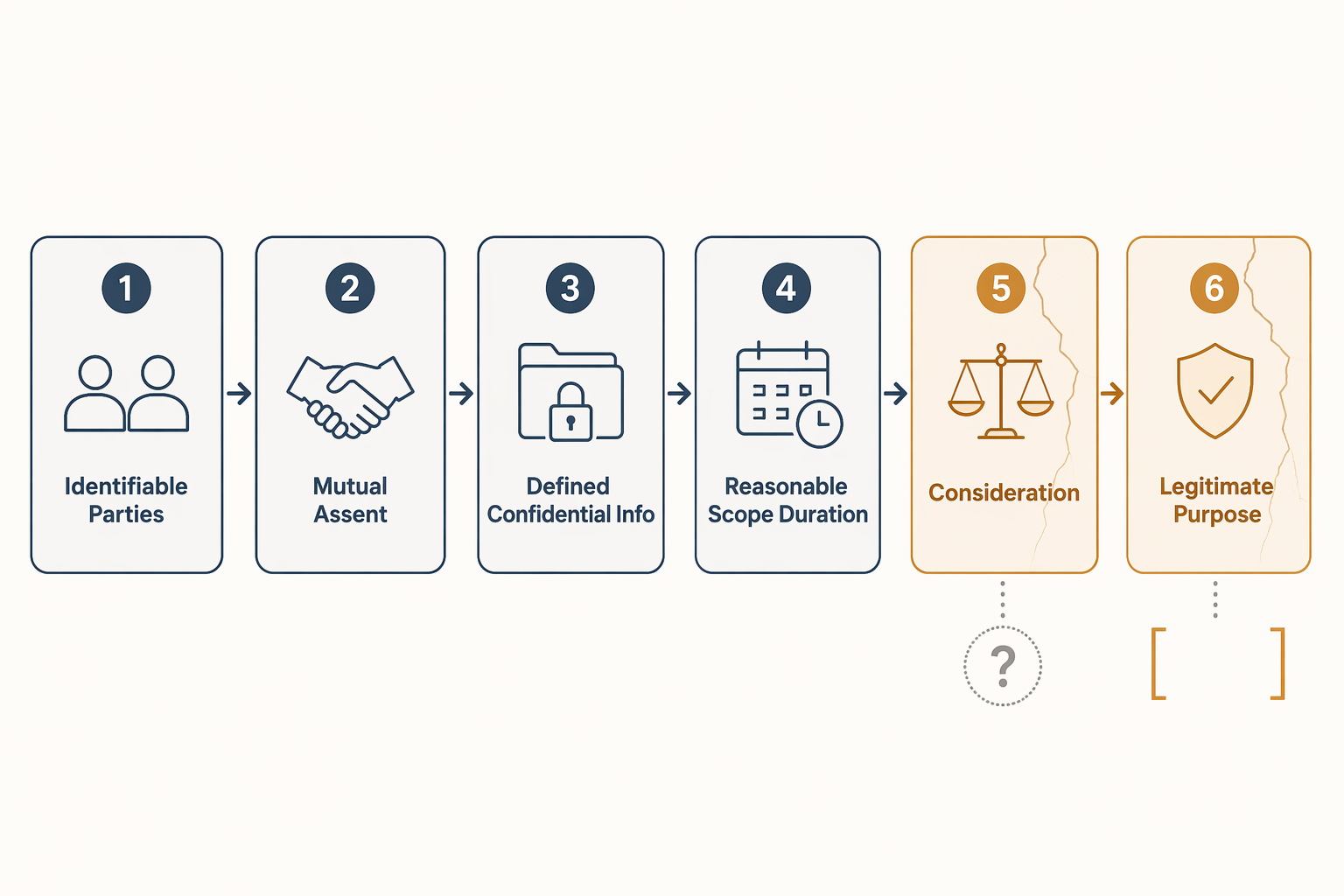
| Requirement | How it usually works | Wedding NDA pressure point |
|---|---|---|
| Identifiable parties | The disclosing and receiving parties are named or otherwise ascertainable. | Mass electronic execution must still tie each guest to the agreement. |
| Mutual assent | The signer manifests agreement, including through properly designed electronic acceptance. | Clickwrap can help, but records of what was presented and when matter. |
| Defined confidential information | The NDA identifies what information cannot be disclosed. | Event details, photos, videos, schedules, security plans, and guest identities should not be swept into vague total secrecy. |
| Reasonable scope and duration | Restrictions are limited to what is needed to protect a legitimate interest. | A lifetime ban on discussing every aspect of a wedding may invite scrutiny. |
| Consideration | The recipient receives something legally sufficient in exchange for the promise. | It is unsettled whether a social invitation alone is enough. |
| Legitimate purpose | The NDA protects a lawful confidentiality interest. | Privacy protection cannot override statutory rights to report harassment, assault, discrimination, or unlawful acts. |
Identifiable Parties and Clickwrap Assent Are the Easier Problems
For a large wedding, party identification is mostly an operational problem. If each invitation is tied to a named guest, each electronic signature is logged, and the final signed document can be reproduced, the host is at least building the evidentiary record a court would expect. The watermarked invitation reported in the Swift-Kelce coverage may also strengthen attribution if a guest forwards a document, photo, or access credential.[1]
Clickwrap assent is not inherently suspect. The practical question is whether the system can show the guest had notice of the terms and took an affirmative step to accept them. A buried link in a social RSVP flow is weaker than a conspicuous checkbox or signature screen that requires acceptance before admission materials are released. Counsel should care less about whether the process looks elegant and more about whether it creates usable proof.
Confidential Information Has to Be Defined Like a Legal Object
A wedding NDA can sensibly cover categories such as nonpublic location details, unreleased photographs and videos, security arrangements, vendor access credentials, seating charts, private schedules, and guest identities. Those categories are concrete enough to tell a guest what conduct is restricted and to tell a court what promise was allegedly breached.
The trouble begins when the definition expands from event privacy into atmospheric control: no discussion of the wedding, no description of anything seen or heard, no disclosure of any interaction, no exception for information already public. Courts reviewing NDAs generally look for specificity and reasonable limits, not ceremonial maximalism.[4][6]
Scope and Duration Should Match the Interest Being Protected
Some wedding information loses sensitivity quickly. Arrival instructions and security routes matter before and during the event. Unreleased photographs may remain valuable until publication decisions are made. Guest health, family, or safety information may deserve longer protection. Treating all of it as confidential forever is tidy for a drafter and unattractive for enforcement.
The better legal question is not whether a famous couple has privacy interests. They plainly may. The question is whether the restriction is calibrated to those interests. A narrowly written NDA that distinguishes pre-event logistics from post-event media assets is easier to defend than a document that tries to convert attendance into permanent silence.
Consideration Is the Weak Seam in a Guest NDA
Consideration is where wedding secrecy NDAs become genuinely interesting. In employment and commercial NDAs, the exchange is easier to identify: a job offer, continued employment where permitted, access to proprietary information, vendor engagement, or a business opportunity.[5][7] A wedding guest receives something more socially delicate: permission to attend.
No reported case law squarely decides whether a social wedding invitation, standing alone, is legally sufficient consideration for a guest’s confidentiality promise. That absence should not be inflated into a rule that wedding NDAs are unenforceable. It should be treated as uncertainty. Courts could view attendance at a private, access-controlled event as a benefit conditioned on confidentiality. They could also be skeptical where the invitation looks less like a bargained-for exchange and more like a unilateral social condition imposed after expectations were set.
Timing matters. If the NDA is presented with the original invitation and the guest must accept before receiving event details, the host has a cleaner argument that access was conditioned on confidentiality. If the NDA arrives after travel has been booked, outfits purchased, or social commitments made, the consideration argument becomes messier. The guest may say the host offered nothing new in exchange for the added legal burden.
There are drafting responses, though none turns the problem into a guaranteed win. The host might condition access to private venues, transportation, after-parties, unreleased media, or restricted areas on signing. A planner might separate the general invitation from confidential logistics released only after assent. Those choices do not manufacture case law, but they make the exchange easier to describe in contract terms.
This is also where inner-circle exemptions become more than gossip. Page Six and Cosmopolitan reported that certain close guests were excused from signing.[2][3] If true, that design choice reflects a practical judgment many event lawyers will recognize: the person most likely to cause social damage may be the person the client least wants to sue. Exempting a few trusted relationships can be less irrational than pretending every emotional tie should be managed as a litigation asset.
No Penalty Clause Changes the Remedy Conversation
TMZ’s most legally consequential reported detail is not the guest count. It is that the NDA had no monetary penalty clause.[1] Without a liquidated damages provision or another specified contractual remedy, the host may still have a contract claim if the NDA is otherwise enforceable. But winning liability and proving meaningful damages are different projects.
A leaked seating chart, a private photograph, or an early description of the ceremony can cause real harm. Translating that harm into recoverable contract damages is harder. What is the dollar value of a guest’s disclosure if the same information appears from another source an hour later? How much of a media cycle was caused by the breach rather than the celebrity status of the event itself? Did the leak reduce the value of an exclusive photo arrangement, increase security costs, or force a change in logistics? Those are fact questions, and the answers may be expensive to prove.
Liquidated damages clauses exist because some harms are difficult to calculate after the fact. They are not automatically enforceable; they must still be drafted within applicable law. But a carefully written clause can at least give the parties an agreed measure of loss. A no-penalty NDA leaves the drafter to argue actual damages, equitable relief, or some other remedy after the disclosure has already done its work.
Injunctive relief may help before or during an event if a threatened disclosure is identified in time. It is less satisfying after the guest has posted the photo, forwarded the invitation, or fed the quote to a publication. The faster the leak cycle, the more the NDA behaves like a warning label rather than a recovery device.
Deterrence and Attribution Are Still Real Legal Design Goals
It would be too easy to dismiss a no-penalty wedding NDA as useless. Many event confidentiality tools are designed to prevent the breach rather than monetize it. A guest who signs an NDA may hesitate before posting. A watermarked invitation may discourage forwarding because it makes anonymity less plausible. A planner may be able to cut off access or remove a guest if a leak is traced during the event.
Those are operational consequences, not necessarily judicial remedies. They may be exactly what the client wants. The danger is letting the client believe those consequences are the same thing as a strong damages case. A lawyer can respect the deterrent value of the instrument and still tell the client that courtroom recovery may be uncertain, slow, and reputationally unpleasant.
The reported Swift-Kelce structure, if accurate, looks optimized for behavioral control: mass assent, visible confidentiality expectations, traceable invitations, and selective exemptions for relationships where enforcement would be socially costly.[1][2][3] It looks less optimized for a clean damages claim after breach. That is not necessarily a drafting failure. It is a choice that should be made consciously.
Public Policy Limits Do Not Disappear at a Private Wedding
A wedding NDA cannot be drafted as a private-law blackout curtain over legally protected disclosures. The Speak Out Act, enacted in 2022, limits enforcement of pre-dispute nondisclosure and nondisparagement clauses involving sexual assault and sexual harassment disputes.[8] California’s Silenced No More Act, SB 331, which took effect in 2022, restricts confidentiality provisions that would prevent disclosure of certain unlawful workplace acts, and California is generally described as taking a stricter approach to NDA enforceability than many other states.[5]
The wedding setting does not erase those boundaries. If an NDA purports to stop a guest, vendor, employee, performer, or staff member from reporting assault, harassment, discrimination, unsafe conduct, or other unlawful acts, that language may fail regardless of how famous the hosts are or how private the venue is. Celebrity privacy is a legitimate interest; it is not a license to contract around statutory policy.
This is why the legitimate-purpose requirement deserves more than a passing sentence. Protecting private event details is one thing. Suppressing allegations of unlawful conduct is another. A serious wedding NDA should make that boundary explicit rather than relying on broad confidentiality language and hoping no one tests it.
What Practitioners Should Take From the Swift-Kelce Reports
The practical lesson is not that every luxury wedding needs a harsher NDA. It is that counsel should identify which job the document is being hired to do. If the goal is to signal seriousness and deter casual posting, a simple clickwrap NDA paired with watermarked invitations may be rational. If the goal is to recover money after a leak, the same instrument may be underbuilt.
A wedding secrecy NDA has the best chance of enforceability when the parties are identifiable, assent is well documented, confidential information is defined with specificity, scope and duration are reasonable, consideration is tied to conditioned access, and the purpose stays within lawful bounds. The hardest unresolved question remains consideration: no cited source identifies a wedding-guest case squarely holding that a social invitation is enough. The most practical drafting question remains remedies: a no-penalty NDA may leave the client with attribution and anger, but not a simple damages number.
If the reported Swift-Kelce NDA is accurate, it shows a plausible and sophisticated form of silence theater: not empty, not foolish, but not necessarily built for courtroom recovery. Lawyers advising event clients should say that plainly before everyone clicks the box and assumes the legal work is finished.
References
- Taylor Swift & Travis Kelce Wedding Celebration NDA Details, TMZ, June 30, 2026
- Why Taylor Swift Is Letting Certain Guests Off the Hook With NDAs for MSG Wedding, Page Six, July 1, 2026
- Taylor Swift Inner Circle No Wedding NDAs, Cosmopolitan, July 1, 2026
- Non-disclosure agreement (NDA), Cornell Legal Information Institute
- What Makes a Non-Disclosure Agreement Legally Enforceable?, Hanley Law, June 2025
- NDAs and Contracts: How to Structure an Enforceable Non-Disclosure Agreement, UB Greensfelder
- 4 things to know about non-disclosure agreements, Thomson Reuters, October 2024
- S.4524 - Speak Out Act, Congress.gov, 2022
Comments
Join the discussion with an anonymous comment.