
Tom Homan’s public line after the 2026 ICE shooting controversies sounded, at first, like the language anxious families and local officials usually ask to hear: referrals to internal affairs, promises of accountability, and assurances that misconduct would not be tolerated. In February, he also said he was unaware of any officer being “found guilty of anything inappropriate,” while defending ICE enforcement operations and describing accountability as part of the agency’s posture.[1]
That phrasing does a great deal of work. Found guilty where? By an internal affairs office, a state jury, a federal grand jury, a federal civil court, or a judge applying an immunity doctrine before discovery? The legal liability question after Homan is not whether an official can say the word accountability after a fatal shooting. It is whether any forum can hear a claim long enough to test what happened.
The historical record makes the distinction hard to avoid. The Trace documented 59 ICE shootings from 2015 through 2021, 23 of them fatal, and reported that no agent in those cases was successfully sued or criminally indicted.[2] That period crosses administrations and policies, so it should not be flattened into a single political story. But as a litigation fact, it is stark: visible force, repeated death, and no successful civil or criminal accountability outcome against agents in that set.
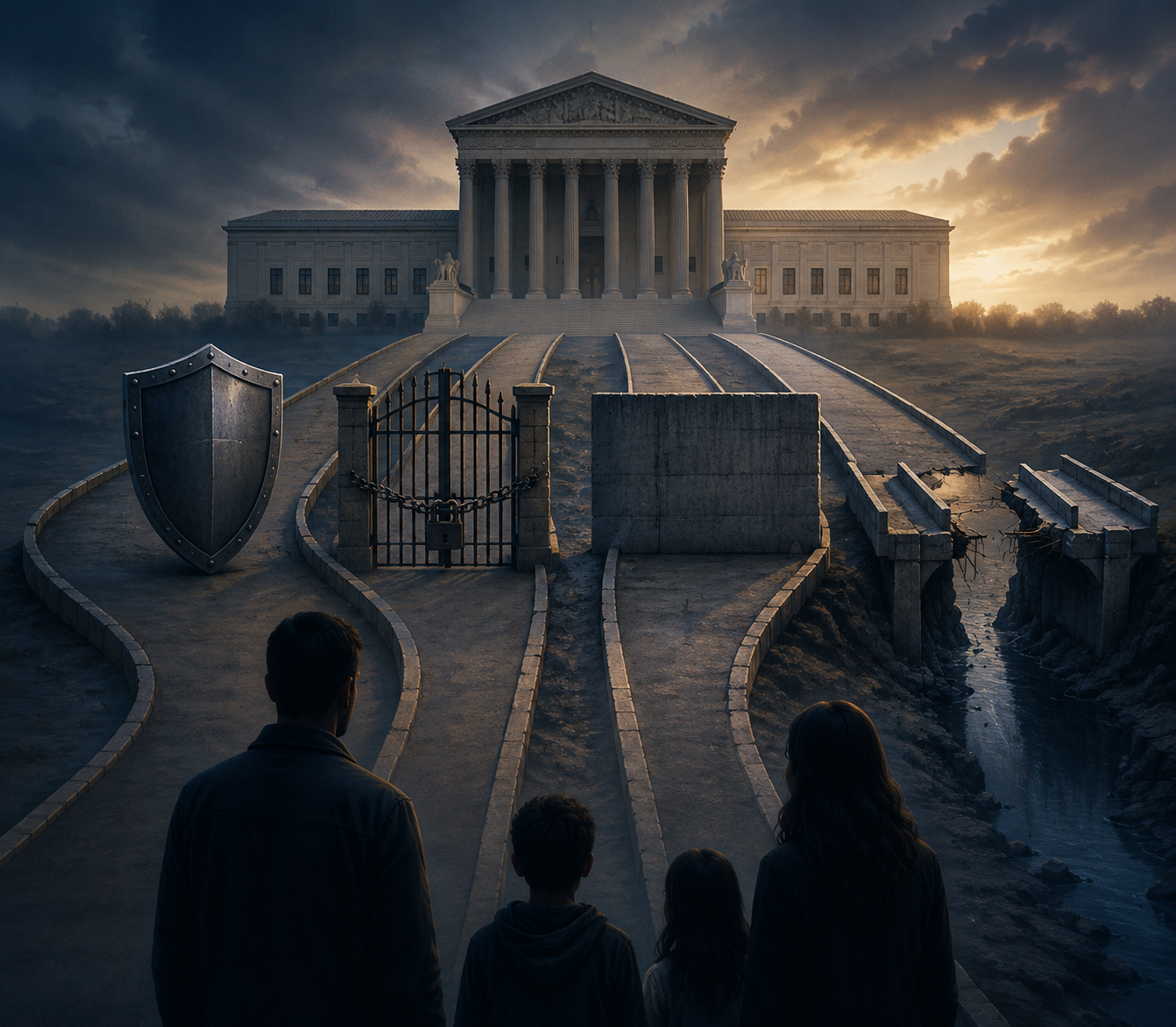
The 2026 cluster of fatal shootings in Minneapolis, Houston, and Maine sits on top of that older record. The immediate public dispute has included body cameras, vehicle stops, and competing accounts of threat. Those facts matter. But body-camera absence is an evidentiary problem, not a cause of action. A use-of-force policy may shape internal discipline, but it does not automatically waive immunity. And an official promise of review does not itself give a family a claim.
The Four Routes, Before the First Trapdoor
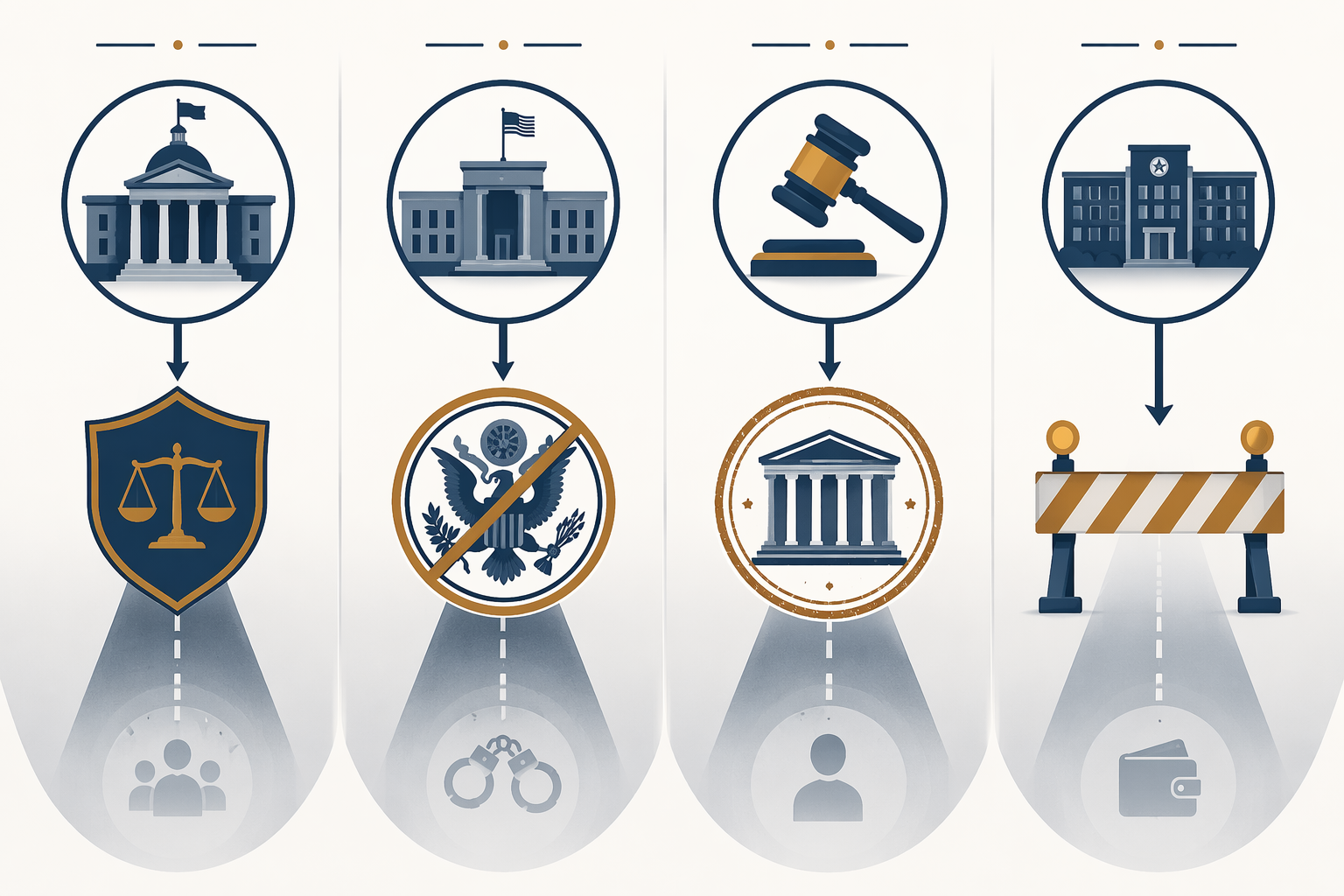
In a fatal shooting by a federal immigration officer, the recurring liability map has four main routes. None is imaginary. None is clean.
| Route | Who brings it | What it tries to reach | First serious barrier |
|---|---|---|---|
| State criminal prosecution | Local or state prosecutors | The individual federal officer | Federal removal and Supremacy Clause immunity |
| Federal criminal prosecution | U.S. Department of Justice | The individual officer for willful constitutional violations | High proof burden, institutional discretion, and DOJ declination |
| Bivens civil damages claim | Victim’s family or estate | The individual federal officer | Recent Supreme Court doctrine against extending Bivens |
| FTCA claim | Victim’s family or estate | The United States | Exceptions including discretionary-function barriers after Martin |
For intake purposes, the table is useful only if it is read pessimistically. The question is not whether a complaint can be drafted. The question is where the government’s first motion is likely to land: removal, immunity, failure to recognize a damages remedy, discretionary-function exception, or prosecutorial declination.
State Prosecution: Powerful, Not Formally Absolute
State prosecution is the route the public most readily understands. A person is killed in a state. A local prosecutor reviews the shooting. A state homicide, assault, or manslaughter statute appears to be available. If the shooter were a municipal officer, the case would still be hard, but the forum would not feel conceptually foreign.
Federal officers change that sequence. A state criminal case can be removed to federal court, and the officer can assert Supremacy Clause immunity. The doctrine is often described as if it were a blanket exemption from state criminal law. That is too loose. The classic Neagle inquiry asks whether the officer was acting under color of federal office and whether the conduct was necessary and proper to carrying out federal duties. The shield is broad, but it is not the same thing as saying federal officers have a roving license to commit crimes.
The practical effect is still severe. Stanford Law professor Robert Weisberg, discussing federal shootings and constitutional limits, emphasized that state prosecution runs into constitutional protection for federal functions when officers act within the scope of federal authority.[3] TIME’s explainer on prosecution of federal officers made the same operational point: local accountability may begin in a county courthouse, but federal immunity and removal can move the fight to a forum where the threshold question becomes the officer’s federal authority rather than the ordinary state-law elements alone.[4]
That shift matters because it changes who gets to decide what kind of case exists. A state prosecutor may see a reckless shooting. The federal officer will frame the same encounter as an enforcement operation, a threat assessment, and an act taken under federal command. Before a jury hears a murder or manslaughter theory, a federal judge may have to decide whether the officer’s conduct falls within the protective zone of federal duty.
This is why “absolute immunity” is a bad shorthand even when the state route is unlikely to succeed. Legal experts have rejected the broad claim that federal officers simply possess absolute immunity from prosecution.[5] But families do not litigate against shorthand. They litigate against removal statutes, immunity motions, burden allocation, and judicial reluctance to let state criminal law regulate federal enforcement decisions.
Federal Prosecution: The Route That Exists Only If DOJ Uses It
The federal criminal route is usually discussed through 18 U.S.C. § 242, the civil-rights statute that permits prosecution of officials who willfully deprive a person of constitutional rights under color of law. It avoids the Supremacy Clause problem because the United States is prosecuting its own officer. It also creates a different problem: the injured family does not control the case.
A § 242 prosecution requires proof of willfulness, not merely bad tactics, negligence, poor training, or a disputed threat assessment. Prosecutors must be able to prove beyond a reasonable doubt that the officer acted with the required culpable state of mind. In a shooting case, especially one involving claims that a vehicle was used as a weapon or that agents faced an imminent threat, that evidentiary burden can be decisive before indictment.
The Renee Good matter shows the institutional dimension. After the Minneapolis fatal shooting, DOJ declined federal charges, and more than 12 federal prosecutors resigned in connection with the declination, according to reporting and analysis of the case.[6] That does not prove that the legal standard was met. It does show how narrow the route is: even when career lawyers reportedly object, the charging decision remains inside the federal executive branch.
For civil litigators, that distinction is not academic. A federal declination does not decide a tort case, and it does not establish that force was lawful. But it can leave survivors with the worst combination: no criminal case, no discovery from a prosecution, and no public trial record that resolves the factual conflict.
Bivens: A Damages Remedy in Name, Rarely in This Setting
A Bivens claim is the familiar civil-rights instinct: sue the individual federal officer for damages for violating the Constitution. In a fatal shooting, the theory may sound straightforward. Excessive force, Fourth Amendment seizure, individual officer, money damages.
The modern doctrine is not straightforward. The Supreme Court has repeatedly warned lower courts not to extend Bivens into new contexts, and immigration enforcement is the kind of national-security, border, removal, and executive-policy terrain where courts are especially reluctant to create a judge-made damages remedy. Capital B News, covering qualified-immunity debates renewed by ICE shootings, framed the problem around the shrinking availability of individual-officer civil accountability in the federal setting.[7]
That makes the Bivens route different from an ordinary qualified-immunity fight. A plaintiff may never reach the question whether the officer violated clearly established law. The case can fail earlier, at the remedial-recognition stage, because the court refuses to recognize a Bivens remedy for this context at all.
FTCA Claims After Martin
The Federal Tort Claims Act has often looked like the more concrete civil route because it targets the United States rather than requiring a new constitutional damages action against an individual officer. The theory is familiar: plead state-law tort claims, satisfy administrative exhaustion, and use the FTCA’s waiver of sovereign immunity to reach the government.
That route had particular appeal where Bivens was collapsing. If courts would not create a constitutional damages claim against an ICE agent, plaintiffs could try battery, wrongful death, negligence, or related state-law theories against the United States. The FTCA also contains a law-enforcement proviso that has sometimes made intentional-tort claims against federal law-enforcement officers look more viable than claims against other federal employees.
Martin v. United States narrowed that optimism. In June 2025, the Supreme Court held that certain FTCA exceptions, including discretionary-function barriers, continue to matter even when plaintiffs plead state-law tort theories connected to federal law-enforcement conduct.[8] The decision did not erase the FTCA. It did make clear that invoking state tort law does not automatically carry a plaintiff past sovereign-immunity exceptions.
For a shooting case, the practical fight becomes granular. The government may argue that challenged decisions involved judgment, threat assessment, operational planning, prioritization, or discretionary enforcement choices. Plaintiffs will try to characterize the conduct as violating a mandatory directive or as conduct that falls outside protected discretion. The case can turn less on whether the shooting was morally defensible than on how precisely the complaint identifies a non-discretionary rule and a breach that state tort law can recognize.
Vehicle shootings show the point. DHS’s 2023 use-of-force policy prohibits shooting at the operator of a moving vehicle unless the operator poses an imminent threat, yet NBC News identified 13 ICE or CBP shootings from September 2025 through February 2026, seven of which involved vehicle scenarios.[9] That pattern may support policy scrutiny, training questions, or oversight pressure. In litigation, however, a policy violation must still be translated into a claim that survives the FTCA’s exceptions and the government’s immunity defenses.
The same caution applies to body cameras. Congress appropriated $20 million for ICE body cameras in April 2026, but agents involved in the fatal Houston shooting in July 2026 reportedly had none; reporting also noted the rollout remained incomplete.[10] The evidentiary gap is serious. It may affect credibility, internal review, public confidence, and settlement posture. But absent a recognized cause of action or waiver, a missing camera does not itself answer the FTCA question.
Policy Pressure Is Not the Same as Liability
After the July shootings, ICE paused some vehicle stops, according to July 14, 2026 reporting by The New York Times.[11] That is an important operational fact. It suggests that the agency recognized risk in traffic-stop encounters, or at least recognized the public and institutional cost of continuing them unchanged.
But a pause is not an admission. A policy revision is not a verdict. A body-camera appropriation is not discovery. Internal affairs is not a private right of action. This is the recurring mismatch in federal-officer shooting cases: the public sees administrative movement and reasonably treats it as evidence that something went wrong, while the courthouse asks a narrower sequence of questions about forum, waiver, remedy, immunity, and proof.
Why Minnesota’s Lawsuit Takes a Different Shape
The Minnesota Attorney General’s lawsuit against DHS is important because it does not try to do the thing many readers expect after a fatal shooting. It does not proceed as a direct damages claim against the shooter. It does not ask a state prosecutor to push through Supremacy Clause immunity. It does not depend on DOJ indicting one of its own officers.
Instead, the lawsuit reframes the dispute around federal interference, state sovereignty, speech, and operational control. Syracuse Law Review’s analysis describes the case as invoking First and Tenth Amendment grounds after the fatal ICE-involved shooting of Renee Good.[6] That framing is not a substitute for a wrongful-death claim by a family. It is a workaround by a state actor looking for a forum that may still be open when the conventional liability routes are blocked.
That is the strategic lesson for legal professionals watching these cases. The viable plaintiff may not be the person most directly harmed. The viable claim may not name the officer whose shot killed someone. The viable remedy may not be damages for the death. The available courthouse door may be constitutional structure, state operations, or federal interference rather than a clean excessive-force case.
That conclusion is not satisfying, but it is the one the current liability architecture keeps producing. Homan’s statements matter because they expose the distance between executive assurances and enforceable recourse. After fatal ICE shootings, the professional question is no longer simply whether accountability has been promised. It is which forum can still hear a claim at all.
This analysis is for legal professionals evaluating doctrine, risk, and forum constraints. It is not legal advice about any particular shooting, claimant, agency partner, prosecution, or litigation strategy.
References
- Border czar Homan promises accountability, The Hill, February 20, 2026.
- ICE Shootings Investigation, The Trace.
- Can ICE Agents Be Prosecuted? Stanford Law’s Robert Weisberg Explains Federal Shootings and Constitutional Limits, Stanford Law School, January 27, 2026.
- Federal Officers Shooting Immigration Portland Minneapolis Prosecution Immunity, TIME.
- Federal Officers Do Not Have Absolute Immunity, Protect Democracy.
- Minnesota Sues Department of Homeland Security Following the Fatal ICE-Involved Shooting of Renee Good, Syracuse Law Review.
- Qualified Immunity Federal Shootings Immigration, Capital B News.
- Martin v. United States, Supreme Court of the United States, June 2025.
- ICE shootings list: Border Patrol, Trump immigration operations, NBC News.
- DHS Was Granted $20M for Body Cameras. ICE Agents in Fatal Houston Shooting Had None, U.S. News & World Report, July 10, 2026.
- ICE Agents Traffic Stops, The New York Times, July 14, 2026.
Comments
Join the discussion with an anonymous comment.