
The analog AI patent landscape through 2025 starts with a dataset large enough to resist the usual anecdote-driven story. IAM Media’s July 2026 review examined 5,913 patent families filed from 2015 through 2025 across the USPTO, EPO, WIPO, CNIPA, and KIPO, making it the most directly useful map for counsel and R&D leaders trying to understand who has already claimed what, and where the claims are likely to collide next.[1]
That scale matters because analog AI is easy to over-narrate. The field sits across neuromorphic computing, in-memory computing, non-volatile memory devices, mixed-signal circuits, and system architectures. A patent family count will not tell a company whether a particular chip will work in production. It can, however, show where experienced filers believe future control points may sit: at the memory cell, at the crossbar, at the peripheral circuit, at the ADC/DAC boundary, at the training or inference scheme, or at the system interface.

The Visible Landscape Is Concentrated, But Not Closed
The incumbent cluster is the first thing to notice. IAM’s analysis places IBM, Samsung, and Intel at the center of the analog AI patent landscape, a pattern that fits the capital intensity and prosecution habits of semiconductor incumbents.[1] These are not companies filing a few speculative applications around a fashionable label. They have the budgets, legacy portfolios, and international filing discipline to build layered claim positions across devices, circuits, architectures, and systems.
For patent teams, that concentration changes the practical question. The issue is not whether there is a single “winner” in analog AI. The safer question is where the incumbent estates are densest, where claims have matured from lab-scale device language into implementation language, and which jurisdictions are worth monitoring before a product roadmap hardens.
PatSnap’s neuromorphic computing analysis provides a narrower but useful cross-check. It identifies 596 patents in its dataset and reports a 401% surge in 2025, which supports the view that filing activity is accelerating even if it does not measure the same universe as IAM’s broader analog AI family set.[2] The point is not that 596 and 5,913 should be reconciled into one master number. They describe different cuts through a nearby problem.
ipCapital Group’s race framing is broader again, counting 1,438 neuromorphic patents since 2020 and identifying IBM as the leading filer with 161 patents.[3] That reinforces the incumbent-heavy picture, but it should not be read as a direct league table against PatSnap or IAM. A change in keywords, family treatment, legal-status filters, or date range can move a company up or down without any change in its underlying technical position.
| Source | Scope reported | What it is useful for | What not to infer |
|---|---|---|---|
| IAM Media | 5,913 patent families, 2015–2025, across USPTO, EPO, WIPO, CNIPA, and KIPO | Primary landscape view for analog AI filing concentration and jurisdictional spread | Not a product-readiness ranking |
| PatSnap neuromorphic analysis | 596 patents and a reported 401% surge in 2025 | Acceleration signal in neuromorphic-related patenting | Not directly comparable to IAM’s family universe |
| ipCapital Group | 1,438 neuromorphic patents since 2020, with IBM leading at 161 | Competitive race framing among major filers | Not proof that all uncounted jurisdictions or classifications are weak |
The Claims Are Moving Up the Stack
The more important movement is not merely who files. It is what they are trying to own. IAM’s landscape points to a broadening of claims beyond device physics, while PatSnap’s in-memory analog computing work identifies hybrid analog-digital interface IP as a high-value and underappreciated filing area.[1][4] That is where the patent strategy becomes more consequential.
Early analog AI prosecution naturally tends to gather around the physical elements: memory devices, conductance states, arrays, switching behavior, peripheral circuits, and methods for using analog properties during computation. Those claims remain important. But as the field gets closer to deployable systems, the defensible value often shifts toward the points where analog computation must be made legible to digital infrastructure.
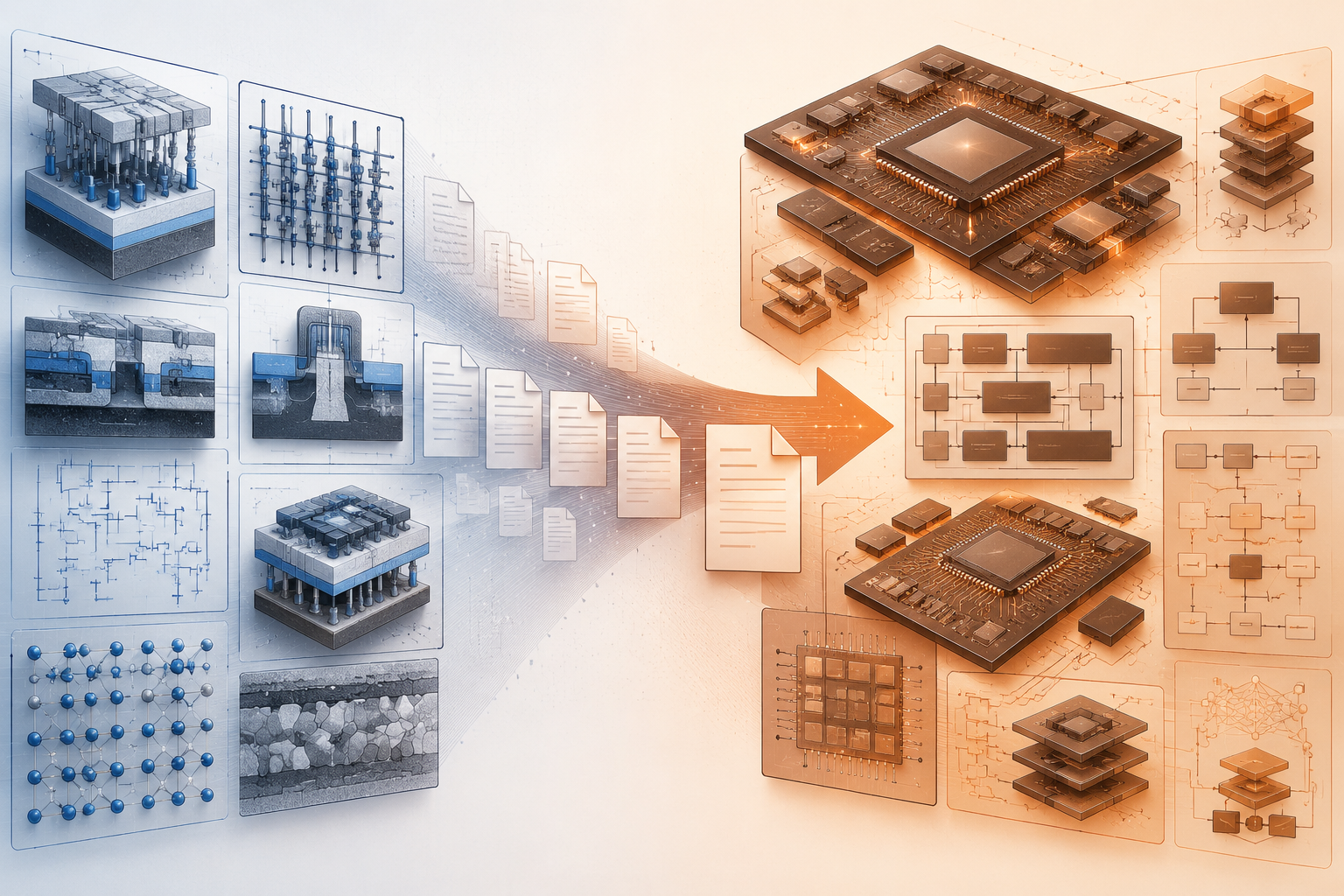
That shift has immediate consequences for portfolio review. A device-level claim may help protect a materials or memory-cell innovation, but an integration claim can sit closer to the commercial implementation: how signals are converted, calibrated, corrected, scheduled, trained, read, or combined with digital control. A company that owns only the device layer may still face blocking risk at the interface layer. A company with no breakthrough substrate may still build valuable IP around making analog compute usable inside a larger AI system.
This is also where startup filings deserve attention. Startup activity may not yet outweigh incumbent portfolios by volume, but the more relevant question is whether new entrants are claiming around integration chokepoints rather than trying to out-file IBM, Samsung, or Intel across every device category. A small portfolio aimed at calibration, conversion, endurance management, error compensation, or analog-digital orchestration can matter more than its raw family count suggests.
Jurisdictional Counts Need Careful Reading
ipCapital Group reports that the United States accounts for 51% of neuromorphic filings in its dataset, equal to 730 patents.[3] That is a meaningful filing signal, especially for companies deciding where to monitor competitor activity and where enforcement exposure may be most visible. It does not, by itself, prove that technical work is geographically concentrated in exactly the same proportion.
The China signal is the cleaner example of why a patent landscape should be read with the filing strategy screen open. ipCapital Group reports only five China patents in its neuromorphic dataset, but PatSnap’s dataset identifies Zhejiang University, Tsinghua University, and Peking University as meaningful players, with Tsinghua associated with 68 patents and Peking University with 35.[2][3] Those facts can coexist if the datasets classify the field differently, if applications are filed under different technical labels, or if family and jurisdictional counting rules diverge.
For counsel, the practical response is not to average the numbers. It is to separate questions that are often blended together: Where are patents being filed? Which assignees appear under the chosen search strategy? Which jurisdictions are covered by family members? Which applications are alive, pending, granted, abandoned, or unpublished? A low count in one view is a reason to inspect the taxonomy, not a license to ignore a country’s research base.
Samsung’s PCM Position Is Not the Same as a Substrate Verdict
The substrate debate is where many analog AI discussions become too tidy. RRAM, PCM, MRAM, and FeFET each offer a plausible path into non-volatile memory-based analog computation, but the patent record through 2025 does not support a simple production-winner story. CEA-LETI data cited in the research materials indicates that no single NVM substrate has clearly won across those candidates.[5]
Samsung still deserves particular attention. PatSnap’s in-memory analog computing landscape identifies Samsung as holding the broadest PCM position, with more than 15 entries across Korea and Japan spanning two decades.[4] In a portfolio review, that is not a footnote. Durable, jurisdictionally distributed activity around PCM can shape clearance analysis, design-around work, and partnership diligence even if the wider substrate contest remains unresolved.
The distinction matters. A notable PCM estate can coexist with uncertainty about whether PCM, RRAM, MRAM, FeFET, or some combination becomes dominant in deployed analog AI systems. Patent strength around one substrate is a competitive fact. It is not the same thing as proof of manufacturing adoption, performance superiority, or market convergence.
Market Forecasts Belong in the Context Box, Not the Driver’s Seat
The commercial pull is real enough to explain why analog AI patenting is receiving attention. Precedence Research estimates the market at $250.85 million in 2025 and projects $2.45 billion by 2035, implying a 25.6% CAGR.[6] That forecast is useful context, particularly for internal presentations that need to explain why patent spend is rising before market revenue has fully arrived.
It should not substitute for patent-level analysis. A paid market forecast does not identify blocking claims, claim-scope migration, continuation strategy, or jurisdictional exposure. It also does not resolve whether value will concentrate at the substrate, circuit, accelerator architecture, software interface, packaging, or system-integration layer. Those are the questions that decide whether a company files narrowly around a device improvement or builds a layered estate around deployment.
What This Means for Patent Strategy Through 2025
The first strategic conclusion is that incumbent monitoring has to remain disciplined. IBM, Samsung, and Intel are not merely brand names attached to the field; they sit in the visible center of the landscape.[1][3] Watching them only for new grants is too late. Prosecution history, continuations, family expansion, and claim amendments may reveal more about where they expect enforceable value to sit.
The second conclusion is that R&D teams should avoid treating the patent decision as a choice between “device” and “system.” The filing question is more specific: what part of the implementation would a competitor have difficulty changing without degrading performance, yield, interoperability, or manufacturability? In analog AI, that answer may sit at the analog-digital interface, not only in the memory element itself.
The third conclusion is that startup portfolios should be evaluated for claim position, not just count. A startup that files around hybrid interface control, correction methods, or system integration may be more strategically relevant than a larger but thinner set of device-description filings. That is especially true while the substrate layer remains unresolved and while incumbents already occupy large parts of the visible terrain.
Through 2025, the analog AI patent landscape is concentrated but not closed, increasingly system-oriented, and still technically unresolved at the substrate layer. The defensible posture is to monitor incumbent estates closely, watch startup filings for integration-layer claims, and resist the temptation to use market forecasts or substrate narratives as substitutes for patent evidence.
References
- Analog AI: The IP landscape ahead of the market, IAM Media, July 2026.
- Neuromorphic computing chip patents surge 401% in 2025, PatSnap.
- The $8.3 Billion Brain: Inside the Neuromorphic Computing Patent Race, ipCapital Group.
- In-memory analog computing landscape 2026, PatSnap.
- Non-volatile memory substrate data, CEA-LETI.
- Analog AI Market Size, Share, and Trends, Precedence Research.
Comments
Join the discussion with an anonymous comment.