
The legal problem with the White House Media Offenders portal starts with its officialness. It is not a campaign microsite, a private influencer list, or a president’s social-media broadside. It is hosted at whitehouse.gov, uses categories such as “Lie,” “Left-Wing Lunacy,” and “Bias,” invites public submissions through a tipline, and features an “Offender of the Week” designation with a Leaderboard.[1][2] That design matters because government speech carries the weight of the state even when it is phrased like political theater.
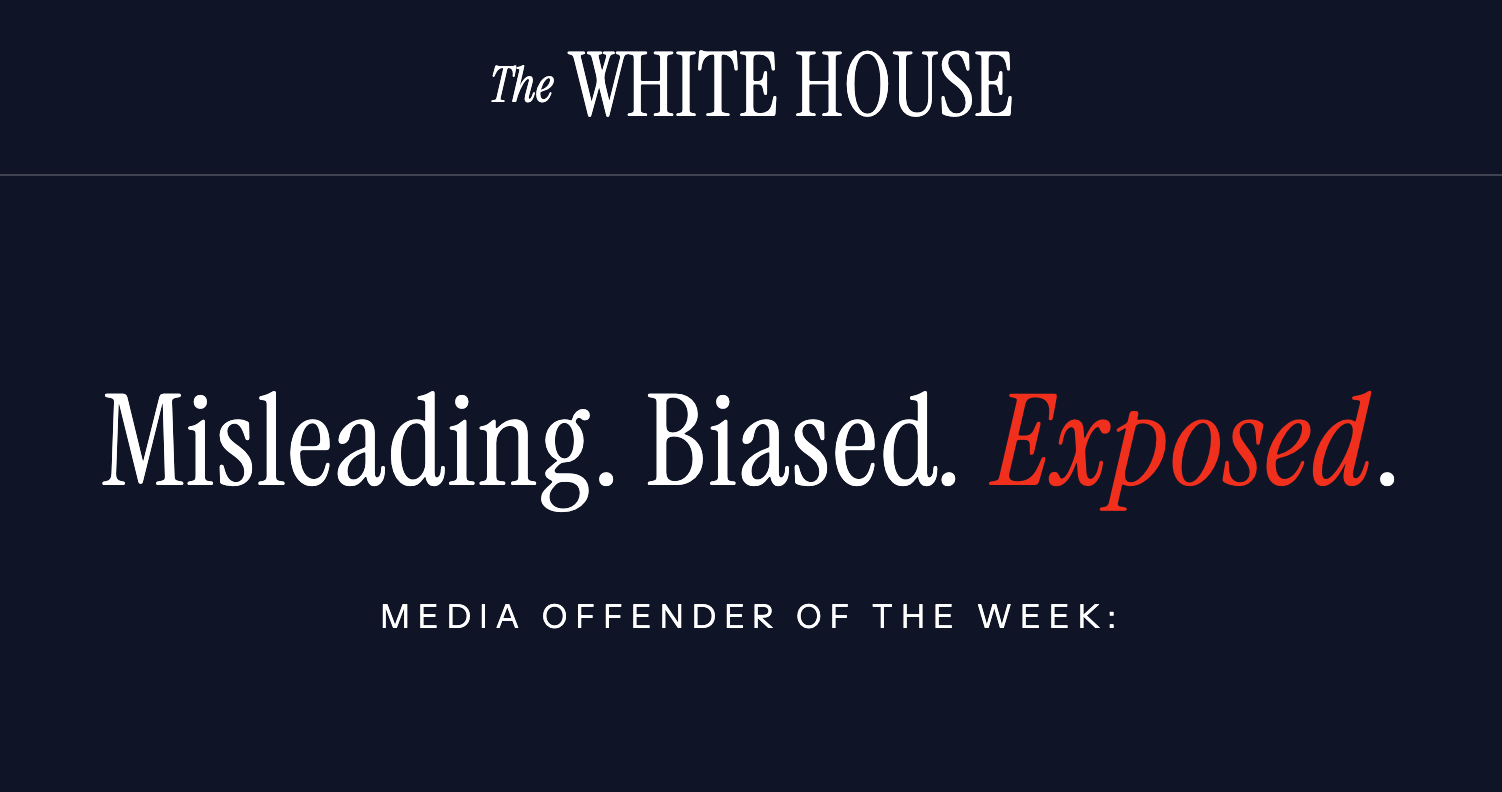
The site launched in December 2025 as a public-facing media-bias tracker, and by June 2026 the administration had added a “Leftist Influencers” section naming online commentators including Brian Tyler Cohen, David Pakman, Don Lemon, and Stephen Colbert.[2][3] That addition widens the legal implications beyond the familiar fight over press rooms, pool access, and institutional media. It reaches political speakers whose work may be distributed through YouTube, podcasts, newsletters, cable segments, or social platforms rather than through a traditional newsroom credentialing system.
The instinctive reaction is to ask whether the list is constitutional. That is too blunt a question. The better question is what, if anything, the government does next. A government page that denounces named speakers can be shameful, intimidating, and professionally dangerous without yet being the kind of state action that supports a First Amendment damages claim. It can also become strong evidence in such a claim if a later credential denial, enforcement action, regulatory threat, or other penalty follows the label.
The Boundary Is Not Taste. It Is Adverse Action.
Government officials may criticize the press. They may answer coverage with rebuttals, accuse outlets of unfairness, and publish the administration’s view of disputed reporting. That is the ordinary terrain of government speech. The First Amendment does not give journalists, commentators, or publishers immunity from official criticism, even harsh official criticism.
The line begins to move when the criticism is tied to an adverse government act that would chill a person of ordinary firmness from continuing protected speech. In practical terms, the question is not whether the label is ugly. It is whether the label becomes part of a penalty system. A list alone sits on one side of the line. A list followed by denied credentials, selective enforcement, regulatory pressure, audit-like scrutiny, loss of access under non-neutral rules, or official threats aimed at business partners begins to look different.
That is why FIRE legal director Will Creeley’s assessment is the most useful starting point. Speaking to Military.com, he called the page “shameful” and said it was “intended to cow critics into silence,” but he also said the page alone does not amount to a First Amendment violation; in his view, a constitutional problem would arise only if it were “accompanied by action against reporters.”[3] That is not a judicial ruling. It is an expert assessment of the litigation posture. But it captures the distinction a lawyer would have to make before advising a newsroom or commentator that a viable claim exists.
The same distinction keeps the Nixon Enemies List comparison from doing more work than it can bear. The legally important feature of that historical comparison is not that names appeared on a list. It is the alleged machinery around the list: FBI surveillance, IRS audits, leaks, and other actions meant to harm targets. TIME and Military.com both place the current portal in conversation with that history, but the current record described in the available materials does not tie comparable enforcement actions to the Media Offenders page.[2][3] The comparison is a warning about what to watch for, not proof that the present page has already crossed the constitutional line.
The Society of Professional Journalists has urged removal of the page and warned that it “heightens the risk of harassment or harm to reporters.”[4] That concern is not a doctrinal technicality. A named reporter can face abusive messages, source anxiety, employer pressure, and personal-security decisions even if no court-ready claim exists. Reporters do not experience reputational targeting in law-school categories. But for a First Amendment retaliation claim, the state-imposed consequence still matters. Harassment by third parties may be foreseeable and serious; it is not automatically the same thing as a government penalty unless the facts support causation, direction, coercion, or ratification.
Reporters Without Borders has described the page as “expanding Trump’s war on the press” and “importing and exporting authoritarian tendencies.”[5] That framing is politically significant and may be useful for institutional advocacy. In litigation, however, it still has to be attached to an act: who made the decision, what rule changed, what access was lost, what enforcement power was used, and whether the speaker’s protected viewpoint or coverage was a motivating factor.
Independent Commentators Make the Coverage Question Harder, Not Empty
The “Leftist Influencers” page complicates the analysis because it does not merely name legacy outlets or reporters who might seek White House credentials. It names online political commentators. That does not make the First Amendment interest disappear. Political commentary is protected speech whether it is published by a newspaper, posted to a video channel, delivered through a podcast, or broadcast as entertainment-adjacent commentary.
The more difficult question is remedial. A credentialed beat reporter may be able to point to briefing access, pool eligibility, or established White House press procedures. An independent commentator who is never seeking a hard pass may instead have to identify a different adverse consequence: official pressure on a platform, a denied interview opportunity under viewpoint-based criteria, a government contracting consequence, or some other concrete action linked to the label. The constitutional injury is not weaker because the speaker is digital. The evidence trail may simply be less familiar.
This is why the “who is the press” debate should not swallow the whole issue. The Press Clause and Speech Clause questions may matter in an access case, but independent commentators are still political speakers. If the government punishes them for viewpoint, the First Amendment problem does not depend entirely on whether they resemble a traditional newspaper correspondent.
How a Retaliation Claim Would Be Built
A First Amendment retaliation theory would start with protected activity: reporting, commentary, criticism, or editorial judgment. It would then require adverse government action serious enough to deter a person of ordinary firmness from engaging in that activity. Finally, it would require a causal link between the protected speech and the adverse action. The Media Offenders page could be evidence in that chain, especially if the later decisionmaker invokes the label, cites the page, uses the same categories, or treats listed speakers differently from comparable unlisted speakers.
| Fact Pattern | Likely Legal Significance |
|---|---|
| The White House posts a critical entry accusing an outlet of bias, without any further official consequence. | Troubling government speech, but standing alone a difficult First Amendment retaliation claim. |
| A listed reporter is later denied press access under vague or shifting criteria tied to the same coverage criticized on the page. | Potential retaliation and due-process issue, depending on record evidence and credentialing procedures. |
| An agency begins selective enforcement against a listed media entity after officials publicly reference the label. | Stronger retaliation theory if causation and differential treatment can be shown. |
| Officials pressure private platforms, advertisers, or business partners to cut ties with a listed commentator. | Potential coercion or retaliation theory, depending on whether the pressure is attributable to the state and carries an implied threat. |
| A listed speaker loses audience trust or receives public criticism with no identifiable government-imposed penalty. | Real reputational harm, but generally a weaker constitutional claim without state action causing a concrete adverse consequence. |
The causation record will matter as much as the insult. Lawyers should expect disputes over timing, comparators, decisionmaker knowledge, and pretext. A denial that occurs after listing is not automatically retaliation. A denial accompanied by emails, public remarks, inconsistent explanations, or differential treatment of similarly situated speakers starts to look less accidental.
The Poynter figure that documented 76 federal actions against journalists in 2025 is useful environmental context, but it should not be overstated.[6] It does not prove that the Media Offenders portal caused any particular injury. It does show why news organizations may treat official labeling as part of a broader risk environment rather than as a one-off communications tactic.
The ACLU’s press-freedom materials likewise help frame the climate of federal pressure on media institutions, including disputes over public-media funding and related executive-branch conduct.[7] That climate may inform risk assessment. It does not replace the plaintiff’s burden to connect a challenged government act to protected speech.
Credentialing Is Where Due Process Enters
If the White House uses the Media Offenders label in credentialing decisions, the analysis changes quickly. Press access to the White House is not a general entitlement to enter any government building at will. But once the government creates a press-access system, it cannot administer that system through arbitrary or viewpoint-discriminatory procedures.
The relevant framework is Sherrill v. Knight, the D.C. Circuit’s 1977 decision involving White House press credentials. Sherrill required that denial of a White House press pass be based on a compelling governmental interest, that the denial be accompanied by notice of the factual basis, and that the applicant receive an opportunity to rebut.[8] That precedent is why a credentialing dispute tied to the Media Offenders page would not be merely a public-relations fight. It would raise procedure, neutrality, and access questions.
A listed reporter denied a hard pass would want to know whether the denial rested on security criteria, space constraints, neutral press-office rules, or the government’s disagreement with coverage. The White House would likely argue that criticism on the portal is separate from credential administration. The reporter would try to show the opposite: that the label functioned as a marker for disfavored viewpoint and infected the access decision.
The evidence to preserve is mundane but decisive: application materials, denial letters, stated criteria, prior credentialing decisions, communications with press staff, public statements by officials, changes in rules after unfavorable coverage, and treatment of similarly situated applicants. Constitutional litigation often turns less on the theatrical public page than on the administrative record behind a closed decision.
Defamation and Business-Harm Claims Are Narrower Routes
Defamation is available only if the page makes false statements of fact capable of defamatory meaning. Labels such as “Bias” or “Left-Wing Lunacy” are likely to be treated as opinion, rhetoric, or political characterization in many contexts. “Lie” is more complicated. It may still be used rhetorically, but if a specific entry asserts a concrete, provably false factual claim about what a reporter knew, what an outlet published, or what a commentator did, the analysis becomes more serious.
Public-figure and fault doctrines would still loom large. Many national media organizations and prominent commentators would face demanding standards. The government would also have defenses rooted in opinion, fair comment, substantial truth, and lack of actionable factual assertion. A defamation claim should not be treated as the natural remedy for being placed on the list. It is a fact-specific option when the government’s entry says something provably false rather than merely insulting.
Tortious interference is similarly possible but narrow. A plaintiff would need more than generalized reputational injury. The stronger version would involve a concrete business relationship or expectancy, government knowledge of that relationship, intentional interference, and resulting harm. If officials used the Media Offenders label while urging an advertiser, distributor, platform, or partner to cut ties, the theory becomes more plausible. If the only harm is public controversy after a government post, the claim is harder.
The Practical Monitoring Frame
As of Q3 2026, the most defensible legal characterization is that the Media Offenders portal is protected but troubling government speech unless and until it is connected to concrete adverse consequences. That conclusion should not be confused with approval. The White House’s use of an official platform to name outlets, solicit public tips, assign weekly offender status, and maintain a leaderboard predictably raises the cost of reporting and commentary. It also creates a ready-made evidentiary trail if later officials act against the same speakers.
For legal professionals, the immediate task is to separate condemnation from penalty. A harsh entry on the portal is one category of fact. A denied credential, selective investigation, regulatory threat, grant or contract consequence, platform-pressure campaign, or documented official instruction to treat listed speakers differently is another. The first may explain motive. The second may supply the adverse action.
That distinction is also the safest way to avoid both complacency and overclaiming. The list alone is not the Nixon machinery. It is not yet a completed retaliation case. But if the label becomes a gateway to state-imposed disadvantage, the page will no longer be just political speech by the government. It will be part of the proof.
References
- Media Offenders – The White House — The White House. https://www.whitehouse.gov/mediabias/
- White House Launches Media Offenders Site and Tipline — TIME, Dec. 20, 2025. https://time.com/7338411/white-house-media-bias-tracker-trump-attacks/
- White House Targets Online Commentators in Leftist Influencers Section — Military.com, June 8, 2026. https://www.military.com/white-house-targets-leftist-influencers-on-official-trump-admin-website
- Trump White House Media Offenders List Sparks New Press Freedom Debate — Noise11, June 7, 2026. https://www.noise11.com/news/trump-white-house-media-offenders-list-press-freedom-debate-20260607
- USA: New White House Hall of Shame Webpage Expands Trump's War on the Press — Reporters Without Borders. https://rsf.org/en/usa-new-white-house-hall-shame-webpage-expands-trump-s-war-press-disparaging-media
- The Numbers That Defined the Trump Administrations Attacks Against the Press in 2025 — Poynter, 2025. https://www.poynter.org/reporting-editing/2025/united-states-press-freedom-donald-trump/
- Trumps Attacks on Press Freedom Escalate — ACLU. https://www.aclu.org/news/free-speech/trumps-attacks-on-press-freedom-escalate-npr-pbs-funding-cuts-explained
- Sherrill v. Knight (D.C. Cir. 1977) — First Amendment Encyclopedia. https://firstamendment.mtsu.edu/article/sherrill-v-knight-d-c-dir/
Comments
Join the discussion with an anonymous comment.