
In a Legionnaires' disease outbreak lawsuit, the first useful question is not whether Legionella can grow in building water systems. It can. The useful question is who had a duty at the control point where the alleged exposure occurred. The named defendants are no longer limited to the hotel, hospital, apartment building, or senior-living facility where the plaintiff became ill. Modern complaints commonly work outward from the premises to the parties that owned, operated, serviced, tested, designed, installed, or supplied the relevant water system.
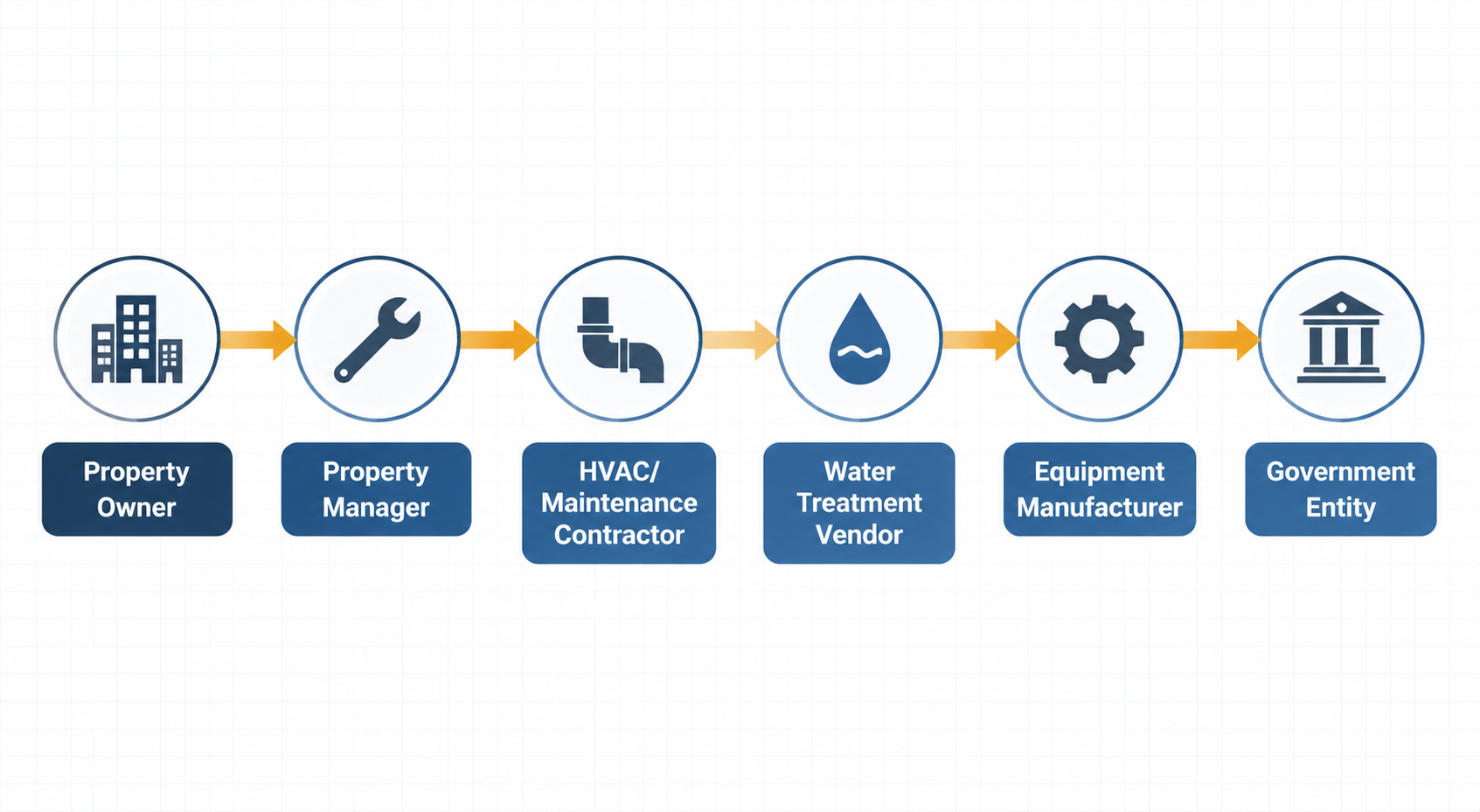
That is the working map for Legionnaires' disease outbreak liability litigation: premises defendants remain central, but the practical defendant universe can include property managers, HVAC and maintenance contractors, water-treatment vendors, equipment manufacturers, construction contractors, and public entities. The theory is usually some version of control plus failure: the defendant had authority over a cooling tower, potable-water system, decorative fountain, hot tub, plumbing component, treatment program, or construction activity, and failed to manage a known Legionella risk with reasonable care.
Pritzker Hageman frames the plaintiff's proof burden around four practical showings: exposure, premises, negligence, and causation. The same source notes that courts have rejected res ipsa loquitur in this context, which means the fact of illness does not itself carry the plaintiff over the pleading or proof line.[1] That point matters because a positive Legionella diagnosis and a public-health announcement may start a case, but they do not finish one.
The defendant map widened after ASHRAE 188
ASHRAE Standard 188 changed the litigation posture because it gave lawyers a structured water-management reference point. The standard was published in 2015, and CMS later endorsed Legionella risk-management expectations for healthcare facilities in 2017.[2] That does not make ASHRAE 188 a self-executing statute in every jurisdiction. It is a water-management program standard, not a guarantee that any specific system will be pathogen-free. But it changed what a complaint can plausibly allege and what discovery can demand.
Before that shift, defendants had a cleaner dismissal argument: there was no established industry standard requiring a particular Legionella management program. Vellucci v. Allstate and Flaherty v. Legum & Norman are useful before-picture cases because they show how claims could fail when plaintiffs could not point to a recognized standard of care governing the defendant's conduct.[2] CLM Magazine, writing in 2013 before ASHRAE 188 was published, described the difficulty of establishing premises liability where the legal and industry standards were still unsettled.[3]
Post-2015, the better plaintiff complaint does not simply say “Legionella was present.” It asks who performed the building survey, who identified hazardous conditions, who maintained the water-management plan, who monitored control limits, who responded to test results, and who documented corrective action. Circle of Blue described the growth of Legionnaires' disease litigation after ASHRAE 188 and the use of the standard as a reference point in claims, but the source set does not identify a controlling appellate decision that formally adopts ASHRAE 188 as the universal legal standard of care.[4] That distinction is not academic. It is the difference between a useful negligence benchmark and a dispositive rule.
The expanded defendant list follows from that benchmark. If a building owner delegated treatment to a vendor, the vendor's contract, service logs, recommendations, and sampling history move to the center of the case. If construction allegedly disturbed water systems or aerosolized contaminated water, the construction contractor enters the frame. If the facility is public, governmental entities may be named subject to notice, immunity, and statutory constraints. If a component failed or was defectively designed, product liability may sit beside premises liability rather than replace it.
Real outbreak pleadings show the chain, not a single obvious defendant
The Harlem reporting is a clean example of how complaints can reach beyond the property owner. ABC7 NY reported a 2025 lawsuit accusing Skanska and Rising Sun, construction companies, of negligence in connection with a Harlem hospital Legionnaires' disease outbreak.[5] PRNewswire later reported a May 2026 lawsuit against New York City entities in connection with a Harlem Legionnaires' disease outbreak.[6] Those reports do not prove liability; they show the pleading instinct in the post-ASHRAE 188 period. Plaintiffs look for every actor with a plausible control point and then test the chain in discovery.
The Napa example points in a different direction: the water-treatment vendor. The Press Democrat reported that a wrongful-death trial over a 2022 Napa Legionnaires' disease outbreak ended in settlement and identified Chem-Aqua in the water-treatment context.[7] A settlement is not an adjudication of breach or causation. It is still useful because it shows why service vendors should not treat Legionella work as a back-office technical role. In litigation, their contracts and records may become the closest evidence of what was supposed to happen, what actually happened, and who knew when control measures were not working.
The same logic applies to hospitals, nursing facilities, hotels, commercial towers, apartment buildings, and municipal facilities. The building owner may be the obvious first defendant, but it is rarely the only possible source of duty. The question is whether each additional defendant had actual control, contractual responsibility, statutory responsibility, or product responsibility tied to the exposure pathway.
ASHRAE 188 helps establish breach, but it does not erase the proof burden
ASHRAE 188 is most powerful when it converts a vague sanitation allegation into a document request. If the standard applies to the facility type or is incorporated through regulation, contract, policy, expert testimony, or local law, the plaintiff can ask for the water-management program, hazard analysis, control measures, monitoring records, validation, verification, corrective actions, and responsible-person assignments. The absence, incompleteness, or nonuse of those materials can become breach evidence.
But breach evidence is not the whole case. A plaintiff still has to connect the defendant's conduct to the plaintiff's illness with specifics. The four elements identified by Pritzker Hageman are a useful litigation checklist because they force the case out of outbreak-general language and into admissible proof: exposure, premises, negligence, and causation.[1]
| Element | What the plaintiff needs to tie down | Why defendants contest it |
|---|---|---|
| Exposure | That the plaintiff encountered an aerosolized water source capable of transmitting Legionella during a relevant illness window. | A person may have visited multiple buildings, used multiple water sources, or had no documented contact with the alleged source. |
| Premises or control point | That the implicated water system, device, or work activity was owned, operated, maintained, serviced, designed, or controlled by the defendant. | Ownership of the building is not the same as control over every treatment decision, repair, test, or component. |
| Negligence | That the defendant failed to use reasonable care, often measured against water-management practices, regulations, contracts, or expert testimony. | ASHRAE 188 may be disputed as legally binding, factually applicable, or satisfied by the defendant's actual program. |
| Causation | That the defendant's failure caused or substantially contributed to the plaintiff's Legionnaires' disease. | Positive environmental testing, clinical testing, timing, alternative sources, and expert methodology all become battlegrounds. |
Exposure is often the first hard problem. Public-health investigators may identify a cluster, and environmental testing may identify Legionella in a building system, but civil proof usually needs the plaintiff's own path through the alleged exposure zone. A guest who used a hotel shower presents a different proof problem from a pedestrian who passed near a cooling tower or a patient who moved among several healthcare units.
Premises proof is equally unforgiving. The defendant must be tied to the system, not merely to the outbreak headline. A property manager may have day-to-day operating authority. A water-treatment vendor may have chemical-treatment and sampling duties but no capital-repair authority. A construction contractor may control a worksite but not the hospital's internal plumbing. A manufacturer may control product design or warnings but not field maintenance. Those differences shape duty, breach, indemnity, and settlement value.
Negligence proof is where ASHRAE 188 now does the most work. The standard gives experts and lawyers a vocabulary for reasonable water management, but it does not automatically answer which defendant owed which task. The plaintiff still has to show that the defendant failed to do something it was legally or contractually responsible to do. A missing water-management plan may hurt the owner. An ignored test result may hurt the manager or vendor. A poorly documented corrective action may hurt whoever signed off on the program. The same fact can point at several parties, but it still has to point somewhere.
Causation is where many attractive complaints become expensive expert cases. The plaintiff must link the illness to the alleged source and then to the defendant's breach. The proof may include clinical diagnosis, timing, environmental sampling, genetic or strain evidence if available, building records, public-health findings, and expert opinion. The research materials support the narrower point that res ipsa loquitur has been rejected, not the broader claim that every plaintiff must produce the same scientific evidence in every jurisdiction.[1] The governing evidentiary standard will still come from the forum and the claims pleaded.
The legal theories are best sorted by what each one adds
Negligence and premises liability do most of the work. The premises theory asks whether the owner or operator failed to keep the property reasonably safe for residents, patients, guests, workers, or visitors. The negligence theory can reach the same facts but is flexible enough to capture service providers and contractors whose duty arises from contract, undertaking, professional practice, or operational control. In both theories, ASHRAE 188 usually matters as evidence of what reasonable Legionella risk management looked like at the relevant time.
Negligence per se is the bridge theory, but it has to be handled carefully. ASHE 188 itself is a consensus standard, not a statute. A plaintiff seeking negligence per se usually needs a statute, regulation, ordinance, or binding healthcare requirement that applies to the defendant and protects the class of persons injured from the type of harm suffered. Where local Legionella laws, healthcare requirements, or incorporated standards exist, the negligence per se argument becomes more concrete. Where they do not, ASHRAE 188 may still be persuasive evidence of reasonable care, but calling it “de facto” should not be confused with proving it is legally conclusive.
Product liability enters when the alleged failure is not maintenance but the product itself: a cooling tower component, plumbing device, filtration system, control technology, chemical-feed equipment, or other product alleged to be defectively designed, manufactured, or warned about. The plaintiff then needs product-specific proof. It is not enough that Legionella appeared somewhere in a system containing the product. The product defect has to be connected to the failure mode and the exposure.
Wrongful death changes damages and parties, not the basic proof architecture. The estate or statutory beneficiaries still need exposure, duty, breach, and causation. The Napa wrongful-death settlement illustrates why those cases can create serious settlement pressure, but it does not eliminate the need to prove which defendant's conduct caused the fatal infection.[7]
Joint-and-several liability is the settlement force-multiplier. Where available under state law, it can allow a plaintiff to recover full damages from one liable defendant even if other responsible parties are insolvent, immune, absent, or underinsured. McEldrew Purtell identifies joint-and-several liability as a feature that can affect Legionnaires' disease outbreak claims.[8] The practical point is leverage, not pleading magic. The plaintiff still must establish liability against the defendant from whom recovery is sought, and the defendant will look for contribution, indemnity, allocation, and contractual defense rights.
The records that matter are the ones that assign control
The best Legionella case files are not just medical files. They are control files. They show who was supposed to inspect, test, treat, clean, flush, repair, notify, or shut down a system. They show whether the same person had authority to act or merely authority to recommend. They show whether a warning was escalated or buried.
- Ownership and management agreements identifying operational responsibility for water systems.
- Water-management plans, including responsible-person assignments and hazard analyses.
- Cooling tower, potable-water, hot-water, spa, decorative-water, and plumbing maintenance logs.
- Vendor contracts, scopes of work, service tickets, chemical-treatment logs, and recommendations.
- Legionella sampling results, corrective-action records, and communications after adverse findings.
- Construction schedules, water interruptions, commissioning records, flushing records, and infection-control communications.
- Public-health notices, internal incident reports, resident or patient communications, and post-outbreak remediation records.
Those records can help either side. A plaintiff uses them to show notice, deviation, and causation. A property owner uses them to show delegation, reasonable program implementation, or lack of connection to the exposure window. A vendor uses them to show that it performed its limited scope and warned the owner about work outside that scope. A contractor uses them to separate construction activity from the water system that allegedly caused the disease.
The post-ASHRAE 188 case is therefore more document-intensive, but not necessarily easier. A standard creates questions: Was the building within the standard's scope? Was a program required by law, contract, policy, or reasonable care? Was the program actually implemented? Were control measures monitored? Were deviations corrected? Which defendant had the authority to correct them? Those questions survive the outbreak press release and decide the litigation.
Coverage may be the last defendant-side shock
After duty and causation are mapped, insurance can still narrow the case in a way the pleadings do not reveal. Howden Group's June 2026 analysis warns that standard commercial general liability programs often contain pollution or bacteria exclusions that insurers may invoke against Legionella claims.[9] The issue is not whether Legionella is dangerous in the abstract. The issue is policy text: how the policy defines pollutant, bacteria, fungi, contaminant, discharge, dispersal, and bodily injury; whether an exclusion has exceptions; and how the jurisdiction construes the wording.
That coverage problem hits different defendants differently. A building owner may assume premises coverage will respond to a bodily-injury claim arising at the property. A water-treatment vendor may assume professional or contractor coverage will respond to alleged service failures. A manufacturer may look to products coverage. A public entity may have a statutory risk arrangement or self-insurance structure. None of those assumptions settles the exclusion analysis.
Coverage counsel should resist broad industry shorthand. “Pollution exclusion” is not a complete answer. Neither is “bacteria exclusion.” The operative question is whether this claimant, this source, this transmission mechanism, this defendant's role, and this policy language fit the exclusion under the governing law. The research base here supports caution, not a universal coverage rule.
What a lawyer can safely take from the current framework
ASHRAE 188 has made Legionnaires' disease litigation more structured and more dangerous for defendants who cannot show a working water-management program. It has not removed the plaintiff's burden to prove exposure, premises or control, negligence, and causation. It has not made every service provider liable for every contaminated system. It has not made negligence per se available without a binding legal hook. And it has not guaranteed insurance proceeds at the end of the case.
The practical triage remains straightforward: identify every actor with a control point, separate legal duty from factual involvement, demand the water-management and service records, test the exposure window, and read the insurance policies before valuing recovery. The rest is jurisdiction-specific: negligence per se, joint-and-several liability, public-entity defenses, expert admissibility, and pollution or bacteria exclusions all have to be confirmed in the forum that will decide the case.
References
- Determining Liability for a Legionnaires' Disease Outbreak, Pritzker Hageman
- Legionella Lawsuits: Case Law Review and Legal Precedents, EAI Water
- Legionnaires' Disease and Premises Liability, CLM Magazine
- As Legionnaires' Disease Cases Surge, Lawsuits Pile Up, Circle of Blue
- NYC Legionnaires' outbreak: New lawsuit accuses construction companies of negligence at Harlem hospital, ABC7 NY, 2025
- First Lawsuit Filed Against the City of New York in Harlem Legionnaires' Disease Outbreak, PRNewswire, May 2026
- Trial over wrongful death in 2022 Napa Legionnaires' outbreak ends in settlement, Press Democrat, May 2026
- Legionnaires' Disease Outbreaks and Lawsuits, McEldrew Purtell
- The Legionella liability gap in standard insurance programs, Howden Group
Comments
Join the discussion with an anonymous comment.