
The legal reason Peter Thiel’s Argentina relocation can avoid Argentine worldwide taxation is not hidden in the mansion story. It sits in a less cinematic distinction: Argentina can treat a person as present, settled, or immigration-resident without necessarily treating that person as a tax resident.
That distinction matters because the public facts point in two directions at once. Thiel has reportedly bought a Buenos Aires mansion for about $12 million, enrolled his children in local schools, and met President Javier Milei at Casa Rosada.[1][2] Those facts look like family relocation. They do not, by themselves, answer whether Argentina may tax his Palantir stake, venture interests, and wider global wealth on a worldwide basis.
For a high-net-worth client, this is not a semantic point. It is the planning line. A household can establish a visible life in Argentina while advisers still manage the two legal triggers that matter for Argentine tax residency: acceptance of permanent residency, and physical presence over the relevant 12-month threshold. The current public record does not confirm Thiel’s precise immigration status, and no Argentine tax authority ruling on his personal position has been made public. The available analysis is therefore best read as counsel-based statutory interpretation, not as an official AFIP determination on Thiel.

Family Settlement Is Not the Same Legal Event as Tax Residence
Argentina separates migration residency from tax residency. Migration status is administered through immigration law and Migraciones. Tax residency is governed through the tax code and administered by AFIP and provincial revenue authorities where relevant. The two regimes may overlap in ordinary cases, but they are not the same legal category.[3]
That is why the publicly reported facts are legally incomplete. A home purchase may support an inference about where a family intends to spend time. School enrollment may show that children are living locally. A meeting with Milei may be politically interesting and optically useful. None of those facts is the same as accepting permanent residency or exceeding the statutory presence threshold.
This is also where some coverage of the move becomes too loose. “Moved to Argentina” is a social description. “Became taxable in Argentina on worldwide assets” is a legal conclusion. The first can be true while the second remains false, at least until one of the tax-residency triggers is met.
The Two Triggers Advisers Have to Watch
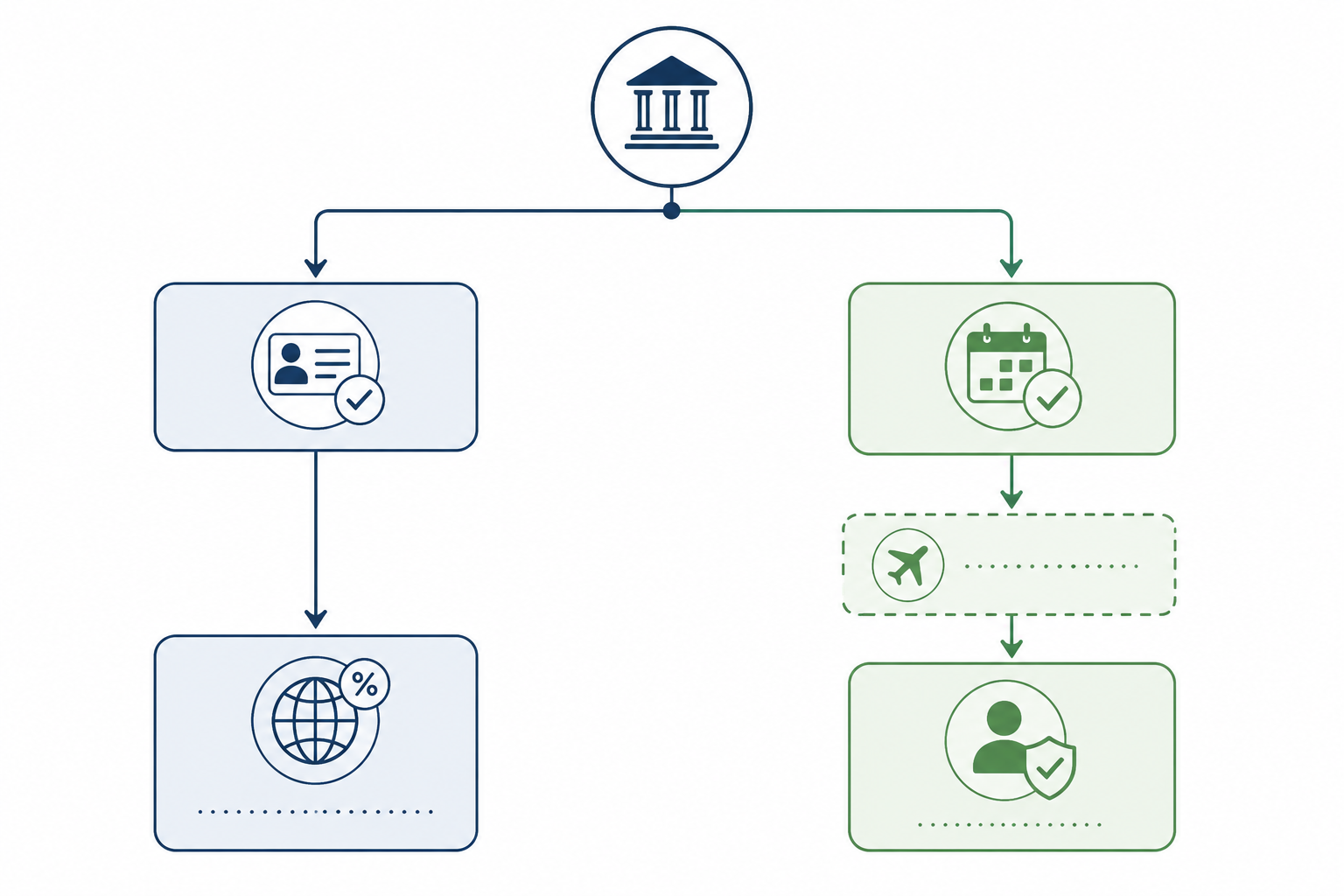
The reported Argentine-law analysis identifies two principal routes by which a foreign individual becomes an Argentine tax resident. The first is status-based: acceptance of permanent residency. The second is presence-based: remaining in Argentina long enough as a temporary resident to cross the 12-month physical-presence threshold, with roughly 90 days of permitted temporary absences.[3]
| Trigger | What matters | Tax consequence described in the available analysis |
|---|---|---|
| Permanent residency acceptance | The individual accepts permanent residency status under the immigration regime | Worldwide taxation begins from the first day of the following month |
| Physical presence as a temporary resident | The individual exceeds 12 months of physical presence, with roughly 90 days of temporary absences tolerated | Tax residency can arise even without permanent residency |
The first trigger is easy to miss because it sounds administrative. It is not merely a paperwork upgrade. Under the analysis cited by Sauerborn, accepting permanent residency would cause worldwide taxation to attach from the first day of the following month.[3] For a client whose principal wealth is held outside Argentina, that date is a cliff.
The second trigger is less formal but just as important. A temporary resident may remain outside Argentine worldwide taxation if the person does not accumulate the relevant 12-month physical-presence period. The analysis allows for approximately 90 days of temporary absences, meaning that travel patterns have to be tracked, not merely described.[3] In practice, this is where a calendar can become more important than the lease, the school file, or the social photograph.
The public reporting suggests an intermittent travel pattern rather than uninterrupted Argentine presence, but the exact day count has not been publicly verified. That matters. If an adviser says the structure works, the support for that statement should be a status file and a travel ledger, not a general impression that the client is “based” somewhere.
Why Permanent Residency Is the Cleaner Line
Permanent residency is a particularly clean trigger because it does not require a debate about lifestyle intensity. If the status has been accepted, the tax consequence described in the available analysis follows from the status event and the next-month rule.[3] That creates a documentable before-and-after point.
For clients used to treating immigration status as a convenience, this can be counterintuitive. A more secure or prestigious immigration status may be attractive for family stability. It may also be exactly the status that turns on worldwide tax exposure. The planning question is therefore not whether Argentina will let the family live there in some form. It is which form has been accepted, and what that form does under the tax code.
Why the Day Count Still Matters
Avoiding permanent residency does not make the calendar irrelevant. The physical-presence route is designed to catch people whose residence becomes tax-relevant through actual time spent in the country. A client who stays too long may create tax residence even without crossing the permanent-residency line.[3]
This is the unglamorous operating layer of a relocation plan. Someone has to know which days count, which absences are temporary, and whether the accumulated pattern still sits below the threshold. For a founder or investor with global board meetings, investment obligations, and multiple residences, that may be manageable. It is still a compliance exercise, not a lifestyle description.
What Argentina Can Still Tax If Thiel Remains Non-Resident
Non-resident status does not mean Argentina taxes nothing. It means the asset base changes. Under the available analysis, Argentina’s personal assets tax, Bienes Personales, reaches only Argentina-situated assets for non-residents. Foreign assets remain outside the Argentine wealth-tax net.[3]
For Thiel, that distinction is the economic center of the structure. A Buenos Aires mansion is an Argentina-situated asset. Palantir shares, US venture interests, and a global investment portfolio are not converted into Argentine-situs assets merely because a family spends time in Buenos Aires. Fortune’s reporting similarly framed the attraction for wealthy movers through the limited local reach of the tax base, citing private-client advisers Dominic Volek of Henley & Partners and David Lesperance.[4]

That is why “relocation” can be a misleading shorthand. The tax question is not whether Thiel has valuable assets while living part of his life in Argentina. It is whether Argentina’s tax rules can reach those assets. If he remains a non-resident for Argentine tax purposes, the local wealth-tax issue is principally residual exposure on Argentina-situated property, not a claim over his worldwide balance sheet.
Milei-era reductions to Bienes Personales make that residual exposure lighter than it otherwise would have been. The reported changes include lower rates and a higher floor.[3] They are relevant, but they are not the core explanation. A rate cut reduces the cost of being within scope. Non-resident asset scoping determines what enters the calculation in the first place.
The Citizenship-by-Investment Angle Is Still Developing
Argentina’s investment-naturalization framework adds another layer, but it should not be treated as an operating program in the way Caribbean citizenship-by-investment practitioners would understand that term. Decree 524/2025 was issued on July 31, 2025, and Fortune reported that expected terms could include a donation of about $500,000 or an investment of about $1 million in zero-coupon government bonds.[4] As of July 2026, however, the program is not yet accepting applications, and final thresholds may differ from the reported expectations.[4][5]
The tax point is narrower and more important than the marketing point. The decree reportedly provides that naturalization through investment does not, by itself, create Argentine tax residency.[4] If that rule remains in the implemented program, it would reinforce the same separation already doing most of the work in Thiel’s case: nationality, immigration permission, and tax residence are related concepts, but they are not automatically interchangeable.
That does not make the program irrelevant. It may eventually give wealthy foreigners another lawful status route into Argentina. But until applications are open and final regulations are visible, it is too early to use the program as proof of a completed Argentine safe-haven strategy.
California Explains the Timing, Not the Argentine Tax Result
The California context helps explain why this kind of planning is salient in 2026. Proposition 40 is scheduled for the November 3, 2026 ballot and proposes a one-time 5% wealth tax on billionaires, with a January 1, 2026 eligibility cutoff.[6][7] Reports cited in the research materials say six billionaires left California before that cutoff, though that figure has not been independently confirmed by the California Franchise Tax Board.
Those facts belong in the motive file, not in the Argentine-law answer. A client may have strong reasons to reconsider California residence, including proposed state-level wealth taxation. But leaving California does not decide where the client becomes taxable next, and it certainly does not answer whether Argentina has worldwide taxing rights.
The broader market context points in the same direction. Henley & Partners reported that 142,000 millionaires migrated internationally in 2025 and projected 165,000 such moves in 2026. It also reported that US applications for alternative residence and citizenship doubled in 2025.[8] Those figures show demand for mobility planning. They do not show that any given destination is a tax haven, or that relocation alone produces the desired tax result.
The Professional Reading of Thiel’s Argentina Move
The cleanest reading of Thiel’s Argentina relocation is not that Argentina has no taxes, or that billionaires can move household life without legal consequences. It is that Argentine law appears to leave room for a structured separation between migration presence and tax residence, provided the client does not accept the wrong status or overrun the day-count threshold.
That reading still depends on facts not yet public. Thiel’s visa category has not been confirmed by Migraciones, AFIP, or Thiel himself. The Sauerborn analysis is detailed and consistent with the statutory distinction it describes, but it is not an official ruling on Thiel. The citizenship-by-investment program exists as a legal framework but is not yet operational. Those limitations are not cosmetic; they are exactly the points on which a real file would turn.
For advisers, the useful lesson is narrower than the headline. In cross-border wealth migration, the decisive question is not where the client appears to live. It is which legal status has been accepted, how many days have accrued, and which assets the local tax base can actually reach.
References
- Peter Thiel’s Argentina move is part of a broader migration of the global rich, The New York Times, May 28, 2026
- Peter Thiel is moving his family to Argentina, Business Insider, 2026
- Thiel Argentina Tax Myth, The Brief
- The global rich see Peter Thiel’s safe haven in Argentina, Fortune, July 16, 2026
- Peter Thiel links to Argentina after leaving US, Newsweek
- 2026 California Proposition 40, Wikipedia
- Billionaire Tax Act: California Wealth Tax Ballot Measure, Tax Foundation
- Henley Private Wealth Migration Report 2026, Henley & Partners
Comments
Join the discussion with an anonymous comment.