
A wildfire evacuation order is easy to read as an emergency instruction: leave now, stay out, wait for clearance. In a legal file, it is also a timestamped government act that starts moving through criminal enforcement, public-entity immunity, utility claims, insurance coverage, wage obligations, rental housing disputes, and future land-use approvals.
That matters because the same order can answer very different questions later. Was the client unlawfully inside a closed area? Did a government-claim deadline start running? Were hotel costs voluntary or required by civil authority? Did an employer have workers reporting through hazardous smoke? Did an environmental impact report assume evacuation conditions that courts now reject? The legal implications of wildfire evacuation orders rarely stay inside emergency law.
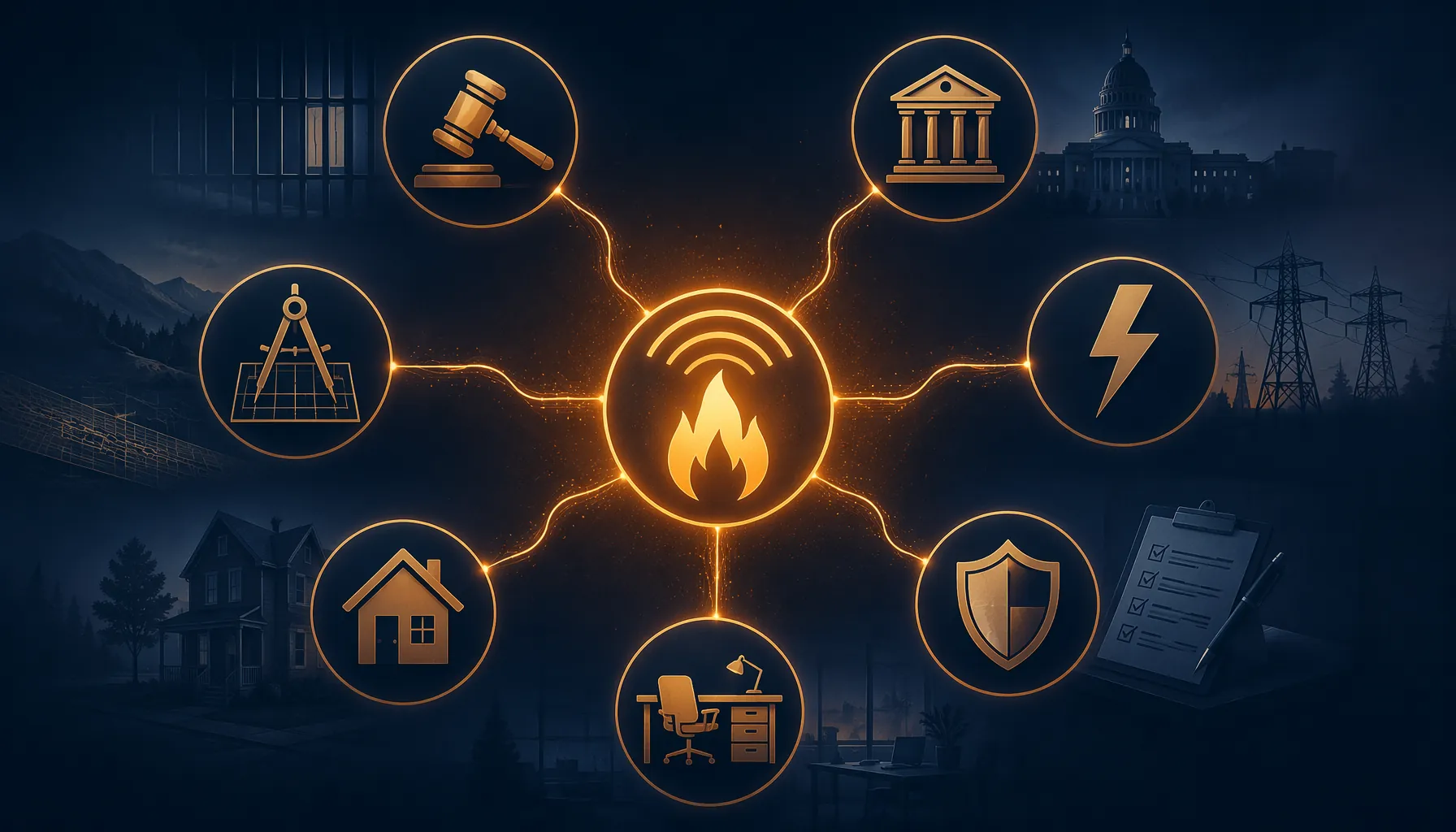
| Domain | What the evacuation order changes |
|---|---|
| Criminal enforcement | Defines closed areas, reentry restrictions, and misdemeanor exposure for unauthorized access. |
| Government liability | Frames discretionary emergency decisions, operational failures, notice deadlines, and immunity defenses. |
| Utility liability | Helps document displacement and evacuation costs in equipment-caused fire claims. |
| Insurance | Connects civil-authority displacement, additional living expenses, total-loss payments, and policy limits. |
| Employment | Affects worksite access, smoke exposure, unsafe-work refusals, wage treatment, and leave issues. |
| Landlord-tenant | Changes access, habitability, rent, possession, and lease termination analysis. |
| CEQA and planning | Becomes the real-world scenario against which evacuation modeling is later tested. |
The First Question Is Access, Not Fault
The immediate legal question is usually narrow: who may enter, remain, or return? In California, Penal Code section 409.5 authorizes designated officials to close areas during a menace to public health or safety, and unauthorized entry into a closed emergency area can be charged as a misdemeanor punishable by up to six months in jail and a $1,000 fine. FindLaw notes that few people are arrested for refusing evacuation, and the available materials do not provide aggregate prosecution data, but the statutory exposure is real enough to matter in client advisories about reentry, property retrieval, media access, and private security decisions.[1]
The practical distinction is between refusing to leave and crossing a closure line after officials have restricted access. Clients often describe both as “not evacuating,” but the paper trail may separate them. The order, map, roadblock notice, sheriff’s alert, or repopulation bulletin can determine whether a person was inside a warning zone, inside a mandatory evacuation area, or entering a closed disaster perimeter after the fact.
That same access record later affects noncriminal issues. A tenant’s inability to reach a unit, an employee’s inability to report to a worksite, or an insured’s hotel stay during a civil-authority closure may all turn on the same county alert or incident command update. Counsel should preserve the actual order as issued, not just a news story describing it.
Government Liability Turns on the Line Between Discretion and Operations
The harder litigation question is not whether evacuation decisions were consequential. They were. The question is whether the challenged act is protected emergency discretion or a narrower operational failure that can survive immunity.
California materials make this a high-bar inquiry. Plaintiff-side wildfire summaries describe California courts as recognizing absolute immunity for discretionary evacuation decisions under the California Emergency Services Act, leaving a narrower path for claims framed around operational negligence rather than the core decision whether, when, or how broadly to order evacuation.[2] That distinction is not academic. The complaint theory has to be built around what officials allegedly did after a duty was operationalized: whether alerts were transmitted, whether known access routes were managed, whether vulnerable populations received warning, or whether already-adopted protocols were followed.
The recent Palisades Fire litigation illustrates how evacuation records become part of a government-liability file. Robins Cloud reported wrongful death lawsuits filed against Los Angeles and California in the final weeks of 2025 arising from the Palisades Fire, which the firm described as involving 12 deaths and more than 7,000 structures destroyed; the timing was tied to a December 31, 2025 deadline under California Code of Civil Procedure section 377.34 for pre-death pain-and-suffering claims.[3] Those are pleadings and plaintiff-side descriptions, not adjudicated findings of liability. Their value for a practitioner is more procedural: they show how quickly evacuation timing, warning sufficiency, survival damages, and claim-preservation choices can converge.
The notice problem is equally unforgiving. The same Robins Cloud government-liability summary states that claims against public entities may require a formal notice within 60 to 180 days, and that missing the applicable deadline can bar the claim.[2] Because notice periods and claim statutes depend on the defendant, jurisdiction, and cause of action, the evacuation file should identify every possible public actor early: city, county, state agency, fire district, law enforcement agency, transportation authority, and any joint powers or mutual-aid structure that may have controlled a disputed warning or closure.
The legal work here is not to assume that bad evacuation outcomes create public-entity liability. They often do not. The work is to separate protected emergency judgment from recordable operational acts, then calendar the shortest plausible notice period before memories, alert logs, radio traffic, and GIS closure layers become harder to obtain.
The Displaced Person’s Paper Trail
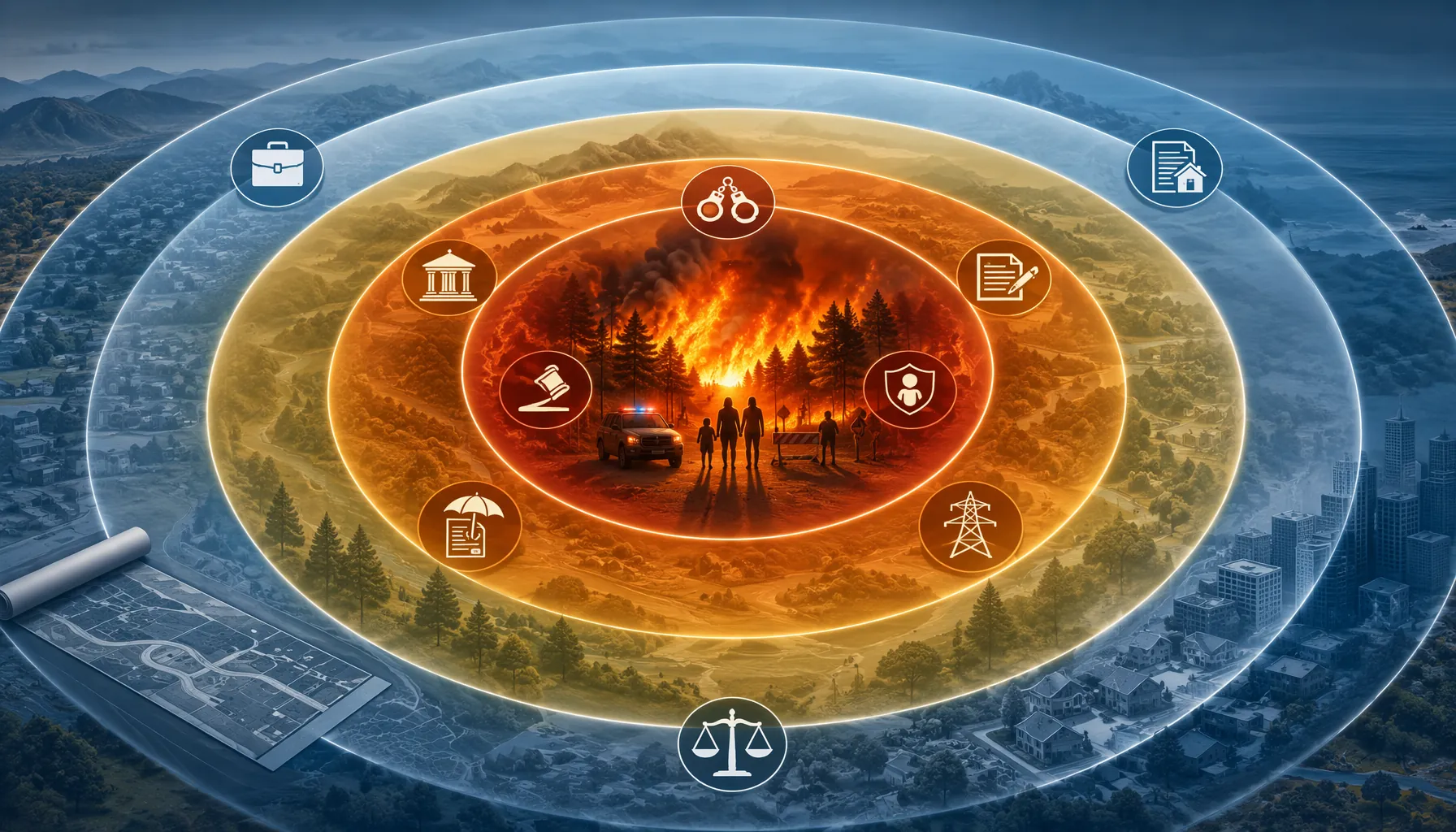
Once people leave, the evacuation order becomes less a command and more a proof document. It helps distinguish a voluntary precaution from a required displacement. That distinction can affect utility claims, insurance payments, employer decisions, and rental disputes, even when each domain uses its own vocabulary.
Utility Claims: Strict Liability Does Not Eliminate the Need for Proof
California’s inverse condemnation doctrine is unusually important in utility-caused wildfire cases. McNicholas & McNicholas describes the doctrine as imposing strict liability on utilities for property damage caused by their equipment, regardless of negligence.[4] That is a strong claimant-side rule, but it does not make every loss self-proving. A claimant still has to connect the fire, the equipment, the affected property or person, and the claimed categories of damage.
Evacuation costs sit directly in that proof gap. Maison Law states that evacuation-related costs may include temporary housing, relocation expenses, and lost income in claims against PG&E, and frames a mandatory evacuation order as important evidence that displacement expenses were required rather than optional.[5] The point is not that a hotel receipt automatically becomes recoverable in every utility case. The point is that the order gives counsel a dated external trigger against which receipts, mileage, boarding costs, missed work, medication replacement, and temporary housing records can be organized.
That organization matters when losses develop in layers. One family may have a short civil-authority evacuation, followed by smoke damage, followed by a longer period of uninhabitability. Another may have no structural damage but may still claim costs tied to mandatory displacement. A business may have closed because employees were barred from access even before physical damage was assessed. In each file, the evacuation order is not the full damages case. It is the first clean date in the damages chronology.
Insurance: ALE Depends on the Policy, and 2026 Reforms Are Uneven
Insurance coverage then asks a different set of questions: whether the policy covers civil-authority evacuation, whether additional living expense coverage applies before direct physical loss is confirmed, how long payments continue, whether a total-loss rule changes the amount owed, and whether the insurer must advance contents or cash-value payments. The evacuation order is usually necessary evidence, but it is not a substitute for policy language.
California’s SB 876, tracked in the 2025-2026 session, is relevant because it responds to the gap between mandatory displacement and available additional living expense coverage. The CalMatters Digital Democracy tracker describes the proposal as expanding additional living expense policy limits by 100% in total-loss cases and requiring upfront cash-value payments within 30 days.[6] Because the bill is legislative material rather than settled final text in this article’s Q3 2026 frame, its provisions should be verified against enacted law before they are used in a coverage letter, demand, or regulatory complaint.
Nevada supplies a different warning, not a national rule. AB 376, effective January 1, 2026, is identified in LegiScan as legislation allowing wildfire coverage to be excluded from standard homeowners policies, requiring separate supplemental coverage.[7] That development is significant because it shows that wildfire insurance rules are moving in different directions across Western states. It does not mean a California ALE analysis, a Nevada exclusion analysis, and a policyholder’s claim in another state can be collapsed into one answer.
For lawyers entering after evacuation, the immediate insurance task is documentary: obtain the declarations page, all endorsements, civil-authority and ALE provisions, insurer notices, payment logs, denial letters, evacuation-zone records, repopulation notices, and proof of when the dwelling became safe or unsafe to occupy. The order starts the inquiry; the policy controls the result.
Employment Issues Do Not Wait for the Fire to Reach the Worksite
An evacuation order can make a workplace problem before the workplace burns. Employees may be unable to report because roads are closed. Others may be asked to work remotely, cover emergency shifts, protect inventory, or return while smoke remains hazardous. The employer’s first mistake is often treating the order as a facilities issue only.
California employers must account for wildfire smoke exposure under Cal/OSHA section 5141.1, and Fisher Phillips’ 2025 wildfire FAQ identifies that rule as part of the employer compliance framework during wildfire conditions.[8] Buchalter separately emphasizes California employer duties around wildfire safety and compliance, including the need to address unsafe conditions rather than simply rely on ordinary attendance expectations.[9]
Wage analysis then turns on classification and work performed. Nonexempt employees generally raise questions about hours actually worked, reporting-time obligations, remote-work authorization, and paid leave use. Exempt employees raise different salary-basis issues when a business closes for part of a workweek or when work remains available. The research materials also flag employee rights to refuse unsafe work under California law and protections for employees serving as volunteer relief workers under USERRA.[8][9]
- Was the worksite inside a mandatory evacuation area, a warning zone, or only affected by smoke?
- Who directed employees to report, remain, evacuate, work remotely, or return?
- Were nonexempt employees paid for all time worked, including emergency communications and remote tasks?
- Were smoke-exposure controls, respirator rules, air-quality communications, and unsafe-work refusals documented?
- Did any employees miss work because of military, emergency, or volunteer relief obligations?
The evacuation order does not decide every wage or safety issue. It does, however, fix the moment when ordinary operations became emergency operations, and that is often the moment payroll, safety, HR, and facilities records should be preserved together.
Rental Housing: Access, Habitability, and Possession Separate Quickly
A tenant who is ordered out may still have a lease, personal property inside, rent coming due, renters insurance questions, and a landlord who cannot inspect the unit. The legal issue may begin with access, but it rarely ends there.
California Civil Code section 1942.9 is identified in tenant-side wildfire materials as providing protections when a dwelling is rendered uninhabitable by an emergency.[10] Other California wildfire-season guidance notes that leases may be voided when a rental unit is physically destroyed.[11] Those propositions should be applied with care: a temporary evacuation order, smoke intrusion, utility shutoff, red-tagged structure, and total destruction are not the same legal condition.
The landlord-tenant file should therefore avoid a single label such as “evacuated.” Counsel needs the access history, habitability evidence, inspection notices, repair timeline, rent ledger, security-deposit communications, local emergency ordinances, insurance correspondence, and any agreement allowing temporary rent abatement, early termination, or property retrieval. A unit may be inaccessible but not destroyed; damaged but repairable; habitable but unreachable; or destroyed in a way that changes possession entirely.
CEQA Is Where the Evacuation Order Reappears Before the Next Fire
The same evacuation record eventually moves upstream into land-use disputes. After a fire, planners, project opponents, agencies, and courts do not only ask whether evacuation happened. They ask whether the next project’s environmental review modeled evacuation in a way that reflects how congestion, phased warnings, road closures, vulnerable populations, and fire behavior interact.
Fehr & Peers’ 2025 analysis of California wildfire evacuation planning describes recent rulings including Center for Biological Diversity v. County of Lake, SCALE v. County of Sonoma, and Sierra Watch v. County of Placer as raising the bar for CEQA evacuation analysis and making static modeling legally vulnerable in favor of dynamic traffic assignment methods.[12] The California Attorney General’s October 2022 wildfire guidance likewise calls for local governments to use expert-driven evacuation analysis in environmental review.[13]
This is not the same legal question as a damages claim after a particular evacuation failure. CEQA asks whether the agency adequately studied a project’s wildfire and evacuation impacts before approval. But real evacuation orders supply the record against which assumptions are judged: how long it took to clear a corridor, which roads failed, whether warnings reached residents, and whether the modeled network resembled the network people actually used.
For project counsel, the task is not to paste emergency-plan language into an EIR and call it evacuation analysis. For litigators, the useful record is operational: alert timing, road-capacity data, closure maps, traffic controls, shelter locations, and after-action reports. The evacuation order that once governed public movement can later test whether a proposed project’s evacuation assumptions were defensible.
The Jurisdictional Limits Are Part of the Analysis
The strongest materials for this map are California-heavy: Penal Code section 409.5, California public-entity immunity, inverse condemnation against utilities, Cal/OSHA wildfire-smoke rules, California landlord-tenant protections, and CEQA evacuation modeling. Nevada’s 2026 insurance development is a useful comparison point because it shows a neighboring state moving toward separable wildfire coverage, but it is not evidence of a national insurance rule.[7]
The same caution applies to source type. Several useful wildfire materials come from plaintiff-side or defense-side law firms. They can identify statutory hooks, pleadings, coverage issues, and litigation theories, but they should not be treated as final adjudications or jurisdiction-free statements of law. Where 2026 legislation is involved, current bill status and enacted text should be checked before relying on a provision.
A mandatory evacuation order is therefore best handled as a legal switchboard. It may create criminal exposure at the closure line, start public-entity claim analysis, document utility-related displacement losses, support or limit insurance payments, change workplace obligations, alter rental housing rights, and later expose brittle evacuation assumptions in project approvals. Attorneys advising on any one of those issues should identify adjacent domains early, verify the controlling jurisdiction and current statutory text, and preserve the source record while it still exists.
References
- Can You Be Arrested for Not Complying with an Evacuation Order? FindLaw.
- Government Liability in Wildfires Robins Cloud LLP, Jan. 2026.
- Wildfire Evacuation Failures & Lawsuits Robins Cloud LLP, Dec. 2025.
- Inverse Condemnation in California Wildfire Lawsuits McNicholas & McNicholas.
- Can You Include the Cost of Evacuation in a Claim Against PG&E? Maison Law.
- CA SB 876 CalMatters Digital Democracy.
- NV AB376 LegiScan.
- Employer FAQs for the California Wildfires Fisher Phillips, Jan. 2025.
- Wildfires and the Workplace Buchalter, Jan. 2025.
- Can You Get Compensation if You Were Forced to Evacuate? Bernheim Law Firm, Jan. 2025.
- Know Your Rights During California Wildfire Season Kershaw Talley Barlow, Aug. 2024.
- California Courts Raise Bar on Wildfire Evacuation Planning Fehr & Peers, Aug. 2025.
- Attorney General Bonta Guidance for Local Governments to Mitigate Wildfire Risk California Department of Justice, Oct. 2022.
Comments
Join the discussion with an anonymous comment.