
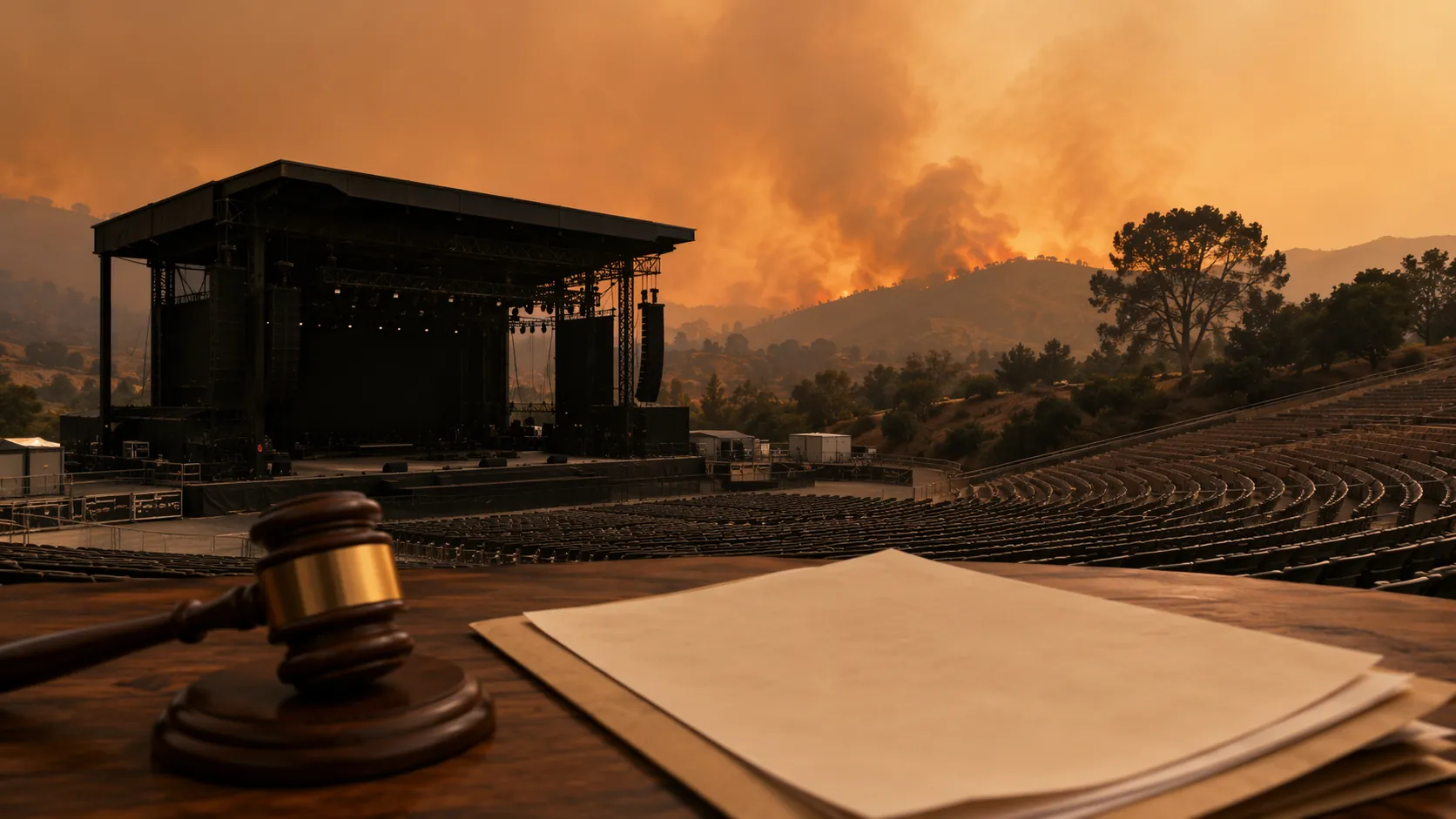
The July 2026 wildfire-smoke cancellations put a familiar live-event problem in a less familiar form. An outdoor concert could not safely proceed because smoke from distant fires had pushed air quality into hazardous territory; the venue, promoter, artist team, insurers, ticketing platform, and local staff all had to act before anyone had a judicial answer. The contract, meanwhile, may have said only “fire,” “act of God,” “weather,” or “government order.” Wildfire smoke is now the uncomfortable cancellation risk many agreements never bothered to name.
TicketNews reported a July 2026 disruption wave tied to Canadian wildfire smoke, including AQI readings exceeding 600 at affected Midwest venues, cancellations or postponements involving more than five major tours or performance groups, and a geographic spread across Wisconsin, Illinois, Michigan, Minnesota, and New York.[1] Rolling Stone separately covered wildfire-driven postponements during the same period, corroborating that this was not an isolated local venue call.[2] AXS TV also reported smoke-related cancellations affecting popular music and orchestral or classical programming.[3]
Those facts explain why cancellation may have been operationally reasonable. They do not, by themselves, answer who bears the loss. A dangerous AQI reading may justify keeping audiences, crews, security workers, vendors, musicians, and stagehands out of the venue. It does not automatically satisfy a force majeure clause written for something else.
The Contract Problem Starts With the Missing Words
Force majeure analysis usually begins in a less dramatic place than the public dispute. It begins with the list. If the clause identifies “fire,” “flood,” “earthquake,” “war,” “terrorism,” “labor strike,” “epidemic,” or “government order,” the first question is whether the event that actually stopped performance is within the language the parties chose.
Venable’s force majeure primer states the general U.S. contract-law point plainly: courts construe force majeure clauses narrowly and generally will not read unlisted events into the clause merely because performance became difficult or impossible.[4] That principle matters here because wildfire smoke is not necessarily the same contractual event as a fire. The fire may be hundreds of miles away. The venue may have no physical damage. The stage may be intact. The artist may have arrived. The impediment is the air.
That distinction is where many entertainment agreements become vulnerable. A clause updated after COVID may now include “pandemic,” “epidemic,” “public health emergency,” or “government restriction,” while still omitting “wildfire smoke,” “hazardous air quality,” “air quality index,” or “smoke from wildfires.” The musiclegal.co.uk analysis of live-music force majeure provisions describes that post-COVID modernization pattern and notes that air-quality and wildfire-smoke language often remained absent, while also discussing narrow interpretive tools such as ejusdem generis under English-law reasoning.[5] That source is useful comparison, not controlling U.S. authority. The U.S. outcome still turns on state law, the contract wording, and the facts developed after cancellation.
The revealing point is not that lawyers failed to predict every climate-related disruption. No clause can sensibly list every possible event. The point is that live-event contracts did learn to name the last visible crisis. Many learned to say “pandemic.” Fewer learned to describe the mechanism by which distant climate events can make a perfectly undamaged venue unsafe to occupy.
Why “Fire” May Not Reach Smoke From Somewhere Else
The ordinary assumption is tempting: wildfire smoke comes from fire, the clause says fire, so the cancellation is covered. That is exactly the assumption counsel should be slow to make.
How To Concerts’ entertainment force majeure analysis draws a practical distinction among a fire at the venue, direct physical damage from fire, wildfire conditions affecting the event site, and smoke transported from distant fires.[6] In a venue-fire case, the causal chain is short. The building burned, the stage is damaged, access is blocked, or safety officials close the premises. In the distant-smoke scenario, the venue may remain physically available while conditions above or around it make outdoor attendance unsafe.
That difference affects more than vocabulary. It affects proof. The party invoking force majeure may need to show the event was within the clause, that it prevented or excused performance under the clause’s standard, that notice requirements were satisfied, and that reasonable mitigation or postponement obligations were addressed. If “fire” is interpreted as direct fire damage or a fire at or near the venue, smoke from distant Canadian wildfires becomes a harder fit.
The same problem appears with “act of God.” The phrase sounds broad, but broad labels do not always do broad work in force majeure litigation. Where a clause contains a specific list, courts often focus on the enumerated events and the surrounding words rather than treating “act of God” as a catchall for every natural condition that disrupts performance.[4] If a contract lists fire, flood, earthquake, tornado, and other physical disasters but says nothing about air quality, a party relying on wildfire smoke is asking the clause to travel a legal distance the text may not support.
There is also no reported U.S. entertainment-contract case squarely deciding whether wildfire smoke qualifies as a force majeure event. That absence should not be buried. It means the July 2026 cancellations sit in a zone of analogical reasoning: general force majeure doctrine, weather and public-health cases, contract-specific wording, and evidence of what actually made performance unsafe. The lack of direct precedent does not make smoke claims weak in every case. It makes confident universal answers irresponsible.
The July 2026 Facts Make the Drafting Gap Harder to Ignore
The reported scale of the July disruption is why this issue belongs on contract desks now, not after the next tour leg collapses. TicketNews tied the cancellations and postponements to more than 800 Canadian wildfires, AQI readings above 600 at affected Midwest venues, and disruption across multiple states and performance categories.[1] Rolling Stone’s wildfire postponement coverage and AXS TV’s reporting on smoke-related cancellations add chronology and industry texture, but they do not supply legal doctrine.[2][3]
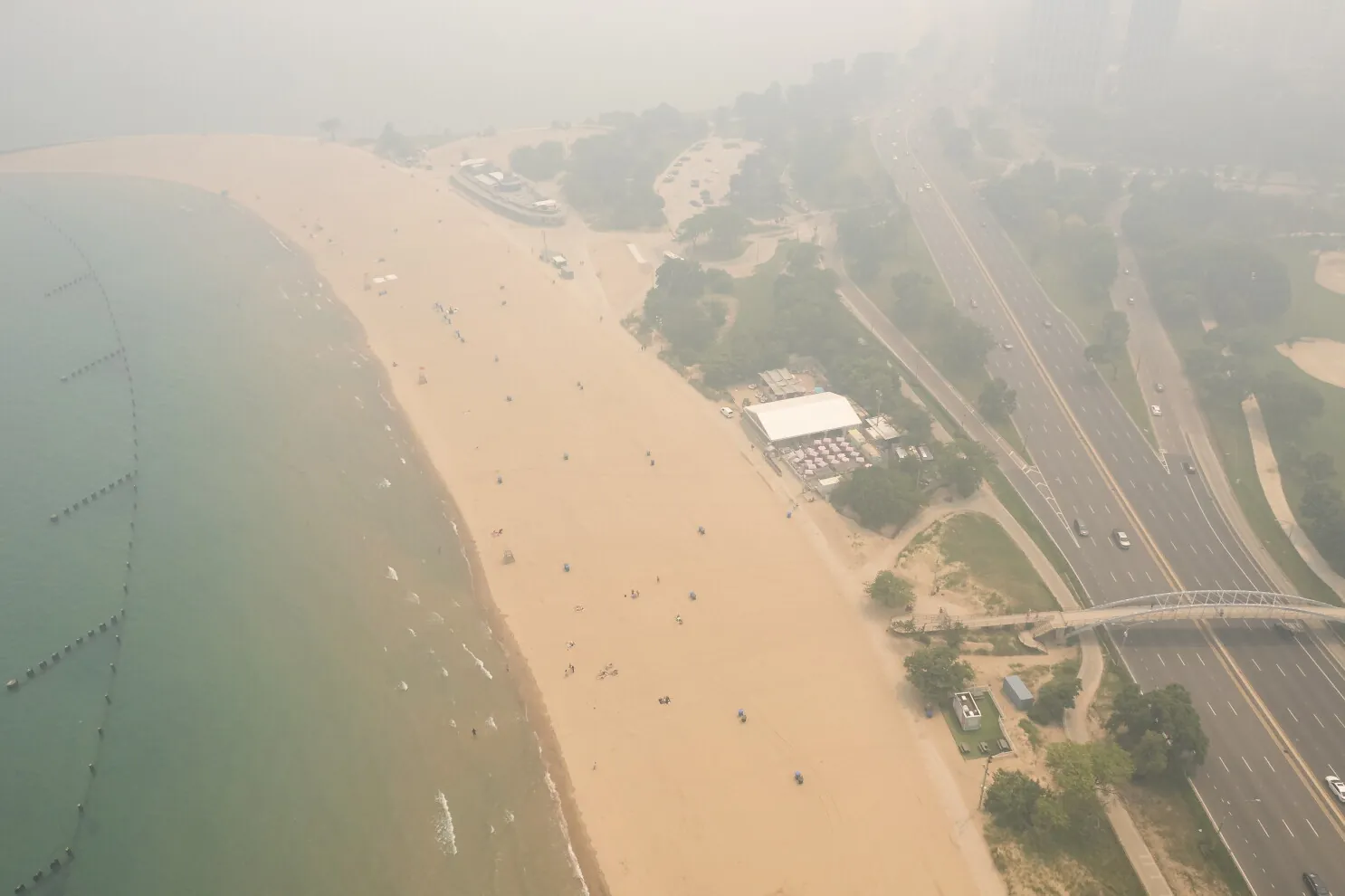
That distinction between chronology and doctrine is not academic. News coverage can establish that cancellations happened, that air quality was severe, and that multiple markets were affected. It cannot determine whether a particular artist agreement, promoter contract, venue license, sponsorship agreement, or ticketing term excused nonperformance. Those answers sit in the agreements and in the evidence file created around the cancellation decision.
The evidence file may matter as much as the clause heading. Who measured the AQI? At what location? Was the relevant threshold tied to the venue, the city, the county, or a government alert? Did local officials issue an advisory or order? Did the promoter consult the venue, artist representatives, production manager, insurer, and public authorities before canceling? Was postponement feasible? Were load-in, rehearsal, security, food service, and crowd management affected before gates opened? These facts can determine whether a smoke event merely made performance undesirable or made it unsafe, impracticable, impossible, or contractually excused under the governing language.
The Artist Who Already Traveled Is a Separate Problem
Smoke cancellations also collide with artist-payment language. How To Concerts notes the “ready, willing, and able” issue in entertainment agreements: an artist who has traveled and is prepared to perform may argue that the guarantee remains payable if cancellation is not clearly excused or if the risk allocation does not shift the loss.[6]
That is not a small accounting point. By the time an outdoor event is canceled for hazardous air, the artist may have incurred travel costs, the promoter may have paid deposits, the venue may have staffed the event, vendors may have loaded in, and ticket holders may already be in transit. A clause that says only “force majeure” without addressing deposits, guarantees, postponement windows, rescheduled-date obligations, and refund allocation leaves several parties doing remedial work under a text that may not answer their most immediate questions.
The party most exposed is not always the party that made the safest decision. A promoter may cancel to protect attendees and workers, then face an artist-payment dispute. A venue may close outdoor areas, then confront rental, concession, and staffing consequences. An artist may be physically present but unable to perform safely. The liability analysis should not punish safety reflexively, but neither should it pretend that a safety-driven cancellation automatically reallocates money.
What Counsel Should Revisit After the Smoke Wave
The better drafting conversation now is not whether “act of God” can be stretched far enough. It is whether entertainment agreements should say what the parties actually mean when smoke makes performance unsafe. These are drafting considerations, not model terms, and they should be tested against the governing law, insurance program, venue type, bargaining position, and operational reality of the event.
| Contract Issue | Why It Matters After July 2026 |
|---|---|
| Named trigger | If parties expect wildfire smoke or hazardous air quality to excuse performance, naming it reduces reliance on general fire or act-of-God language. |
| AQI threshold | A venue-specific threshold can reduce disputes over whether conditions were merely unpleasant, medically hazardous, or contractually disabling. |
| Source of measurement | The agreement can identify whether the relevant reading comes from a government agency, venue monitor, citywide alert, or another specified source. |
| Government alerts and orders | A warning, advisory, closure order, or emergency declaration may have different legal consequences depending on the clause. |
| Postponement duties | The contract can distinguish cancellation from postponement and set timing, availability, and cost-sharing expectations. |
| Financial allocation | Artist guarantees, deposits, refunds, venue fees, ticketing charges, vendor costs, and insurance deductibles may need separate treatment. |
| Notice and mitigation | A party invoking force majeure may need to document when it knew of the condition, whom it notified, and what alternatives it considered. |
| Insurance interaction | Event cancellation, non-appearance, property, and business-interruption coverage may not track the contract’s force majeure wording. |
The AQI point deserves particular care. A general reference to “unsafe conditions” may still invite argument over who decides, when the decision must be made, and what evidence controls. A rigid threshold can create certainty, but it can also create a cliff: one reading below the number may not capture cumulative exposure for workers setting up outdoors for hours; one reading above it may occur before mitigation or schedule changes are considered. Counsel should decide whether the threshold is mandatory, presumptive, or one factor in a broader safety determination.
Government action should also be drafted with precision. A local emergency order closing outdoor gatherings is different from an air-quality advisory urging sensitive groups to limit exposure. A contract that treats all alerts as automatic force majeure may be too broad for one party and too uncertain for another. A contract that requires a binding government prohibition may be too narrow for a promoter that must decide before gates open, before a formal order arrives, or before touring personnel are exposed during load-in.
Postponement language is where legal drafting meets calendar reality. If the artist is available two nights later but the venue is not, who bears the cost? If the smoke persists across a regional route, does each date stand alone or does the tour have a broader suspension right? If tickets are honored for a new date, are refunds optional, mandatory, or governed by ticketing terms and local law? If the contract is silent, the parties may find themselves negotiating under pressure with ticket holders already demanding answers.
Insurance should not be treated as a substitute for contract drafting. The existence of event-cancellation coverage, non-appearance coverage, or other policies does not mean the policy uses the same trigger, exclusions, proof requirements, or loss allocation as the artist or venue agreement. Counsel reviewing smoke language should compare the contract against the insurance program rather than assuming one will rescue the other.
No One Should Overread the Current Law
The strongest current conclusion is a drafting conclusion, not a prediction about how every court will rule. U.S. force majeure law varies by state. The musiclegal.co.uk discussion, including its treatment of ejusdem generis and live-music clauses, comes from English-law analysis and should be used comparatively rather than as U.S. authority.[5] Venable’s narrow-construction principle is a sound starting point for U.S. contract analysis, but the result in any dispute still depends on the clause, governing law, causal evidence, notice, mitigation, and the specific performance obligation at issue.[4]
The July 2026 cancellations show why the old language is no longer comfortable. Hazardous wildfire smoke is not simply another label for bad weather, and it is not always the same thing as fire damage. If entertainment lawyers expect smoke transported from distant wildfires to allocate cancellation risk, they should name the condition, identify the decision trigger, and connect that trigger to payment, postponement, refund, notice, mitigation, and insurance consequences. Litigation outcomes will remain fact- and contract-specific, but the drafting lesson is already visible.
References
- July 2026 coverage, TicketNews.
- Wildfires Force Concerts to Postpone, Rolling Stone.
- Wildfire Smoke Forces Concert Cancellations, AXS TV.
- Understanding Force Majeure Clauses, Venable LLP.
- The Legal Foundations of Force Majeure in the Live Music Industry, musiclegal.co.uk.
- What is Force Majeure in Entertainment?, How To Concerts.
Comments
Join the discussion with an anonymous comment.