
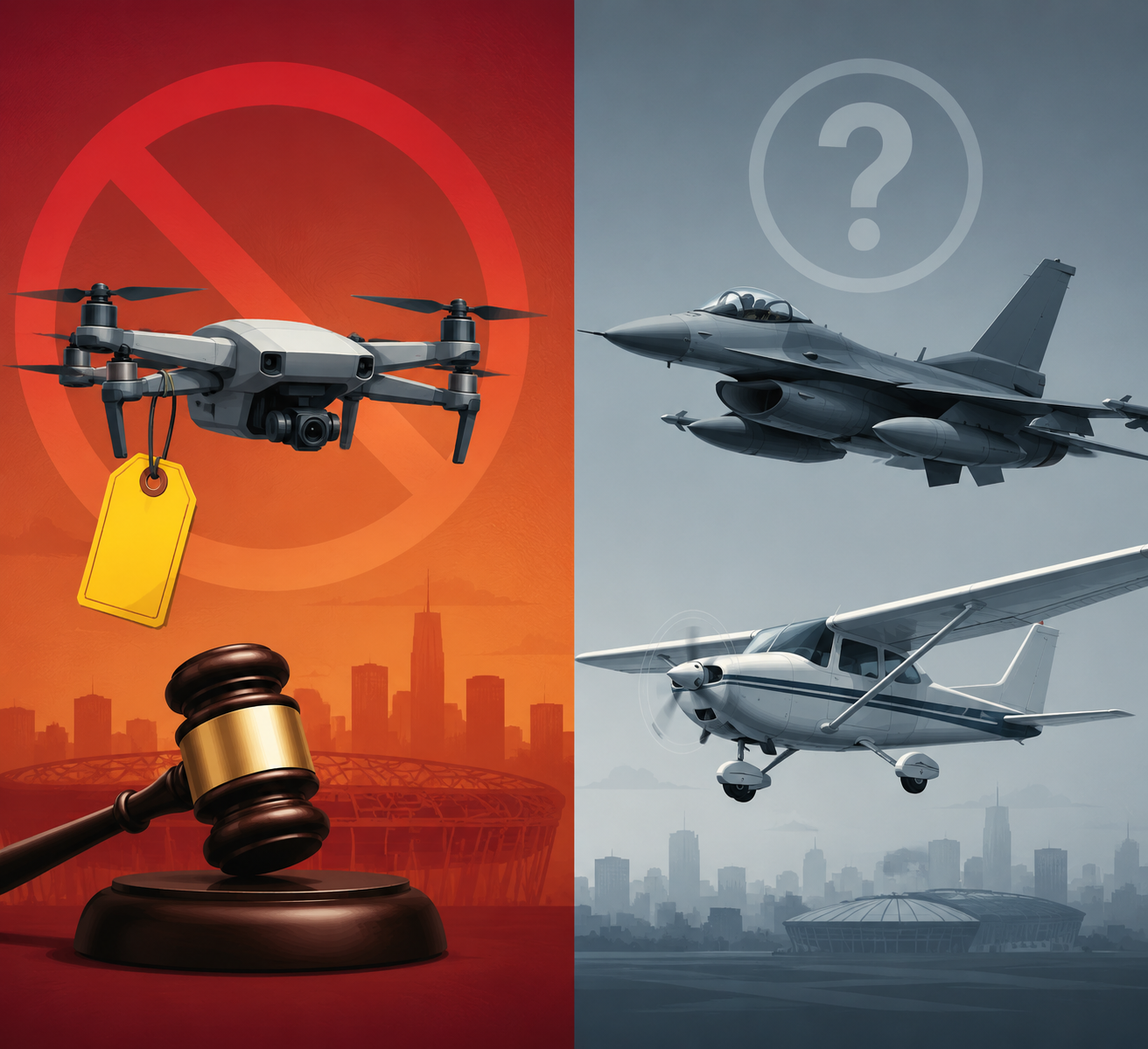
The early World Cup 2026 airspace enforcement record is not developing evenly. Drone operators are already appearing in seizure and charging data: more than 400 drones seized across 11 U.S. host cities, four federal criminal charges identified by name, and field-office figures that show localized enforcement activity in Houston, Seattle, Kansas City, Dallas, and Miami. General aviation pilots, meanwhile, have generated the more dramatic public images: NORAD intercepts, fighter aircraft, and flares. Yet as of this Q3 2026 reporting date, there is no publicly documented FAA civil penalty, certificate action, or criminal follow-up tied to the pilots in the reported NORAD intercepts.
That split is the practical center of the World Cup no-fly zone legal issue. The most visible event is not necessarily the event doing the most immediate legal work. A drone seizure creates a different client problem than a military escort. A federal criminal complaint creates a different timeline than an FAA investigation that may not yet be public. A press release about an intercept tells counsel something important, but not everything needed to assess exposure.
Editorial note: Lex Machina Review is covering this aviation-security story because it is a live example of enforcement-risk analytics under fast-moving regulatory conditions. The point is not aviation spectacle. It is what lawyers can and cannot infer from uneven public records when advising operators before the government’s full enforcement posture has surfaced.
The Enforcement Split Appeared Early
Fox News reported that federal authorities had seized more than 400 drones across 11 U.S. World Cup host cities and that four drone operators had been federally charged: Dinh, Meza, Heer, and Zale. The same reporting gave city-level figures from FBI field offices, including 28 drones seized in Houston, 22 in Seattle, 8 in Kansas City, 4 in Dallas, and 52 tickets issued by FBI Miami as of June 23.[1]
Those figures should not be stretched beyond what they show. They are not a complete national enforcement census. They do not prove that every drone flight near a venue resulted in seizure. They do, however, show an operational pattern: when small unmanned aircraft appear in restricted World Cup airspace, federal authorities are acting quickly enough that seizures, tickets, and criminal charges are already visible in the public record.
The manned-aircraft record is visible in a different way. On July 19, NORAD announced that it had intercepted multiple aircraft violating temporary flight restrictions in the Northeast Region, including more than 10 violations, three military intercepts, and two flare deployments that day.[2] On July 17, NORAD separately announced an intercept of an aircraft violating temporary flight restrictions over New York, New York.[3]
For public understanding, a flare deployment by a fighter aircraft is more memorable than an FBI evidence log. For legal counseling, the immediate consequence may be the reverse. The public NORAD materials establish that intercepts occurred. They do not, standing alone, establish whether the pilot later received a certificate action, a civil penalty notice, a warning letter, a remedial-training resolution, or no FAA follow-up at all.
What the Drone Record Already Shows
The drone side of the record is more developed because the enforcement act itself is tangible. A drone can be located, disabled, seized, cataloged, and tied to an operator investigation. When prosecutors bring a federal charge, the operator’s legal problem moves from compliance counseling to criminal defense.
The available numbers point to both volume and selectivity. More than 400 seizures across host cities is a broad operational footprint; four federal criminal charges is a narrower prosecutorial subset. That distinction matters. Seizure is not the same as conviction, and a charging decision is not proof of guilt. But for a client whose drone has just been taken by federal agents, the difference between “we will review this later” and “your equipment is now in government custody” is not academic.[1]
The field-office breakdown also matters because it suggests enforcement was not merely symbolic at the national level. Houston’s 28 seized drones, Seattle’s 22, Kansas City’s 8, Dallas’s 4, and Miami’s 52 tickets show that local federal personnel were processing incidents, not only issuing general warnings from Washington.[1]
For drone operators, the immediate advisory problem is therefore concrete: preserve communications, identify who controlled the aircraft, determine whether the flight was recreational or commercial, collect authorization records if any existed, and assume that device metadata, controller logs, and flight-path evidence may matter. The public record already supports that level of caution.
What the NORAD Intercepts Do—and Do Not—Establish
The NORAD releases are primary-source evidence of military intercept activity. They identify the existence of temporary flight restriction violations and describe operational responses, including intercepts and flare deployments. They are not FAA enforcement orders. They do not identify final administrative outcomes for pilots. They do not say whether the pilots were later investigated, warned, penalized, referred, or cleared.
That distinction is easy to lose because the intercept image is so forceful. A general aviation pilot who enters a World Cup TFR may face immediate airborne intervention, instructions from air traffic control or military aircraft, post-landing interviews, and later agency contact. But the documented public consequence, as of the cited materials, is the intercept itself—not a publicly reported FAA civil penalty or certificate case.
The absence of public FAA follow-up is not exoneration. FAA enforcement can lag the incident date. Some outcomes do not appear quickly in public reporting. Some matters may resolve through administrative processes that are less visible than a NORAD press release or a federal charging announcement. The safer reading is narrower: the manned-aircraft violations have produced public NORAD intervention, but no public FAA follow-through has been documented in the materials available for this article.

The TFR Framework Explains Part of the Difference
The FAA’s World Cup materials establish the operating baseline: temporary flight restrictions, No Drone Zone designations, safety communications, and penalty warnings for airspace violations tied to the tournament.[4] Those materials place drone operators and pilots under the same broad security environment, but not the same enforcement pathway.
Drone enforcement can run through FAA rules, federal law-enforcement seizure authority, counter-UAS operations, and criminal prosecution depending on the facts. Manned-aircraft cases more typically implicate pilot conduct under FAA operating rules, certificate obligations, airspace compliance, and possible civil penalty or criminal exposure. The legal risk overlaps at the level of “restricted airspace,” but it separates quickly once counsel asks which aircraft, which operator, which agency, and which remedy.
The FAA materials also refer to the Drone Expedited and Targeted Enforcement Response initiative, or DETER, as part of the World Cup enforcement posture.[4] The public materials confirm deployment of that initiative; they do not fully document its internal mechanics. It is therefore fair to treat DETER as evidence of an accelerated drone-enforcement posture, but not as proof of any specific timeline, penalty amount, or charging threshold in an individual case.
Executive Order 14305, issued June 6, 2025, helps explain why the federal posture toward drones is especially aggressive. The order, titled “Restoring American Airspace Sovereignty,” created a federal task-force structure, directed FAA counter-UAS rulemaking activity, and expressly identified FIFA World Cup 2026 as a priority event.[5]
None of that eliminates exposure for manned-aircraft pilots. It explains why a drone may trigger a faster and more visible enforcement chain. A small unmanned aircraft near a stadium can be treated simultaneously as an aviation violation, a security threat, an evidentiary object, and potential contraband for seizure purposes. A Cessna or other general aviation aircraft that strays into a TFR creates a serious security problem too, but the post-incident legal track may depend on pilot intent, communications, flight planning, ATC instructions, notice, deviation history, and FAA enforcement discretion.
Penalty Exposure Is Real, Even When Public Outcomes Lag
The FAA’s World Cup penalty framework warns that TFR and No Drone Zone violations can carry serious consequences, including civil penalties, criminal exposure, and loss of operating privileges.[4] The research record for this article identifies statutory civil penalties up to $75,000 per violation under 49 U.S.C. § 46301 and potential federal criminal fines up to $100,000 for qualifying TFR violations. Those ceilings should be read as exposure limits, not as predictions of what the government will seek in an ordinary case.
For drones, forfeiture risk changes the client conversation immediately. Even before a charging decision, the operator may be trying to recover equipment, protect business records, preserve flight logs, and avoid statements that convert a regulatory incident into a criminal case. A commercial drone operator also has downstream consequences: customer contracts, insurance notice, platform credentials, and future authorization requests.
For manned-aircraft pilots, the most important consequence may arrive later. A pilot who is intercepted and lands without arrest may still face FAA questioning, a request for records, a certificate action, a civil penalty inquiry, or an insurance and employer review. If the pilot is a certificated professional, even a non-criminal administrative outcome can affect employment, insurability, and future compliance disclosures.
This is why public silence after an intercept should not be oversold. It may mean nothing more than that the legal system is slower than the security system. NORAD can respond in minutes. FAA enforcement files, prosecutor reviews, and administrative records move on a different clock.
Venue Geometry Matters, But It Is Not the Whole Story
The specific airspace dimensions vary by location and event function. Newsweek reported FAA TFR details for the New York-area World Cup environment, including a 3-nautical-mile, 3,000-foot restriction around MetLife Stadium and 1-nautical-mile, 1,000-foot restrictions for certain fan-event venues.[6]
Those dimensions matter for defense and mitigation. A pilot or drone operator may have a different explanation if the flight path barely clipped a boundary, if the operator relied on outdated planning information, if the aircraft launched from inside a newly activated zone, or if the operator received conflicting instructions. But the early enforcement record suggests that boundary arguments will be made after federal security personnel have already acted, especially for drones.
Counsel should therefore separate preflight compliance from post-incident defense. Before flight, the task is conservative: current TFR review, NOTAM review, authorization documentation, geofencing verification, crew briefing, and a no-launch decision when the operator cannot confirm status. After an incident, the task changes: preserve records, avoid speculative explanations, identify the agency making contact, and determine whether the matter is administrative, criminal, forfeiture-related, or some combination.
A Practical Risk Map for Counsel
The first question is not simply whether a no-fly zone was violated. It is what kind of aircraft was involved and which enforcement channel has already touched the case. The same stadium security perimeter can generate very different procedural consequences.
| Incident posture | Immediate legal concern | What counsel should verify first |
|---|---|---|
| Drone seized by federal agents | Forfeiture, criminal investigation, FAA enforcement, device evidence | Who seized it, what paperwork was issued, who controlled the aircraft, and what flight data exists |
| Drone operator ticketed but not charged | Administrative or criminal escalation, admissions, repeat-offender treatment | Ticketing agency, cited authority, operator statements, and any prior warnings |
| Manned aircraft intercepted by NORAD | FAA investigation, certificate exposure, civil penalty risk, possible referral | ATC communications, NOTAM/TFR review, pilot planning records, and post-landing contacts |
| Pilot contacted after landing without public charge | Delayed administrative enforcement and record-building | Whether the contact is voluntary, investigative, safety-related, or enforcement-related |
That map is intentionally procedural. It does not assume that every drone operator will be charged or that every intercepted pilot will be spared. It recognizes that the first visible government action often determines the next legal move. A seizure requires property and evidence analysis. An intercept requires reconstruction of flight planning, communications, and pilot decision-making. A ticket may look minor until it becomes the documented first contact in a larger file.
For corporate risk officers, the distinction is just as practical. A media team operating drones near a fan zone needs approval records, vendor controls, and a launch/no-launch chain of command. A company moving executives by charter during event windows needs pilot briefings, airport procedures, and a plan for diversion or delay when restrictions change. Both are aviation-risk problems. They do not produce the same enforcement file.
The Boundary Around NORAD Authority
There is a larger legal architecture behind domestic air-defense operations, including the relationship between NORAD’s mission, civilian airspace regulation, and domestic law-enforcement limits. That question is important, but it is not the issue doing most of the practical work in the current World Cup record.
For this fact pattern, the more useful boundary is evidentiary. NORAD releases show the security response. FAA materials show the TFR and penalty framework. FBI-related reporting shows seizure and charging activity. Each source answers a different question. Treating them as interchangeable leads to bad advice.
A fighter intercept does not itself tell counsel the FAA’s final enforcement position. An FAA No Drone Zone warning does not itself prove a particular operator committed a chargeable offense. A seizure count does not establish conviction rates. The legal implications come from connecting each documented act to the agency and procedure that can actually impose consequences.
The Current Judgment
World Cup 2026 appears to be establishing a sharply differentiated enforcement posture. Drone operators are facing fast, visible seizure activity and documented federal criminal charges. Manned-aircraft violations have produced dramatic NORAD intercepts, including flare deployments, but no publicly documented FAA civil penalty, certificate action, or criminal follow-up appears in the available record as of this reporting date.
The advisory implication is not that pilots are safe, or that drone operators are always criminally exposed. It is that mass-event TFR counseling has to be tailored by aircraft type, enforcement agency, and timing of public records. In this World Cup record, the most important legal consequence is not appearing at the same speed for every airspace user.
References
- Feds charge four in World Cup drone crackdown that tops 400 seizures across US host cities nationwide, Fox News
- NORAD intercepts multiple aircraft violating temporary flight restrictions in Northeast Region, DVIDS, July 19, 2026
- NORAD intercepts aircraft violating temporary flight restrictions over New York, New York, DVIDS, July 17, 2026
- FIFA World Cup 2026, Federal Aviation Administration
- Restoring American Airspace Sovereignty, The White House, June 6, 2025
- Fighter Jets Intercept Plane Violating World Cup No-Fly Zone in New York, Newsweek
Comments
Join the discussion with an anonymous comment.