
A ticket listed for a 2026 World Cup match in Toronto is not legally equivalent to a ticket listed for a match in Kansas City, Foxborough, Houston, Mexico City, or the New York/New Jersey market. That is the practical problem behind World Cup ticket resale regulation in 2026: FIFA can operate one tournament and impose one private resale posture, but the enforceable rules still turn on where the match is played, where the seller acts, what the platform does, and which public authority has jurisdiction.
The best current synthesis of that problem treats the 2026 resale market as a three-country patchwork in which FIFA’s private ticket terms sit beside U.S. federal anti-bot law, U.S. state resale statutes, Canadian provincial interventions, and thinner Mexican municipal enforcement materials. It also notes the pressure behind the market: a reported 500 million random-selection-draw entries and a 2026 resale commission structure described as moving from Qatar’s 5% fee to a 30% commission model, figures that should be used as context rather than as a substitute for jurisdictional analysis.[1]
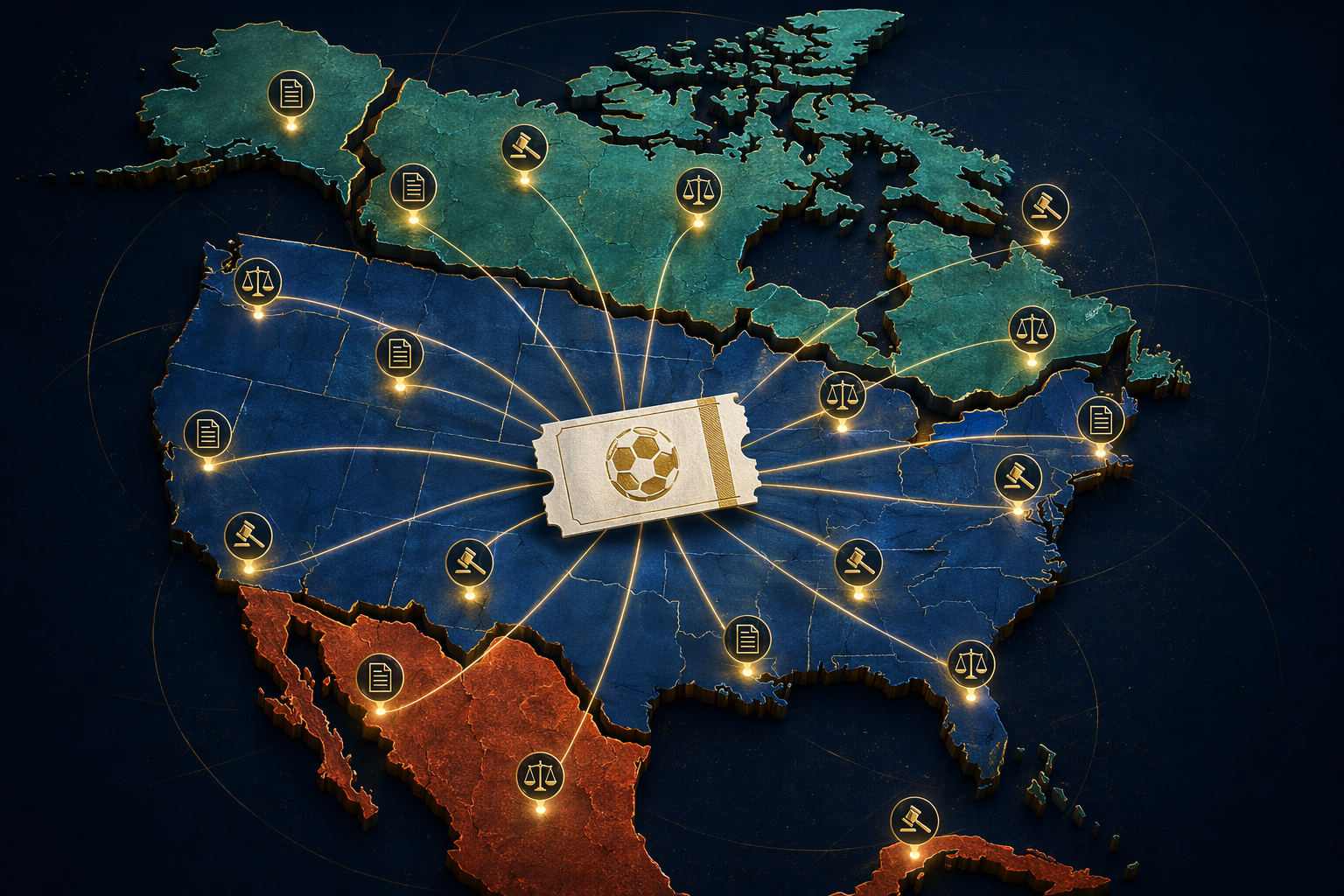
The quick jurisdiction map
For a platform, the first compliance move is not to ask whether a resale is “World Cup legal.” It is to identify the venue jurisdiction and then separate FIFA’s contractual permissions from public-law limits that may affect price, method of sale, physical location of sale, licensing, bot use, or platform listings.
| Jurisdiction layer | Most concrete rule or gap in the available materials | Compliance consequence |
|---|---|---|
| FIFA private terms | FIFA controls official ticketing and resale channels, with the 2026 model described as using a 30% resale commission. | A listing may violate FIFA terms even where local law does not impose a price cap. |
| U.S. federal law | The BOTS Act targets circumvention of ticket-purchase controls; FTC guidance does not treat it as a resale-price statute. | Bot acquisition risk is federal; markup legality remains mostly state-level. |
| U.S. state law | Rules vary sharply, including Maine’s 10% cap, Massachusetts’ $2 limit, New York licensing and venue-proximity rules, Texas venue-adjacent limits, and many states with no price regulation. | A platform needs state-by-state listing logic rather than one U.S. rule. |
| Ontario | Ontario’s World Cup-specific measure caps resale for Toronto matches at face value and allows penalties up to $250,000 per violation. | The clearest documented platform response is Ticketmaster delisting Ontario resale tickets. |
| Mexico | The most specific available rule is Mexico City’s public-space restriction on above-face resale near stadium/public zones; comparable detail for Guadalajara and Monterrey is not established in the provided record. | Mexico requires narrower venue-by-venue caution, not broad claims about national resale law. |
Private FIFA rules are not the same thing as public resale law
FIFA’s private ticketing architecture matters because it controls access to official inventory and the official resale path. But private ticket terms do not answer the separate question of what a state, province, federal agency, or municipality can enforce against a reseller or platform. A breach of FIFA’s terms may allow cancellation or denial of entry; a statutory violation may trigger fines, injunctions, licensing consequences, or consumer-protection enforcement.
That distinction is easy to blur because the same listing can raise both questions. A resale above face value may be outside FIFA’s preferred channel, lawful in one U.S. state, restricted in another, prohibited for Toronto matches under Ontario’s World Cup measure, and vulnerable to a public-space enforcement theory in Mexico City. The operative answer is not supplied by the tournament brand.
Ontario shows why this difference is not academic. Bill 97 created a face-value cap for resale of tickets to Toronto World Cup matches and authorized penalties of up to $250,000 per violation.[2] Ticketmaster then delisted Ontario resale tickets after the new cap took effect, a direct example of a jurisdiction-specific rule changing platform behavior before kickoff.[3]
The U.S. layer: federal anti-bot enforcement, state resale rules
The United States supplies most of the 2026 host venues, but not a single resale-price regime. The federal BOTS Act is important, just not for the reason it is sometimes invoked. FTC compliance guidance frames the statute around circumventing online ticket controls, using bots or similar tools to bypass purchase limits, and selling tickets obtained through that kind of circumvention. It does not set a national cap on resale prices.[4]
That leaves the price and marketplace-design questions largely to state law. A commercial 50-state resale-law grid is useful as a finding aid, although not a substitute for primary statutory review. Its survey identifies Maine’s 10% cap, Massachusetts’ narrow $2-above-face limit, New York’s licensing and 1,500-foot venue-proximity rules, Texas restrictions on venue-adjacent resale, and more than 20 states with no price regulation at all.[5]
Maine is useful because the statutory text is unusually direct: Title 8, Section 1301 limits resale to no more than 10% above the original price for certain tickets.[6] Maine is not a 2026 host state, but its cap matters as a counterexample to the assumption that U.S. resale law is uniformly permissive. If a state with a World Cup venue had adopted that model, platform pricing rules would need to change for that venue in the same way Ontario has already forced a change for Toronto.
What that means for the U.S. host markets
A U.S. marketplace cannot solve 2026 compliance by tagging all domestic matches as one category. The relevant review has to start with the host venue and then expand to the conduct around the sale: where the ticket is listed, where the seller is located, whether the platform is licensed where licensing is required, whether physical resale occurs near a venue, and whether acquisition involved prohibited bot circumvention.
| Host-market example | Rule signal in the available materials | Why it matters |
|---|---|---|
| Foxborough / Massachusetts | Massachusetts is identified as allowing only a narrow $2 markup above face value. | A platform treating all U.S. listings as uncapped would risk missing one of the strictest state price limits. |
| New York / New Jersey market | New York is identified with licensing obligations and a 1,500-foot venue-proximity rule. | The FIFA host label does not eliminate the need to map conduct on each side of the state line. |
| Dallas and Houston / Texas | Texas is identified with a venue-adjacent resale restriction. | The legal issue may be less the online markup and more where physical resale activity occurs. |
| Other U.S. host states | The survey identifies many states with no price regulation. | No price cap does not mean no compliance work; bot acquisition, disclosure, fraud, transferability, and platform terms still matter. |
The most common analytical mistake is to let the BOTS Act do more work than it can do. If a ticket was acquired through unlawful circumvention, federal enforcement risk may attach. If a ticket was acquired without bot circumvention and then listed at a high markup, the federal anti-bot statute is not the price regulator. That second question drops back into state law, private platform rules, FIFA terms, and ordinary consumer-protection theories.
That division also affects evidence gathering. A bot case asks for logs, purchase-limit bypass evidence, account patterns, and circumvention tools. A state resale-price case asks for face value, fees, markup, location, license status, and the statutory category of the ticket. A platform that collects only one set of facts will be underprepared for the other.
Ontario is the sharpest current test
Canada’s host-city picture is not evenly developed in the available materials. Vancouver may raise its own provincial and consumer-protection questions, but the record supplied here is strongest for Ontario because the province enacted a World Cup-specific intervention for Toronto matches. Ontario’s rule is not merely a general anti-fraud statement. It targets resale price by capping covered resale at face value and backs that cap with penalties up to $250,000 per violation.[2]
The platform consequence followed quickly enough to matter for compliance planning. CBC reported that Ticketmaster delisted Ontario resale tickets after the new law capped prices at face value.[3] That response is more probative than a generic debate about whether resale caps are good policy. It shows that a platform with tournament inventory exposure may decide that the operational answer is not repricing, warning language, or case-by-case review, but removal from the resale channel.
Ontario’s enforcement posture has also been described in provincial reporting as a tightening of fines on illegal ticket resellers ahead of the World Cup.[7] The important point for a legal or compliance reader is the combination: a specific event-linked price rule, a high stated penalty ceiling, and a documented platform reaction. That combination makes Ontario the cleanest example so far of public law reshaping the 2026 resale market before the tournament begins.
It also creates a hard contrast with many U.S. host states. In a no-cap state, FIFA may still prefer official resale and may still impose private consequences for unauthorized transfer. In Ontario, the province has added a public price rule. That difference changes listing design: a platform may need venue-level suppression, face-value validation, fee treatment review, seller notices, and escalation paths for Toronto tickets that it does not apply to other North American venues.
Mexico: the known rule is narrower than the risk
The Mexico materials support a more cautious conclusion. A global ticket-resale law summary identifies Mexico as more restrictive than fully open resale markets, but the supplied record does not provide a complete federal-versus-state analysis for World Cup ticket resale.[8] That limits what can responsibly be said about Guadalajara and Monterrey.
The most specific available Mexican rule concerns Mexico City: public-space resale above face value near stadium or public zones is treated as restricted under the Mexico City Civic Culture Law as summarized in the available materials.[8] That is not the same as a fully mapped national online-resale regime. It is a location-sensitive rule, and its practical force may depend on where the resale conduct occurs, whether enforcement is directed at street activity, and how authorities treat digital listings tied to local delivery or venue access.
For Guadalajara and Monterrey, the safer conclusion is that the current record is incomplete. A platform or adviser should not assume those markets are unregulated merely because the available English-language materials are thinner. Nor should they import Mexico City’s public-space rule wholesale into other host cities without confirming the applicable state, municipal, consumer-protection, and event-specific authorities.
Where compliance decisions actually get made
For secondary marketplaces, the patchwork becomes a product and operations problem. The legal memo has to become listing fields, seller attestations, automated blocks, manual review queues, fee calculations, geofencing decisions, delisting triggers, and records that can be shown to regulators later.
- Venue classification: identify the stadium jurisdiction, not just the FIFA host-city label.
- Price logic: distinguish no-cap states, narrow markup caps, face-value caps, and rules that apply only to physical or venue-adjacent resale.
- Acquisition review: separate bot-circumvention risk from ordinary secondary resale.
- Channel control: decide when FIFA terms require official-channel use even if local law is silent on price.
- Evidence retention: preserve face value, seller identity, listing history, transfer route, and delisting rationale.
Consumer-facing enforcement pressure sits nearby but should not be mistaken for the core resale-law map. Practical guides warning about fake World Cup tickets and unauthorized sellers are useful reminders that fraud and invalid-transfer risk will accompany the tournament.[9] They do not answer whether a particular markup for a particular venue is lawful.
The same is true of broader scrutiny of major resale platforms and state attorney general activity. Those developments may influence enforcement appetite, disclosure expectations, and settlement risk, but the venue-specific legal questions remain. A Toronto resale cap, a Massachusetts markup limit, a Texas venue-adjacent restriction, and a Mexico City public-space rule are different compliance events.
The unresolved conflict
The most difficult conflicts may not be fully visible until tickets move at scale. FIFA can condition ticket use through contract. Governments can regulate resale conduct through statutes, administrative enforcement, consumer-protection law, and public-space rules. Platforms sit between them, often bearing the immediate cost of translating both into operational controls.
Several questions remain open on the present record: how courts would treat a conflict between FIFA transfer restrictions and a local law that protects resale rights; how regulators will allocate responsibility between individual sellers and marketplaces; whether fees count toward capped resale price in every jurisdiction; and how municipal restrictions on in-person resale apply when the transaction begins online.
What the evidence does support is narrower and more useful: the 2026 World Cup resale market is not governed by a unified legal regime. Until courts or regulators clarify the boundaries between FIFA terms and local law, compliance depends on venue-by-venue rule mapping rather than tournament-wide assumptions.
References
- Tickets, Please! Regulation of the 2026 FIFA World Cup Ticket Resale Market, Suffolk Journal of High Technology Law, May 2026
- Ontario Bill 97 tackles ticket resale for FIFA World Cup 2026, Gowling WLG, June 2026
- Ticketmaster delists Ontario resale tickets after new law caps prices at face value, CBC, 2026
- BOTS Act compliance: Time for a refresher?, Federal Trade Commission, April 2025
- Ticket Resale Laws by U.S. State, ticketflipping.com
- Title 8, §1301, Maine Legislature, 2025
- Ontario cranks up fines on illegal ticket resellers ahead of FIFA World Cup, Toronto Sun, 2026
- Ticket Resale Laws By Country (Global Summary), ticketflipping.com
- What to Know About Ticket Scalping and Fake World Cup Tickets During the 2026 World Cup, Sports Planning Guide
Comments
Join the discussion with an anonymous comment.