
A denied World Cup visa leaves a newsroom with an urgent legal question and a scheduling problem at the same time. For journalists denied World Cup visas, the legal options start with an uncomfortable rule: in nearly all cases, a federal court will not review the consular officer’s decision. Immigration-law analysis of the doctrine of consular non-reviewability notes that the Supreme Court reaffirmed that barrier in 2024, leaving most rejected applicants outside ordinary judicial review even when the denial disrupts work, travel, or family plans.[1]
That does not mean the file is dead. It means the useful work usually moves back inside the visa system and, for a tournament, into the institutions around it. The first task is to separate a denial that may be fixed with a clearer factual record from one that turns on a legal interpretation, a travel-ban category, or a discretionary waiver request.
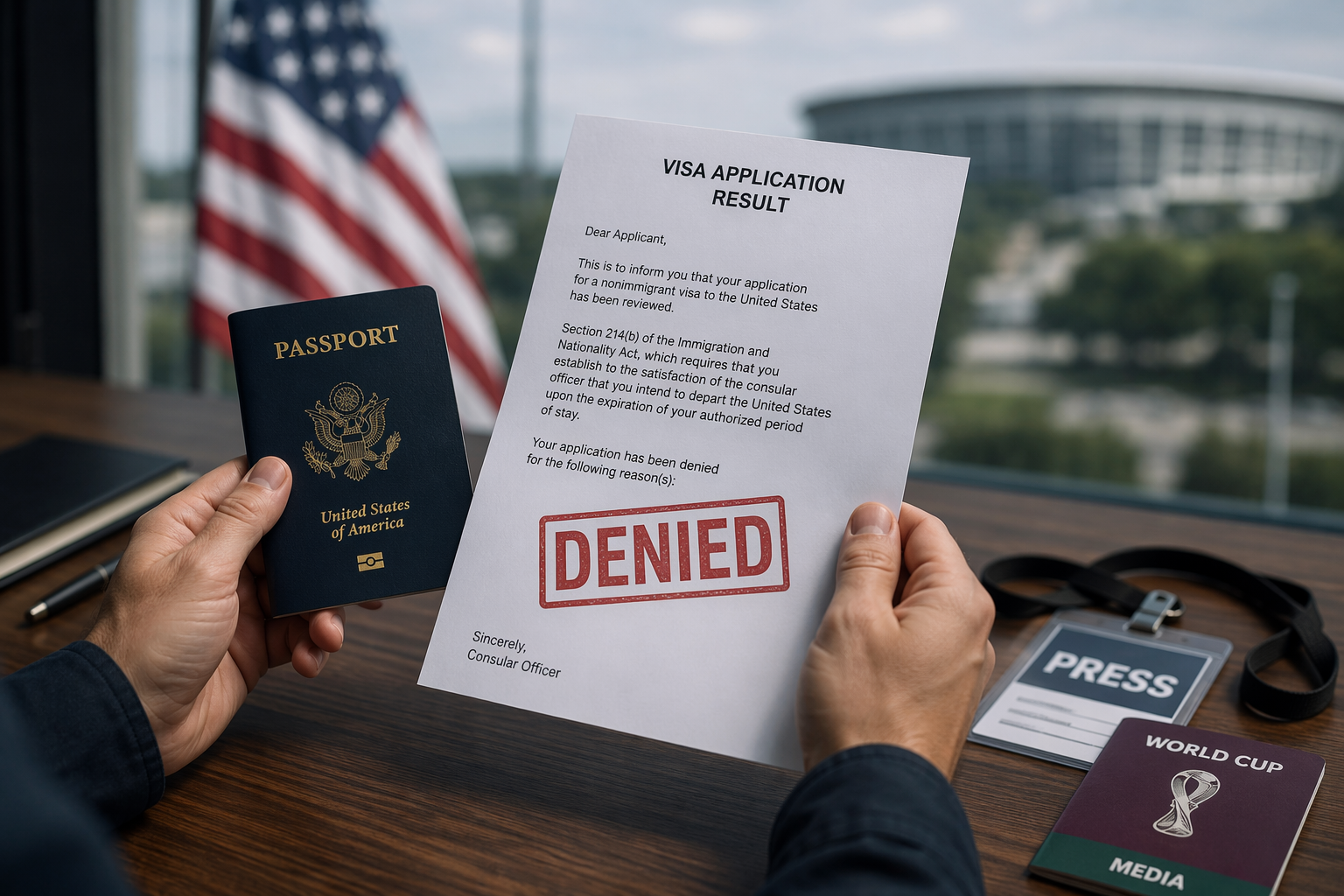
The denial record matters before the next move
Before a correspondent reapplies, asks for review, or seeks help from an outside organization, the newsroom should preserve the record exactly as it exists. Keep the refusal sheet, appointment confirmation, DS-160 confirmation page if applicable, accreditation materials, assignment letter, itinerary, prior visas, travel history, and any correspondence from the consular post. If the refusal cites INA 214(b), that usually points to eligibility or intent evidence. If it cites a proclamation, security review, administrative processing, or a specific ineligibility ground, the next step may be different.
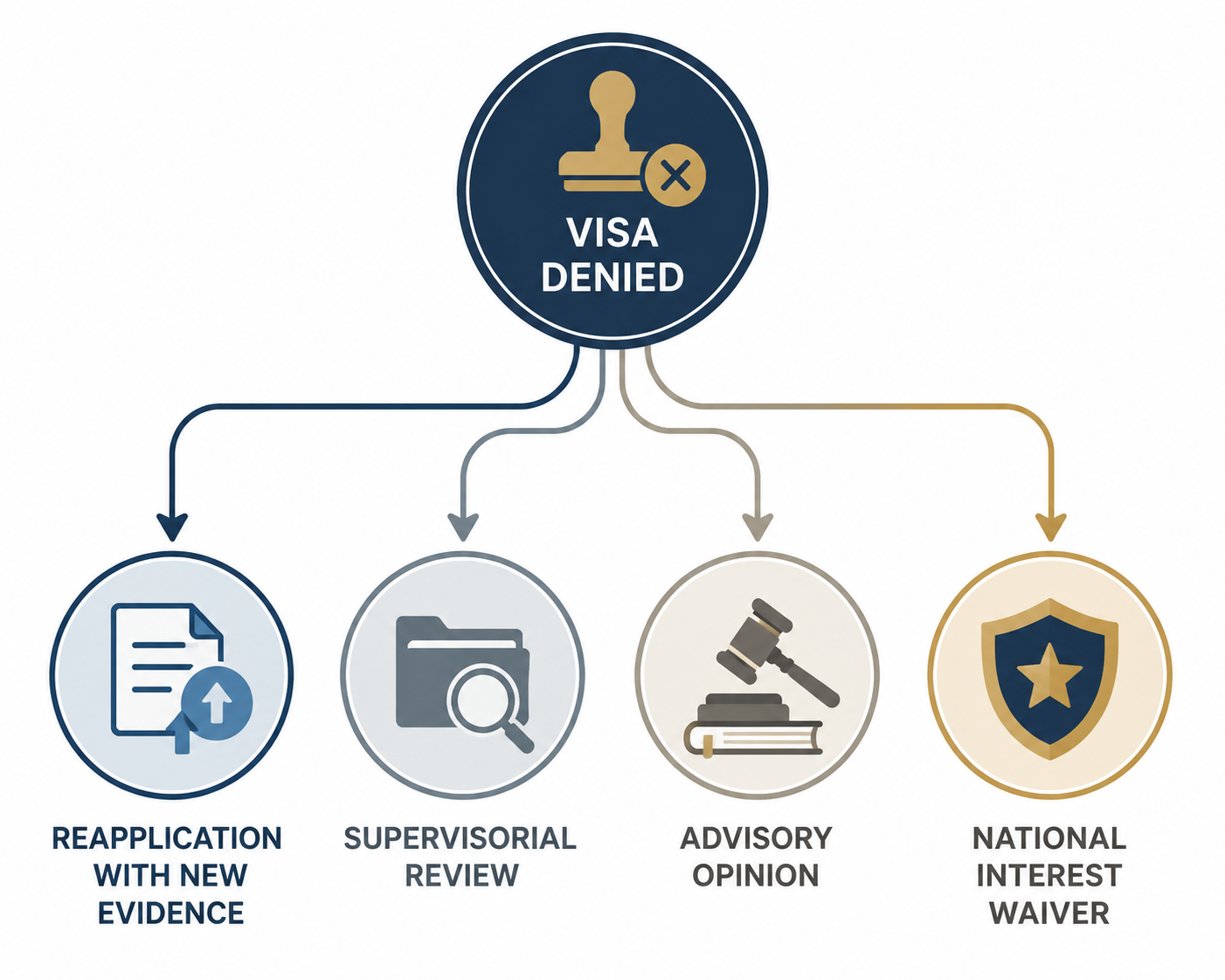
This is also the point to stop treating “appeal” as one thing. A reapplication, a supervisorial review, an advisory opinion, and a national interest waiver request are different routes controlled by different officials. Mixing them together can waste the short time between a fixture, an assignment, and a border crossing.
| Route | Best used when | Who controls it | Main limit |
|---|---|---|---|
| Reapplication | The journalist can add new evidence or correct a weak record | The consular post through a new visa application | A repeat filing without new material may simply repeat the denial |
| Supervisorial review | The concern is that the refusal was mistaken, incomplete, or inconsistent with consular practice | Supervisory staff at the consular post | It is not a guaranteed appeal or a right to a new outcome |
| Advisory opinion | The issue is legal interpretation rather than missing documents | State Department Advisory Opinions Division | It does not reweigh every factual judgment |
| National interest waiver | A proclamation restriction applies and the applicant can make a case-specific public-interest argument | Secretary of State discretion under Proclamation 10998 Section 6(e) | No published formal application mechanism or documented journalist success is identified in the cited materials |
Reapplication is often the practical first route
For many nonimmigrant visa refusals, especially INA 214(b) refusals, reapplication is the most common available route. It is not an appeal of the first officer’s decision. It is a new application, ideally with a stronger file: a clearer assignment letter, proof of employment, proof of residence abroad, prior travel compliance, accreditation, match schedule, return travel, and any evidence that directly answers the reason suggested by the denial.
The discipline is to add material, not volume. A stack of generic letters saying the journalist is respected will rarely be as useful as one precise letter explaining who is assigning the reporter, which events are being covered, how costs are paid, when the reporter leaves, and why the applicant needs the visa category requested. If the first interview left an ambiguity, the second filing should remove it.
A reapplication is weaker when nothing has changed. If the denial turned on a proclamation category, a legal interpretation, or a consular conclusion that the journalist cannot realistically rebut with new facts, simply booking another interview may consume time without changing the decision-maker’s frame.
Supervisorial review exists, but it is not a courtroom
A consular refusal can also be raised for supervisorial review at the post. The important point is modest but real: consular practice includes internal review. Immigration-law summaries of Foreign Affairs Manual guidance describe required review within 30 days for immigrant visa denials, and review of at least 20% of nonimmigrant denials, with deferrals possible for up to 120 days.[1]
For a journalist on deadline, that distinction matters. Supervisorial review may be worth requesting when the record suggests a factual mistake, a mismatch between the visa category and the assignment, overlooked accreditation, or inconsistent treatment of similar applications at the same post. It should be framed as a concise request for review of a specific error or missing consideration, not as a demand that the post defend its judgment.
The newsroom should not describe this to an editor as an appeal with a deadline by which the denial must be reversed. The cited guidance supports the existence of review practices; it does not turn them into a guaranteed second interview, a formal adversarial process, or a stay of the assignment calendar.
Advisory opinions are for legal interpretation
An advisory opinion is a different tool. The State Department’s Advisory Opinions Division can issue guidance on legal interpretation, and immigration-law summaries describe that interpretation as binding, with an interim response expected in roughly 15 days.[1]
That makes the advisory opinion route most relevant when the dispute is about what the law or a proclamation means: whether a category applies, whether an exemption is being read correctly, or whether a refusal rests on a legal premise that the post should not decide alone. It is much less useful when the real dispute is factual, such as whether the officer believed the applicant’s ties abroad, employment documentation, or travel purpose.
A request for an advisory opinion should therefore be narrow. It should identify the legal question, cite the controlling language, attach the relevant refusal and application materials, and avoid relitigating the entire interview. If the question is really “please believe our reporter this time,” reapplication or supervisorial review is usually the more honest label.
The national interest waiver is available on paper, not proven in practice
Proclamation 10998 creates one of the sharpest mismatches for World Cup coverage. NAFSA’s regulatory analysis says the proclamation categorically exempts “athletes and members of athletic teams,” but does not give journalists the same exemption.[2]

Section 6(e) of the same proclamation leaves room for case-by-case national interest waivers at the discretion of the Secretary of State, according to NAFSA’s analysis. But the same available materials do not identify a published formal application mechanism for journalists. They indicate that the issue must be raised during the visa process, case by case.[2]
That makes the waiver worth preserving in the record, but dangerous to oversell. A newsroom can prepare a concise waiver argument explaining the public interest in independent coverage, the specific assignment, the journalist’s credentials, the time-limited itinerary, and the absence of a practical substitute. Counsel can ask that the waiver issue be considered and documented. What the cited record does not support is telling a denied journalist that invoking “national interest” is a known path to admission.
No cited source documents a successful journalist waiver under Proclamation 10998 Section 6(e). That absence is not proof that no waiver has ever been granted; it is a limit on what can responsibly be promised.
Why the World Cup setting makes ordinary visa categories harder
The 2026 tournament adds a structural problem that ordinary assignment travel does not have. It is a three-country event, and AIPS president Gianni Merlo warned in a June 5, 2026 letter that single-entry visas could strand journalists who need to move between host countries and return to the United States during coverage.[3]
The country lists also do not produce one simple answer. NAFSA’s analysis describes Iran and Haiti as subject to a complete ban without a journalist exemption, while some partial-ban countries face restrictions on B, F, M, and J visas but not I visas.[2] The Athletic reported denials affecting journalists despite those category distinctions, and also reported FIFA’s position that consular and immigration matters remain for the authorities rather than FIFA to decide.[4]
That FIFA posture matters operationally. It means FIFA accreditation is powerful evidence of assignment purpose, but not a substitute for a visa. It can support a file; it does not command a consular officer.
Escalation outside the consulate can still help the file
FIFA’s grievance and tournament channels remain worth using when a denial threatens accredited coverage. The request should be practical: confirm accreditation, explain the assignment schedule, identify the consular post and refusal date, and ask whether FIFA can provide documentation or raise the access problem through its own channels. The point is not to imply that FIFA can reverse a visa refusal. The point is to add institutional proof that the journalist is covering a specific event under a recognized credentialing process.
Press-freedom organizations can serve a different function. CPJ published a May 21, 2026 World Cup safety advisory, maintains a World Cup 2026 resource page, and lists a WhatsApp safety chatbot at +1-206-590-6191.[5] Those resources are not visa adjudicators, but they can help a journalist and editor assess safety, rights, documentation, and urgent support needs while counsel handles the immigration file.
The Reporters Committee for Freedom of the Press can also be part of the newsroom’s support map, particularly where legal rights, press access, or detention-risk questions intersect with the visa problem. Its legal hotline is 1-800-336-4243. For immigration strategy itself, the journalist should still rely on qualified immigration counsel; press-rights counsel and immigration counsel are solving related but not identical problems.
The broader access concern is not speculative. In September 2025, the International Federation of Journalists and 118 organizations called on the United States to withdraw visa restrictions affecting foreign journalists covering the World Cup.[6] That statement helps show the issue is collective, but it should not crowd out the individual file work that decides whether one reporter can travel.
A usable post-denial sequence
A newsroom does not need to wait for a perfect legal theory before acting. It needs a clean triage sequence.
- Preserve the refusal record and all application materials before changing the file.
- Identify the apparent basis of refusal: factual weakness, missing documentation, legal interpretation, proclamation restriction, or administrative processing.
- If the problem is factual or documentary, prepare a reapplication with new evidence rather than a louder version of the same file.
- If the problem appears to be an error at the post, request supervisorial review in a concise, documented submission.
- If the problem is legal interpretation, ask counsel whether an advisory opinion request is appropriate.
- If Proclamation 10998 is involved, raise a Section 6(e) national interest waiver argument without presenting it as a proven remedy.
- Escalate through FIFA channels for accreditation support and contact press-freedom organizations where safety, rights, or urgent legal-support issues arise.
The decision for the desk is then practical. If new evidence exists and time remains, reapplication may be the fastest meaningful step. If the file turns on a legal reading, counsel should not bury that issue in a second application without asking whether an advisory opinion or waiver request belongs in the record. If travel is impossible on the original timeline, the editor may need to reassign coverage while the correspondent continues the administrative route.
These options are real procedures. They are not equally strong, and none guarantees entry. The useful distinction after a World Cup visa denial is not between giving up and suing; it is between an available step, an appropriate step, and a step likely to change the record before the assignment disappears.
References
- Options After a Consular Officer Denies Your U.S. Visa Application, Prizant Law.
- Proclamation of December 16, 2025 Travel Ban Effective January 1, 2026, NAFSA.
- International press body calls in FIFA to help with journalist entry to US, Inside World Football, June 8, 2026.
- World Cup journalist visa Iran Africa, The Athletic, June 6, 2026.
- World Cup 2026, Committee to Protect Journalists, May 21, 2026.
- World Cup 2026: Journalists must be able to report unhindered, International Federation of Journalists, September 2025.
Comments
Join the discussion with an anonymous comment.