
For a Yellowstone hot spring injury, the hard answer is usually that recovery dies in federal court long before a jury hears the human story. The one recovery worth naming is the $20,000 Hecht settlement from 1970, a pre-judgment payment in a child-death case that carried no admission of liability and never became a pattern [3].
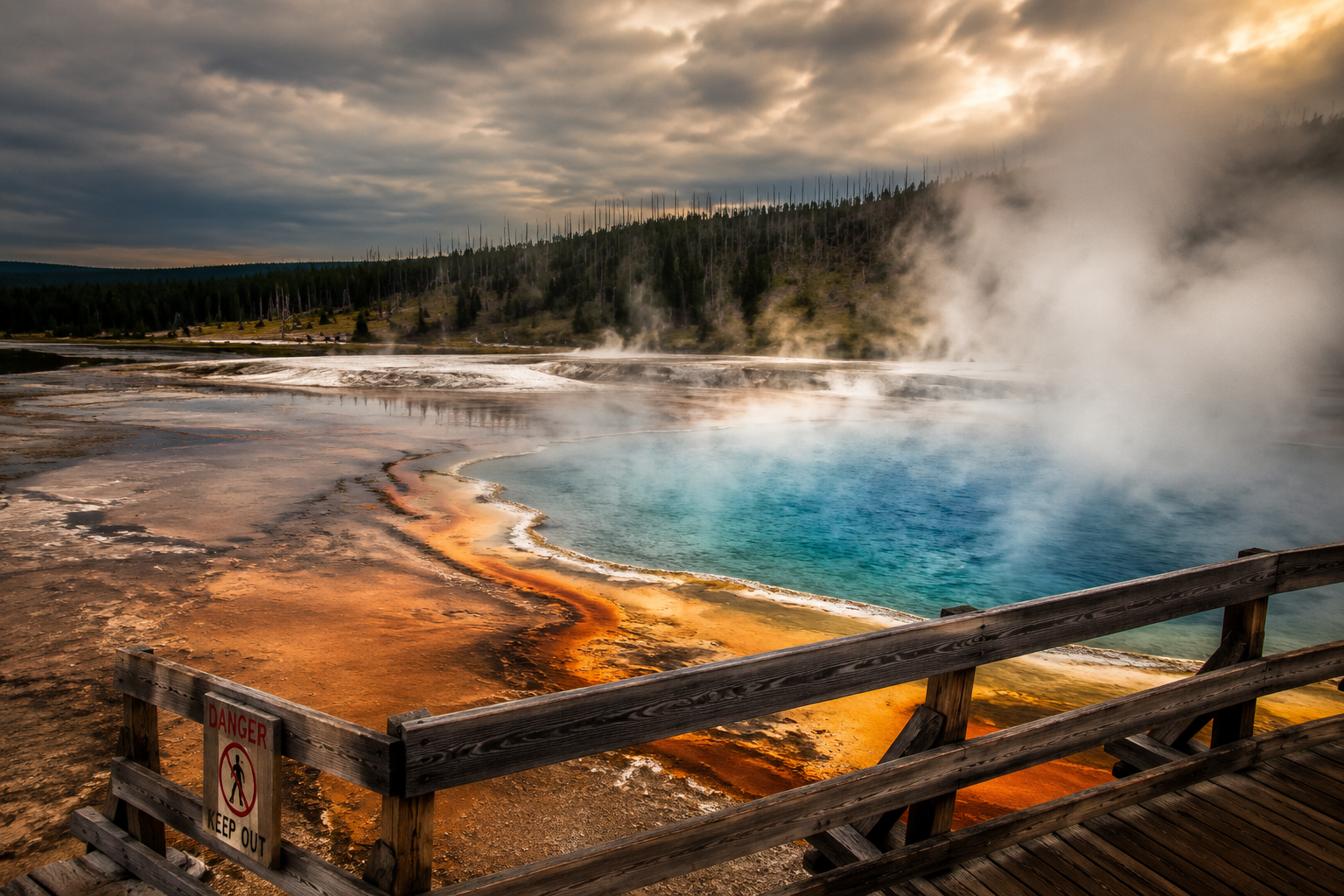
That blunt result sits beside the park's own warning that burns from thermal features are a common cause of serious injury and death, and that the ground around a feature may look solid while being only a thin crust [1]. Yellowstone's thermal features have killed 22+ people since 1890, more than bears and bison combined, so nobody can pretend the hazard is hidden [2].
The FTCA Funnel
The thermal-injury question narrows fast once the claim reaches the statute's procedural gatekeeping. A claimant has 2 years to present the claim, must file an SF-95 with the agency, and generally waits 6 months for agency review before suit can proceed; miss any of that, and the courthouse door closes before fault matters [4][5].
Even when the paperwork is timely, the discretionary function exception does most of the work. Once the injury is framed as a complaint about trail placement, boardwalk design, warning placement, or the choice to leave a thermal area open in a particular configuration, the government argues the case is about policy-laden judgments, not a simple operational miss. If the visitor also left the boardwalk or entered a restricted area, the defense has an obvious fault argument: the danger was posted, visible, and chosen.
Hecht And Buchi
Hecht is the one recovery that deserves to be named because it is so small and so isolated. Media reports describe a $20,000 settlement in the 1970 wrongful-death case involving a child who fell into a pool near Old Faithful. The figure came before judgment, there was no liability admission, and the case led to publicity and safety attention rather than a durable change in the liability record [3].
Buchi is the case defense lawyers point to because it shows how catastrophic injury can still lose on doctrine. In 2004, Lance Buchi reportedly suffered burns over more than 90% of his body after falling into Cavern Spring, a 178F pool, at night after leaving the boardwalk area. A Wyoming federal judge dismissed the suit, holding that trail and boardwalk management decisions fell within the FTCA discretionary function exception [6].
That combination matters more than the emotional weight of the injury. Hecht shows the outer edge of recovery: a small pre-judgment payment with no admission. Buchi shows the center of gravity: severe burn injuries can still end in dismissal when the alleged negligence is recharacterized as protected park management. The recorded Yellowstone thermal-injury history gives plaintiff lawyers no verdict to build on.
Later Incidents, Same Wall
The later incidents only confirm that the hazard keeps recurring. Colin Scott died in 2016 after leaving the boardwalk to go hot-potting; the public reporting points to a fatal, restricted-area entry, not a promising tort record [7]. In 2022, a visitor's foot was found in Abyss Pool, but no public docket or media report has shown a follow-on claim [8].
The 2024 and 2025 injury reports read the same way. In September 2024, the NPS reported a 60-year-old woman with second- and third-degree burns after a fall in a thermal area [9]. On July 29, 2025, the NPS said a 17-year-old had broken through thin thermal crust near Lone Star Geyser and suffered burns to a foot and ankle, describing it as the first thermal injury in Yellowstone in 2025; the investigation was still ongoing at crawl time, so any lawsuit trajectory remains uncertain [10].
The size of the claimed loss can still get large. A $270 million wrongful-death claim tied to an unsecured gate at Arches shows that plaintiffs are pursuing very large administrative demands against the NPS, but it involves a different hazard entirely and does not change the Yellowstone thermal record [11].
Severity is not the missing piece, either. In the 1990s alone, 16 thermal-injury patients were flown to a burn center, averaging 20-day hospitalizations [12]. The injuries are real, the warnings are explicit, and the legal record still leaves only one modest settlement and no plaintiff verdict to point to.
References
- Yellowstone National Park safety page, National Park Service.
- Yellowstone hot springs death toll comparison, Outside Online / USGS.
- Hecht wrongful-death settlement reporting, Outside Online / OregonLive.
- Federal Tort Claims Act filing deadlines and administrative claim requirements, Cutter Law P.C.
- Federal Tort Claims Act claim process and agency review period, National Security Law Firm.
- Buchi v. United States dismissal reporting, Deseret News, Jan. 30, 2004.
- Tourist dies in Yellowstone hot spring after leaving the boardwalk, BBC News, 2016.
- Yellowstone visitor foot found in Abyss Pool, OregonLive, 2022.
- Woman suffers burns after fall in Yellowstone thermal area, National Park Service, Sept. 18, 2024.
- Teen burns foot and ankle after stepping through thermal crust near Lone Star Geyser, National Park Service, July 29, 2025.
- Arches National Park wrongful-death claim reported at $270 million, Wyoming Public Media, 2020.
- Thermal-injury severity data from Yellowstone burn cases, Outside Online.
Comments
Join the discussion with an anonymous comment.