
The Yurezz Home Center matter stopped looking like a contained arrest story on July 16, when the Georgia Bureau of Investigation publicly framed it as a multi-state fraud investigation and asked potential victims to send information to a centralized GBI email address. That posture matters. It tells customers where to report losses, tells other agencies where victim information is being collected, and tells counsel watching the case that Georgia is no longer treating the matter as background noise from another state. The GBI said it was seeking information from people who purchased mobile homes from Yurezz Home Center and directed them to contact its Commercial Gambling Unit, identifying the matter as a multi-state fraud investigation involving the company and its owner, Mark Altman.[1]
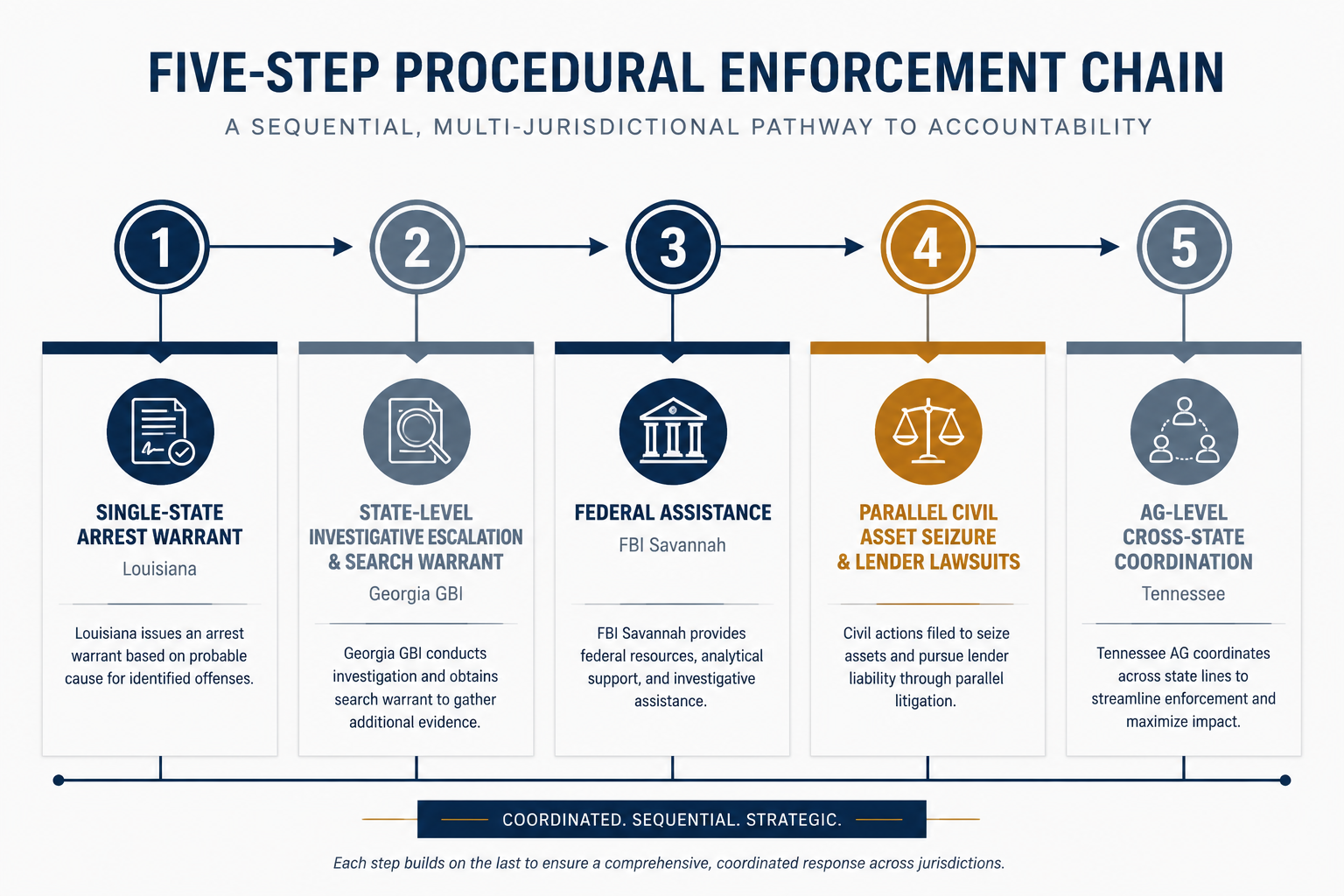
For compliance officers, that is the useful entry point. The question is not whether every allegation will be proved, or whether every civil complaint will survive. The question is how a consumer-facing business dispute becomes visible as a layered enforcement response: first a warrant in one state, then investigative action in another, then federal assistance, then lender litigation and asset preservation, and then movement by additional state authorities.

The sequence matters more than the label
A phrase like “multi-state fraud investigation” can flatten too much. It can make the case sound as though every agency moved at once, under one command structure, toward one already-set conclusion. The public record available so far points to something more incremental and more familiar: different institutions responding to different problems at different moments.
| Procedural signal | What the available record shows | Why it matters operationally |
|---|---|---|
| Louisiana arrest warrant | Mark Altman was arrested in Louisiana on July 8, according to local reporting. | A single-state criminal action can become the trigger that makes other states move faster. |
| Georgia search warrant | GBI agents executed a search warrant at Yurezz Home Center in Baxley, Georgia. | Search execution turns an inquiry from intake and review into evidence collection. |
| Federal assistance | The FBI Savannah Resident Agency was described as assisting Georgia law enforcement. | Assistance is not the same thing as federal control or federal charges. |
| Civil lender pressure | Lenders filed lawsuits and sought emergency seizure of inventory and collateral. | Asset preservation can run beside a criminal investigation, not merely after it. |
| Additional state movement | Tennessee investigative activity was reported after the Georgia and Louisiana actions. | Multi-state coordination often appears in layers rather than in a single public announcement. |
That sequence is also a warning against sloppy source hierarchy. The GBI press release is the best public source for the official Georgia investigative posture and victim-intake channel. Local reporting supplies details about execution, timing, affected customers, and lender actions. Civil lawsuits show private financial pressure and allegations by lenders, not criminal findings. Each source answers a different question.
From a Louisiana arrest to Georgia investigative escalation
The public timeline begins, for practical purposes, with the July 8 arrest of Yurezz co-owner Mark Altman in Louisiana. WCYB reported that Altman was behind bars after being arrested on a Louisiana warrant, and that the arrest came as lenders were seeking emergency action over Yurezz inventory and collateral.[2] That first date is important because it gives the rest of the enforcement pattern a point of ignition.
Georgia’s role then became more visible. WTOC reported that the GBI executed a search warrant at the Yurezz Home Center location in Baxley in connection with the multi-state fraud investigation.[3] A search warrant is a different procedural animal from a public request for tips. It means investigators have moved from receiving or reviewing complaints into court-authorized evidence collection at a specific location.
That does not make every reported loss a proven criminal count. It does mean the state had reached the point where business records, communications, or other materials at the premises were considered important enough to seek judicial authorization. For a company, that is usually the stage at which ordinary customer-service chaos becomes legal triage: documents must be preserved, staff need instructions, and any informal explanations given to customers can become part of the record.
The GBI’s July 16 request for information sharpened the picture. The bureau asked people who purchased mobile homes from Yurezz Home Center to contact investigators at a dedicated email address and identified the GBI unit collecting that information.[1] Centralized victim intake is not decorative. It reduces the chance that reports scatter across local police departments, attorney general complaint portals, dealership contacts, social media groups, and private counsel inboxes.
Federal assistance should be read carefully
The Greeneville Sun reported that the FBI Savannah Resident Agency assisted as Georgia law enforcement executed the search warrant at Yurezz Home Center in Baxley.[4] That is significant, but it should be kept in its lane. Assistance by an FBI resident agency is not the same as a public federal takeover of the case, and the available materials do not support saying federal charges have been filed.
This distinction is not hair-splitting. In multi-state matters, federal agents may help with logistics, interviews, records, technical capacity, or coordination without becoming the charging authority reflected in the public docket. If a company’s internal message to executives turns “FBI assisting” into “the FBI is leading,” it can distort privilege decisions, disclosure planning, insurance notice, and board reporting.
The more reliable reading is narrower: state investigators in Georgia had a search warrant; the FBI Savannah Resident Agency assisted; the public record, as of now, does not show federal charges. That is enough to raise the stakes without inventing a procedural status that has not been announced.
Why lenders moved while investigators were still gathering facts
The civil side did not wait for the criminal side to finish. WCYB reported that lenders, including Northpoint Commercial Finance and 21st Mortgage, filed lawsuits tied to Yurezz, and that Northpoint claimed it was owed $28.9 million.[2] That number belongs to the lender’s civil claim. It is not a criminal loss finding, and it is not the same thing as a verified customer-loss total.
Still, it explains why the case escalated quickly on the asset side. When lenders believe inventory, proceeds, or collateral are at risk, they do not need to wait for an attorney general, state bureau, or prosecutor to finish building a fraud case. They can seek emergency relief in civil court to preserve property or prevent further dissipation. That pressure can land on the business at the same time investigators are executing warrants and customers are reporting losses.
This is one of the more useful lessons from the Yurezz record. A company in distress may experience the civil and criminal tracks as one crisis, but they are not the same track. A lender complaint tests contract rights, collateral, financing arrangements, and emergency remedies. A criminal investigation tests evidence of unlawful conduct under applicable statutes. The witnesses, documents, and allegations may overlap, but the burdens and objectives differ.
That distinction is especially important for Heather Altman. The research record identifies her as named in civil lawsuits, but it does not support saying she has been criminally charged. Articles and internal briefings that collapse civil defendants into criminal defendants create avoidable legal and reputational errors.
Victim intake is not just a public-facing gesture
Customer accounts explain why intake mechanics matter. WSAV reported from customers who described paying money toward mobile homes and then facing uncertainty after Yurezz’s closure, including individual reported losses in the tens of thousands of dollars.[5] Those accounts should not be used to calculate an official loss total, but they show the practical problem investigators face: many people may have similar-looking documents, similar payment histories, and different stages of delivery, financing, or title transfer.
WSAV also reported that a customer-created Facebook group had grown to more than 200 members.[5] That is useful context, not an official victim count. A social media group can include purchasers, relatives, observers, employees, reporters, and people still trying to understand whether they are affected. Treating that number as a verified customer total would overstate what the source can bear.
The better use of that detail is operational. When a customer group grows outside formal channels, investigators and company counsel should assume information is already circulating before subpoenas, warrants, or preservation notices are complete. Screenshots, payment receipts, sales documents, text messages, and rumors may all begin moving at once. A centralized intake address, like the one announced by the GBI, gives potential victims a place to send information that can be sorted, compared, and preserved in a more disciplined way.[1]
The state count is less settled than the pattern
There is some variation in public descriptions of how many states Yurezz operated in or affected. Some reporting describes operations across five states, while other accounts include Alabama separately in the broader footprint. The safe conclusion is narrower: the investigation and related reporting concern alleged conduct crossing multiple southeastern state lines, with Georgia, Louisiana, and Tennessee each appearing in the public procedural timeline.
That narrower conclusion is still enough for compliance purposes. A business does not need a perfectly settled state count before the coordination problem becomes real. Once customers, inventory, financing, sales locations, bank accounts, and witnesses sit in different jurisdictions, no single local explanation will be operationally sufficient.
How AG-level coordination fits beside state bureau work
The Tennessee piece is important because it shows the investigation expanding across state lines rather than merely generating Georgia activity after a Louisiana arrest. WCYB reported that Tennessee authorities had opened an investigation connected to Yurezz, adding another state-level lane to the matter.[2] That does not mean every state is doing the same thing, or that all agencies have identical evidence. It means the case has the kind of footprint that can draw separate state authorities into related but distinct roles.
That is consistent with how multi-state attorney general investigations often work as a general procedural matter. A Reuters legal-industry piece by Troutman Pepper Locke describes state AG investigations as matters that may involve civil investigative demands, coordination among states, document production, negotiation, and eventual settlement mechanics.[6] That article is not evidence about Yurezz. It is useful because it describes the broader machinery that can run parallel to criminal investigative steps.
In practice, counsel should not wait for one master notice titled “multi-state investigation.” The first notice may be a customer complaint forwarded by an AG office. The second may be a subpoena, CID, preservation request, warrant, insurer inquiry, lender default letter, or call from another state’s investigator. The Yurezz record illustrates why the order matters: by the time the public sees a coordinated pattern, several institutions may already have been acting from their own authority.
What counsel should take from the Yurezz timeline
The practical lesson is not that every troubled dealership, retailer, lender relationship, or customer complaint will become a multi-state fraud investigation. Most will not. The lesson is that when escalation does happen, it often becomes visible in pieces. A local arrest does not answer the Georgia question. A Georgia search warrant does not answer the Tennessee question. FBI assistance does not answer the federal charging question. A lender’s $28.9 million civil claim does not answer the criminal loss question.[2][4]
A useful internal escalation memo would track the case by authority and function, not by headline. Which agency issued the warrant? Which court authorized the search? Which agency is collecting victim information? Which private parties are trying to preserve assets? Which states have opened their own investigative lanes? Which allegations are civil, and which charges have actually been filed?
- Treat centralized victim intake as a sign that investigators are organizing evidence, not merely asking for tips.
- Separate assisting agencies from lead agencies unless an official source says otherwise.
- Keep lender allegations, customer reports, and criminal charges in separate columns.
- Preserve documents before trying to reconcile every public inconsistency in state counts or customer totals.
- Watch hearing dates and emergency asset motions because they may determine what remains available while investigations continue.
The next procedural milestone now sits in civil court. WCYB reported an August 4 hearing in Georgia Statewide Business Court tied to the emergency seizure effort.[2] That hearing is the place to stop the analysis for now. It may clarify what happens to inventory or collateral while the criminal and state investigative tracks continue, but it should not be treated as a forecast of final criminal outcomes.
The Yurezz Home Center multi-state fraud investigation is still developing. What is already visible is the architecture: single-state arrest, Georgia search activity, federal assistance, civil lender pressure, centralized victim intake, and additional state movement. For companies and counsel, the warning signs arrive sequentially; waiting for them to arrive simultaneously can leave organizations reacting late.
References
- GBI Seeks Information in Multi-State Fraud Investigation, Georgia Bureau of Investigation, July 16, 2026.
- Lenders seek emergency seizure of inventory with Yurezz co-owner behind bars, WCYB.
- GBI issues search warrant at local mobile home center in connection to multi-state fraud investigation, WTOC, July 17, 2026.
- Georgia law enforcement executes search warrant at Yurezz Home Center in Baxley, The Greeneville Sun.
- Customers of Yurezz Home Center speak out on nightmare closure, WSAV.
- Navigating multistate state AG investigations: From first CID to final settlement, Reuters / Troutman Pepper Locke, April 8, 2026.
Comments
Join the discussion with an anonymous comment.