
AI Weapons Legal Implications Shift as DoD Rewrites 3000.09
- Authority
- U.S. Department of Defense
- Rule type
- regulation
- Jurisdiction scope
- US federal
- Effective date
- Jan 1, 2023
- Source text
- Read primary rule text ↗
Autonomous and semi-autonomous weapon systems must allow appropriate levels of human judgment over use of force; triggering systems require senior-level certification before fielding.
The obligations record counsel should preserve now
The practical AI autonomous weapons legal implications in the United States do not begin with a ban. They begin with DoD Directive 3000.09, a senior-review and design-standard regime for autonomy in weapon systems, last updated in January 2023, that requires “appropriate levels of human judgment” over the use of force and imposes additional review for certain autonomous and semi-autonomous systems before fielding.[1]
That baseline is now unstable. Publicly available materials describe a June 2026 presidential memorandum directing a 90-day rewrite of 3000.09 to “eliminate unnecessary barriers to rapid deployment.” Those words matter, but counsel should treat them as a verification item until the memorandum text and revised directive are checked directly, not as a free-standing replacement for the current directive.[2][3]
| Issue | Current record | Source type and verification status | What may change | Counsel should re-check |
|---|---|---|---|---|
| Governing DoD text | DoD Directive 3000.09 governs autonomy in weapon systems and sets the current policy, definitions, review triggers, design expectations, and exemptions.[1] | Primary DoD directive; highest-confidence pre-rewrite baseline. | The directive is reportedly subject to a 90-day rewrite ordered in June 2026.[2][3] | Compare the January 2023 directive against the revised text line by line once published. |
| Core legal misconception | 3000.09 is not an autonomous-weapons ban and does not impose a universal human-in-the-loop rule. CSIS also reported in 2022 that no DoD organization had completed a full 3000.09 review.[4] | Independent policy analysis; useful for correcting shorthand, but dated to the 2022 policy environment. | A rewritten directive could alter review triggers, approval levels, evidentiary requirements, or exemptions. | Do not reuse pre-rewrite compliance language that assumes the review path is routine. |
| Human-judgment standard | The directive requires autonomous and semi-autonomous weapon systems to be designed to allow commanders and operators to exercise appropriate levels of human judgment over the use of force.[1] | Primary directive text. | The rewrite mandate is framed around removing deployment barriers; whether it changes the human-judgment standard cannot be assumed from press-release language alone.[2][3] | Track whether the phrase remains, is narrowed, is moved into guidance, or is paired with different testing or approval requirements. |
| Senior review | Certain systems require high-level certification by the Chairman of the Joint Chiefs of Staff and senior civilian acquisition and policy officials against 11 requirements before fielding.[1] | Primary directive text. | The 90-day rewrite could change who certifies, what must be certified, or which systems are exempt. | Preserve the old approval map and create a new one when the revised directive is issued. |
| Congressional oversight | Sen. Ruben Gallego’s June 15, 2026 letter asked six safeguard-focused questions and requested a response by June 26, 2026.[2] | Senate press release; primary for the senator’s request, not for DoD’s answer. | DoD’s response, if available, may become important legislative-history and oversight material. | Check for the actual DoD response, not only the press release. |
| Statutory oversight proposal | Small Wars Journal reported a Kelly NDAA amendment to codify human oversight in statute.[5] | Secondary report; verify against NDAA text, amendment text, and final legislative status. | If enacted, statutory language could sit above the directive and narrow DoD discretion. | Confirm whether the amendment survived committee, floor, conference, and enactment. |
What 3000.09 requires before the rewrite
The directive’s definitions are the first place sloppy summaries go wrong. It defines an autonomous weapon system as one that, once activated, can select and engage targets without further intervention by an operator. It separately defines semi-autonomous systems and human-supervised autonomous weapon systems, rather than treating all autonomy as one legal category.[1]
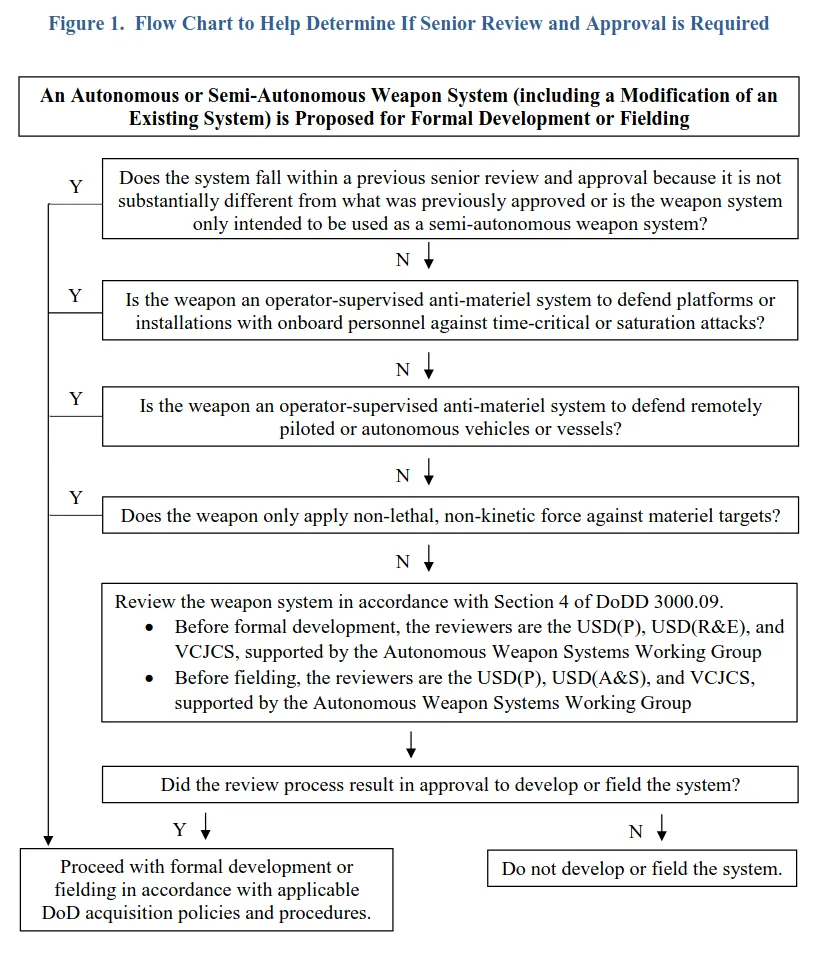
That structure is why “the Pentagon bans autonomous weapons” is the wrong file note. The directive permits development and fielding if the system satisfies the applicable design, testing, training, legal-review, and senior-approval conditions. The compliance question is not whether autonomy appears in a weapons program. It is what kind of autonomy, at what point in the targeting and engagement chain, under what human-judgment design, and under which review pathway.
Human judgment is a standard, not a loop diagram
3000.09 does not say every engagement must include a human pressing a final approval button. Its operative standard is that autonomous and semi-autonomous weapon systems must be designed to allow commanders and operators to exercise “appropriate levels of human judgment over the use of force.”[1]
That phrase is less tidy than “human in the loop,” but it is more useful for a compliance file. It points counsel toward design records, operator information, interface choices, training, commander understanding, test conditions, and the circumstances under which the system may select or engage targets. A final-click requirement is only one possible form of human judgment. The directive’s actual language leaves room for different control architectures, while still requiring the department to account for human judgment before use of force occurs.
CSIS made this correction in 2022 after documenting persistent public confusion about the directive. Its point remains important for counsel because a mistaken “human-in-the-loop” memo can create two opposite risks: it may overstate a legal restriction that the directive does not impose, or it may under-document the broader design and review showing needed to satisfy the standard that the directive does impose.[4]

The senior review is formal, and apparently rare
For systems that trigger the directive’s heightened process, 3000.09 requires senior-level review before fielding. The directive identifies certification by the Chairman of the Joint Chiefs of Staff and two under secretaries against 11 requirements, including requirements tied to law-of-war compliance, testing, system safety, operator training, cybersecurity, human-machine interfaces, failure management, and commander/operator understanding of the system’s capabilities and limits.[1]
The number that should change a compliance conversation is not a casualty estimate or a procurement total. It is CSIS’s 2022 statement that no DoD organization had ever completed a full review under 3000.09.[4] That does not mean no autonomous features had been used, and it does not prove noncompliance in a particular program. It means counsel should not treat the senior-review pathway as a familiar procurement checkpoint with a thick body of completed precedents.
The absence of completed full reviews also makes the rewrite more consequential. A mature compliance regime can absorb changed wording through existing templates, committee practice, and prior approval packages. A rarely traveled regime offers less institutional muscle memory. If the new directive changes the trigger or the approval authority, old assumptions about who signs, what evidence is sufficient, and when legal review is complete may age badly.
Two site files show why that distinction matters in practice. The YFQ-44A live-fire discussion is useful as a contrast for what the current regime may permit in operational testing. The Bullfrog L-MADIS procurement analysis is useful for the opposite reason: it illustrates why a decade without completed senior-level reviews is not a technical footnote for contractors.
Exemptions are narrow compliance routes, not a general safe harbor
3000.09 treats some categories differently, including autonomous or semi-autonomous cyber systems for cyberspace operations and certain defensive systems such as missile-defense or active-protection functions. Those exemptions should be read by function and context, not by marketing label. A system does not become exempt merely because a contractor describes it as defensive, automated, or protective.[1]
In a diligence file, the exemption analysis should be separate from the human-judgment analysis. The first asks whether the system is within a carved-out category. The second asks, if the directive applies, whether commanders and operators have the required judgment over the use of force. Mixing the two produces the familiar bad paragraph: “human supervised, therefore exempt.” The directive does not support that shortcut.
The June 2026 rewrite pressure
The live issue is not that 3000.09 exists. It is that the operative text is reportedly being rewritten under a short clock. Sen. Gallego’s June 15, 2026 release describes a presidential memorandum directing the Defense Department to revise the directive within 90 days to remove “unnecessary barriers to rapid deployment” and to support adaptation of commercial and open-source AI for military use. DefenseScoop reported the same rewrite pressure that day.[2][3]
For legal work, the source posture is critical. The Gallego release is primary for Gallego’s warning and his questions. It is not itself the presidential memorandum. DefenseScoop is corroborating journalism. Neither should be quoted in a legal opinion as if counsel had reviewed the final memorandum text, the implementing tasking, or the revised directive.
Still, the reported phrase “eliminate unnecessary barriers” is not noise. It signals that the rewrite may target process friction: approval levels, review timelines, documentation burdens, category definitions, exception language, or deployment gates. The present directive’s most important legal features are therefore also the most important comparison points: human judgment, senior certification, the 11-requirement showing, cyber and defensive exemptions, and the connection to weapons legal review.
Gallego’s questions convert policy language into safeguards
Gallego’s June 15 letter requested answers by June 26, 2026 and asked six questions. As described in his release, they include friendly-fire prevention, adversarial exploitation of autonomous-weapons incidents, safeguards for host-nation civilians, briefings for allies on basing and overflight, and whether the Defense Autonomous Warfare Group has enough capacity to mitigate civilian harm.[2]
Those questions are not a replacement for 3000.09. They are a useful map of what congressional overseers may treat as operationally concrete. “Appropriate human judgment” can sound complete inside a policy office. Gallego’s questions push the file toward harder proof: how the system distinguishes friendly forces, what happens when an adversary manipulates an incident, what a host nation is told before deployment, and who inside DoD has the capacity to evaluate civilian-harm mitigation.
Because the requested response date has passed as of July 31, 2026, a current matter file should not stop at the June 15 release. It should ask whether DoD responded, whether the response was public, whether any classified response was referenced in public materials, and whether the answers changed the review assumptions for a specific program. The provided source set does not establish those later facts.
The NDAA amendment remains a status item until text and enactment are verified
Small Wars Journal reported on June 17, 2026 that a Kelly amendment to the National Defense Authorization Act would codify human oversight for autonomous AI in the kill chain.[5] That is potentially significant because statute would not merely restate DoD policy; it could limit how far a revised directive may move.
But the file label should be precise: reported NDAA amendment, status to verify. Before using the amendment in advice to a contractor or litigation team, counsel should check the amendment text, the bill version, committee and floor action, conference changes, and enactment. A secondary report that an amendment exists is not the same thing as a statutory requirement binding DoD.
Where weapons review fits
3000.09 does not stand alone. It sits beside the Defense Department’s law-of-war review obligations for weapons, which are often discussed in relation to Article 36 of Additional Protocol I even though the United States is not a party to that protocol. Lieber Institute commentary in 2026 links autonomy review to the DoD Law of War Program and to the continuing U.S. position that human responsibility is retained through judgment and oversight.[6][7]
That connection should not be inflated into a full treaty treatise in a contractor memo. The operational point is narrower: a system may need both a 3000.09 pathway analysis and a weapons legal review. The former asks how the autonomy policy applies. The latter asks whether the weapon, as designed and intended for use, complies with applicable law of war obligations.
For deeper mechanics on the legal-review side, the site’s Article 36 weapons-review workflow is the better exit than trying to turn 3000.09 into international law. For procurement teams documenting human-control evidence, the terminal-autonomy liability checklist is the more practical companion file.
The international treaty debate, including broader discussions about meaningful human control and accountability gaps, remains relevant background. It should not be mixed into a 3000.09 obligations chart unless it changes a review step, a contract representation, a litigation theory, or a deployment approval. The U.S. directive rewrite is a domestic policy event with procurement and review consequences now.
How to keep the file usable while the baseline moves
The safest working product is a dated before/after record. The pre-rewrite side should preserve the January 2023 directive, the system classification analysis, the human-judgment showing, any exemption analysis, senior-review trigger analysis, weapons-review status, and the evidence used to support each conclusion.
- Quote the current 3000.09 language directly when advising on “appropriate levels of human judgment,” rather than translating it into “human in the loop.”
- Separate autonomous, semi-autonomous, and human-supervised autonomous classifications before analyzing approvals.
- Identify whether the program actually triggers the heightened senior-review process, and document why.
- Treat cyber and missile-defense or active-protection exemptions as narrow categories requiring textual fit.
- Flag the June 2026 memorandum, Gallego response status, and NDAA amendment as moving items until primary text is in the file.
- Re-run the analysis when the revised directive is published, rather than appending the new policy to an old memo.
The legal implication is not that autonomous weapons are suddenly lawful, and not that they are categorically banned. The review gate, human-judgment standard, exemptions, congressional oversight frame, and weapons-review connections are being redrawn in real time. A usable legal file should show what the rule required before the rewrite, what changed after it, and which claimed changes are still only press-release or secondary-report propositions.
References
- DoD Directive 3000.09, Autonomy in Weapon Systems, U.S. Department of Defense, January 2023.
- Gallego Warns Pentagon Against Rushing Autonomous Weapons Policy at the Expense of U.S. Troops and Allies, Office of Sen. Ruben Gallego, June 15, 2026.
- Lawmaker questions Pentagon’s plan to revise autonomous weapons policy, DefenseScoop, June 15, 2026.
- DoD Is Updating Its Decade-Old Autonomous Weapons Policy, but Confusion Remains Widespread, Center for Strategic and International Studies, June 6, 2022.
- Kill Chain Autonomous AI Senate, Small Wars Journal, June 17, 2026.
- Legal Accountability for AI-Driven Autonomous Weapons, Lieber Institute, March 9, 2026.
- Human Responsibility Retained: US Positions on Judgment and Oversight in LAWS, Lieber Institute, May 4, 2026.
Operationalizing workflow
No workflow has been explicitly linked to this obligation yet. See Workflows generally.
Illustrative cases
No illustrative case is currently tracked for this obligation. See Risk Digest for documented incidents generally.
← Back to RegulationReport a correction or tip
Spotted an outdated figure, a misstated fact, or a ruling this regulation entry should reflect? Public comments are disabled for this content given the professional cost of a misreported case outcome, penalty amount, or rule text — use the structured correction channel instead.
Report a correction or tip for this record →