
Who is liable when an Amazon delivery drone crashes?
- Authority
- Federal Aviation Administration (FAA)
- Rule type
- regulation
- Jurisdiction scope
- US federal, US state
- Source text
- Read primary rule text ↗
Drone package delivery requires FAA Part 135 operator certification; proposed Part 108 would add operator-centered BVLOS duties and property-damage reporting.
No U.S. lawsuit over an Amazon MK30 delivery-drone crash has been located in the public record reviewed for this article. That matters. The liability answer is therefore not “Amazon is liable”; it is that Amazon is the first defendant a claimant would look at because the public facts do not scatter the usual roles across a pilot, a separate aircraft maker, and an independent field contractor.
The FAA treats drone package delivery outside ordinary small-drone rules as an air-carrier-style operation, and its package-delivery page describes Part 135 as the current path for beyond-visual-line-of-sight package delivery; it also notes that the first standard Part 119/135 certificate for a drone over 55 pounds was issued in August 2020.[1] That does not make every crash a civil-liability finding. It does mean that a crash involving Prime Air begins with an operator-centered record, not a hobbyist-drone frame.
This article is a litigation-risk map, not legal advice. It separates public crash evidence, possible pleadings, and unresolved regulatory questions. A claimant, insurer, city lawyer, or defense team would still need jurisdiction-specific law, the aircraft file, maintenance and software records, FAA communications, and final agency findings before treating any theory as proved.
The public incident set is uneven
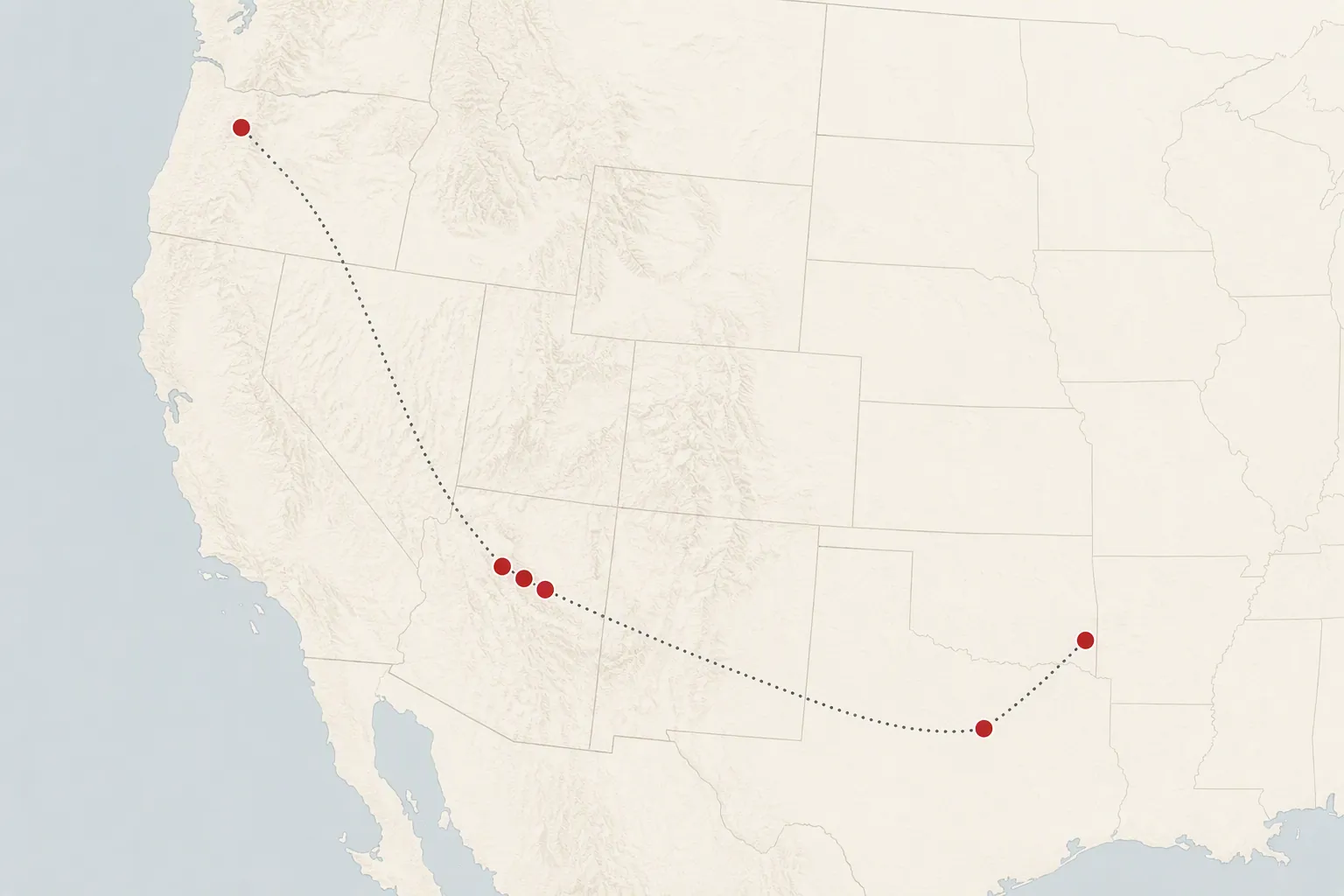
The crash record most often cited against Prime Air is not a single clean docket. It is a mix of preliminary accident material, FAA investigations, city briefing material, media reporting, and third-party incident synthesis. The status distinction is not cosmetic. It affects whether a complaint can allege a fact directly, plead on information and belief, or merely use an event as background.
| Incident | Public status | What it can fairly support now |
|---|---|---|
| Pendleton, Oregon — Dec. 16, 2024, two MK30 crashes | Reported NTSB findings and Amazon response in public reporting. | The strongest public design-defect hook: reporting says Amazon removed backup “squat switch” landing sensors before the crashes; Amazon disputed the characterization as misleading.[2][3] |
| Tolleson, Arizona — May 2025; Avondale, Arizona — July 2025; Goodyear, Arizona — Oct. 14, 2025 | Included in a third-party analyst timeline rather than primary public accident records reviewed here. | Useful for risk orientation only. These entries should not be treated as FAA-confirmed findings in a pleading without additional records.[4] |
| Tolleson, Arizona — Oct. 1, 2025, two MK30s struck the same crane boom | Aviation Safety Network record plus FAA/NTSB probe reporting. | The anchor operational-negligence fact pattern: two aircraft hit the same obstruction within minutes, at an estimated 150–165 feet AGL, with a battery fire, during operations under FAA exemption 18601E.[5][6][7] |
| Waco, Texas — Nov. 18, 2025, cable strike | FAA investigation reported; no final public FAA finding cited here. | Concrete property-damage exposure. Amazon reportedly self-reported, identified aircraft N139PA, and paid for cable repair; those facts are not the same thing as an admission of legal liability.[8][9] |
| Richardson, Texas — Feb. 4, 2026 | FAA investigation reporting plus city-council/HOA briefing material. | A practical remediation record: city briefing material described telemetry, a signal-interference explanation, delivery restrictions for multi-family properties, and operational disclosures.[10][11] |
Scale also needs a label. Amazon Prime Air has been described as having completed about 16,000 deliveries as of February 2026, but that number says more about operational adoption than crash causation.[12] One analyst synthesis counted seven incidents and estimated roughly one incident per 570–1,140 flight hours, based on about 4,000 disclosed flight hours attributed to a Shawnee, Kansas official; that is not an FAA incident-rate statistic.[4]
Why Amazon is the central defendant on these facts
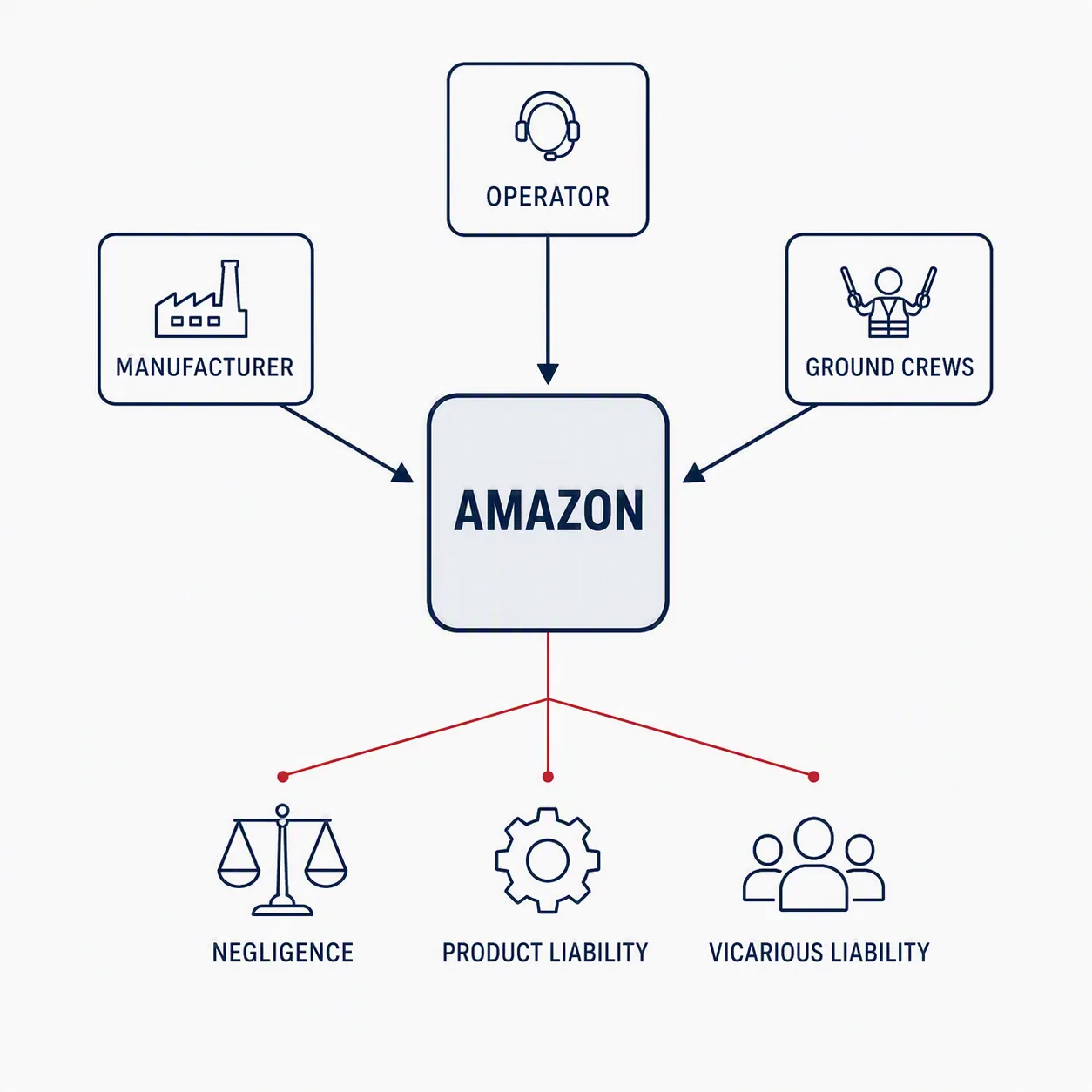
In many aviation and product cases, the pleading map spreads outward: operator, pilot, lessor, aircraft manufacturer, component supplier, maintenance provider, premises owner, and sometimes a public entity. The Amazon MK30 record points in a more concentrated direction. Amazon is not merely the brand printed on the box. On the public record described here, Prime Air is the operating structure: the certificated delivery operation, the aircraft program, and the ground-surveillance structure all point back toward the same corporate family.
That concentration affects three familiar theories. A negligence claim would ask whether the operator used reasonable care in route planning, obstruction awareness, telemetry review, dispatch, weather and signal-risk assessment, emergency response, and post-incident suspension decisions. A product-liability claim would ask whether the MK30 or one of its systems was defectively designed, manufactured, or warned about. A vicarious-liability theory would ask whether employees or agents acting in the operation of Prime Air caused damage while performing assigned work.
Those theories can be pleaded together without being redundant. A drone can be safely designed but negligently dispatched into an obstruction environment. It can be poorly designed even if the crew followed procedures. A ground observer or technician can create exposure even if the aircraft design is not defective. The unusual feature here is that the claimant’s caption may still start with the same defendant.
The Tolleson crane collisions are an operations case before they are a technology story
The Oct. 1, 2025 Tolleson record is the cleanest public operational-negligence example because the facts are concrete. Two Amazon MK30 drones struck the same crane boom within minutes of each other. The Aviation Safety Network record places the impact height at an estimated 150–165 feet above ground level and notes a battery fire after the crash.[5] CNBC and Reuters reported FAA and NTSB involvement the next day.[6][7]
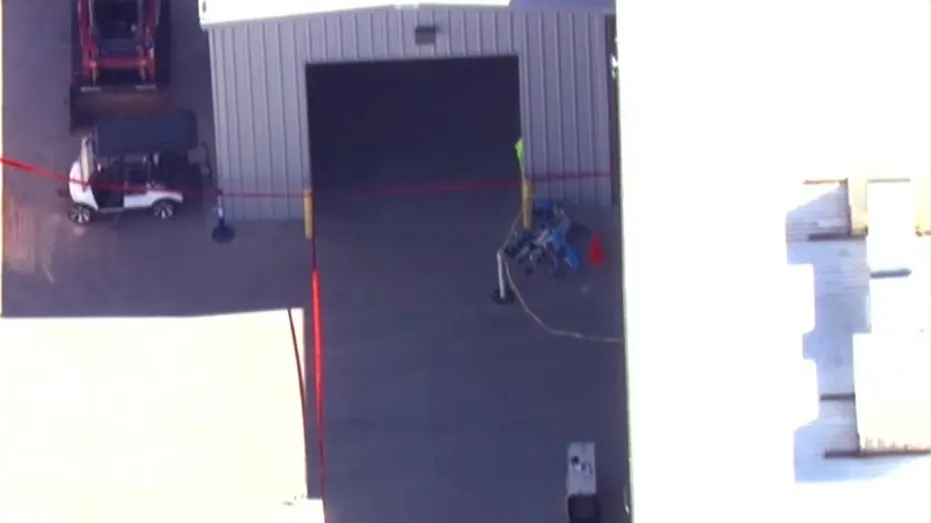
A plaintiff would not need futuristic rhetoric to make that event legible. The likely questions are ordinary: Was the crane known or knowable? Did the route database account for temporary construction obstructions? Did remote personnel receive, recognize, and act on a hazard? Why did a second aircraft enter the same hazard area after the first impact? What stop-flight or alert protocol existed between the first and second strike?
The battery fire matters because it changes the damages picture. A drone strike is not only an impact event. It can become a fire-response, site-control, cleanup, and adjacent-property problem. The person with the damaged roof, burned yard, struck cable, or interrupted construction project does not experience the aircraft as an abstraction in an FAA docket.
Still, the public Tolleson record does not by itself answer causation. It supports investigation into route planning, obstruction detection, remote supervision, and emergency procedures. It does not yet establish which system, person, software decision, map input, or operational command failed.
The Oregon squat-switch dispute is the strongest public design-defect hook
The Pendleton, Oregon crashes do a different job in the liability map. They are not mainly about hitting an external obstruction. They point toward aircraft design and redundancy. Public reporting on NTSB findings said Amazon removed backup “squat switch” landing sensors before two MK30 crashes on Dec. 16, 2024.[2] Amazon responded that the coverage was misleading and disputed the framing of the findings.[3]
That dispute should not be softened into a vague “safety questions were raised” sentence. It is more specific than that. A backup sensor was reportedly removed. If a claimant can tie that design change to loss of safe landing, crash dynamics, or failure to detect ground contact, the fact pattern begins to look like a design-defect case: a known redundancy existed, the manufacturer allegedly chose not to use it, and the aircraft later crashed during operations where that redundancy may matter.
But it should not be overstated either. A public report about a removed sensor is not a jury finding that the removal caused a crash. Product-liability pleading would still have to move through defect, alternative design, feasibility, risk-utility, causation, and damages under the governing state law. Amazon’s dispute matters at the pleading stage because it previews exactly where the defense would push: whether the sensor was actually relevant, whether other systems supplied equivalent protection, whether the crash sequence had a different cause, and whether the public summary leaves out engineering context.
The legal significance is that Amazon’s manufacturer role prevents the company from staying only in the operator lane. If a complaint alleges that the MK30’s landing-sensing architecture was unreasonably risky, Amazon cannot answer only as the carrier that flew the route. It would also have to answer as the entity responsible for the aircraft design choices the claimant identifies.
Waco and Richardson show the property-damage layer
The Waco incident is smaller than the crane collision in aviation drama and more useful for ordinary damages analysis. CNBC reported that the FAA was investigating after an Amazon delivery drone struck an internet cable in Waco on Nov. 18, 2025.[8] Fox Business reported FAA confirmation, identified the aircraft as N139PA, and reported that Amazon self-reported the event and paid to repair the cable.[9]
Payment for a repair is a practical fact. It may reduce damages, support notice, or show a remediation pathway. It is not automatically an admission that Amazon was legally negligent. Counsel on either side should resist turning customer-service posture into liability doctrine. The same distinction appears in other corporate-risk settings: an apology, repair payment, or voluntary remediation can be important evidence without being a conceded tort element, a point this site has treated separately in its discussion of why an apology does not equal a liability admission.
Richardson adds a different kind of record. AeroTime reported a Feb. 4, 2026 Amazon Prime Air drone incident in Texas.[10] A Creek Hollow HOA page summarizing Richardson city-council briefing material described Amazon telemetry, a signal-interference explanation, operational flight-volume information, and a restriction affecting multi-family delivery locations.[11] That is not a final FAA causation finding. It is, however, the kind of municipal record a lawyer would want preserved quickly: telemetry descriptions, city communications, revised operating limits, and representations about what Amazon believed happened.
For a homeowner, HOA, utility, or city, these incidents also make clear that the likely first loss may be boring: a severed cable, damaged landscaping, emergency response costs, blocked access, debris cleanup, or a temporary halt to nearby work. The complaint may read less like aviation catastrophe litigation and more like a property-damage case with federal aviation issues attached.
What a claimant can plead before final agency findings
A final FAA or NTSB report is valuable, but property damage does not always wait for a final report. A claimant can file on the facts available, then use discovery to test telemetry, design history, maintenance records, incident response, and communications with regulators. The risk is pleading beyond the public record and giving the defense an easy target.
| Theory | Likely factual focus | Status caution |
|---|---|---|
| Negligence | Route planning, obstruction awareness, ground surveillance, dispatch decisions, emergency stop procedures, telemetry monitoring, and post-incident response. | FAA or exemption compliance can be evidence, but a regulatory issue is not automatically civil liability. |
| Product liability | MK30 design, landing-sensing redundancy, detect-and-avoid architecture, software/hardware integration, warnings, and feasible alternative designs. | The squat-switch issue is public and specific, but Amazon disputes the causal framing. |
| Vicarious liability | Acts or omissions of Amazon ground crews, remote personnel, maintenance staff, or other operational employees or agents. | The theory depends on employment or agency facts, not merely the Amazon brand. |
| Trespass, nuisance, or property damage | Low-altitude overflight, debris landing on private property, cable strikes, noise, repeated interference, or loss of use. | Low-altitude drone claims remain entangled with FAA airspace authority and state property law. |
| Negligence per se or statutory-duty theory | Alleged violation of FAA rules, exemption limits, local safety duties, or delivery-zone requirements if applicable. | The governing jurisdiction must recognize the statute or regulation as a civil standard of care. |
The cleaner complaint would not try to prove everything from the crash headline. It would separate aircraft facts from operator facts: what the MK30 did, what Amazon systems recorded, what Amazon personnel knew, what local property was damaged, and what remedial action followed. That separation matters because Amazon can be both the alleged tortfeasor and the keeper of the technical record.
There is also a preservation problem. Drone incidents generate telemetry, command logs, maintenance records, flight-path data, weather and signal information, dispatch communications, software-version records, map and obstruction inputs, customer-delivery-zone data, and incident-response notes. The party cleaning up the yard or calling the internet provider will not have those records. Amazon will.
FAA compliance is evidence, not a civil-liability shortcut
The regulatory record matters, but it does not replace tort analysis. A plaintiff may use FAA rules, exemption conditions, Part 135 obligations, or operational authorizations to argue that Amazon fell below a standard of care. A defense team may answer that it complied with the applicable FAA regime, that the agency occupied the field, or that state-law claims would interfere with federal aviation authority.
Neither move is complete by itself. FAA compliance does not immunize ordinary property damage if state tort law survives. FAA noncompliance does not automatically prove causation, damages, or the right plaintiff. Drone-crash liability commentary in the United States commonly treats operator responsibility, property damage, negligence, and insurance as overlapping but distinct issues rather than one merged regulatory answer.[13]
Preemption is the harder forum problem. The FAA controls navigable airspace and aircraft safety regulation, but state law traditionally supplies remedies for damaged property, personal injury, nuisance, and trespass. Low-altitude drone operations press on the seam between those systems. A claimant may be able to draft a state-law complaint quickly and still spend months fighting whether the claim is preempted, narrowed, removed, or reframed.
That is especially true for nuisance and trespass. A drone that briefly crosses overhead, a drone that repeatedly serves a neighborhood, and a drone that crashes into a yard are not the same event. The strongest state-law footing is usually concrete damage: broken cable, burned property, debris impact, repair costs, emergency response, or loss of use. Pure discomfort with drones overhead is a different case.
Part 108 is the forward boundary, not current law
The pending BVLOS rulemaking is important because it shows where the FAA may move the accountability model. The FAA’s Aug. 7, 2025 Federal Register notice proposed a new Part 108 for normalizing beyond-visual-line-of-sight unmanned aircraft operations. The proposal includes an operator-centered corporate-responsibility model without individual airman certificates, a 110-pound gross-weight tier for package delivery, reporting for property damage over $500 within 10 days, and duties concerning customer clearance and obstruction-free delivery zones.[14]
If finalized as proposed, Part 108 would not erase state tort claims by magic. It would, however, make the regulatory center of gravity more explicit. Responsibility would sit with the operator entity, not with a named pilot in the conventional aviation sense. For Amazon, that points in the same direction as the crash map: the system operator remains the obvious defendant.
The proposed delivery-zone language also matters after a cable strike or yard crash. If the rule ultimately imposes defined duties around customer clearance and obstruction-free areas, future plaintiffs will have a more specific regulatory vocabulary for arguing breach. Until then, those duties are proposed terms, not enforceable Part 108 obligations.
The Tolleson crane facts explain why the rulemaking debate is not theoretical. Routine BVLOS delivery depends on the premise that an operator can account for temporary obstacles, residential property boundaries, communications conditions, emergency procedures, and bystander risk at scale. When two aircraft strike the same crane boom within minutes, the question is not whether drones are impressive. The question is whether the operating system had enough friction in it to stop the second impact.
The exposure judgment
On the public facts now available, Amazon is the central defendant for an MK30 crash claim because the operator, manufacturer, and ground-crew-employer roles converge there. The Tolleson crane collisions supply the strongest public operational-negligence pattern. The Pendleton squat-switch record supplies the strongest public design-defect hook, with causation expressly contested by Amazon. Waco and Richardson show the practical property-damage and remediation layer, but repair payments, apologies, telemetry explanations, and delivery restrictions should not be treated as admissions.
The unresolved questions are the ones that will decide how durable a complaint is after filing: what final FAA or NTSB findings say, how much state tort law survives federal aviation preemption, whether low-altitude trespass or nuisance theories can be pleaded without overreaching, and whether a final Part 108 hardens the operator-centered model that already appears in the public crash record.
References
- Package Delivery by Drone, Federal Aviation Administration.
- Amazon delivery drones crashed after company removed safety sensor, New York Post, May 16, 2025.
- Amazon responds to media as NTSB releases findings from Oregon drone crashes, Unmanned Airspace.
- When Delivery Drones Fall From the Sky: What Amazon’s Crash History Means for Risk and Insurance, David Ison PhD.
- Aviation Safety Network Wikibase occurrence 548550, Aviation Safety Network.
- FAA, NTSB investigate after two Amazon delivery drones crash in Arizona, CNBC, Oct. 2, 2025.
- NTSB, FAA probe crashes of two Amazon delivery drones, Reuters, Oct. 2, 2025.
- Amazon drone delivery incident in Texas probed by FAA, CNBC, Nov. 25, 2025.
- Amazon investigated by FAA after delivery drone strikes internet cable, Fox Business.
- Amazon Prime Air drone incident in Texas, AeroTime.
- Amazon Prime Air, Creek Hollow HOA.
- Amazon Prime Air, Wikipedia.
- Drone Crash Liability in the United States: Legal Responsibilities Every Drone Operator Must Know, Rupprecht Law.
- Normalizing Unmanned Aircraft Systems Beyond Visual Line of Sight Operations, Federal Register, Aug. 7, 2025.
Operationalizing workflow
No workflow has been explicitly linked to this obligation yet. See Workflows generally.
Illustrative cases
No illustrative case is currently tracked for this obligation. See Risk Digest for documented incidents generally.
← Back to RegulationReport a correction or tip
Spotted an outdated figure, a misstated fact, or a ruling this regulation entry should reflect? Public comments are disabled for this content given the professional cost of a misreported case outcome, penalty amount, or rule text — use the structured correction channel instead.
Report a correction or tip for this record →