
Why ayahuasca depression therapy has no single legal status
- Authority
- The White House
- Rule type
- executive order
- Jurisdiction scope
- US federal
- Effective date
- Apr 18, 2026
- Source text
- Read primary rule text ↗
Directs FDA/DEA to accelerate serious-mental-illness psychedelic pathways; does not change DMT Schedule I status or legalize ayahuasca therapy.
Last verified: August 3, 2026. This record is for regulatory orientation only and is not legal advice. It does not assess any person’s eligibility for a religious exemption, any sponsor’s drug-development prospects, or any operator’s compliance with federal, state, local, customs, health-care, advertising, or professional-licensing rules.
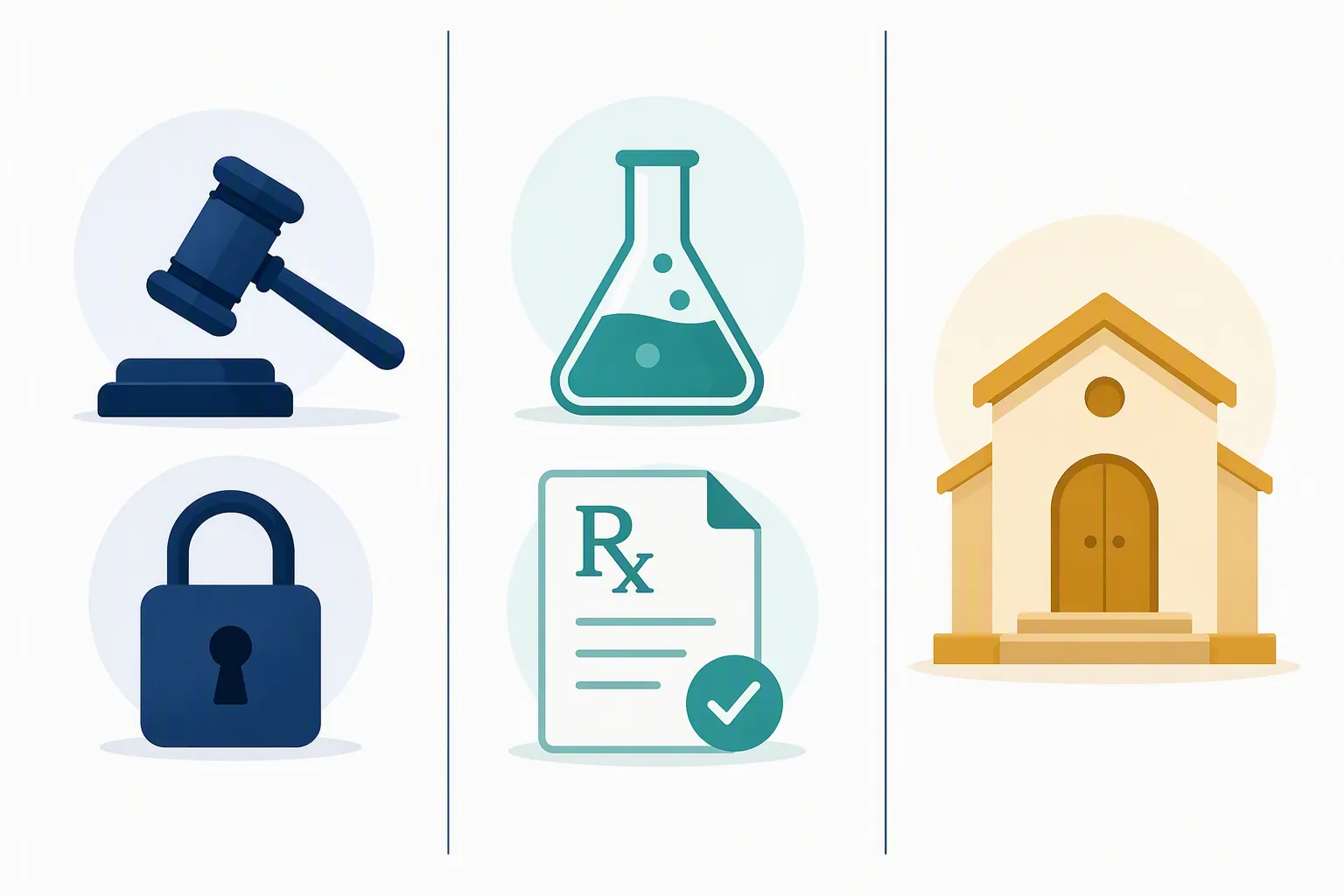
A search for “ayahuasca depression therapy FDA regulation legal status” asks one practical question, but US law answers it through three separate authorities. DMT remains a Schedule I controlled substance. The FDA is building and accelerating clinical-investigation pathways for psychedelic drug products, including some DMT formulations, but that is not the same thing as approving ayahuasca brew. RFRA litigation and settlements may protect particular religious organizations using the brew as a sacrament, but those outcomes do not create a general therapeutic market.

| Lane | What it controls | Current US status as of Q3 2026 |
|---|---|---|
| Controlled-substance enforcement | DMT possession, manufacture, importation, distribution, and handling | DMT is federally Schedule I and has been listed since 1971; the DEA fact sheet identifies a federal statutory maximum of 20 years for certain DMT offenses. [1] |
| FDA drug review | Investigational and approved drug products used in clinical care or research | EO 14401 and FDA actions accelerated serious-mental-illness psychedelic review infrastructure, including priority vouchers and guidance, but did not approve or deschedule ayahuasca brew. [2][3][4] |
| RFRA religious-exercise protection | Specific organizations’ sacramental use of ayahuasca or hoasca | O Centro and later exemption materials protect particular religious claimants or branches; they are not a blanket authorization for retreats, clinics, vendors, or depression therapy services. [5][6][7] |
The fixed floor: DMT remains Schedule I
The first object to identify is the substance. Ayahuasca is a plant brew associated with traditional and religious use. DMT is the controlled substance that places the brew in federal-risk territory. The DEA’s DMT fact sheet states that DMT has been controlled in Schedule I since 1971, and it describes federal criminal exposure for DMT offenses, including a statutory maximum of 20 years for certain violations. [1]
That baseline matters because none of the 2026 FDA activity changed the Controlled Substances Act schedule. A person can be reading about FDA vouchers, serious mental illness, DMT clinical trials, or psychedelic research guidance and still be looking at a Schedule I substance outside a properly authorized setting. In ordinary compliance terms, the FDA lane may explain how a sponsor investigates a drug product; it does not, by itself, supply permission to import, possess, serve, sell, advertise, or administer ayahuasca brew.
The same separation appears in adjacent psychedelic-trial compliance work. An FDA IND does not make DEA Schedule I handling disappear; it creates a research pathway that still requires controlled-substance controls. Readers tracking that mechanics layer may want the parallel record on psilocybin clinical trial compliance, which follows the same FDA-plus-DEA problem in a different psychedelic context.
What the April 2026 Executive Order actually changed
EO 14401, signed April 18, 2026, is the source most likely to be overread. It directed the FDA to use Commissioner’s National Priority Vouchers for certain treatments for serious mental illness, called for an FDA/DEA pathway to support Right to Try access involving Schedule I substances, directed at least $50 million in ARPA-H state-matching support, and required Attorney General review of Schedule I products that complete Phase 3 trials. The order also states that it does not create enforceable rights. [2]
Six days later, on April 24, 2026, the FDA announced its first implementation steps. The first three Commissioner’s National Priority Vouchers went to COMP360 psilocybin for treatment-resistant depression, Usona psilocybin for major depressive disorder, and Transcend methylone for post-traumatic stress disorder. The same announcement identified the first US noribogaine IND, DemeRx NB, and committed to finalizing psychedelic-drug clinical-investigation guidance. [3]
On July 14, 2026, the FDA made available its final guidance, “Psychedelic Drugs: Considerations for Clinical Investigations,” finalizing the June 26, 2023 draft. That guidance belongs in the clinical-investigation lane: it tells sponsors how the agency is thinking about studies of psychedelic drugs. It is not a marketing authorization for any ayahuasca product, and it is not a CSA rescheduling action. [4]
| 2026 federal act | What it supports | What it does not do |
|---|---|---|
| EO 14401 | Priority review tools, interagency pathway work, funding direction, and review triggers for certain serious-mental-illness treatments | Does not deschedule DMT, approve ayahuasca, or create enforceable private rights |
| FDA April 24 implementation announcement | Identifies initial voucher recipients and a noribogaine IND; confirms FDA movement on psychedelic-drug development | Does not include ayahuasca brew among approved products |
| FDA July 14 final guidance | Gives industry-facing considerations for clinical investigations of psychedelic drugs | Does not legalize non-investigational administration or override DEA controls |
The narrow reading is not hostile to psychedelic medicine; it is simply the only reading that keeps the authorities in their lanes. A sponsor may benefit from a faster FDA review process. A patient population may create urgency. A clinical protocol may be scientifically serious. None of those facts answers whether an unaffiliated operator may serve ayahuasca brew for depression.
“FDA-reviewed ayahuasca” is usually a category error
The FDA lane turns on the drug product under investigation. In the DMT context, the clearest example in the cited materials is not ayahuasca brew. It is SPL026, a synthetic intravenous DMT fumarate formulation studied as a 21.5 mg dose in a phase IIa randomized controlled trial with 34 participants. [8]

That distinction carries most of the legal answer. A synthetic IV DMT formulation in a sponsor-controlled study is a different regulatory object from a plant brew served in a ceremony, retreat, church, or wellness setting. The first may be analyzed through FDA investigational-drug rules and DEA research handling. The second is ordinarily discussed through CSA risk and, in a limited set of cases, RFRA.
The depression context should be handled with the same restraint. The existence of small depression studies explains why regulators, sponsors, and clinicians are watching the DMT space. It does not support a generalized claim that ayahuasca therapy is effective, FDA-reviewed, or legally available for depression. The SPL026 trial’s participant count alone is enough to warn against treating it as broad clinical proof, and it did not study ayahuasca brew. [8]
Expert commentary on EO 14401 has also warned against treating the order as a rescheduling command. Harvard’s Petrie-Flom Center Q&A with I. Glenn Cohen and Mason Marks emphasized that the executive order cannot itself compel rescheduling and that some of its post-approval review mechanics overlap with existing DEA obligations. [9]
The RFRA lane: real, narrow, and hard to count cleanly
The current lawful-access pathway for the brew itself is not FDA approval; it is organization-specific religious-exercise protection. The anchor case is Gonzales v. O Centro Espírita Beneficente União do Vegetal. In 2006, the Supreme Court affirmed preliminary relief for the União do Vegetal’s sacramental hoasca use, applying RFRA’s demanding test to the government’s effort to bar that religious use. [5]
The case is often described too broadly. O Centro did not create a national ayahuasca license. It did not legalize commercial depression therapy. It did not make every church label dispositive. It required the government to satisfy RFRA’s standard as applied to a particular claimant and a particular religious practice.
That is why exemption counts vary. Mind Medicine Law’s guide describes four confirmed exempt organizations: UDV, Santo Daime, Iowaska Church of Healing, and Church of Gaia, with Iowaska identified in 2024 and Church of Gaia in May 2025 as the first exemption granted without litigation. [6] ICEERS presents the US landscape differently, emphasizing UDV and specific Santo Daime branches, including Oregon and Los Angeles. [7]
Those differences are not necessarily contradictions. They reflect what is being counted: a denomination, a branch, a court injunction, an administrative grant, a settlement, or a still-developing claim. The Church of the Eagle and the Condor also appears in the exemption landscape as a settlement matter, which adds another counting problem rather than a clean national category. [6][7]
| RFRA question | Why it matters |
|---|---|
| Which legal entity is claiming protection? | A branch, affiliate, retreat partner, facilitator, or vendor may not share the same protection as the named organization. |
| What document creates or recognizes the protection? | A Supreme Court ruling, injunction, settlement, or agency grant may have different parties, conditions, and enforcement consequences. |
| What use is protected? | Sacramental use in a religious practice is not the same claim as depression therapy, wellness programming, coaching, or commercial retreat services. |
| What substance and supply chain are covered? | A protection for hoasca or ayahuasca under specific controls does not automatically answer importation, storage, distribution, advertising, or third-party service questions. |
For counsel or compliance staff, the practical consequence is straightforward: a RFRA-relevant document must be read against the named organization, the covered sacrament, the stated practice, and the operational controls. Treating an exemption as a transferable credential is where legal risk starts to hide.
Enforcement examples show why the gray zone is not merely academic
Federal enforcement has not disappeared just because public interest in psychedelic medicine has increased. In one South Texas matter, the US Attorney’s Office announced charges against a local man accused of importing a powerful psychedelic in an ayahuasca-related DMT case. The point is not that every disputed ceremony produces a prosecution; it is that importation and possession can still be treated as controlled-substance events. [10]
Civil exposure also sits beside criminal and regulatory exposure. The cited materials identify the 2024 Soul Quest wrongful-death judgment as a reminder that operators may face liability theories even when the public debate focuses on religious freedom or drug scheduling. [6]
These examples should not be inflated into a frequency claim. They are useful because they show where a loose “legalized therapy” statement can fail in practice: customs, controlled-substance handling, medical or mental-health representations, participant screening, emergency response, insurance, advertising, and entity-specific exemption status.
State and local changes do not answer the federal ayahuasca question
State and local developments can change enforcement priorities or create state-law programs, but they do not revise the federal CSA or convert FDA investigational activity into general access. Colorado’s Proposition 122 is often invoked because Colorado’s natural-medicine framework includes DMT, but the cited legal-status materials do not support treating Colorado as a state-licensed ayahuasca-center market. [11]
City deprioritization resolutions should be read even more cautiously. A local policy can affect how a city chooses to spend local enforcement resources. It does not bind federal authorities, does not create FDA approval, and does not supply a RFRA exemption to a private operator. The distinction is similar to other state-level controlled-substance tracking problems: a state may act, but the federal layer has to be checked separately. For comparison, see the site’s record on the Texas delta-8 THC ban date in 2026.
A usable legal-status test
The safer way to brief ayahuasca depression therapy is to refuse the single-label answer. Start with the object: ayahuasca brew, synthetic DMT, psilocybin, methylone, noribogaine, or another product. Then identify the use: clinical investigation, approved medical treatment, religious sacrament, commercial retreat, wellness service, journalism, investment diligence, or vendor partnership. Then identify the authority being relied on: CSA registration and handling controls, FDA IND or approval status, RFRA order or exemption, state law, local deprioritization, or none.
| If the claim is... | The first verification point is... |
|---|---|
| “FDA-regulated ayahuasca therapy” | Which FDA-reviewed drug product is being discussed, and whether it is actually ayahuasca brew or a distinct pharmaceutical formulation |
| “Legal ayahuasca church” | The named entity, branch, RFRA document, covered sacrament, and conditions |
| “Colorado allows it” | Whether the statement means state-law deprioritization, a licensed program, or federal authorization |
| “DMT is in clinical trials” | Whether the trial product is synthetic DMT under an IND and controlled-substance controls, rather than brew access |
| “Depression treatment is available” | Whether the representation is clinical-trial participation, approved treatment, religious practice, or an unapproved commercial service |
As of Q3 2026, the legally relevant question in the United States is not simply whether ayahuasca depression therapy is legal. It is which substance, which use, which authority, and which organization-specific exemption or FDA pathway the actor is actually relying on.
References
- N,N-Dimethyltryptamine (DMT), DEA Diversion Control Division.
- Accelerating Medical Treatments for Serious Mental Illness, The White House, April 18, 2026.
- FDA Accelerates Action on Treatments for Serious Mental Illness Following Executive Order, US Food and Drug Administration, April 24, 2026.
- Psychedelic Drugs: Considerations for Clinical Investigations; Guidance for Industry; Availability, Federal Register, July 14, 2026.
- Gonzales v. O Centro Espirita Beneficente Uniao do Vegetal, 546 U.S. 418 (2006), Justia US Supreme Court Center, 2006.
- Ayahuasca, Mind Medicine Law.
- Legal Information: United States of America, ICEERS.
- Dimethyltryptamine-assisted therapy for moderate-to-severe major depressive disorder: a phase 2a randomized clinical trial, Nature Medicine.
- A New Executive Order on Psychedelics: Q&A with I. Glenn Cohen and Mason Marks, Petrie-Flom Center, Harvard Law School, April 18, 2026.
- Local man charged with importing powerful psychedelic, US Attorney’s Office for the Southern District of Texas.
- Legal status of ayahuasca by country, Wikipedia.
Operationalizing workflow
No workflow has been explicitly linked to this obligation yet. See Workflows generally.
Illustrative cases
No illustrative case is currently tracked for this obligation. See Risk Digest for documented incidents generally.
← Back to RegulationReport a correction or tip
Spotted an outdated figure, a misstated fact, or a ruling this regulation entry should reflect? Public comments are disabled for this content given the professional cost of a misreported case outcome, penalty amount, or rule text — use the structured correction channel instead.
Report a correction or tip for this record →