
What federal rules govern psilocybin medical research?
- Authority
- U.S. FDA and DEA
- Rule type
- regulation
- Jurisdiction scope
- US federal
- Source text
- Read primary rule text ↗
Secure an FDA IND and a DEA Schedule I researcher registration; maintain documented controlled-substance security, inventory, ordering, and disposal controls.
Last verified: August 2, 2026. Scope: U.S. federal law only. This article is an informational obligations tracker, not legal advice and not a substitute for sponsor, institutional, pharmacy, DEA, FDA, IRB, or state-law review.
A U.S. psilocybin clinical trial can be lawful in 2026, but there is no single federal approval that makes it operationally ready. The FDA track governs whether a sponsor may proceed with an investigational drug study under the IND framework; the DEA track governs whether the site and investigators may receive, store, use, inventory, transfer, and dispose of Schedule I psilocybin. Those two permissions overlap in practice, but they are not interchangeable.[1][2]
| Federal obligation | Main authority or form | Operational consequence |
|---|---|---|
| Clinical-trial authorization | FDA IND framework under 21 CFR Part 312 | The study may not begin until the IND is in effect; FDA may place the study on clinical hold during the review window.[1] |
| Schedule I researcher authority | DEA researcher registration and research protocol requirements under 21 CFR § 1301.18 | The investigator or site must be registered for Schedule I research before receiving or handling psilocybin.[2] |
| Ordering and domestic movement | DEA Form 222 system for Schedule I and II controlled-substance orders | Lawful supply must move through documented controlled-substance ordering channels, not ordinary research purchasing.[3] |
| Import, if applicable | DEA import permit process, including Form 357 where import applies | Foreign-sourced psilocybin adds a separate DEA import-control step before material can enter the site’s chain of custody.[4] |
| Inventory | Controlled-substance inventory rules, including biennial inventory under 21 CFR § 1304.11 | The site must maintain inventories that can prove what was on hand, received, used, transferred, or otherwise disposed of.[5] |
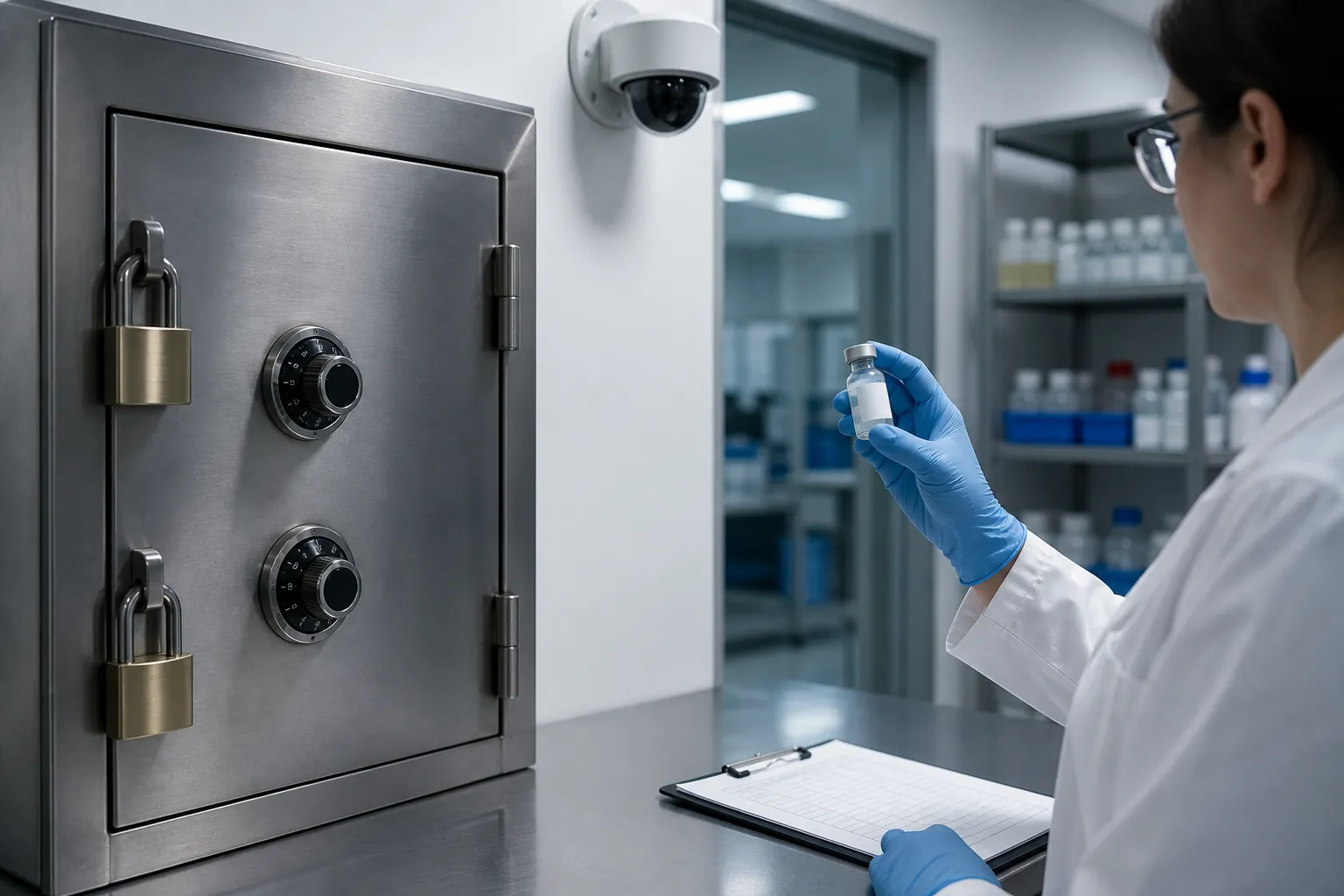
| Storage and physical security | DEA physical-security controls for non-practitioners and controlled-substance handling under 21 CFR §§ 1301.72 and 1301.75 | The research pharmacy, storage room, safe, access controls, surveillance, and written procedures become launch-critical infrastructure.[6] |
| Disposal | DEA-compliant disposal channels, commonly including reverse-distributor or other compliant destruction procedures | Unused, expired, damaged, or excess material cannot simply be discarded through ordinary laboratory waste processes. |
For a federal-state status baseline, see the companion article on hallucinogen legal status in the United States. This piece does not redraw that map. It follows the federal operating stack that a research institution has to make work after the scientific protocol is written.
The FDA permission and the DEA permission answer different questions
The IND asks whether the proposed clinical investigation may proceed under FDA’s investigational-drug rules. The DEA registration asks whether the applicant is authorized to conduct Schedule I research with the particular controlled substance, at the particular location, under the submitted protocol and security conditions. A clean answer on one side does not cure a missing answer on the other.
That distinction is easy to lose in an academic launch meeting. Investigators tend to track the protocol, consent form, investigator brochure, safety monitoring plan, and IND status because those are the documents that define the clinical study. The controlled-substance file asks a blunter set of questions: who is registered, where is the material stored, who has access, how is each unit ordered, how is administration recorded, what inventory exists today, and what happens to the remainder.

A practical psychedelic research-program review by Barnett and coauthors treats the FDA and DEA processes as parallel, interdependent workstreams rather than as a neat relay. The FDA materials, IRB materials, protocol, investigator credentials, and pharmacy procedures help support the DEA package, while the DEA inspection and registration status may still control when drug can actually arrive at the site.[7]
FDA IND timing is the more defined clock
The FDA side has a recognizable timing rule: after an IND is submitted, a sponsor generally may not begin the clinical investigation until 30 days after FDA receives the IND, unless FDA notifies the sponsor that the study may begin sooner; FDA may also impose a clinical hold.[1] That does not mean the protocol is substantively easy. It means the federal timing framework is legible enough that a study team can build an internal launch calendar around the 30-day IND review and clinical-hold possibility.
For psilocybin studies, the FDA’s July 2026 final guidance on psychedelic-drug clinical investigations is relevant to clinical development design, including issues peculiar to psychedelic trials, but it does not convert psilocybin into an ordinary pharmacy item and does not displace DEA Schedule I controls.[9]
DEA timing is the less comfortable clock
The DEA registration track is where many launch plans become too optimistic. The rules establish the registration and research-protocol requirements for Schedule I research, but the real-world duration depends on the site, the existing registration status, the drug code, the completeness of the application, security readiness, and inspection logistics.[2]
Practice sources place a new Schedule I research registration on a much longer path than the FDA’s 30-day IND review window. Barnett and coauthors and attorney-authored guidance describe new-site DEA registration timing in the range of 6 to 12 months or more, while an existing Schedule I registrant adding a new drug code may face a shorter range, described in practice guidance as roughly 4 to 12 weeks. Those are practice-based estimates, not binding DEA deadlines.[7][8]
The difference matters because a study can be scientifically ready, IRB-approved, and through the FDA IND waiting period while still unable to receive psilocybin. A site that has never held a Schedule I research registration should not treat DEA registration as a late administrative filing. It is a facility, pharmacy, security, and inspection project.
What usually has to travel with the DEA research package
The DEA researcher-registration process is not satisfied by a conclusory statement that the study has FDA clearance. For Schedule I research, the research protocol is part of the controlled-substance review. In practice, the Form 225 package commonly needs to be supported by investigator qualifications, the protocol, IRB approval, the FDA IND letter or IND status documentation, and site-specific security procedures.[2][7]
- Investigator and key personnel credentials, including a curriculum vitae for the principal investigator or responsible registrant.
- A protocol specific enough for DEA to understand the Schedule I activity being requested.
- IRB approval or other institutional review documentation, as applicable to the clinical study.
- FDA IND correspondence or evidence that the FDA clinical-trial pathway has been addressed.
- Storage, access-control, inventory, ordering, dispensing, administration, discrepancy, and disposal SOPs.
- A site-security description that matches the room and equipment a Diversion Investigator can inspect, not a generic policy copied from another controlled-substance program.
The inspection point is not cosmetic. If the controlled substance will be stored in a research pharmacy, the pharmacy director and research administrator need to know before submission whether the safe or vault, access restrictions, alarm or surveillance arrangements, key control, logbooks, receiving workflow, and destruction procedures can satisfy the federal security and recordkeeping expectations. An SOP that describes a locked safe is not very useful if the proposed safe, room, camera coverage, or access list does not match the rule-driven inspection file.
The custody chain starts before the first participant visit
Once the DEA registration problem is solved, the next mistake is treating psilocybin like a study supply that can be purchased, shipped, received, stored, and reconciled through ordinary investigational-drug service routines. Schedule I status follows the material. The custody chain begins with lawful sourcing and continues through ordering, receipt, storage, inventory, dispensing, administration, transfer, return, destruction, and final record retention.
For domestic Schedule I movement, DEA Form 222 is the ordering mechanism that keeps the transfer inside the controlled-substance distribution system.[3] If psilocybin is sourced outside the United States, the import step adds DEA import-permit controls, including Form 357 where applicable; practice materials describe import permits as a separate process that may take about 30 days, but that is an estimate rather than a guaranteed federal processing time.[4][7]
Receipt is not a clerical afterthought. The receiving person should be the person authorized under the site’s DEA-controlled workflow, the package should be matched to the order and shipping documentation, and any shortage, breakage, tampering concern, or discrepancy should trigger the site’s controlled-substance deviation process. A study monitor’s source-document checklist will not substitute for the controlled-substance record if the two disagree.
Inventory has to prove custody, not just stock level
Federal inventory rules require controlled-substance inventories, including biennial inventory obligations.[5] For a psilocybin research site, the useful inventory file is more granular than a statement that the pharmacy has material on hand. It should be able to reconstruct the path of each container or unit from receipt to administration, transfer, or destruction.
Barnett and coauthors identify monthly documented inventory as a practical best practice for psychedelic research programs. That monthly cadence is not the same thing as the biennial federal inventory rule; it is an operational control that helps a site discover discrepancies while they are still explainable.[7]
| Custody point | Record question the site should be able to answer |
|---|---|
| Order | Who ordered psilocybin, under which DEA registration, from which lawful supplier, using which controlled-substance form or permit? |
| Receipt | Who received it, when, in what quantity, and did the received quantity match the order and shipping documentation? |
| Storage | Where was it placed, who had access, and did the storage location match the registered site and inspected security plan? |
| Dispensing or administration | Which participant or protocol event used the material, in what amount, under whose authorization, and with what witness or reconciliation record? |
| Remaining supply | What quantity remained after each use, and does the inventory balance reconcile with the administration and dispensing records? |
| Transfer, return, or disposal | Was the movement or destruction performed through a DEA-compliant channel, and can the site show the final disposition? |
Security is a room-level problem
The DEA physical-security rules for non-practitioners and controlled-substance handling are why psilocybin research becomes a facility problem. The relevant question is not merely whether the principal investigator is trustworthy. It is whether the storage location, safe or vault, locks, alarm or surveillance arrangement, restricted-access procedures, and institutional controls are adequate for the Schedule I material at that registered location.[6]
That creates a predictable institutional handoff problem. The scientific team may write the protocol. Sponsored research may submit the budget. The IRB may approve the human-subjects materials. But the pharmacy director or controlled-substance officer may inherit the locked cabinet, the access log, the receiving record, the discrepancy investigation, and the inspection response. If that person joins the project after the IND is cleared, the schedule is already at risk.
A realistic launch sequence
There is no universal timeline that deserves confidence across all institutions. A sponsor using an experienced site that already holds the right Schedule I registration is in a different position from a medical center building a Schedule I research pharmacy process for the first time. The defensible planning move is to separate the regulatory clocks and identify the dependency that controls first-patient-in timing.
| Workstream | Timing that can be stated carefully | Planning consequence |
|---|---|---|
| IND submission | FDA’s IND framework includes a 30-day review period before the investigation may begin unless FDA permits earlier start or imposes a clinical hold.[1] | This is the more defined federal timing anchor, but it does not authorize possession of Schedule I psilocybin. |
| New DEA Schedule I research registration | Practice sources describe approximately 6 to 12 months or more for a new site; this is not a binding DEA deadline.[7][8] | Start early enough that security buildout, SOPs, and inspection can occur before the desired launch. |
| Existing Schedule I registrant adding a drug code | Practice guidance describes a shorter range of about 4 to 12 weeks; this is also not a binding agency timeline.[8] | Confirm that the existing registration covers the correct site, substance, activity, and protocol. |
| Import permit, if foreign supply is used | Practice materials describe import permits as taking about 30 days, but timing can vary.[7] | Do not assume IND effectiveness and DEA registration are enough if the supply chain crosses the border. |
| Security inspection and launch readiness | No single federal duration applies across sites. | Treat the inspection file, storage location, access list, and controlled-substance SOPs as launch dependencies, not closeout documents. |
The cleanest sequence is usually not fully sequential. IRB, IND, DEA registration, supplier qualification, pharmacy workflow, and security preparation should move in parallel once the protocol is stable enough to support the controlled-substance application. Waiting for one agency step to finish before beginning the next may feel orderly, but it can leave the site with FDA permission and no lawful way to receive the drug.
A hypothetical example shows the dependency. Suppose a university sponsor receives no FDA clinical hold after the IND waiting period, but the clinical research pharmacy has not yet installed the required storage controls or hosted the DEA inspection. The protocol may be ready for participants, but the site still cannot lawfully take possession of psilocybin. The launch date is then governed by the controlled-substance workstream, not by the IND calendar.
What the 2026 developments change — and what they do not
The 2026 federal signals are real, but they should be read at the right level. DEA’s final aggregate production quotas for 2026 included 50,000 grams of psilocybin and 80,000 grams of psilocin, figures the agency also highlighted in its January 9, 2026 release.[10][11] Those quota levels support a larger lawful research and manufacturing ecosystem. They do not authorize an unregistered site to receive psilocybin, loosen Schedule I storage controls, replace Form 222 or import-permit requirements, or forgive weak inventory records.
FDA’s July 2026 final psychedelic-drug guidance also matters, especially for sponsors designing clinical investigations in an area with distinctive blinding, psychological-support, safety-monitoring, and abuse-related considerations.[9] But FDA clinical-development guidance is not DEA registration. A sponsor can use the guidance to improve the drug-development file and still need a separate controlled-substance file that can survive inspection.
The funding signal is similar. FDA announced accelerated action on treatments for serious mental illness in April 2026, and Emory reported in April 2026 that it had joined a $21 million NIH study on psychedelics for chronic pain in older adults.[12][13] Those developments help explain why more academic centers and sponsors are asking operational questions now. They do not change the custody obligations for a vial in a research pharmacy safe.
The file that should exist before dosing begins
Before the first participant visit involving psilocybin, the institution should be able to assemble a federal controlled-substance file without reconstructing it from emails. The file should show the IND status, the DEA registration and approved research activity, the protocol and IRB approval, the supplier and ordering path, the storage location, the access roster, the inventory method, the dispensing and administration workflow, the discrepancy procedure, and the disposal route.
The same file should also show where responsibility sits. If the principal investigator is the DEA registrant, the pharmacy still needs written authority and procedures for physical handling. If the institution or pharmacy holds the relevant registration, the study team needs to know what it may and may not do without the registrant’s controlled-substance personnel. If a CRO, central pharmacy, sponsor, manufacturer, importer, or reverse distributor touches the material, the study file should not leave those handoffs implicit.
That is the federal posture in Q3 2026: the path exists, but it is not a single permission. A psilocybin trial that succeeds operationally will treat the drug as both an investigational product and a Schedule I controlled substance, with a custody record that remains continuously provable from lawful source to final disposition.
References
- 21 CFR Part 312 — Investigational New Drug Application, Electronic Code of Federal Regulations.
- 21 CFR § 1301.18 — Research protocols, Electronic Code of Federal Regulations.
- 21 CFR Part 1305 — Orders for Schedule I and II Controlled Substances, Electronic Code of Federal Regulations.
- 21 CFR Part 1312 — Importation and Exportation of Controlled Substances, Electronic Code of Federal Regulations.
- 21 CFR § 1304.11 — Inventory requirements, Electronic Code of Federal Regulations.
- 21 CFR §§ 1301.72 and 1301.75 — Physical security controls for non-practitioners and physical security controls for practitioners, Electronic Code of Federal Regulations.
- Practical considerations in the establishment of psychedelic research programs, Psychopharmacology, December 2024.
- Conducting Psychedelic Clinical Trials: Five Legal Considerations, Husch Blackwell, June 2023.
- Psychedelic Drugs: Considerations for Clinical Investigations, U.S. Food and Drug Administration, July 2026.
- Established Aggregate Production Quotas for Schedule I and II Controlled Substances and Assessment of Annual Needs for the List I Chemicals Ephedrine, Pseudoephedrine, and Phenylpropanolamine for 2026, Federal Register, January 5, 2026.
- DEA Releases 2026 Aggregate Production Quotas, Drug Enforcement Administration, January 9, 2026.
- FDA Accelerates Action on Treatments for Serious Mental Illness Following Executive Order, U.S. Food and Drug Administration, April 24, 2026.
- Emory joins landmark $21 million NIH study on psychedelics for chronic pain in older adults, Emory University, April 2026.
Operationalizing workflow
No workflow has been explicitly linked to this obligation yet. See Workflows generally.
Illustrative cases
No illustrative case is currently tracked for this obligation. See Risk Digest for documented incidents generally.
← Back to RegulationReport a correction or tip
Spotted an outdated figure, a misstated fact, or a ruling this regulation entry should reflect? Public comments are disabled for this content given the professional cost of a misreported case outcome, penalty amount, or rule text — use the structured correction channel instead.
Report a correction or tip for this record →