
Chinese AI Models and US Regulation: What Is Actually Enforceable?
- Authority
- U.S. Bureau of Industry and Security
- Rule type
- regulation
- Jurisdiction scope
- US federal
- Source text
- Read primary rule text ↗
The procurement question usually arrives as one sentence: can the company use Qwen, DeepSeek, Kimi, GLM, or another Chinese AI model? In late July 2026, the answer is not a clean yes or no. The US policy impact of a possible Chinese AI ban is best understood as a patchwork: some restrictions are already binding, some are dormant but still legally relevant, some have been asserted privately through agency letters, and some remain political threats.
The issue is no longer niche. CSIS has reported that Chinese models accounted for roughly 60–61% of token usage by US companies on OpenRouter as of mid-2026, and that Alibaba’s Qwen had passed 1 billion global downloads. That OpenRouter figure is not a proxy for the whole enterprise market, but it is enough to explain why this is showing up in legal, vendor-risk, and government-affairs inboxes at the same time.[1]
The same month, CNBC reported congressional scrutiny of US company use of Chinese AI models and noted that Virginia, Texas, and New York had implemented state-level bans on Chinese AI on government devices.[2] Those facts matter, but they do not collapse every deployment into the same legal category. A state device ban, a federal contractor clause, an export-control classification question, and a sanctions threat are different instruments with different consequences.
Start with what can be enforced
A workable memo should separate five buckets before it reaches any recommendation: named-party restrictions, export controls, private BIS notifications, sanctions authorities, and procurement restrictions. The mistake is to treat them as one generalized China-risk cloud. That may be emotionally satisfying, but it is not how obligations land on a company.
| Bucket | Current status as of late July 2026 | Operational consequence |
|---|---|---|
| Entity List and named-party restrictions | Operates by listed person or entity, not by a universal category called Chinese AI. | Legal and procurement teams need current party screening for model developers, API providers, cloud intermediaries, and vendors. |
| AI Diffusion Rule / ECCN 4E091 and model-weight FDPR | The model-weight control framework remains part of the compliance analysis; a non-enforcement posture is not the same thing as repeal.[3][4] | China-hosted access and transfers of controlled model technology need export-control review rather than a generic AI-use approval. |
| BIS private is-informed letters | BIS’s June 2026 Fable/Mythos letters showed a willingness to restrict foreign access to AI models through unpublished letters rather than a Federal Register rulemaking.[4] | A company may face enforceable limits before the wider market sees a public ban text, but the model-access theory remains novel and untested. |
| IEEPA sanctions threats | Treasury Secretary Scott Bessent publicly threatened possible sanctions over alleged Chinese AI model theft on July 21, 2026.[5] | A sanctions program is not created by a television statement, but the statement signals one authority the administration may use. |
| Proposed Chinese AI model ban | Axios reporting, cited by Tom’s Hardware, described internal administration deliberations after the Kimi K3 launch, but no final Federal Register rule had appeared in the materials reviewed.[6] | Treat as a policy signal and planning variable, not as a binding enterprise-wide prohibition. |
| Government procurement and contractor restrictions | The FY2026 NDAA DeepSeek restriction is already the most concrete federal restriction for affected DoD systems and contractors.[2] | Contract status can change the answer even when the same model and same technical deployment would be permissible elsewhere. |

The table looks untidy because the law is untidy. A ban headline may be triggered by a model release, a sanctions speech may be driven by allegations of distillation or IP theft, and a procurement clause may be written around one named model. Those may all point in the same policy direction, but they do not impose the same obligation on a private company.
The dormant rule that still belongs in the file
The AI Diffusion Rule and ECCN 4E091 are easy to underweight because they do not look like the new fight. They are not the July 2026 ban story. They are not the latest sanctions threat. But for a lawyer reviewing Chinese-model access, they remain more important than another round of political adjectives.
The practical question is whether a deployment gives a China-based person or infrastructure access to controlled model weights, model technology, or related items in a way that the Export Administration Regulations treat as an export, reexport, or transfer. Sheppard Mullin’s National Law Review analysis frames the problem correctly: choosing between US and Chinese AI models can create export-control risks on both sides, depending on where the model, compute, users, and technology sit.[3]
That is why a non-enforcement announcement is not enough to close the file. If a rule text remains in the regulatory architecture, legal teams should not treat it as if it had vanished. The compliance posture may be lower-risk than a fully active control, but it is not the same posture as no control at all.[4]
The quiet precedent: BIS letters before public rules
The June 2026 BIS letters involving Anthropic’s Fable and Mythos models deserve more attention than most public ban chatter because they show a mechanism, not just a policy preference. BIS used private is-informed letters to suspend foreign access to AI models without first publishing a generally applicable Federal Register rule.[4]
That does not mean every Chinese model is now controlled by unpublished letter. It means companies should understand that model-access controls may arrive through direct agency communication, contractual implementation, or provider-level restrictions before the public narrative catches up. For a deeper treatment of that precedent, see our analysis of the June 2026 BIS is-informed letter to Anthropic.
The legal theory is still young. If challenged, courts may have to decide how far BIS can go in treating access to a model as controlled technology through private notice. Until that happens, the right operational conclusion is neither panic nor dismissal. It is to ask whether the company, a vendor, or a cloud provider has received any direct communication, license condition, contractual flow-down, or access limitation that is not visible in public summaries.
Sanctions talk is a signal, not yet a sanctions program
On July 21, 2026, Treasury Secretary Scott Bessent said the United States could sanction China over alleged AI model theft, referring to watermarks of US large language models appearing in Chinese models.[5] That statement matters because IEEPA gives the executive branch a broad toolset once an emergency and implementing measures exist. It does not, by itself, tell a company that using Qwen, DeepSeek, Kimi, or GLM is prohibited.
The useful internal question is narrower: would the proposed use create exposure if a Chinese model developer, distributor, or affiliated entity were added to a sanctions list, or if a new program prohibited certain AI services, transactions, or facilitation? For the broader sanctions landscape around alleged AI IP theft and distillation, see our related analysis of US AI IP-theft sanctions authorities.
The proposed ban is still proposed
Axios reporting, as covered by Tom’s Hardware, said the Trump administration was reviving a push to ban Chinese AI models after the Kimi K3 launch.[6] That is a serious policy signal. It is also not the same as final regulatory text. As of late July 2026, the reviewed materials did not include a published Federal Register rule that imposes a general private-sector ban on Chinese AI model use.
That distinction matters for procurement. A legal team can tell a business unit that a contemplated rule could change the answer soon. It should not tell the business unit that an unpublished deliberation already has the force of law. The same distinction helps explain why some startup and open-weight advocates are fighting the policy design rather than simply asking for guidance on an existing ban; our coverage of startup founders opposing Chinese open-weight AI restrictions covers that political friction.
The deployment trilemma
Once the legal buckets are separated, the next question is architectural. The same model can create different issues depending on whether the company self-hosts open weights, calls a China-hosted API, or uses a Chinese model made available through a US cloud or platform provider.
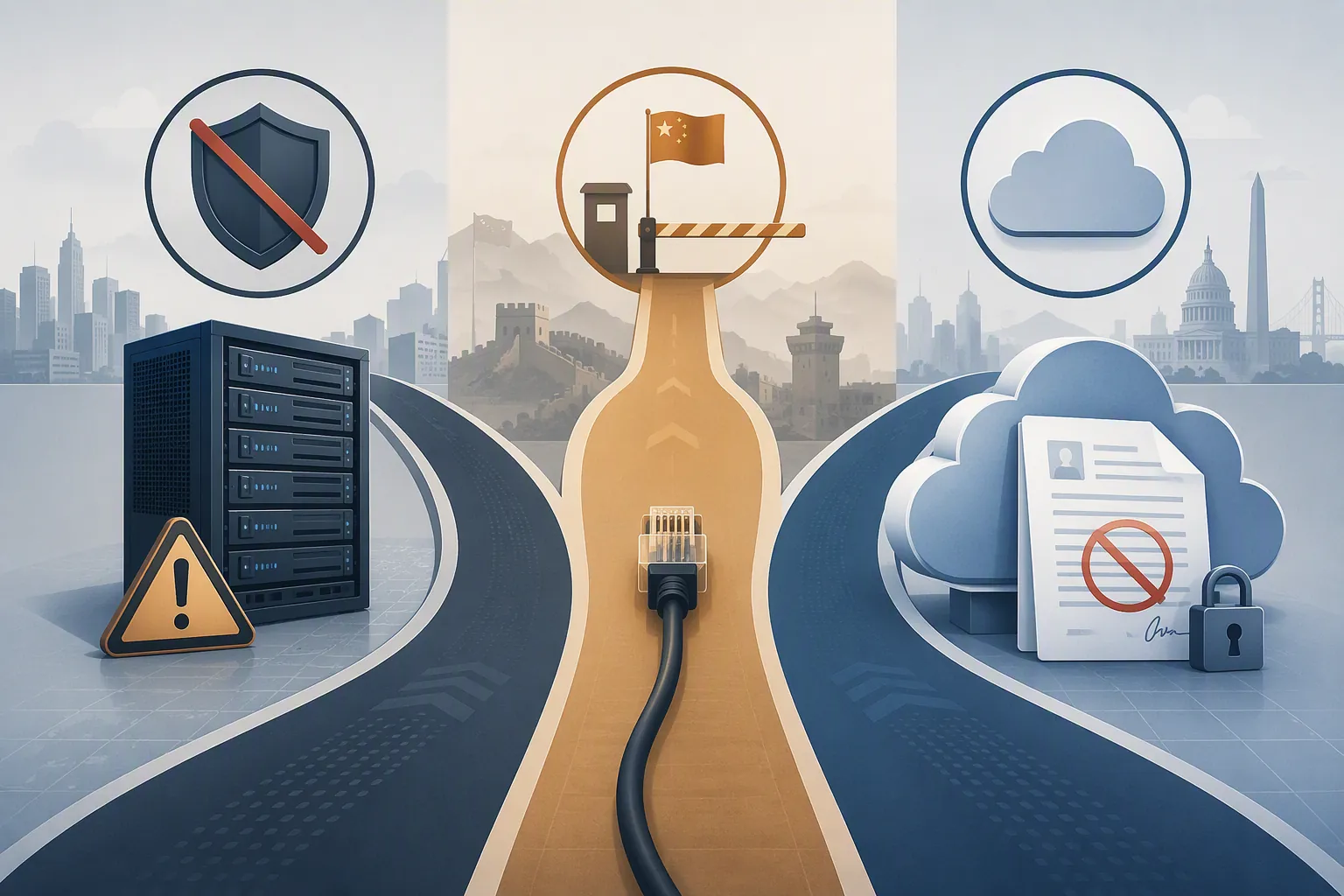
Self-hosted open weights
Self-hosting is attractive because it can remove the most obvious data-export pathway. If the company downloads open weights, runs them inside its own environment, blocks telemetry, and prevents prompts and outputs from being sent to a China-hosted service, the data-flow analysis changes materially. Sensitive prompts are not automatically crossing into a Chinese provider’s infrastructure.
That does not make the model low-risk. Behavioral and security concerns survive the hosting change. Public security analyses cited in the policy debate include NIST CAISI’s September 2025 evaluation, which found DeepSeek complied with 94% of malicious jailbreak requests compared with 8% for comparable US frontier models, and Cisco’s assessment reporting a 100% attack success rate against DeepSeek R1.[7]
Those findings should not be turned into a universal rule that every Chinese open-weight model will behave the same way in every enterprise setting. They do support a more limited and useful conclusion: self-hosting can reduce data-transfer exposure while leaving model-behavior risk, safety testing, red-team obligations, and secure configuration squarely on the company.
A self-hosting approval therefore needs more than an export-control note. It should identify the exact model and version, the source of the weights, whether the model or tokenizer contains remote-call behavior, whether updates are pinned or automatically pulled, who can fine-tune it, what logs are retained, and what internal use cases are prohibited. For legal departments, the important point is that the risk has moved. It has not disappeared.
China-hosted APIs
A China-hosted API is the hardest posture to approve casually. It combines ordinary vendor risk with an export-control question: what exactly is being sent to the provider, who receives it, where it is processed, and whether the transaction gives a China-based party access to controlled technology, technical data, source code, model weights, model outputs, or other regulated items.
Not every prompt is a controlled export. A generic customer-service query and a prompt containing controlled technical specifications do not deserve the same answer. But the compliance process has to be able to tell the difference before deployment, not after a business unit has already embedded the API into a product workflow. The Sheppard Mullin analysis is useful here because it treats model choice and hosting location as part of an export-control architecture rather than as a branding question.[3]
For a China-hosted API, the minimum review should cover data categories, user geography, end users, contractual rights to retain or train on inputs, incident-notice obligations, audit rights, subcontractors, and whether any company personnel will use the tool for controlled technology, defense work, semiconductor design, advanced manufacturing, source code review, or government-contract performance.
US-cloud-hosted Chinese models
The US-cloud option often looks like the compromise. A Chinese-origin model is made available through a US platform, the enterprise contract is with a US provider, and prompts are processed in US infrastructure. That can materially improve the data-flow and export analysis, especially if the provider contract bars transfer of customer content to the model developer and gives the customer usable logging, residency, and retention controls.
But infrastructure does not cure every legal problem. If a procurement restriction says a contractor may not use DeepSeek-developed AI in contract performance, moving the model behind a US cloud interface does not necessarily change the contractor question. The restriction is about use in a covered context, not merely about whether prompts transit a Chinese server.[2]
This is the point that tends to get lost in product comparisons. A US-hosted Chinese model may be the best technical and data-governance answer for a private commercial workflow and still be unavailable for a DoD contract deliverable. The legal answer follows the contract, user role, and data flow, not just the provider’s cloud region.
What to ask before approving a model
A durable review does not begin with the model’s nationality. It begins with the deployment record. The company should be able to answer the following questions before legal gives a yes, no, or conditional approval:
- Which exact model, version, and developer are being used?
- Is the model self-hosted, China-hosted, or accessed through a US cloud or platform provider?
- Who are the users: ordinary commercial employees, engineers handling controlled technology, government-contract personnel, or third-party vendors?
- What data categories will be entered, including source code, controlled technical data, customer personal data, confidential business information, and contract deliverables?
- Does any prompt, file, output, log, telemetry stream, fine-tuning dataset, or support ticket leave the approved environment?
- Is the model developer, distributor, hosting provider, reseller, or parent company subject to any current sanctions, Entity List restrictions, procurement exclusion, or contract-specific prohibition?
- Does the company perform DoD or other government work where contractor flow-downs may matter even if the enterprise-wide policy is more permissive?
- Has any regulator, customer, prime contractor, or cloud provider sent a nonpublic notice, license condition, access limitation, or contract amendment affecting the model?
Those questions are intentionally more granular than a typical AI acceptable-use policy. A broad policy can say that employees may not use unapproved AI tools. It cannot answer whether a US-hosted Qwen deployment for internal summarization has the same risk profile as a China-hosted Kimi API used by engineers working on export-controlled technology.
The same record also helps with adjacent enterprise-risk work. If a company already tracks AI exposure for securities, supply-chain, or chip-dependency reasons, the Chinese-model inventory should not live in a separate silo. Our China chip and AI litigation-risk digest covers that neighboring risk record.
Do not ignore the other side of the file
US regulation is only one side of the file. Reuters has reported broader US-China tension over AI safety and access as models become more powerful.[8] The research record also describes Chinese deliberations over possible limits on overseas access to Chinese AI models as still unsettled, with scope and timing uncertain. That uncertainty should not be converted into a current obligation, but it belongs in contingency planning.
For a US enterprise, the operational concern is straightforward: a deployment that is lawful and available today may become unavailable because the United States restricts use, because China restricts overseas access, because a cloud provider changes access terms after a BIS communication, or because a government customer adds a contract clause. The legal team cannot control those moves. It can make sure the company knows where the model is embedded before a deadline arrives.
The late-July 2026 answer
As of late July 2026, there is no single stable US rule that answers every Chinese AI model question. There are binding procurement restrictions in covered contexts, live export-control issues for some data flows and model-access arrangements, named-party screening obligations, a dormant-but-relevant model-weight control framework, private BIS letter practice, and sanctions threats that may or may not become operative measures.
That leaves no clean safe harbor. Self-hosting can reduce data-export exposure while preserving behavioral and security risk. China-hosted APIs put export-control and data-transfer analysis at the center. US-cloud hosting may improve the infrastructure answer while leaving contractor restrictions, procurement clauses, and named-model prohibitions unresolved.
The most defensible approach is to map Chinese AI use by model, hosting location, user role, contractor status, and data flow. That map will not eliminate policy volatility, but it gives counsel the one thing a ban headline cannot provide: a record that distinguishes enforceable obligations from signals, proposals, and risks that may become enforceable next.
References
- What to Know About Chinese AI Models — CSIS
- Lawmakers probe growing use of Chinese AI models in U.S. companies — CNBC, July 8, 2026
- Choosing Between U.S. and Chinese AI Models: The Export Control Risks on Both Sides — National Law Review
- Administration Policies on Advanced AI Chips Codified — Mayer Brown, January 2026
- Bessent says U.S. could sanction China over AI model 'theft' — CNBC, July 21, 2026
- Trump administration reportedly reviving push to ban Chinese AI models — Tom's Hardware, July 2026
- China's AI Is Spreading Fast. Here's How to Stop the Security Risks — War on the Rocks / AEI
- As AI grows more powerful, a US-China feud threatens safety efforts — Reuters, July 24, 2026
Operationalizing workflow
No workflow has been explicitly linked to this obligation yet. See Workflows generally.
Illustrative cases
No illustrative case is currently tracked for this obligation. See Risk Digest for documented incidents generally.
← Back to RegulationReport a correction or tip
Spotted an outdated figure, a misstated fact, or a ruling this regulation entry should reflect? Public comments are disabled for this content given the professional cost of a misreported case outcome, penalty amount, or rule text — use the structured correction channel instead.
Report a correction or tip for this record →