
China Chip Bans, AI Spending, and Securities Litigation Risk
As China's AI breakthroughs and hyperscaler capex concerns drive a Nasdaq correction, the Super Micro Computer case provides a replicable template for securities class actions. This digest maps the macro triggers to pleading requirements, helping litigators and risk managers assess exposure under Sections 10(b) and 20(a).
- Jurisdiction
- US Federal
- Court
- US District Court
- AI tool named
- Kimi K3
- Ruling date
- Mar 19, 2026
- Source document
- View primary court order ↗
- Last verified
- Jul 29, 2026
Lex Machina Review is an independent risk-tracking and reference resource. Nothing on this site is legal advice, and using it does not create an attorney-client relationship. Every record is reviewed against primary sources but may not reflect the most current status of a matter — always verify directly against the cited court order, rule text, or a licensed attorney before relying on it.
Companion explanation — secondary to the source document above
The useful starting point is not the July sell-off. It is the six-day litigation sequence that preceded it.
On March 19, 2026, the U.S. Department of Justice announced an indictment alleging a chip-smuggling scheme involving China. Super Micro Computer’s stock fell 33% in a single trading day. On March 25, plaintiffs filed a securities class action under Sections 10(b) and 20(a), alleging that the company failed to disclose China sales exposure and export-control weaknesses, according to The D&O Diary’s discussion of the case. [1]
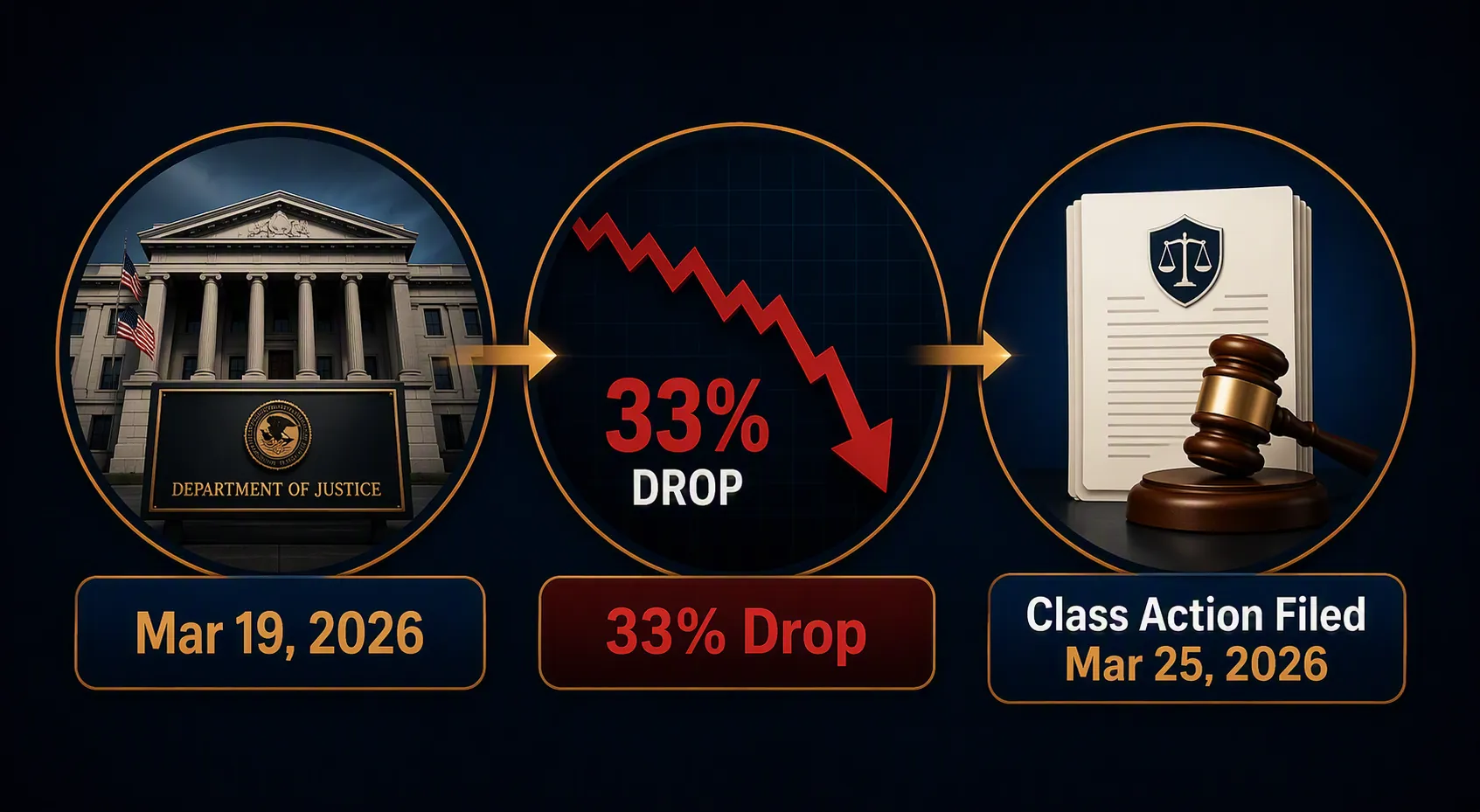
That is the template. Not “China risk” in the abstract. Not “AI bubble” commentary. A government action supplied the alleged corrective event; the stock price supplied the market reaction; plaintiffs’ counsel converted the decline into a complaint within a week. The pleading theory, as reported, was issuer-specific: investors were allegedly told an AI-growth story without adequate disclosure of the export-control and China-sales risks sitting underneath it. [1]
The current convergence of China chip restrictions, AI-spending anxiety, and Nasdaq semiconductor volatility now describes more than a market theme. For securities-litigation purposes, it describes a possible pleading environment: export-control facts, China-linked AI competition, hyperscaler capex doubt, and a semiconductor stock decline can be arranged into a loss-causation narrative. The arrangement still has to be proved company by company.
Why Super Micro Travels
Super Micro matters because it gives plaintiffs a litigation sequence they do not have to invent. A complaint can start with an issuer’s AI-infrastructure sales narrative, identify China-related exposure, point to allegedly deficient export-control controls or disclosures, and then use a sharp stock drop after a government or market event as the claimed corrective disclosure. That sequence does not establish liability by itself, but it is easier to plead than a generalized theory that investors became worried about AI.
The statutory pathway is familiar. Under Section 10(b) and Rule 10b-5, plaintiffs still need an allegedly false or misleading statement or omission, materiality, scienter, reliance, loss causation, and damages. Section 20(a) then supplies the control-person claim if the complaint can plausibly tie executives or directors to the alleged primary violation. A semiconductor issuer does not become a securities-fraud defendant because the Nasdaq falls. It becomes vulnerable when the fall can be tied to a prior disclosure gap.
That distinction is what makes the Super Micro pattern operational. The export-control allegation is not just regulatory background. It is the fact plaintiffs can try to place beside earlier revenue guidance, risk-factor language, customer-concentration disclosures, compliance assurances, or statements about AI-server demand. If the company had material China-related revenue, supply-chain dependency, or resale-channel exposure, the question becomes whether investors were told enough to price that risk before the corrective event.
The stronger complaints will not merely quote optimistic AI language. They will try to show a sequence: management knew or should have known of export-control fragility; the company continued to describe AI growth as durable or compliant; a government action, customer loss, revenue revision, or market shock exposed the gap; the stock declined when the risk became visible. The weak complaints will treat a broad semiconductor correction as if it were a confession.
July 2026 Gave Plaintiffs a Better Market Story
The July market facts do not replace issuer-specific allegations. They make the issuer-specific allegations easier to contextualize.
On July 17, 2026, CNN reported that Moonshot AI’s Kimi K3 had helped trigger a 1.4% Nasdaq decline, reviving the market memory of the January 2025 DeepSeek shock. [2] For a complaint, the important point is not that Kimi K3 proves U.S. AI infrastructure spending is excessive. It is that a China-origin AI model produced a measurable U.S. index reaction. That gives plaintiffs a cleaner way to argue that China AI competition was not a vague, long-range concern but a market-moving risk investors were already pricing.
The same month, China-related chip anxiety spread beyond U.S. equities. Fortune reported on July 28 that South Korea’s KOSPI dropped 11% in a single session and triggered its eighth circuit breaker of 2026 amid semiconductor panic. [3] That kind of cross-border move is not proof that any one issuer lied. It does, however, help plaintiffs answer a common defense theme: that the alleged risk was too remote, too macro, or too speculative to matter to investors.
By late July, the Nasdaq-100 was down 9.7% from its record, while the Philadelphia Semiconductor Index had entered a technical bear market at 20% below its June peak. [3] Those figures matter most in the loss-causation frame. A market-wide semiconductor decline can complicate damages because defendants will argue that the stock moved with the sector. But the same environment can also help plaintiffs if they can identify an issuer-specific disclosure that converted a known macro concern into a company-specific price correction.
That is where the market story becomes useful but dangerous. If a company’s stock fell only because the SOX index fell, the pleading is thin. If the company had previously emphasized AI-driven demand while understating China export-control exposure, customer resale risk, dependence on restricted chips, or sensitivity to hyperscaler capex, the sector decline can become the weather system around a more focused alleged corrective disclosure.
AI Spending Anxiety Changes the Disclosure Lens
The July anxiety was not limited to China’s ability to produce competitive models. It also reached the spending assumptions behind U.S. AI revenue.
Moody’s warned on July 24, 2026 that combined hyperscaler capex projected at $785 billion for 2026 threatened the credit quality of Amazon, Meta, and Alphabet. Alphabet alone was identified with $205 billion in projected capex. Late-July credit-default-swap pressure on Oracle, Nvidia, and SpaceX also signaled that credit markets were pricing AI-spending risk before equities fully adjusted.
For securities pleading, the capex point has a different use than the export-control point. Export controls can support an allegation that revenue was legally or operationally fragile. Capex anxiety can support an allegation that demand assumptions were overstated, especially where a company described AI infrastructure growth as durable while relying on a small group of hyperscaler customers whose spending was becoming a credit concern.
The two theories can reinforce each other. A company selling into AI infrastructure may face one risk if China-linked sales are restricted, another if hyperscalers slow purchases, and a third if its public narrative treats both risks as immaterial. The pleading question is whether the company’s disclosures allowed investors to understand that the AI-growth story depended on a narrow set of regulatory and spending assumptions.
That does not mean every forward-looking AI statement becomes actionable after a correction. Safe-harbor defenses, cautionary language, and the difference between business optimism and factual misstatement still matter. A company can be wrong about demand without committing fraud. The litigation risk rises when optimistic AI-revenue language appears beside allegedly known facts that were omitted, softened, or described too generically to be meaningful.
How a Complaint Would Try to Build the Bridge
A plausible complaint in this space would probably not begin with the Nasdaq chart. It would begin with the issuer’s own words.
| Pleading Element | What Plaintiffs Would Look For |
|---|---|
| Falsity or omission | Statements about AI demand, revenue durability, export compliance, China exposure, customer quality, or supply-chain resilience that allegedly omitted a known risk. |
| Materiality | Facts showing the omitted risk mattered to revenue, margins, backlog, customer access, product availability, or legal compliance. |
| Scienter | Internal reports, executive certifications, board materials, prior regulator communications, customer warnings, or other facts suggesting knowledge or reckless disregard. |
| Loss causation | A corrective event such as an indictment, regulatory action, guidance cut, customer disclosure, or company-specific stock drop occurring inside a broader semiconductor sell-off. |
| Control-person exposure | Executive or director roles tied to the challenged statements, compliance oversight, revenue guidance, or risk disclosures. |
The export-control leg is usually the most concrete. A plaintiff can ask whether the company sold products into China directly, relied on distributors with China exposure, serviced customers who could re-export controlled chips, or publicly assured investors that compliance systems were adequate. The legal vulnerability is not the existence of China revenue. It is the possible mismatch between the revenue story and the disclosed constraints on earning that revenue.
The AI-revenue leg is more subtle. A company may say that demand for accelerators, servers, memory, networking, storage, or related services remains strong. If that statement is tied to backlog, customer commitments, or expected hyperscaler spending, plaintiffs will look for facts showing management knew demand was less certain than represented. Moody’s capex warning and CDS pressure do not prove those facts for any issuer. They do make it harder, after July 2026, to describe hyperscaler spending risk as invisible or immaterial.
The China-competition leg supplies the market sensitivity. Kimi K3’s reported Nasdaq effect and the KOSPI circuit-breaker event show that investors were reacting to Chinese AI and semiconductor developments in real time. [2][3] If an issuer had told investors that its AI demand was insulated, defensible, or accelerating, plaintiffs may test whether those statements fairly accounted for Chinese alternatives, chip restrictions, or customer hesitation.
Loss causation is where many of these cases will tighten or fail. A broad Nasdaq correction can supply timing and market context, but it cannot do all the work. Plaintiffs need a disclosure that revealed the truth allegedly concealed: a subpoena, indictment, export-control settlement, customer cancellation, revenue revision, margin warning, backlog adjustment, or sufficiently specific analyst report. Without that bridge, the complaint risks pleading market disappointment rather than securities fraud.
The Super Micro case is therefore useful not because it guarantees outcomes, but because it shows the bridge in filed form: alleged export-control misconduct, a sharp price reaction, and a class action framed around China-sales and compliance disclosures. [1] The same pipeline appeared in another form in the Seagate export-control matter, where a $300 million BIS penalty preceded a $175 million shareholder settlement; that arc is a closer comparison for readers tracking how regulatory violations become investor claims in AI-adjacent supply chains, as discussed in the Seagate case analysis.
What the July Correction Can and Cannot Prove
A Nasdaq-100 decline of 9.7% from record levels and a SOX technical bear market are powerful facts for market narrative. [3] They are weaker facts for falsity. Securities plaintiffs can use them to show that investors cared about China chips, AI competition, and capex risk. They cannot use them as substitutes for particularized allegations about what a specific issuer said and knew.
This distinction matters for D&O underwriters and in-house counsel because the first wave of post-correction complaints often overclaims. A sector sell-off can create damages, headlines, and plaintiff interest. It does not necessarily create a viable Section 10(b) claim. The higher-risk issuers are those whose prior disclosures gave plaintiffs something to compare against the July facts.
- Material China revenue or China-linked channel exposure described only in generic geographic-risk language.
- AI-growth guidance that depends on hyperscaler capex without meaningful discussion of concentration or spending-cycle risk.
- Export-control compliance assurances made while internal remediation, government inquiries, or channel problems were already known.
- Backlog, bookings, or demand statements that do not distinguish binding commitments from softer AI-infrastructure indications.
- Risk factors that describe restrictions as hypothetical after the company has encountered concrete export-control or customer-access problems.
The lower-risk issuers are not necessarily the ones without China exposure. They are the ones whose disclosures already separate China-related sales, restricted-product risk, customer concentration, capex sensitivity, and compliance uncertainty in a way that gives investors a fair map of the business. In securities litigation, the existence of a hard problem is usually less damaging than a record suggesting the problem was known internally and flattened externally.
That is also why the KLA-style regulatory-stack analysis matters here. Export controls, CFIUS, SEC disclosure obligations, and AI-washing theories do not operate in separate rooms once the market starts repricing AI infrastructure. They stack. The relevant comparison is not whether one company looks exactly like another, but whether the issuer’s disclosure system can carry the combined weight of regulatory limits and AI-demand claims. For a broader treatment of that stack, see the KLAC AI-infrastructure risk analysis.
The AI-Washing Overlay
The July setup also lands in an existing trend. Skadden’s 2026 Insights identified AI-related securities claims, including AI-washing theories, as a litigation trend to watch. [4] That matters because complaints in the chip-export-control space do not have to be pleaded as pure sanctions or export cases. They can be pleaded as AI-narrative cases.
The AI-washing version asks whether the issuer sold investors a story about AI readiness, AI demand, or AI infrastructure leverage that exceeded the company’s actual capacity, compliance posture, or customer durability. In a China chip-ban environment, the theory becomes sharper: the company allegedly promoted AI upside while underdisclosing that the upside depended on restricted chips, vulnerable China channels, or hyperscaler spending that was already under stress.
The phrase “AI” does not make a statement actionable. Nor does an export-control regime convert every revenue projection into a misrepresentation. The risk sits in the combination: specific AI-growth claims, specific China or capex exposure, and a later disclosure that makes investors reassess both at once.
A Practical Exposure Map
For companies, the immediate exercise is not to draft broader risk factors. It is to compare the public record with the internal record.
- Map AI-revenue statements against customer concentration, hyperscaler spending assumptions, backlog quality, and renewal risk.
- Map China-related revenue against direct sales, distributors, resale channels, service obligations, and restricted-product exposure.
- Map compliance assurances against audits, remediation plans, government contacts, stopped shipments, licenses, and denied customers.
- Map risk factors against known events, not just theoretical categories.
- Map post-July stock movement against company-specific disclosures to separate sector beta from corrective-disclosure risk.
For underwriters, the same map becomes a claims-severity screen. The concern is not just whether an insured has China exposure or AI revenue. The concern is whether its prior disclosures create a clean pleading contrast after July 2026: confident AI-demand language on one side, undisclosed export-control or capex fragility on the other, followed by a stock drop.
For litigators, the important discipline is to keep the macro facts in their proper place. Kimi K3, CXMT’s reported $8.6 billion IPO signal, hyperscaler capex anxiety, CDS pressure, the KOSPI circuit breaker, and the Nasdaq/SOX decline can show market sensitivity. They do not plead scienter. They do not identify the false statement. They do not establish that a given issuer’s cautionary language was inadequate. Those elements still have to come from the company record.
July 2026 has made the Super Micro pathway more reusable for plaintiffs. The actionable question remains narrower: did a specific issuer leave a gap between known export-control or AI-spending risk and the AI-growth story it sold to investors?
References
- Geopolitics, Export Controls, and D&O Risk — The D&O Diary, March 2026.
- US stocks slide as Chinese AI model reignites tech worries — CNN, July 17, 2026.
- Why are stocks down? Chips panic hits semiconductors — Fortune, July 28, 2026.
- AI-Related Claims and Other Securities Litigation Trends To Watch — Skadden, 2026.
Related records
Tool profile
Browse tool evaluations →Governing regulation
Browse the obligations tracker →Preventive workflow
Browse verification workflows →
Report a correction or tip
Spotted an outdated figure, a misstated fact, or a ruling this case record should reflect? Public comments are disabled for this content given the professional cost of a misreported case outcome, penalty amount, or rule text — use the structured correction channel instead.
Report a correction or tip for this record →