
Georgia gas tax suspension not extended — what to file now
- Authority
- Georgia Department of Revenue
- Rule type
- statute
- Jurisdiction scope
- US state
- Effective date
- Jun 3, 2026
- Source text
- Read primary rule text ↗
Classify fuel transactions by suspension window; remit resumed Georgia motor-fuel excise tax for post-suspension fuel and follow DOR return/IFTA reporting.

Regulation & Ethics. Last verified: August 2, 2026, UTC. This is a state-rule compliance summary, not legal or tax advice. Reviewer: Georgia state-law editorial review; individual reviewer name not listed.
Compact answer: Georgia’s 2026 motor-fuel tax suspension expired at 11:59 PM on June 2, 2026, and the suspended Georgia gasoline and diesel excise tax rates were back for fuel outside the suspension period: 33.3 cents per gallon for gasoline and 37.3 cents per gallon for diesel under O.C.G.A. § 48-9-3.[1][2] CBS Atlanta reported on June 1 that the governor would not extend the suspension again.[3] This article assumes that expiration verdict and deals with the filing work that follows. For the status-only record, see Has Georgia’s Gas Tax Suspension Expired?.
June 3 is not just a rate date. It is the point where accounting teams have to stop treating the suspension as a single public event and start sorting gallons by window, return treatment, refund path, and enforcement exposure. The most useful sources for that work are the Georgia Department of Revenue’s motor-fuel bulletins, FAQs, and IFTA filing guidance.
Classify the gallons before touching the return
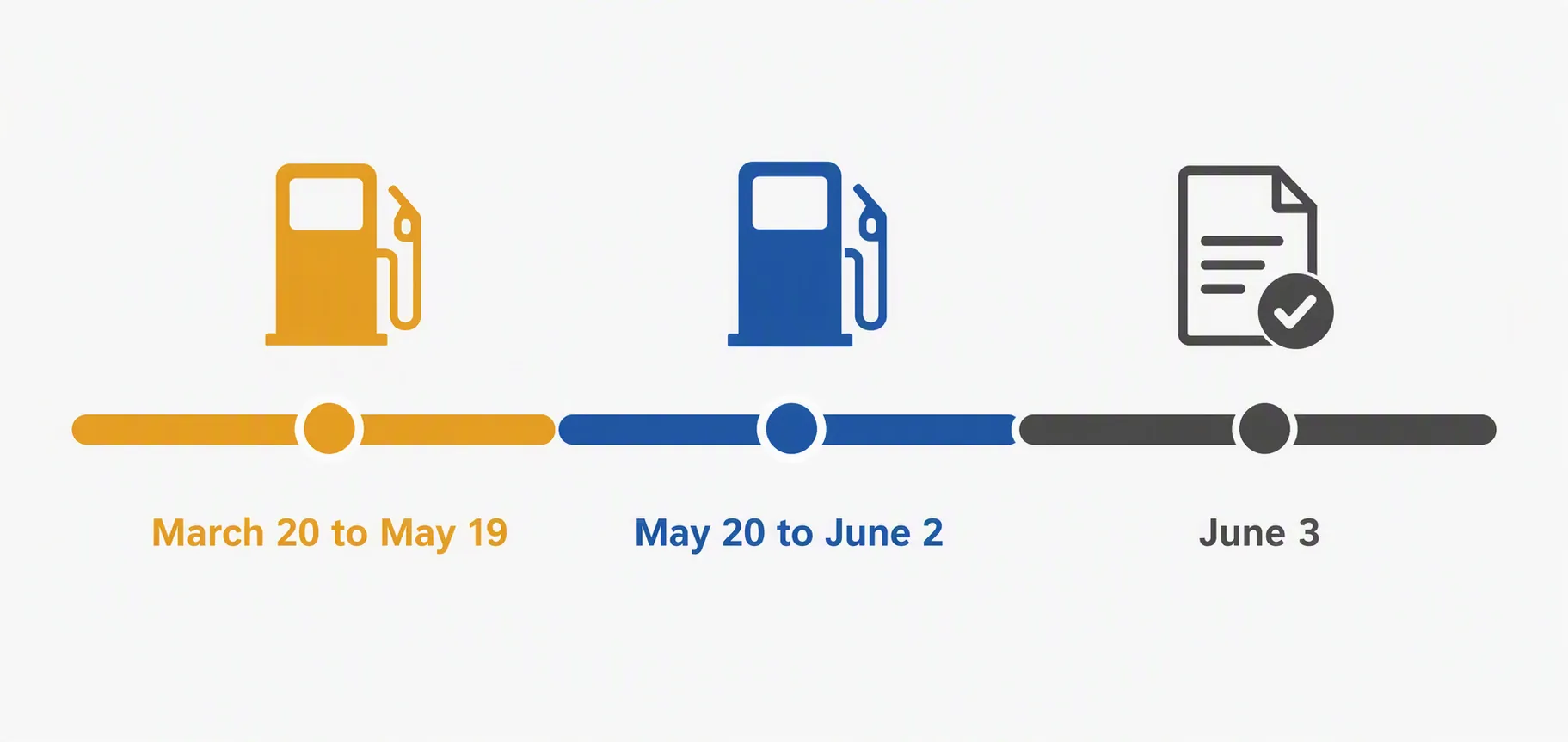
The first control is the date-and-time bucket. A sale, receipt, disbursement, or fleet fuel event should not be pushed into a return line until someone has assigned it to the statutory suspension window, the executive-extension window, or the post-suspension taxable period.
| Window | What the verified sources support | Filing posture |
|---|---|---|
| March 20, 2026, 11:00 AM through May 19, 2026, 11:59 PM | DOR MFT-2026-01 identifies this as the statutory suspension period.[4] | Use the DOR FAQ mechanics for the March–May Motor Fuel Distributor Return where they apply.[2] |
| May 20, 2026, 12:00 AM through June 2, 2026, 11:59 PM | DOR MFT-2026-02 identifies this as the executive extension period.[1] | Treat as a DOR-recognized suspension period, but confirm DOR-directed return-line treatment before assuming the March–May FAQ line mechanics carry over. |
| June 3, 2026 and after | The suspension was not extended again, and the excise rates resumed.[1][2][3] | Post-suspension taxable fuel is back in the ordinary remittance environment unless another exemption applies. |
One wording trap is worth clearing out early. The governor’s May 15 release described the extension as running “through June 3,” but DOR MFT-2026-02 and the DOR FAQ use the 11:59 PM June 2 expiration framing, and the non-extension reporting points to Tuesday night rather than a full June 3 suspension day.[1][2][3][5] For filing purposes, the DOR expiration language is the safer control.
What resumed on June 3
For distributors and other motor-fuel taxpayers in the remittance chain, the practical result is simple only at the highest level: fuel falling after the suspension window is no longer suspension-period fuel. Georgia’s suspended gasoline and diesel excise rates resumed at 33.3 cents per gallon and 37.3 cents per gallon, respectively.[1][2]
That does not answer the return by itself. A June invoice file may contain fuel activity from the May 20–June 2 extension window and from June 3 forward. The tax result turns on the underlying fuel event and the applicable DOR treatment, not on the month-end label attached to the batch.
The clean file is the one that can show, without reconstructing the story from emails, which gallons were inside March 20–May 19, which were inside May 20–June 2, and which were outside the suspension altogether.
Distributor reporting: use the DOR line mechanics where DOR actually gave them
The DOR FAQ is the controlling working document for the concrete March–May distributor mechanics. It addresses how licensed distributors should report suspension-period transactions on the March–May Motor Fuel Distributor Return and points filers to Schedule 1, Schedule 13, and the Gallons worksheet, including Lines 4 and 12.[2] Those line references matter because the return is not corrected by simply deleting suspension-period gallons from the file or treating the holiday as a no-record period.
A distributor preparing the March–May return should therefore build the workpaper from the DOR FAQ outward:
- First, isolate March 20, 2026, 11:00 AM through May 19, 2026, 11:59 PM activity from ordinary March–May activity.
- Second, map the isolated gallons to the specific DOR FAQ treatment for Schedule 1, Schedule 13, and the Gallons worksheet Lines 4 and 12, rather than netting them against taxable gallons informally.[2]
- Third, keep the calculation support with the return file, because the same gallon classification may also explain a refund claim or an audit question later.
The extension period needs a narrower statement. DOR MFT-2026-02 establishes the May 20, 2026, 12:00 AM through June 2, 2026, 11:59 PM suspension extension.[1] The crawled sources for this article did not spell out the same Schedule 1, Schedule 13, and Gallons worksheet line mechanics for that later window. That does not mean the extension was taxable; it means the return-line treatment should be confirmed against DOR instructions before carrying the March–May mechanics forward by analogy.
Refunds for tax mistakenly remitted during the suspension

The DOR FAQ also gives a route for taxpayers that mistakenly remitted motor-fuel tax during the suspension: use the Georgia Tax Center refund process.[2] That is a different task from deciding whether June 3-and-after fuel is taxable. One asks how to recover tax paid during a suspension period; the other asks how to treat fuel after the suspension ended.
The refund file should tie the claimed amount to the same date-and-gallon sorting used for the distributor return. The weak claim is the one that says only “tax holiday” and attaches a ledger total. The better file shows which transactions were inside the covered period, why tax was remitted anyway, where the remittance appeared, and how the refund amount was computed under the DOR route.
Nothing in the verified materials supports replacing the Georgia Tax Center route with an informal credit against later taxable gallons. If a taxpayer wants to offset rather than claim a refund through the stated path, that should be backed by DOR direction, not by convenience.
IFTA fleets still file; Georgia suspension-period miles and gallons are treated as non-taxable where the guidance covers them
The IFTA point is short, but it is easy to mishandle. DOR’s 2026 IFTA Return Filing Guidance says IFTA returns still must be filed, and Georgia miles and gallons during the covered suspension period are reported as non-taxable.[6] The guidance also tells carriers to retain records.[6]
The verified IFTA guidance explicitly covers March 20 through May 19.[6] The sources provided for this article did not verify separate IFTA treatment for the May 20–June 2 executive-extension period. A fleet tax manager should not silently expand the IFTA instruction to the extension period without checking whether DOR issued matching extension-period IFTA direction.
For recordkeeping, the useful packet is ordinary: trip records, jurisdictional miles, fuel receipts, Georgia gallons, and the workpaper showing which Georgia miles and gallons were treated as non-taxable because they fell inside the DOR-covered suspension period. The return still exists; the Georgia tax treatment changes for the covered suspension-period entries.
Retailers: the pass-through warning did not become irrelevant when the rates came back
Retailers do not have the same filing problem as licensed distributors, but they do have a surviving documentation problem. On March 28, 2026, Georgia Attorney General Chris Carr’s Consumer Protection Division warned that a retailer’s failure to pass through the suspension could be treated as an unfair or deceptive act under O.C.G.A. §§ 10-1-390 through 408, with investigation and prosecution if warranted.[7]
That warning was tied to the suspension period, not to a permanent pricing rule. Still, the file a retailer wants after June 3 is not just a price board history. It should preserve supplier cost records, pump price changes, timing of tax-suspension pass-through decisions, and any communications used to explain why a price did or did not move during the suspension.
The broader enforcement climate also stayed active. On July 3, 2026, the U.S. Department of Justice and Federal Trade Commission issued a call-to-action letter to state attorneys general concerning high gasoline prices, and Morgan Lewis later analyzed that federal-state enforcement signal in a July 10, 2026 LawFlash.[8][9] That does not create a new Georgia motor-fuel return line. It does make it harder to treat pass-through support as a disposable month-end note.
Filing posture after expiration
For post-expiration filing, the durable posture is straightforward: classify each transaction by time window; remit on taxable post-suspension fuel; use the DOR-specified March–May distributor reporting mechanics where they are stated; use the Georgia Tax Center refund route for tax mistakenly remitted during the suspension; treat Georgia IFTA miles and gallons as non-taxable where the DOR IFTA guidance covers them; and keep pass-through support because the enforcement risk did not expire as neatly as the tax holiday.
References
- MFT-2026-02 Suspension of Georgia Motor Fuel Taxes, Georgia Department of Revenue, https://dor.georgia.gov/mft-2026-02-suspension-georgia-motor-fuel-taxes
- 2026 Suspension of Georgia Motor Fuel Taxes FAQs, Georgia Department of Revenue, https://dor.georgia.gov/2026-suspension-georgia-motor-fuel-taxes-faqs
- Gov. Kemp not extending Georgia's gas tax suspension, set to expire Tuesday night, CBS News Atlanta, June 1, 2026, https://www.cbsnews.com/atlanta/news/gov-kemp-not-extending-georgias-gas-tax-suspension-set-to-expire-tuesday-night/
- MFT-2026-01 Suspension of Georgia Motor Fuel Taxes, Georgia Department of Revenue, https://dor.georgia.gov/mft-2026-01-suspension-georgia-motor-fuel-taxes
- Gov. Kemp Suspends Gas Tax for Two Additional Weeks, Office of the Governor of Georgia, May 15, 2026, https://gov.georgia.gov/press-releases/2026-05-15/gov-kemp-suspends-gas-tax-two-additional-weeks
- 2026 International Fuel Tax Association (IFTA) Return Filing Guidance, Georgia Department of Revenue, https://dor.georgia.gov/2026-international-fuel-tax-association-ifta-return-filing-guidance
- Attorney General Chris Carr Consumer Protection Division warning on Georgia motor-fuel tax suspension pass-through, March 28, 2026, https://consumer.georgia.gov/press-releases/2026-03-28/atlanta-ga-georgia-attorney-general-c
- Justice Department and Federal Trade Commission Issue Call to Action to State Attorneys General, U.S. Department of Justice, July 3, 2026, https://www.justice.gov/opa/pr/justice-department-and-federal-trade-commission-issue-call-action-state-attorneys-general
- DOJ, FTC Call on State Attorneys General to Investigate High Gas Prices, Morgan Lewis, July 10, 2026, https://www.morganlewis.com/pubs/2026/07/doj-ftc-call-on-state-attorneys-general-to-investigate-high-gas-prices
Operationalizing workflow
No workflow has been explicitly linked to this obligation yet. See Workflows generally.
Illustrative cases
No illustrative case is currently tracked for this obligation. See Risk Digest for documented incidents generally.
← Back to RegulationReport a correction or tip
Spotted an outdated figure, a misstated fact, or a ruling this regulation entry should reflect? Public comments are disabled for this content given the professional cost of a misreported case outcome, penalty amount, or rule text — use the structured correction channel instead.
Report a correction or tip for this record →