
Has Germany's deepfake law changed after Collien Fernandes?
- Authority
- European Union
- Rule type
- regulation
- Jurisdiction scope
- EU
- Effective date
- Aug 2, 2026
- Source text
- Read primary rule text ↗
Disclose AI-generated or manipulated content under Article 50 of the EU AI Act.
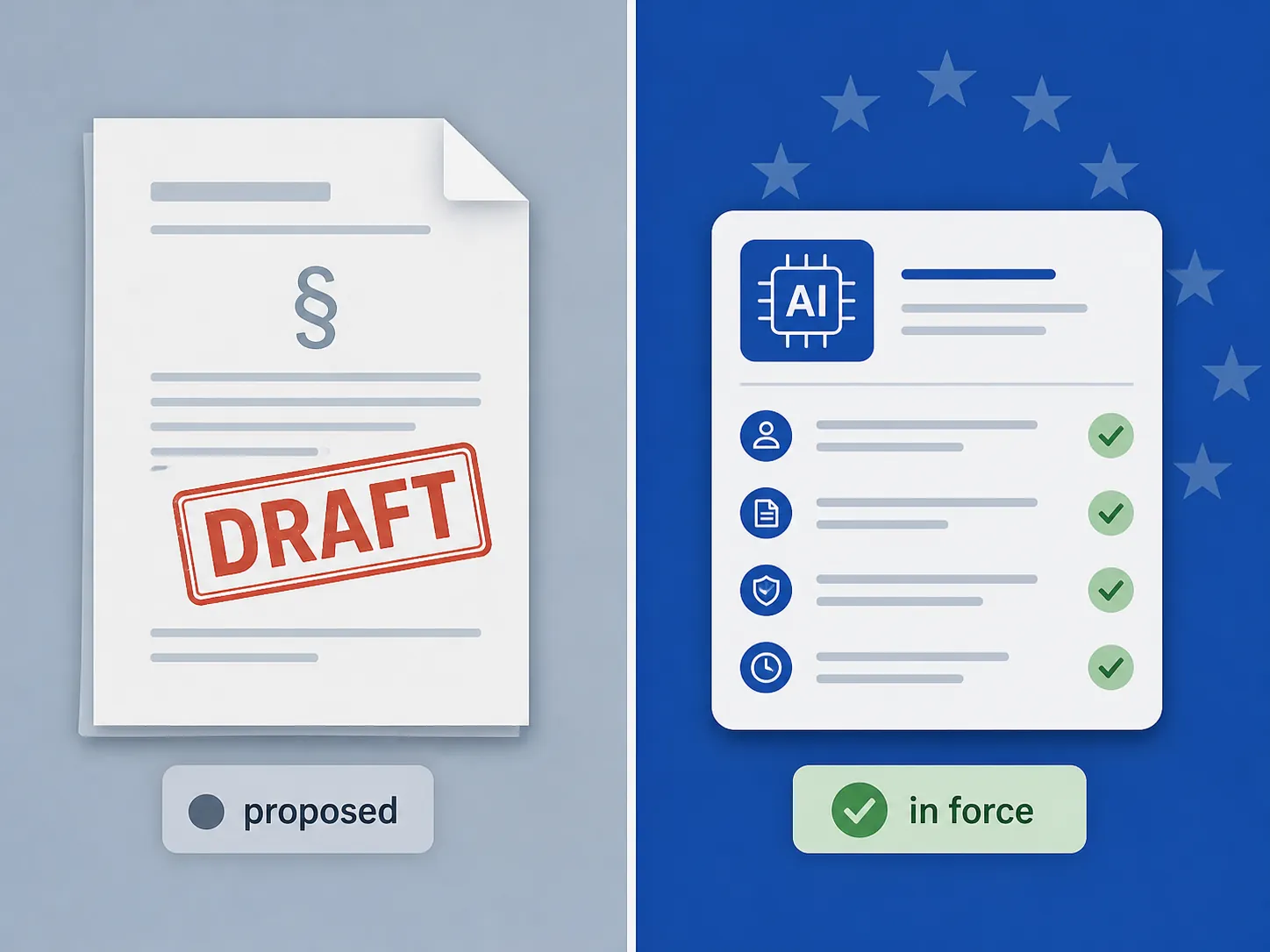
As of Q3 2026, Germany has not enacted a criminal-law offence specifically addressing deepfakes. The proposed §201b of the German Criminal Code (StGB) remains a draft, not an in-force provision. The separate obligation that German organisations must now track is EU-level: Article 50 of the EU AI Act, whose relevant transparency duties apply from 2 August 2026.
For a German obligations register, the entry should therefore read: German criminal offence — proposed, not in force; EU AI Act Article 50 disclosure obligation — in force from 2 August 2026. The two records should not be merged.
The chronology does not support “criminalized after the case”
The named German deepfake offence predates the Collien Fernandes reporting by roughly two years. Bavaria’s Bundesrat initiative was decided on 5 July 2024 and transmitted to the Bundestag as BT-Drs 20/12605. Its proposed new §201b StGB was described as “Violation of personality rights by digital falsification.” [1][2]
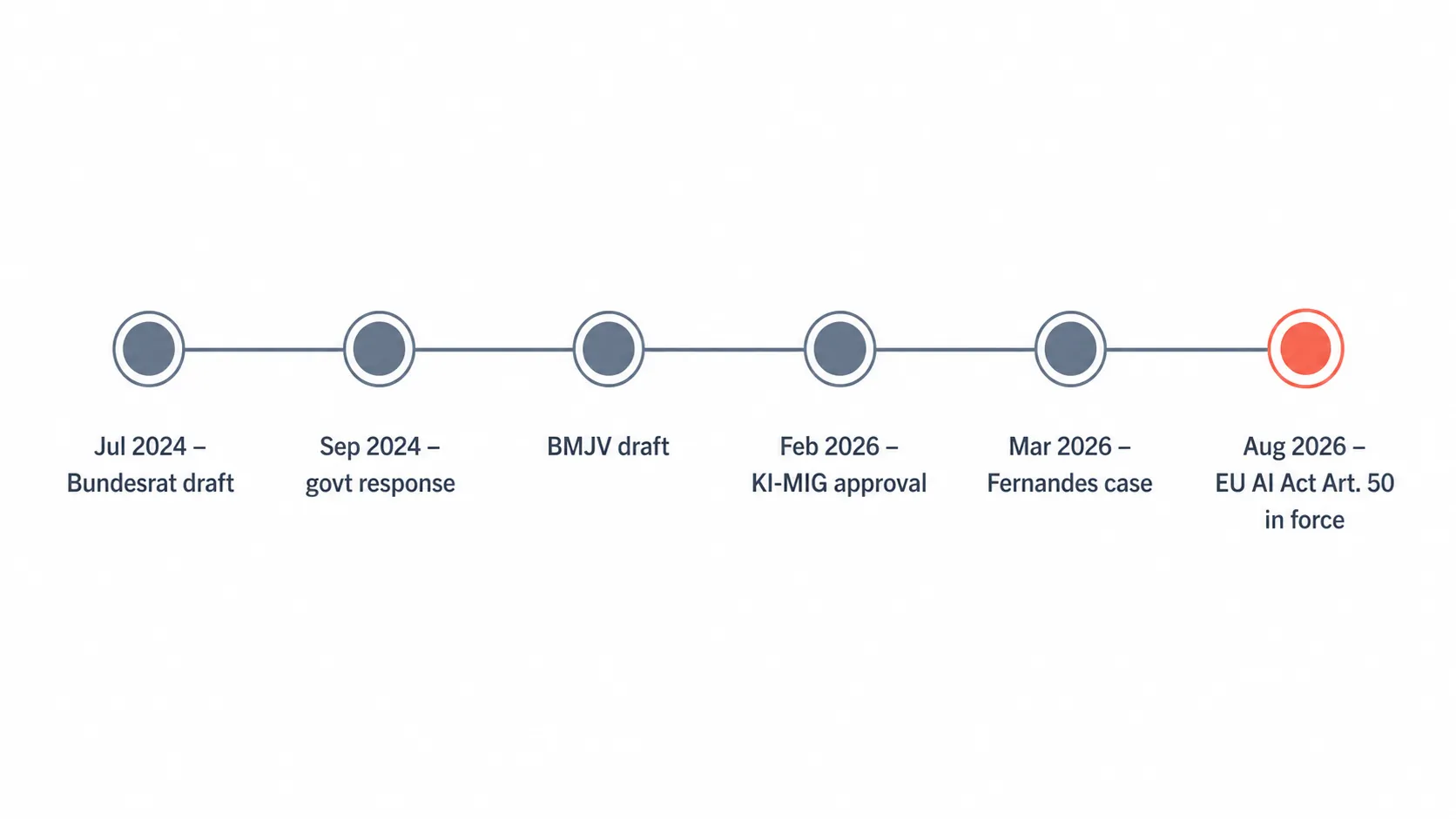
The next dated development cuts against a simple enactment narrative. In September 2024, the Federal Government’s response to the Bundesrat initiative was reported as finding no immediate need for legislative action. That is a government position on the proposal, not an enacted offence and not a penalty provision. [1]
A later vehicle is also in the record. The Federal Ministry of Justice and Consumer Protection (BMJV) prepared a ministerial draft titled “Gesetz zur Stärkung des zivilrechtlichen und strafrechtlichen Schutzes vor digitaler Gewalt.” The Deutscher Juristinnenbund’s 2026 statement discusses that draft as being under review. The materials do not provide a primary German government document confirming its current legislative stage or an effective date. [3]
That leaves an unresolved procedural timeline: the government’s 2024 “no immediate need” position and the BMJV’s later digital-violence draft both need to be recorded, but they do not establish that Parliament has passed §201b or that it is currently enforceable.
What the Fernandes reporting establishes
The Collien Fernandes case explains why the issue received renewed public and political attention in 2026. The BBC reported on 24 March 2026 that Fernandes filed a complaint in Spain against Christian Ulmen. The report also stated that Ulmen was not facing charges and was presumed innocent. More than 250 prominent German women petitioned for stronger protection, and the German government announced an intention to criminalize pornographic deepfakes. [4]
Those facts support a narrower conclusion than the headline claim often attached to them. The case may have renewed political pressure and made the consequences of fabricated sexual material difficult to ignore. It does not show that Germany enacted a new criminal offence after the case. The only named §201b proposal in the supplied record was already dated July 2024.
The procedural outcome of the Spanish complaint is not established by the available materials. It should not be described as pending, withdrawn, settled, or adjudicated without a further authoritative source.
What proposed §201b would cover—and what remains unknown
Secondary summaries describe proposed §201b as addressing the misuse and public dissemination of digitally falsified media, with exceptions for legitimate uses. That description is useful for identifying the draft’s policy direction, but it is not a substitute for the statutory text. The supplied materials do not quote the provision itself.
No source in the record supplies a confirmed penalty range (Strafrahmen) for §201b. A register should therefore leave the penalty field unconfirmed rather than infer one from existing offences or from press language. Nor should the draft’s reported subject matter be converted into a current prohibition.
The relevant German criminal-law record currently has two vehicles: the 2024 Bundesrat proposal, BR-Drs 222/24, and the later BMJV digital-violence draft. Both should carry a draft or proposed status. Neither source vehicle, on the materials available here, establishes an in-force German offence. [2][3]
Do not confuse the 2026 KI-MIG bill with §201b
Another date creates avoidable confusion. On 11 February 2026, the German Cabinet approved KI-MIG, an implementation bill for the EU AI Act. That approval concerned the German framework for implementing the AI Act; it was not an enactment of the proposed deepfake offence in §201b StGB. [5]
The binding obligation is Article 50 of the EU AI Act
For current operational purposes, Article 50 of the EU AI Act is the binding deepfake-related record to add to a German compliance register. Its transparency obligations include disclosure requirements for certain AI-generated or manipulated content, with application beginning on 2 August 2026 under Article 113. [6]
The practical question is whether a particular organisation, system, or output falls within the Article 50 obligation and how the required disclosure must be implemented. That is an EU AI Act compliance analysis, not proof that Germany has created a new criminal offence. Our existing coverage of Article 50 disclosure for AI-generated product images examines that disclosure track in more operational detail.
The available materials do not identify a German supervisory authority or a specific penalty amount for Article 50 non-disclosure. Those fields should remain separately verified rather than being populated with assumptions from the proposed German criminal-law record.
Register status as of 31 August 2026
| Record | Authority and date | Status | What can be recorded |
|---|---|---|---|
| Proposed §201b StGB | Bundesrat initiative BR-Drs 222/24; decision dated 5 July 2024 | Draft — not in force | Reported proposal concerning digitally falsified media; no confirmed penalty range in the available record |
| BMJV digital-violence bill | BMJV ministerial draft; discussed in Deutscher Juristinnenbund statement st26-13 | Draft vehicle; current legislative stage not confirmed | Potential later vehicle for civil and criminal protection from digital violence; no effective date established |
| KI-MIG | German Federal Cabinet approval dated 11 February 2026 | AI Act implementation measure | Do not record as enactment of a German deepfake criminal offence |
| EU AI Act Article 50 | European Union; applicable from 2 August 2026 under Article 113 | In force | Track applicable transparency and disclosure duties separately from the German criminal-law record |
The defensible answer to “Has Germany’s deepfake law changed after Collien Fernandes?” is therefore no—not as an enacted German criminal offence. Fernandes-related reporting helps explain renewed attention, but the chronology places the named German proposal in 2024, before the case reporting in March 2026. Article 50 is the separate EU obligation that is in force from 2 August 2026.
This is a record-level regulatory status assessment, not legal advice. Confirm the current legislative documents, scope, and applicability before relying on any register entry.
References
- Germany’s legal debate on criminal liability for misuse of deepfakes: navigating — Freshfields, 10 September 2024
- BR-Drs 222/24 — Regulations.AI
- Statement st26-13 — Deutscher Juristinnenbund, 2026
- Collien Fernandes: German women call for pornographic deepfake law — BBC, 24 March 2026
- EU AI Act implementation: German Cabinet approved the German AI draft bill — MIAI, 11 February 2026
- Transparency obligations under Article 50 of the AI Act — European Commission
Operationalizing workflow
No workflow has been explicitly linked to this obligation yet. See Workflows generally.
Illustrative cases
No illustrative case is currently tracked for this obligation. See Risk Digest for documented incidents generally.
← Back to RegulationReport a correction or tip
Spotted an outdated figure, a misstated fact, or a ruling this regulation entry should reflect? Public comments are disabled for this content given the professional cost of a misreported case outcome, penalty amount, or rule text — use the structured correction channel instead.
Report a correction or tip for this record →