
Stacking Disclosure Regimes for Amazon AI Product Images
This article maps the four overlapping disclosure regimes — NY, EU, CA, and Amazon policy — that apply to Amazon sellers using AI-generated product images as of August 2026, and explains how fines vary by an order of magnitude and why compliance requires a cross-jurisdictional audit workflow.
- Jurisdiction
- Multi-jurisdictional
- Court
- Various
- AI tool named
- Generative AI
- Ruling date
- Jul 30, 2026
- Source document
- View primary court order ↗
- Last verified
- Jul 30, 2026
Lex Machina Review is an independent risk-tracking and reference resource. Nothing on this site is legal advice, and using it does not create an attorney-client relationship. Every record is reviewed against primary sources but may not reflect the most current status of a matter — always verify directly against the cited court order, rule text, or a licensed attorney before relying on it.
Companion explanation — secondary to the source document above
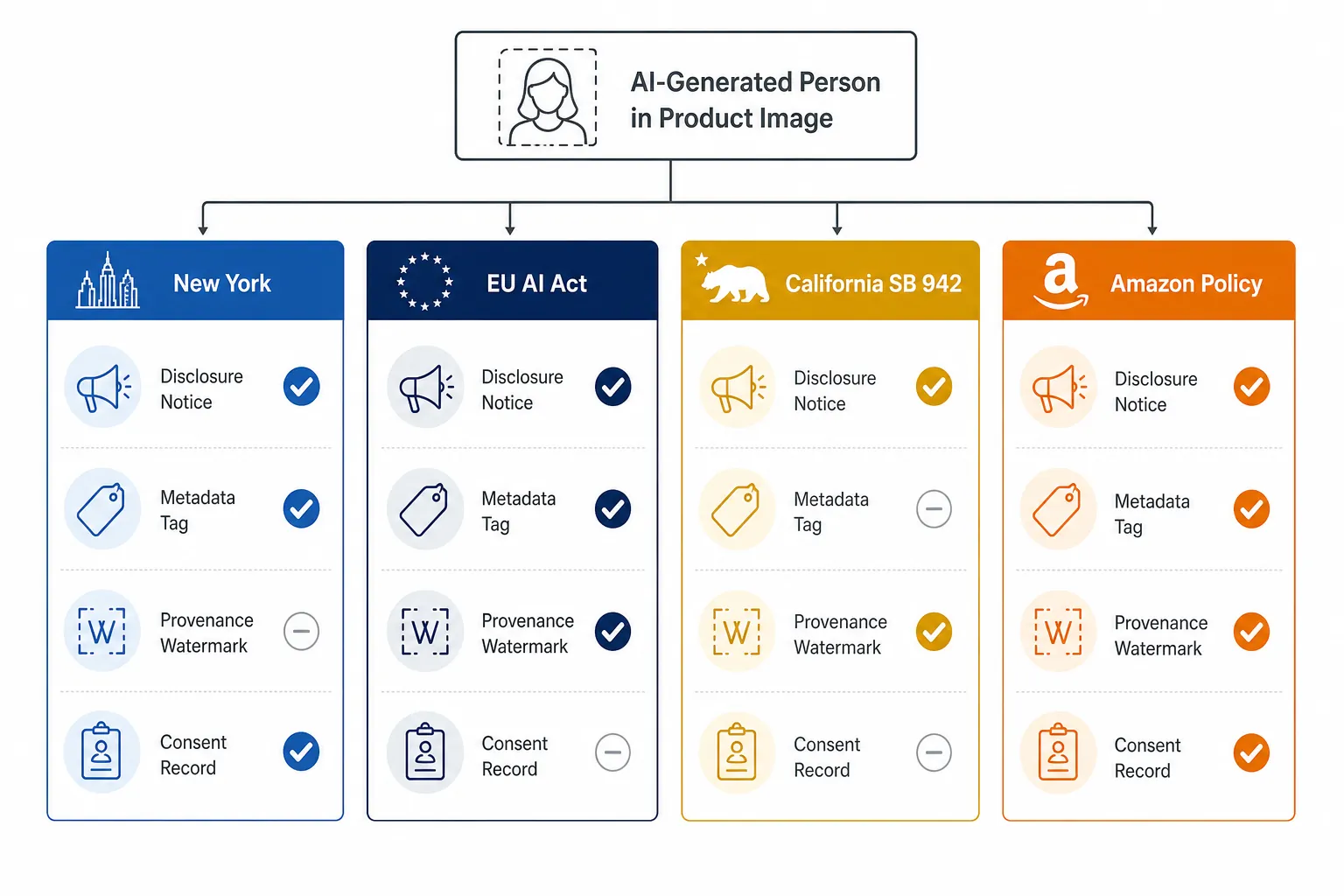
Start with one ordinary listing image: a photorealistic person, generated by AI, holding a consumer product in an Amazon image carousel. The image is not a product claim in the old sense, and it is not merely a design asset in the new sense. By August 2, 2026, that one file can sit under New York synthetic performer disclosure rules, EU AI Act Article 50 transparency obligations, California provenance requirements, Amazon’s own synthetic-performer metadata policy, and the FTC’s baseline deception authority. The legal implications of Amazon AI product images now depend less on whether the seller used a particular image tool and more on where the image appears, what kind of synthetic person it contains, and which records survive when the listing is challenged.

Amazon’s July 2026 move illustrates the problem. The company began requiring sellers to embed a contains-synthetic-performer tag in the XMP dc:subject field for listing images that contain fully synthetic photorealistic people; the policy applies across Amazon stores globally, is enforced through listing suppression or image removal, and was reported as non-retroactive for existing images.[1] That may satisfy Amazon’s intake need. It does not, by itself, answer whether a New York ad disclosure is conspicuous enough, whether an EU-facing campaign has disclosed AI-generated content to natural persons, whether a California provenance obligation has been met, or whether the image is otherwise deceptive.
The distinction matters because these regimes are not substitutes. They come from different issuing authorities, attach to different actors, and use different enforcement paths. A seller can pass Amazon’s metadata check and still have a statutory disclosure problem. A seller can disclose that a person is synthetic and still have an FTC problem if the image misrepresents product fit, size, performance, endorsement, or availability.
The Same Image, Four Different Disclosure Questions
New York’s rule is the most concrete starting point for U.S. sellers because it speaks directly to advertising that uses a synthetic performer. New York General Business Law § 396-b became effective on June 9, 2026, and provides civil penalties of $1,000 for a first violation and $5,000 for subsequent violations, calculated per advertisement; the statute also includes a five-day cure period for publishers placed on notice.[2] The practical exposure is not theoretical for a marketplace seller running multiple listing variants, sponsored placements, and off-platform retargeting creatives built from the same image asset.
The EU AI Act asks a different question. Article 50 transparency obligations become applicable on August 2, 2026, and require disclosure in relevant circumstances that content has been artificially generated or manipulated; violations of certain transparency obligations may reach up to EUR 15 million or 3% of total worldwide annual turnover, depending on the infringing entity and violation category.[3] That penalty scale is in another register from New York’s per-ad civil penalties, and it changes the way a global seller should price “minor” image compliance work.
California’s SB 942 adds a provenance layer rather than simply another consumer-facing label. Its watermarking requirements become operative on August 2, 2026, while duties for large online platforms begin January 1, 2027.[4] A seller looking only for a visible disclosure statement can miss the point: provenance rules concern technical signaling and detection infrastructure as much as the text beside an image.
The FTC sits underneath all of this. Section 5 does not need an AI-specific amendment to reach deceptive advertising. Legal analysis tracking the FTC’s 2025 and 2026 posture points to warning letters under the Consumer Review Rule on December 22, 2025, an AI-washing action on May 21, 2026, and a July 2026 policy statement on AI accuracy with a public comment period closing July 31, 2026.[5] For product imagery, that means an accurate AI label is not a safe harbor if the image causes consumers to believe something false about the product.
| Regime | What It Is Trying To Control | Why Amazon Metadata Is Not Enough |
|---|---|---|
| New York § 396-b | Synthetic performer use in advertising, with per-ad civil penalties | The Amazon tag is file metadata; New York disclosure analysis still turns on the statutory advertising requirement. |
| EU AI Act Article 50 | Transparency to natural persons when content is AI-generated or manipulated | A platform-side metadata field does not automatically deliver the required EU-facing disclosure. |
| California SB 942 | Provenance and watermarking obligations, with platform duties phased later | The Amazon tag identifies a synthetic performer category; it is not the same as a statutory provenance framework. |
| Amazon policy | Marketplace enforcement for fully synthetic photorealistic people in listing images | Passing Amazon review does not resolve statutory exposure outside Amazon’s enforcement system. |
| FTC Section 5 | Deceptive or unfair advertising practices | A labeled synthetic image can still mislead consumers about the product itself. |
Why the Regimes Stack Instead of Canceling Each Other Out
The common operational mistake is to treat the first applicable rule as the controlling rule. That is backwards. Amazon’s rule controls what the marketplace may accept. New York’s rule controls a category of advertising conduct. The EU AI Act controls transparency obligations in its own jurisdictional frame. California’s law controls provenance duties on its own timetable. FTC Section 5 remains available when the resulting ad is deceptive.
There is also no current federal preemption shortcut in the United States. A Tech Policy Press count identified 109 state AI laws enacted through July 1, 2026.[6] That number should not be read as 109 directly relevant image-disclosure laws for Amazon sellers. Its importance is narrower and more useful: state AI regulation is already active enough that a seller cannot responsibly assume one national U.S. disclosure answer will override state-specific obligations.
Nor does the commercial incentive point in the direction of abstinence. Amazon has reported that AI images in Sponsored Brands can deliver 10.3% higher ROAS and up to 40% higher CTR, giving sellers an obvious reason to keep testing synthetic creative even as legal review becomes more cumbersome.[7] Amazon’s own retail environment is also making synthetic imagery more familiar: reporting on its June 3, 2026 generative search-bar described synthetic images of products that do not exist, a separate disappointment-risk vector when shopper expectations outrun actual catalog availability.[8]
That incentive structure is why a checkbox model fails. Sellers will not stop using AI images just because the rules have become layered. They will route around friction unless the compliance process is fast enough to run at listing speed and precise enough to distinguish a statutory disclosure problem from a platform upload problem.
The First Triage Question Is What the Image Actually Contains
Amazon’s synthetic-performer policy is not triggered by every use of AI in an image workflow. Reported guidance distinguishes fully synthetic photorealistic people from ordinary AI-assisted editing such as background removal, lighting changes, color correction, and other retouching of real people.[1] That distinction should be captured before anyone debates disclosure wording.
A practical review should therefore split image files into at least three buckets: product-only images with AI retouching, images of real people altered with AI tools, and images containing fully synthetic photorealistic people. The third bucket is where Amazon’s contains-synthetic-performer tag becomes central. The second bucket may create a different consent or right-of-publicity problem, especially where a real model’s likeness has been extended, modified, or reused beyond the scope of the original release.
New York’s Fashion Workers Act is relevant here because it creates separate consent requirements for digital AI replicas of real models, including scoped written consent, and legal commentary has warned that pre-2024 model releases are generally insufficient for these newer AI-replica uses.[9] That issue is adjacent to synthetic-performer disclosure but not identical to it. A file can require a synthetic-person disclosure without involving a real model; another file can involve a real model consent issue even if the seller does not think of it as a synthetic performer asset.
Platform Rules Are Faster, Narrower, and Still Binding
Amazon is not alone in moving ahead of legislatures. Etsy introduced a “Designed by” attribution approach on January 14, 2026, Meta used an AI Content Label in March 2026, and TikTok Shop has disclosure requirements for AI-generated content in seller contexts.[10] These policies do not create a single marketplace standard. They show that platforms are building their own enforcement layers while statutory rules remain uneven.
For counsel, the important difference is remedy. A platform can suppress a listing, reject an image, remove a placement, or impair account health without waiting for a regulator. A regulator can impose statutory penalties or bring a deception action without caring that the seller satisfied a platform upload field. Those two paths can run at the same time, and the seller-side compliance lead is usually the person asked why both were not anticipated.
Amazon’s global application of its July 2026 metadata rule also creates a useful but slightly dangerous convenience. Applying the tag globally may be easier than maintaining a New York-only image process, and it may reduce one class of platform enforcement risk. But a globally applied Amazon tag should not be described internally as “global legal compliance.” It is evidence of one control, not proof that the seller made the right disclosure decision in every jurisdiction where the image is displayed.
Penalty Scale Changes the Approval Standard
The spread between New York and EU exposure is large enough to affect workflow design. New York’s $1,000 first-violation and $5,000 subsequent-violation civil penalties, calculated per advertisement, can become painful when creative assets are multiplied across campaigns.[2] EU AI Act exposure, at up to EUR 15 million or 3% of worldwide annual turnover for relevant violations, belongs in board-level risk language for larger sellers and agencies.[3]
That does not mean every AI-generated lifestyle image needs outside counsel. It means the routing rule should be based on exposure, not on whether an image looks realistic enough to make someone uncomfortable. EU-facing campaigns, New York-targeted advertising, real-model likeness reuse, influencer-style endorsement scenes, and high-volume sponsored placements deserve a different approval path from a product-only image where AI was used to clean up a background.
A Workflow That Can Survive More Than One Regime
A usable audit process begins before upload. The legal question should not be postponed until Amazon rejects an image or a state-law notice arrives. By then, the seller may already have lost the generation inputs, logs, model releases, agency approvals, and campaign distribution map needed to explain what happened.
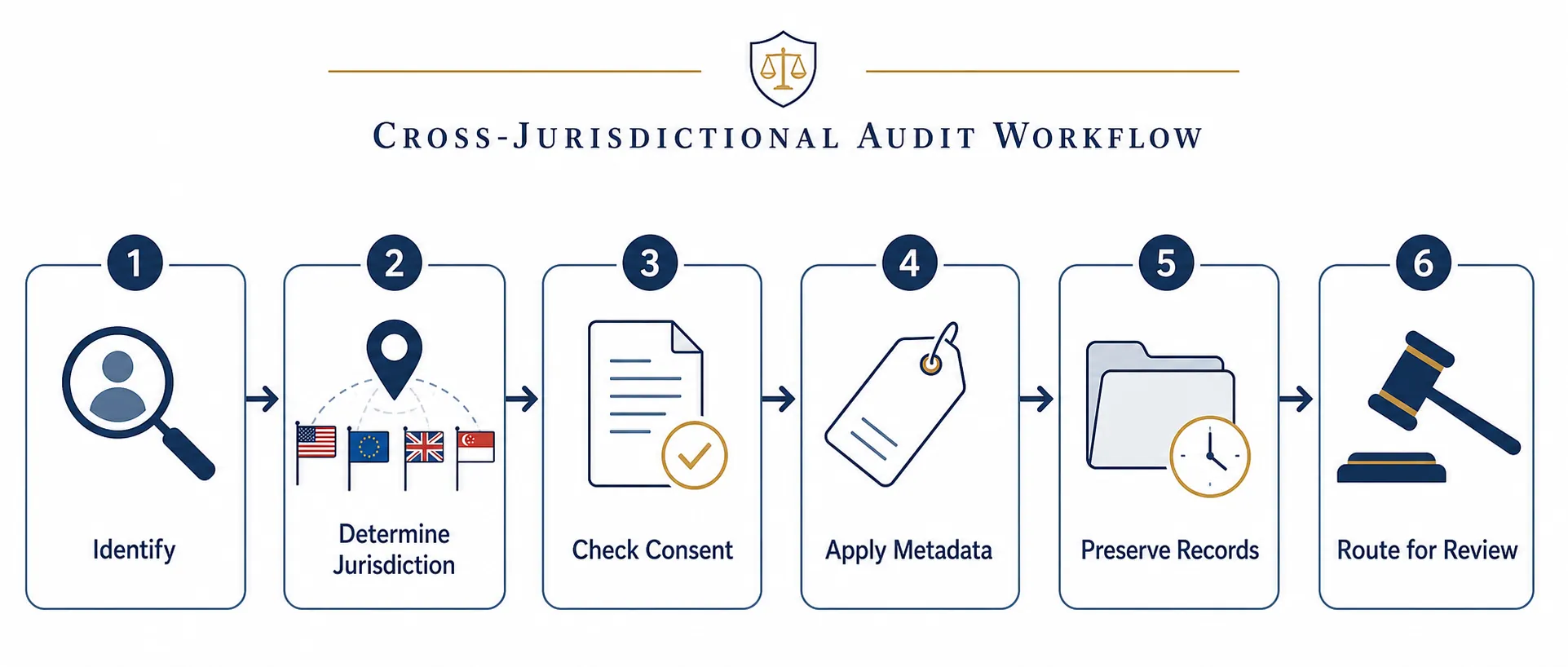
- Identify the image category: product-only AI editing, AI-altered real person, fully synthetic photorealistic person, or a real-person digital replica.
- Determine display geography: Amazon store, ad placement, landing page, social extension, EU-facing campaign, New York-targeted ad, California-relevant distribution.
- Check consent and likeness rights: confirm whether a real model, influencer, employee, or customer likeness was used, extended, or simulated.
- Apply platform controls: embed Amazon’s required metadata where the image contains a fully synthetic photorealistic person, and record any marketplace-specific label or disclosure field.
- Preserve the file history: source asset, generation method, generation input or vendor record where available, disclosure text, approval owner, upload date, and campaign destinations.
- Route higher-risk uses: EU-facing synthetic-person campaigns, New York advertising, California provenance questions, real-model replica use, and endorsement-like imagery should not be cleared only by creative operations.
The recordkeeping piece is not administrative decoration. If a listing is suppressed, the seller needs to know whether the issue was missing metadata, a category mistake, or a broader deception concern. If a New York notice arrives, the seller needs to identify which advertisement used which image and whether a cure period is available. If an EU reviewer asks how transparency obligations were handled, the seller needs more than a screenshot of an Amazon upload page.
Legal departments buying systems to maintain this process should evaluate whether the tool can map obligations by jurisdiction, preserve evidence at the asset level, and distinguish platform policy tasks from statutory disclosures. A procurement process built around those requirements is closer to the framework in the AI compliance tool buyer’s guide for legal departments than to a generic creative-asset management checklist.
The Label Is Only One Control
A seller can do the visible thing and still miss the legal thing. New York may require a disclosure tied to an advertisement. The EU AI Act may require transparency to natural persons in a different form. California may require provenance signaling. Amazon may require a metadata tag. The FTC may still ask whether the image misled shoppers about the product, regardless of how neatly the seller disclosed synthetic content.
By August 2026, Amazon sellers and their counsel cannot treat AI product image disclosure as a one-time label or a platform-only upload task. The defensible process is jurisdiction-aware, asset-specific, and repeatable: classify the image, map where it appears, confirm consent, apply platform metadata, preserve the evidence, and escalate the uses where statutory exposure is meaningfully larger than a suppressed listing.
References
- Amazon cracks down on use of AI images by sellers after New York law, CNBC, July 23, 2026.
- S.8420-A, NY Senate.
- Article 50: Transparency obligations for providers and deployers of certain AI systems, EU AI Act via artificialintelligenceact.eu.
- SB-942 California AI Transparency Act, California Legislative Information.
- The Legal Guide to AI Product Photography in 2026, Nightjar, May 11, 2026.
- 109 state AI laws enacted through July 1, 2026, Tech Policy Press.
- Amazon Claims AI Images Boost ROAS by 10%, sellermetrics.app.
- Amazon's fake product images in search, ppc.land.
- AI Videos, Fake Endorsements, and the New Amazon Seller Risk, patentlaw.us.
- Everything you need to know about emerging AI image regulations, Soona.co.
Related records
Tool profile
How Meta's AI Spending Reshapes Law Firm ProfitabilityGoverning regulation
Browse the obligations tracker →Preventive workflow
Browse verification workflows →
Report a correction or tip
Spotted an outdated figure, a misstated fact, or a ruling this case record should reflect? Public comments are disabled for this content given the professional cost of a misreported case outcome, penalty amount, or rule text — use the structured correction channel instead.
Report a correction or tip for this record →