
Would the $103,265 H-1B fee apply to current visa holders?
- Authority
- DHS/USCIS
- Rule type
- regulation
- Jurisdiction scope
- US federal
- Source text
- Read primary rule text ↗
Proposed $103,265 per cap-subject H-1B petition; final $4,000 per same-employer extension at covered employers.
Status flag, last verified Aug. 25, 2026: the proposed $103,265 H-1B fee is not in force. Reporting describes a Federal Register publication on Aug. 25, 2026, with a 30-day comment window; the operative proposed-rule text still needs direct verification against docket USCIS-2026-0298 before edge cases are treated as final rules. [1][2][3]
The eligibility question is petition-based, not status-based. The reported trigger is an employer’s cap-subject H-1B petition, not the fact that a worker currently holds H-1B status, has an H-1B visa stamp, or is already in the United States. [1][2][3]

Fast filing check
| Filing posture | Current working answer | Why it matters |
|---|---|---|
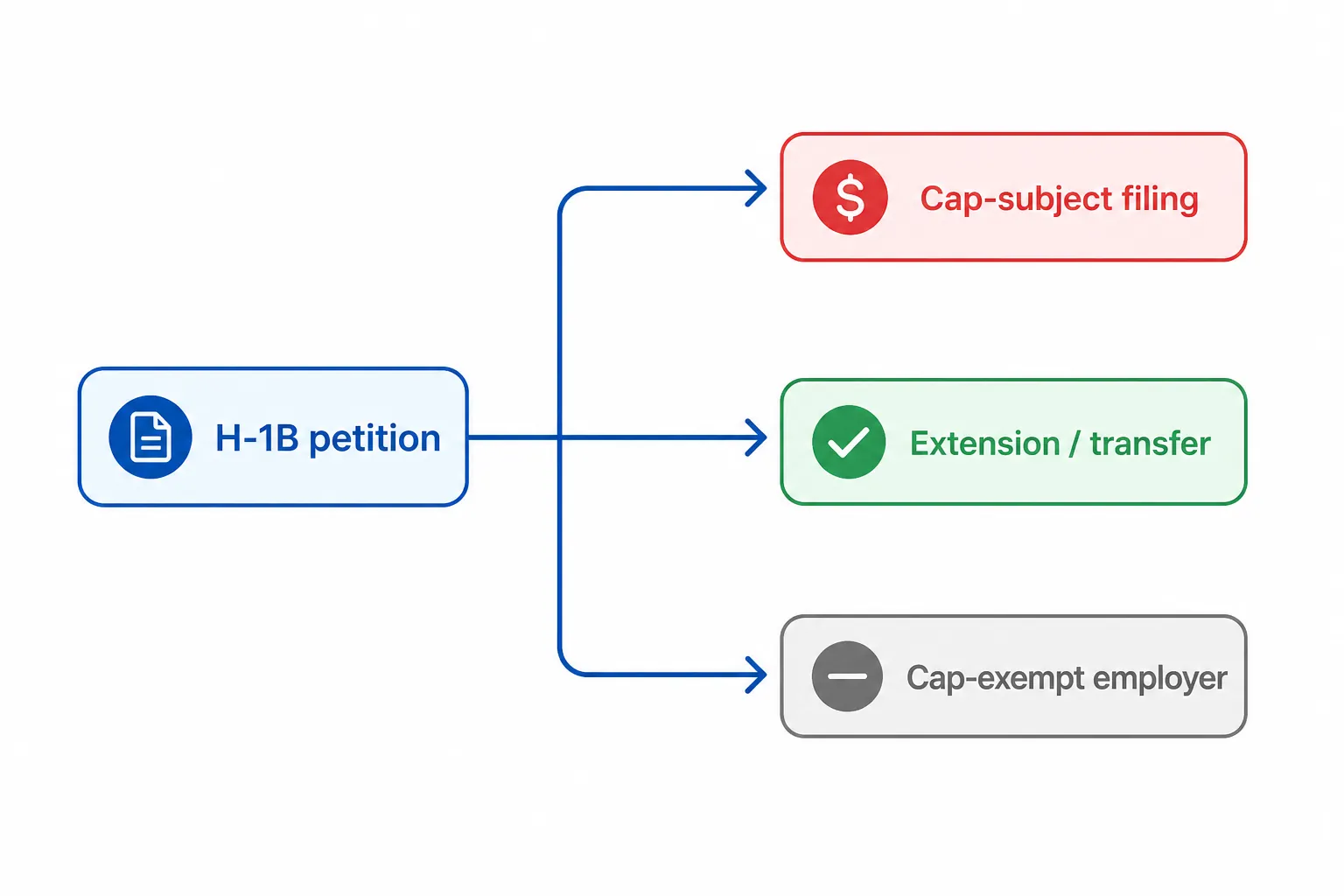
| New cap-subject H-1B petition under the regular 65,000 cap | Inside the proposed $103,265 fee trigger, if the proposal is finalized as reported. | The proposal is described as attaching to cap-subject petitions filed by employers. [1][3] |
| New cap-subject H-1B petition under the 20,000 U.S. master’s cap | Inside the proposed fee trigger, if finalized as reported. | The master’s cap is part of the annual cap-subject filing universe described in the proposal coverage. [1][3] |
| F-1 or OPT worker already in the United States, changing status to H-1B through a cap-subject petition | Inside the proposed fee trigger, based on current reporting. | This is the important expansion from the earlier $100,000 proclamation posture: change-of-status filings are reported as covered. [2][3] |
| Current H-1B worker, same employer extension | Apparently outside the proposed $103,265 fee’s face scope, but not outside all new fee exposure. | The separate finalized $4,000 9-11 biometric fee applies to same-employer H-1B extension petitions at covered employers beginning Sept. 9, 2026. [4] |
| Current H-1B worker, amendment | Apparently outside the proposed $103,265 fee’s face scope, subject to direct rule-text verification. | The reported trigger is cap-subject filing, not every H-1B petition. [3] |
| Current H-1B worker, transfer to a new employer | Most transfers appear outside the proposed fee’s face scope, but the employer still has to check whether the filing is actually cap-subject. | The label “transfer” is not enough if the case posture creates a cap-subject filing issue. [3] |
| Cap-exempt employer, such as a qualifying university, affiliated nonprofit, nonprofit research organization, or government research organization | Reportedly excluded from the proposed $103,265 fee. | The cap-exempt carve-out is one of the reported scope limits, but the employer’s exemption status must be documented. [1][3] |
| H-1B1, E-3, or other adjacent non-H-1B petition categories | Unclear from the available materials. | Do not infer coverage or exclusion until the proposed-rule text is checked directly. |
Cap-subject petitions are the reported trigger
The reported fee is $103,265 per cap-subject H-1B petition, paid by the employer on top of existing filing costs. The covered cap-subject universe is described as the annual H-1B cap, including the regular 65,000 cap and the 20,000 U.S. master’s cap. [1][3]
That makes the first review question very plain: is the petition being filed into the cap-subject H-1B system? If yes, current reporting places it inside the proposed fee. If no, the analysis moves to the next rule or fee track rather than stopping at the worker’s immigration status label.
The change-of-status point deserves special care. Bloomberg Law reports that the new proposal is designed to reach visa workers already in the United States, and Ellis describes F-1 and OPT change-of-status petitions as covered when they are cap-subject H-1B filings. [2][3]
That is a different posture from the earlier $100,000 proclamation fee records. The site’s prior record on OPT students and the $100,000 H-1B fee addressed a fee tied to entry from abroad under the now-vacated proclamation track. This proposed rule, as reported, would move the trigger to cap-subject petitions and therefore would not preserve the same practical answer for F-1 or OPT change-of-status filings. [2][3]
Current H-1B holders are not exposed by status alone
A current H-1B holder does not become subject to the proposed $103,265 fee merely because the person is in H-1B status. The reported fee attaches to the employer’s filing type. A same-employer extension, an amendment, and most transfers of workers already in H-1B status appear to fall outside the proposed fee’s face scope because they are not new cap-subject petitions. [3]
That answer should be kept narrow. “Outside the face scope” is a secondary-source reading until the proposed-rule text is checked directly. It is not a license to clear every case described in an email as an “extension” or “transfer.” The filing reviewer still has to identify the actual petition classification, whether the beneficiary has already been counted against the cap, and whether the employer is filing a cap-subject case in substance.
This is where the common headline wording does damage. “Current visa holders” can mean at least three different things in a filing queue: a worker extending with the same employer, a worker moving from one employer to another, or a person already in the United States in F-1 or OPT status whose employer is filing a cap-subject H-1B change of status. Only the last of those is clearly reported as inside the proposed $103,265 trigger. [2][3]
For employer intake, the cleaner question is not “does the worker already have a visa?” It is: what petition is the employer filing, and is that petition cap-subject?
Extensions and transfers still have a fee issue: the finalized $4,000 rule
The more immediate fee exposure for current H-1B workers is not the proposed $103,265 fee. It is the separately finalized 9-11 Response and Biometric Entry-Exit Fee rule.
That final rule imposes a $4,000 fee on same-employer H-1B extension petitions filed by covered employers, effective Sept. 9, 2026. Covered employers are those with 50 or more U.S. employees where more than half of the U.S. workforce is in H-1B or L-1 status. [4]
For a current H-1B employee at a covered employer, this is the fee that belongs on the near-term checklist. It is final, it has an effective date, and it expressly reaches same-employer H-1B extensions at covered employers. The $103,265 fee, by contrast, remains proposed and turns on cap-subject petition scope as reported.
Cap-exempt employers: excluded, but document the exemption
Current reporting identifies cap-exempt employers as excluded from the proposed $103,265 fee. The reported carve-out covers universities, affiliated nonprofits, nonprofit research organizations, and government research organizations. [1][3]
That does not mean every nonprofit employer, hospital affiliate, or research-adjacent entity can be marked clear from a name alone. The practical file note should identify the cap-exempt basis and retain the support for it. If the employer’s cap-exempt status is uncertain, the proposed-fee answer is uncertain too.
The available materials also do not give a settled answer for H-1B1, E-3, or cap-subject filings filed by employers with some cap-exempt characteristics. Those should stay on a verification list until the proposed-rule text is reviewed.
Do not merge the proposed $103,265 fee with the vacated $100,000 proclamation fee
The proposed $103,265 rule is not the same fee as the earlier $100,000 proclamation fee. The earlier proclamation track was tied to entry from abroad and was the subject of USCIS FAQ guidance before the litigation record changed. [5]
On June 8, 2026, Judge Sorokin of the District of Massachusetts vacated the $100,000 proclamation fee in State of California v. Mullin. [6] The First Circuit denied a stay on July 24, 2026. [7]
That litigation history matters because the total employer-cost picture could change again if the vacated proclamation fee is revived on appeal or if another court track produces a different operative result. For the current eligibility question, however, the safer filing distinction is still separate: the proposed $103,265 fee is reported as a cap-subject petition fee; the vacated $100,000 proclamation fee was a different mechanism.
For the broader litigation record, see the site’s earlier tracker entries on why the $100K H-1B fee lost in Massachusetts but survived in D.C., what the three H-1B visa ban challenges mean for employers, and the blocked $100,000 H-1B visa fee appeal record.
Revenue estimates are not filing rules
DHS reportedly estimates roughly $8.8 billion in annual revenue from the proposed fee, with allocations including about $3.0 billion for USCIS, $2.96 billion for EOIR, $1.05 billion for ICE, $1.21 billion for DOL, $484 million for DOS, and $76 million for CBP. [8]
That projection is not an eligibility test. It also sits beside counter-evidence from the earlier $100,000 fee episode: The Hill reports Cato Institute analysis describing an approximately 90% filing drop and $28 million revenue loss under that fee, along with the government’s own description of the fee as “arguably prohibitive” and as not raising revenue. [1]
There is also a fee-authority issue in the background. SHRM reported BAL attorney Eileen Lohmann’s warning that directing most revenue to non-USCIS agencies “raises significant questions around the scope of USCIS fee authority.” [9]
Those points explain why the proposal is contested. They do not change which case in the filing stack should be marked potentially subject to the proposed $103,265 fee.
Working answer for current visa holders
A current H-1B holder is not broadly exposed to the proposed $103,265 fee by status alone. The reported trigger is the employer’s cap-subject H-1B petition. Cap-subject filings, including F-1 or OPT change-of-status cases filed from inside the United States, are reported as covered. Extensions, amendments, and most transfers of workers already in H-1B status appear outside the proposed fee’s face scope, but that answer should be verified against the proposed-rule text before it is used for an edge case. [2][3]
For current H-1B employees, the already-final fee to watch is the $4,000 9-11 biometric fee on same-employer H-1B extension petitions at covered employers beginning Sept. 9, 2026. The proposed $103,265 fee remains proposed; the rule text still needs direct verification; and the litigation posture around the separate $100,000 proclamation fee could still alter total employer exposure.
References
- DHS proposes $103,265 fee for H-1B visa workers under annual cap — The Hill
- New $103,000 H-1B Fee Planned for Visa Workers Already in US — Bloomberg Law
- The New $103,265 H-1B Visa Fee, Explained (2026) — Ellis
- 9-11 Response and Biometric Entry-Exit Fee for H-1B and L-1 Visas — Federal Register, August 10, 2026
- H-1B FAQ — USCIS
- US District Court Rules $100,000 H-1B Fee Is Unlawful — CDF Labor Law
- First Circuit Denies Stay in $100K H-1B Fee Case — Fredrikson & Byron
- DHS Proposes $103,265 Fee for H-1B Cap-Subject Petitions — Erickson Immigration Group
- Newly Proposed H-1B Fee Would Add Over $100K to Hiring Costs — SHRM
Operationalizing workflow
No workflow has been explicitly linked to this obligation yet. See Workflows generally.
Illustrative cases
No illustrative case is currently tracked for this obligation. See Risk Digest for documented incidents generally.
← Back to RegulationReport a correction or tip
Spotted an outdated figure, a misstated fact, or a ruling this regulation entry should reflect? Public comments are disabled for this content given the professional cost of a misreported case outcome, penalty amount, or rule text — use the structured correction channel instead.
Report a correction or tip for this record →