
H.R. 9854's Birthright Citizenship Rewrite, Section by Section
- Authority
- U.S. House of Representatives
- Rule type
- statute
- Jurisdiction scope
- US federal
- Source text
- Read primary rule text ↗
Would exclude U.S.-born children from citizenship when the mother is in specified noncitizen categories and the father is neither a citizen nor LPR; would bar judicial review of the invader determination.

Verification lane: H.R. 9854, not every birthright-citizenship bill
Last verified: August 3, 2026. This is a Regulation & Ethics legislative-obligations explainer for Lex Machina Review, outside the site’s usual AI-risk digest. It is not legal advice. The primary document used here is the introduced GovInfo text of H.R. 9854, the Citizenship Act of 2026, introduced by Rep. Brandon Gill of Texas on July 22, 2026.[1]
An H.R. 9854 birthright citizenship explainer has to start with a housekeeping point that is easy to miss in a quick partner memo: “Birthright Citizenship Act” is not one stable policy object. H.R. 9854 is the Gill bill discussed below. It should not be collapsed into the more traditional Birthright Citizenship Act proposals using the same general label, McGuire’s separate Birthright Citizenship Clarification Act of 2026, or the Senate Citizenship Act of 2026 release from Sen. Jim Banks.[3][4]
Status matters before substance. GovTrack lists H.R. 9854 as introduced on July 22, 2026, referred to the House Judiciary Committee, with five Republican cosponsors — Reps. Lauren Boebert, Earl L. “Buddy” Carter, Randy Weber, Mary Miller, and Wesley Hunt — and a roughly 2% model prognosis.[2] That prognosis is GovTrack’s model output, not a legal fact. Congress.gov was not accessible during the research pass, so GovTrack is being used here only as a labeled status source. The bill is not enacted law.
The operative map
The bill’s load-bearing provisions are not its title or its findings. They are the designation rule, the rewrite of 8 U.S.C. § 1401(a), the surrogacy carve-out, the judicial-review bar, and the prospective effective date.
| Bill provision | What it would do |
|---|---|
| Findings | States congressional assertions about unauthorized immigration, foreign-born population share, surrogacy, and Trump v. Barbara. These are findings in the introduced bill, not adjudicated facts.[1] |
| Section 3 | Designates unlawfully entering aliens, unlawfully present aliens, and birth tourists as “invaders” for the bill’s purposes.[1] |
| Section 4 | Rewrites 8 U.S.C. § 1401(a) so that a U.S.-born child is excluded from citizenship when the mother falls into specified noncitizen categories and the father was neither a U.S. citizen nor a lawful permanent resident at birth.[1] |
| Covered-nation surrogacy provision | Adds a separate citizenship exclusion for certain commercial-surrogacy births connected to nationals of covered nations, with a citation issue that should be checked against the current U.S. Code before publication or client use.[1] |
| Section 5 | Attempts to bar judicial review of the invasion determination.[1] |
| Section 7 | Applies prospectively from enactment rather than retroactively.[1] |
The findings are assertions, not proof
H.R. 9854’s findings include assertions about roughly 15 million unauthorized aliens in the United States, about 1.5 million People’s Republic of China nationals said to have acquired citizenship through surrogacy, and a foreign-born population approaching 16%.[1] Those numbers may be politically important to the sponsor’s case for the bill, but they do not become independently verified facts merely because they appear in a findings section.
The same caution applies to the bill’s characterization of Trump v. Barbara. H.R. 9854 says Barbara “broadened” the Citizenship Clause.[1] That is the bill’s characterization. The Supreme Court opinion, SCOTUSblog’s case record, the National Immigration Forum’s explainer, and Harvard Law commentary by Gerald Neuman describe the decision in terms of reaffirming the traditional understanding of birthright citizenship, not newly expanding it.[5][6][7][8]
Section 4: the citizenship test turns on the mother first
Section 4 is where H.R. 9854 stops being a statement of policy and becomes something a lawyer would have to translate into a file memo. It would amend 8 U.S.C. § 1401(a), the provision that identifies persons who are nationals and citizens of the United States at birth, by adding an exclusion keyed first to the mother’s status and then to the father’s citizenship or lawful-permanent-resident status.[1]
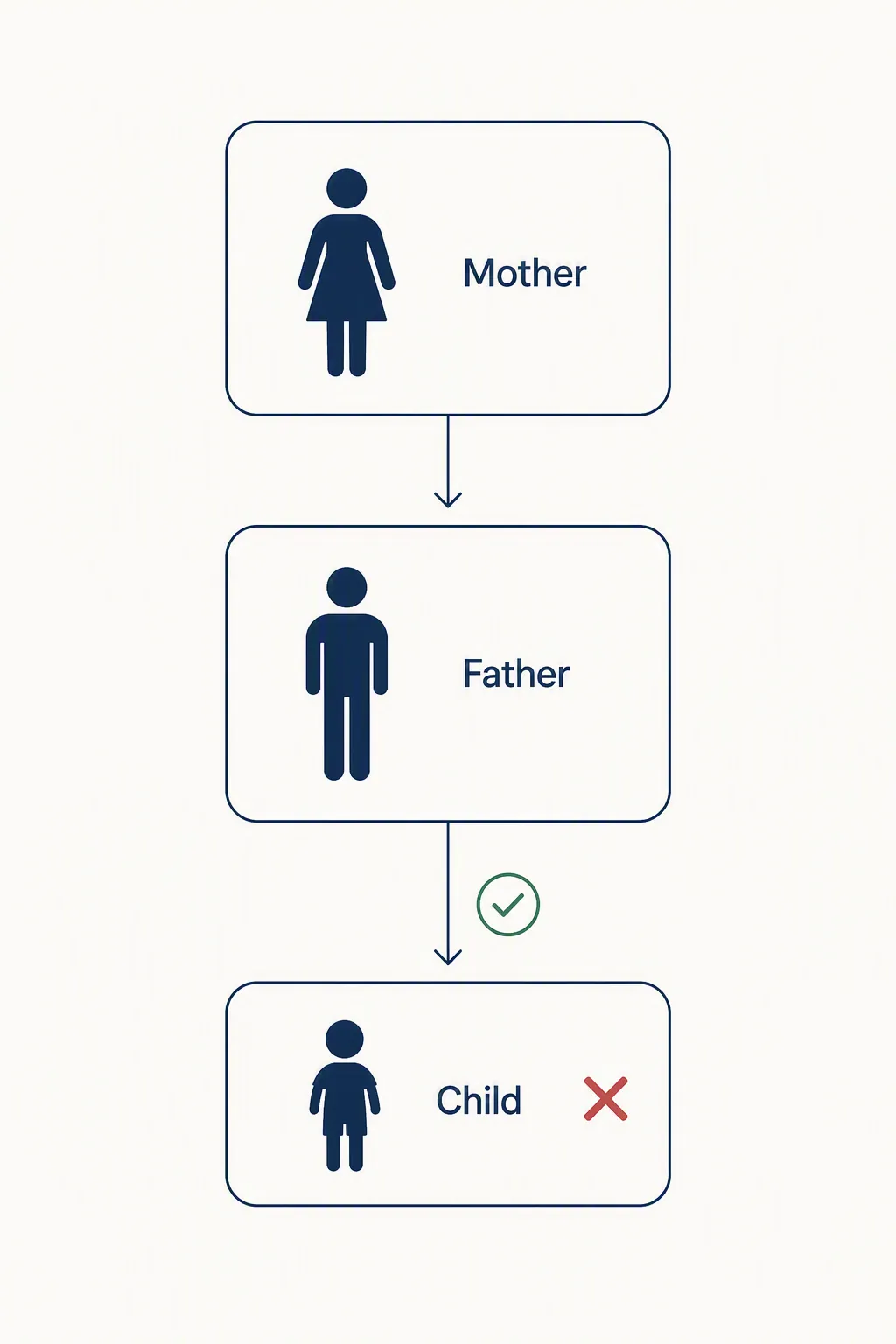
The sequence matters. The first question is not whether both parents lacked permanent ties to the United States. It is whether the mother was an alien who had unlawfully entered, was unlawfully present, or had entered for the purpose of giving birth in the United States. Only if that maternal-status trigger is satisfied does the father’s status become the second half of the exclusion test.[1]
| Question under H.R. 9854 | Consequence under the introduced text |
|---|---|
| Was the child born in the United States? | If no, the Section 4 rewrite of § 1401(a) is not the relevant path. If yes, continue. |
| Did the mother fall into one of the specified categories: unlawful entrant, unlawfully present alien, or birth tourist? | If no, the H.R. 9854 exclusion described here is not triggered by the maternal-status clause. |
| If the mother did fall into one of those categories, was the father a U.S. citizen or lawful permanent resident at the time of birth? | If yes, the two-parent exclusion is not complete. If no, the child is excluded from citizenship under the rewritten § 1401(a). |
That is a deliberately asymmetric rule. The mother’s status opens the exclusion. The father’s citizenship or lawful-permanent-resident status can prevent the exclusion from closing. A mother who is outside the listed categories does not trigger this particular exclusion even if the father lacks citizenship or lawful permanent residence. A mother who is inside the listed categories makes the father’s status outcome-determinative.
For a practitioner, that structure changes the document requests and the risk memo. The relevant record would not stop at the child’s place of birth. It would require evidence of the mother’s immigration status or purpose of entry at birth, and then evidence of the father’s citizenship or lawful-permanent-resident status at the same point in time. The bill does not merely ask whether a child was born in the United States to two noncitizens; it asks a narrower and more uneven question.
Why Barbara is relevant, but not the whole article
Trump v. Barbara was decided on June 30, 2026.[5] The existing Lex Machina Review analysis of the vote split and concurring opinions is here: Trump v. Barbara birthright citizenship analysis. This article does not need to retell that case. The narrower point is that H.R. 9854 arrived after Barbara and uses an operative exclusion that closely resembles the maternal-status, two-parent asymmetry the Court had just rejected in the executive-action context.
Section 3 and Section 5: the invader label and the review bar
Section 3 designates three categories as “invaders”: aliens who unlawfully entered the United States, aliens who are unlawfully present, and aliens who entered for the purpose of giving birth in the United States.[1] In an internal memo, that should be described as a proposed statutory designation. It should not be written as though a court has found those people to be invaders, or as though the designation is already operative law.

Section 5 then tries to do procedural work. It bars judicial review of the invasion determination.[1] That is not just decorative drafting. If enacted and invoked, the provision would be cited to argue that courts may not review the predicate determination on which the bill’s citizenship consequences rest.
That does not settle whether the bar would survive constitutional challenge, how a court would read it, or whether a particular plaintiff could obtain review through another vehicle. Those are merits and jurisdiction questions for another document. The point for this explainer is simpler: H.R. 9854 couples a sweeping label with an attempted jurisdictional shield. A memo that discusses only the label and skips the shield would miss one of the bill’s main drafting choices.
The covered-nation commercial-surrogacy provision
H.R. 9854 also includes a narrower surrogacy provision aimed at certain commercial-surrogacy births involving nationals of “covered nations.”[1] The research record identifies the covered nations under 10 U.S.C. § 4872 as the Democratic People’s Republic of Korea, the People’s Republic of China, the Russian Federation, and the Islamic Republic of Iran, using Cornell’s Legal Information Institute definition page.[9]
There is a citation issue worth flagging before anyone turns this into client-facing guidance. The introduced bill cites section 4872(f)(2) of title 10, while the LII definition page places the “covered nation” definition at 10 U.S.C. § 4872(d)(2).[1][9] That may reflect a drafting, codification, or reference mismatch. The controlling U.S. Code subsection should be verified directly before publication in a filing, advisory, or client memo.
Prospective operation
Section 7 gives H.R. 9854 prospective operation. As drafted, the bill would apply after enactment; it does not purport to retroactively strip citizenship from persons born before the effective date.[1] That is another place where tense matters. The accurate formulation is that the bill would change the rule if enacted. It does not change the citizenship rule today.
The verified bottom line is therefore narrow but important: H.R. 9854 is an introduced, post-Barbara legislative workaround. Its operative exclusion rule would deny citizenship to a U.S.-born child when the mother falls into specified unlawful-entry, unlawful-presence, or birth-tourism categories and the father was neither a U.S. citizen nor a lawful permanent resident at birth. That structure closely tracks the maternal-status, two-parent asymmetry the Supreme Court rejected in June 2026, while adding an invader-designation framework and an attempted bar on judicial review.
References
- BILLS-119hr9854ih, GovInfo, July 22, 2026.
- H.R. 9854: Citizenship Act of 2026, GovTrack.
- Rep. John McGuire Introduces Birthright Citizenship Clarification Act of 2026, Office of Rep. John McGuire.
- Banks Takes Action on Supreme Court’s Birthright Citizenship Ruling, Introduces Citizenship Act of 2026, Office of Sen. Jim Banks.
- Trump v. Barbara, Supreme Court of the United States, June 30, 2026.
- Trump v. Barbara, SCOTUSblog.
- Explainer: Supreme Court Reaffirms Birthright Citizenship in Trump v. Barbara, National Immigration Forum.
- Can birthright citizenship be changed?, Harvard Law School.
- 10 USC 4872: covered nation, Cornell Legal Information Institute.
Operationalizing workflow
No workflow has been explicitly linked to this obligation yet. See Workflows generally.
Illustrative cases
No illustrative case is currently tracked for this obligation. See Risk Digest for documented incidents generally.
← Back to RegulationReport a correction or tip
Spotted an outdated figure, a misstated fact, or a ruling this regulation entry should reflect? Public comments are disabled for this content given the professional cost of a misreported case outcome, penalty amount, or rule text — use the structured correction channel instead.
Report a correction or tip for this record →