
How Kentucky would fill a McConnell Senate vacancy
- Authority
- Kentucky General Assembly
- Rule type
- statute
- Jurisdiction scope
- US state
- Effective date
- Apr 12, 2024
- Source text
- Read primary rule text ↗
Special election only; no interim appointment
Last verified: August 1, 2026. Jurisdiction: Kentucky and the U.S. Senate vacancy rules that apply to a Kentucky seat. Legal review: Amelia Hart, J.D. This record is general legal-process information, not legal advice.
The short answer is narrower than much of the public discussion suggests: under current Kentucky law, a vacancy in Mitch McConnell’s Senate seat would be filled by a special election called by the governor, with no interim appointee serving in the meantime. HB 622, enacted in 2024 over Governor Andy Beshear’s veto, repealed the old interim-appointment pathway and amended Kentucky’s Senate-vacancy procedure on an emergency basis.[1]
That answer assumes a legally recognized vacancy exists. Illness, hospitalization, absence from Washington, or incapacity by itself does not create one. The Congressional Research Service has described the ways a congressional seat becomes vacant as death, resignation, acceptance of an incompatible office, or expulsion by the chamber; it also states that there is no formal congressional protocol for declaring a seat vacant because a member is incapacitated.[2] The Senate’s own expulsion materials point to the same structural limit: expulsion is a Senate power requiring a two-thirds vote, and the Senate lists 15 expulsions in its history, 14 of them during the Civil War.[3]
The vacancy has to exist first
A Senate vacancy is not a medical diagnosis. It is a legal condition. If a senator dies, resigns, accepts an incompatible office, or is expelled by a two-thirds vote of the Senate, the office becomes vacant. If a senator is alive, has not resigned, has not taken an incompatible office, and has not been expelled, the legal materials cited here do not identify a mechanism that lets Kentucky, the governor, a court, party officials, or family members convert incapacity into a vacancy.[2][3]
That distinction matters in real time because public speculation about McConnell’s health can move faster than the legal triggers. The office is not opened by concern, uncertainty, or pressure. Until one of the recognized vacancy events occurs, Kentucky’s replacement procedure has nothing to operate on.
For the broader federal map of Senate vacancy rules across states, see the companion overview on the legal process that determines who fills a Senate vacancy. This record stays with Kentucky because Kentucky’s 2024 statutory change is doing most of the work.
Kentucky’s current stack: federal floor, state constitution, 2024 statute
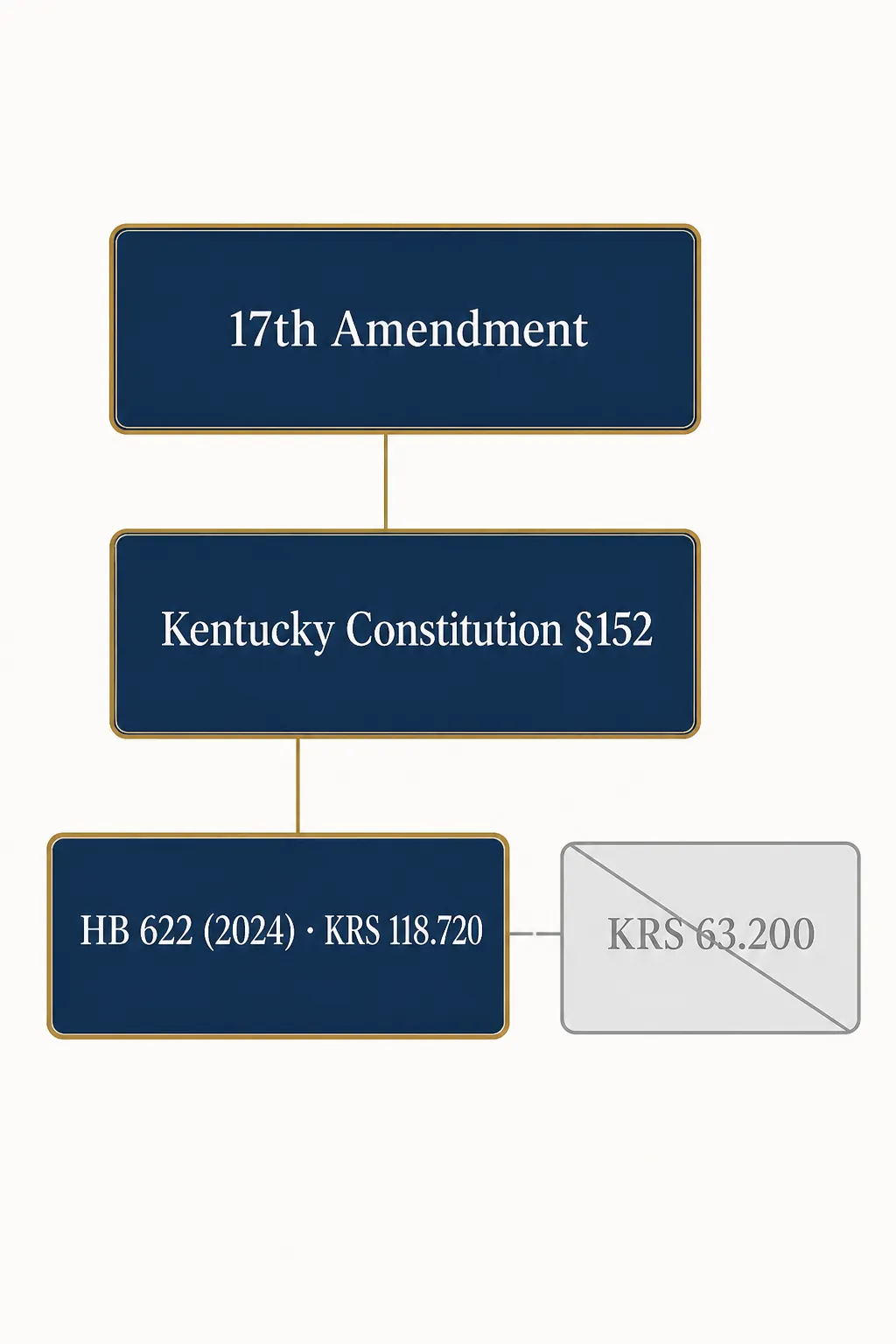
The federal floor is the Seventeenth Amendment framework: Senate vacancies are filled by election, while state legislatures may authorize temporary executive appointments until voters choose a replacement. That permission is not a command. A state can choose a special-election-only model, and Kentucky’s current statute does that for this office.
Kentucky’s own constitutional layer points vacancy-filling back toward election mechanics. The operational question is then statutory: has the legislature authorized someone to sit temporarily, or has it required the seat to remain open until voters act?
Before 2024, Kentucky had an interim-appointment statute. HB 622 removed that path. The Kentucky Legislative Research Commission record for 2024 Regular Session HB 622 shows the bill passed the House 88-4 and the Senate 34-3, was vetoed on April 9, 2024, and had that veto overridden on April 12, 2024, by votes of 81-17 in the House and 29-5 in the Senate. The bill carried an emergency declaration.[1]
The practical effect is the part that often gets blurred. The governor is not choosing a temporary senator under the current model. The governor’s role is to issue the proclamation that starts the special-election process. Spectrum News described the same mechanics in July 2026: no temporary appointee, a governor-called special election, and a vacant seat until a winner is certified.[4]
| Layer | What it does | What it does not do |
|---|---|---|
| Seventeenth Amendment | Sets the federal vacancy framework and permits state-authorized temporary appointments | Does not require Kentucky to allow an interim appointee |
| Kentucky Constitution §152 | Supplies the state constitutional election-vacancy setting | Does not itself identify a current interim senator for a U.S. Senate vacancy |
| HB 622 / KRS 118.720 | Makes the governor’s operative role a proclamation for a special election | Does not let the governor select an interim U.S. senator |
| Repealed KRS 63.200 | Previously supplied the appointment pathway | No longer supplies the current process after HB 622 |
What the governor does now
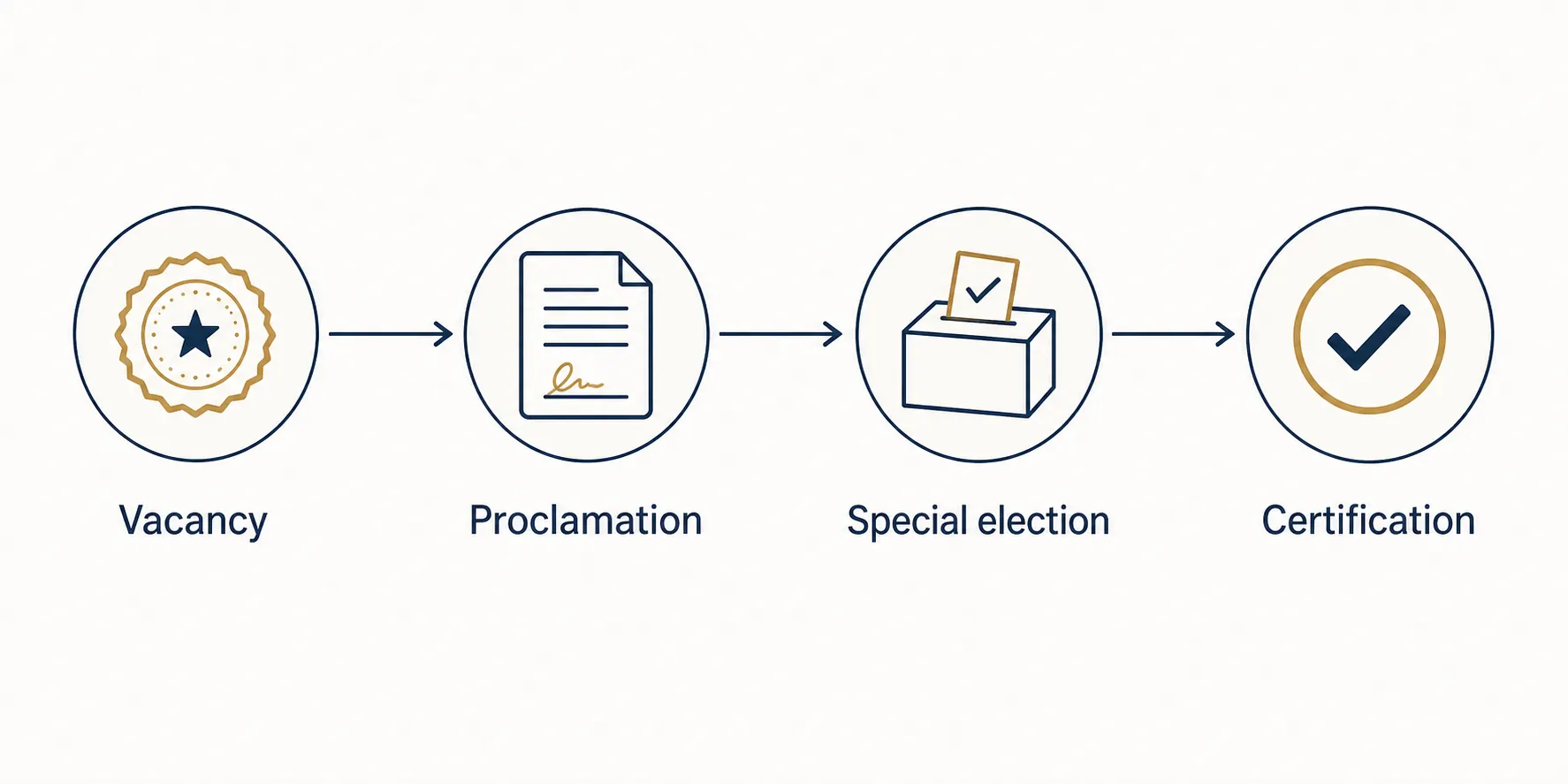
Once a vacancy legally exists, the governor’s current statutory function is to call the special election. That is a real power, because the proclamation starts the election machinery. It is not the same as the old power to name someone to serve until the election.
A useful way to brief the process is simple:
- A legally recognized vacancy occurs.
- The governor issues a proclamation for a special election.
- Candidates qualify under the applicable election deadlines.
- Voters choose a successor in the special election.
- The winner is certified, and the seat is filled.
The empty interval is not a drafting accident. Under the current reading of Kentucky law, there is no temporary senator during that interval.[4]
The election calendar is the unsettled part
The broad sequence is clear. The exact clock should be rechecked against the current text of KRS 118.720 before anyone treats a specific date as settled.
CNBC reported a calendar structure in which the governor’s proclamation must go to county sheriffs at least 63 days before the election, candidate filings are due at least 56 days before the election, and the statute does not set a firm deadline for the governor to issue the proclamation after the vacancy occurs. CNBC also quoted election-law professors Joshua Douglas and Josh Blackman describing the process as untested.[5]
Newsweek framed a possible 2026 calendar around an August 3 deadline, a September 8 special-election date, and the November 3 general election, but it reported different day counts: a 56-day writ and 49-day sheriff-notice framing.[6] Those two accounts should not be blended into one polished timeline. They are a verification conflict.
| Calendar point | CNBC account | Newsweek account | How to use it |
|---|---|---|---|
| Notice or writ timing | Proclamation to county sheriffs at least 63 days before the election | 56-day writ framing and 49-day sheriff-notice framing | Verify against current KRS 118.720 before publishing a deadline |
| Candidate filing | At least 56 days before the election | Tied to the outlet’s August 3 / September 8 / November 3 discussion | Treat as source-attributed unless statute text is checked |
| Governor’s deadline to act | No firm statutory deadline reported for issuing the proclamation | Discussed through the possible election-date window | Do not infer a mandatory date without primary-source confirmation |
For a legal editor, that conflict is not cosmetic. A wrong day count can change whether a candidate-filing statement is accurate, whether an election-date story is defensible, and whether a governor’s delay is described as legally significant or merely politically consequential.
Beshear’s hesitation is a compliance dispute, not an appointment power
Governor Beshear has not committed publicly to following the 2024 procedure. CNBC reported on the legal uncertainty around the process after McConnell’s hospitalization, and Newsweek reported that Beshear characterized the matter as possibly contested in July 2026 coverage.[5][6]
That matters, but it belongs in the right file. The law on the books points to a special election with no interim appointee. A governor’s refusal to commit to that path would create a live dispute over compliance, timing, or interpretation. It does not itself revive repealed appointment authority.
The 1974 Kentucky precedent is therefore only limited help. Spectrum’s explainer notes that Senator Marlow Cook resigned early and Wendell Ford was appointed after having already won the election.[4] That episode occurred under a different vacancy regime. It can orient a reader to Kentucky’s history, but it should not be used as proof of the governor’s current power.
National comparisons should stay secondary
Kentucky is unusual, but the exact state count is itself a moving target. Newsweek, relying on NCSL framing, described Kentucky, North Dakota, Rhode Island, and Wisconsin as states where the governor cannot appoint an interim senator at all.[6] Pew Research Center’s 2024 state-by-state discussion placed Senate vacancy rules in a broader national frame, and older national summaries have included Oregon among special-election-only states before Oregon’s later statutory change became part of the count dispute.[7]
That comparison is useful background, not the governing answer. For Kentucky, the controlling practical question is whether the current Kentucky statute authorizes a temporary senator. On the materials verified here, it does not.
Operational answer as of August 1, 2026
If McConnell’s seat becomes vacant before his term ends in January 2027, Kentucky’s current law points to a governor-called special election, not a gubernatorial interim appointment. The seat would remain vacant until a winner is certified.[1][4]
If McConnell is ill or incapacitated but has not died, resigned, accepted an incompatible office, or been expelled, the materials verified here do not identify a legal mechanism that creates a vacancy.[2][3]
The election calendar should be treated as re-verification required. CNBC and Newsweek report materially different day-count structures, and the current statutory text should control before any precise deadline is published as law.[5][6]
Beshear’s public hesitation is a live compliance issue. It is not a different legal rule.
References
- 24RS HB 622, Kentucky Legislative Research Commission.
- Incapacity of a Member of Congress, Congressional Research Service.
- About Expulsion, United States Senate.
- Senate vacancy procedure, Spectrum News 1, July 7, 2026.
- McConnell health update: Beshear hospitalization Kentucky, CNBC, July 8, 2026.
- Mitch McConnell August 3 deadline: Kentucky special election explained, Newsweek.
- How do states fill vacancies in the U.S. Senate? It depends on the state, Pew Research Center, August 6, 2024.
Operationalizing workflow
No workflow has been explicitly linked to this obligation yet. See Workflows generally.
Illustrative cases
No illustrative case is currently tracked for this obligation. See Risk Digest for documented incidents generally.
← Back to RegulationReport a correction or tip
Spotted an outdated figure, a misstated fact, or a ruling this regulation entry should reflect? Public comments are disabled for this content given the professional cost of a misreported case outcome, penalty amount, or rule text — use the structured correction channel instead.
Report a correction or tip for this record →