
The Medicaid Work Requirements Ruling Leaves All Merits Questions Open
- Authority
- U.S. District Court for the District of Massachusetts
- Rule type
- court order
- Jurisdiction scope
- US federal
- Effective date
- Jul 30, 2026
- Source text
- Read primary rule text ↗
States must implement IFR, with member notices due Aug 31, 2026 and full compliance by Jan 1, 2027.
The July 30 Medicaid work requirements court ruling in 2026 did less than many headlines suggest. Judge Richard G. Stearns denied the plaintiff states’ request for a preliminary injunction without prejudice because they had not proved irreparable harm. He did not hold that CMS’s interim final rule is lawful. He did not reject the Administrative Procedure Act claims. He did not reject the Spending Clause claim. And he expressly left the states a path to renew their request if the merits schedule becomes unreasonable through no fault of their own.[1]
That distinction matters immediately because the rule’s implementation calendar did not pause. The IFR took effect July 31, 2026; the comment period closed the same day; member notices are due August 31, 2026; and full implementation is scheduled for January 1, 2027.[1][2] A state agency cannot treat the order as permission to stand down. A litigation team cannot treat it as a merits loss. The ruling changes the injunction posture and the evidentiary burden, not the legal questions waiting for summary judgment.

What The Order Decided
The plaintiffs are not simply “26 states” in the loose shorthand often used for the case. The complaint was filed by 25 states plus the District of Columbia, with the Governors of Kentucky and Pennsylvania also named as individual plaintiffs.[2] That configuration is not decorative; it affects how counsel should describe standing, state reliance, and asserted implementation burdens.
The order’s operative holding is narrower than the litigation’s political footprint. Judge Stearns found that the states had not carried the irreparable-harm burden required for preliminary relief. Two points did the work: first, the court noted that 90% of the systems costs at issue were reimbursable; second, the court attributed the compressed implementation timetable to Congress rather than CMS.[1]
A preliminary injunction requires more than a serious merits argument. The moving party must satisfy the threshold elements for emergency relief. Here, the failure was on irreparable harm. That is why “injunction denied” is a poor substitute for “CMS won.” The denial did not resolve whether the IFR is contrary to law, arbitrary and capricious, insufficiently attentive to reliance interests, or inconsistent with Spending Clause clear-notice requirements.
The order is also careful in its reservation language. The denial was without prejudice, and the court preserved the possibility of a renewed injunction request if the plaintiffs are unable, through no fault of their own, to obtain merits adjudication on a reasonable timeline.[1] That is not an invitation to relitigate irreparable harm casually. It is a procedural safety valve tied to the summary-judgment schedule.
The Four Merits Claims Remain Live
The complaint asserts three APA claims and one Spending Clause claim.[2] The July 30 order does not dispose of any of them. For implementation counsel, the useful way to read the docket after the PI denial is claim by claim, not headline by headline.
| Claim | Core theory | Status after PI denial |
|---|---|---|
| APA: contrary to law | CMS allegedly added requirements Congress did not authorize, especially in the medical-frailty exclusion. | Not decided; remains available for summary judgment. |
| APA: arbitrary and capricious | CMS allegedly changed position without adequate explanation. | Not decided; remains available for summary judgment. |
| APA: reliance interests | CMS allegedly failed to account for states’ reliance on earlier guidance when building systems and budgets. | Not decided; remains available for summary judgment. |
| Spending Clause | States allegedly lacked clear notice of the conditions CMS later imposed. | Not decided; remains available for summary judgment. |
Contrary To Law: The Medical-Frailty Hinge
The most contested part of the dispute is not the general idea of community engagement. It is the definition of who is excluded as medically frail. The IFR imposes an 80-hour-per-month community-engagement requirement on expansion adults ages 19 to 64 and recognizes nine exclusion categories.[3] One of those exclusions turns on medical frailty.
The complaint focuses on 42 CFR 435.554(c)(5)(i), where CMS’s revised definition adds a functional-impairment component. The states argue that Congress identified medical-frailty categories in section 1902(xx)(9)(A)(ii)(V) without imposing that additional “significantly impairs” test, and that CMS therefore narrowed the exclusion beyond what the statute permits.[2][3]
That is the point where a benefits system has to make a legal judgment in operational clothing. A notice engine, eligibility worker, or classifier has to decide whether a diagnosis, condition, or circumstance satisfies the exclusion as CMS has written it. The July 30 order does not answer whether that rule text is lawful. It leaves the question for merits briefing, which is why the medical-frailty dispute remains central to both litigation strategy and system design. For a closer look at the classifier side of that problem, see AI Classifiers in Medicaid Lawsuits Face a Legal Hinge.
Arbitrary And Capricious: Change Of Position
The arbitrary-and-capricious claim is tied to CMS’s alleged change in position. According to the complaint, CMS’s November 2025 slide deck and December 2025 Informational Bulletin told states they could define medical frailty within the statute’s five categories. The IFR then added the functional-impairment test after states had submitted advance planning documents, budgeted staff, and begun system builds.[2][4]
At summary judgment, the government may argue that earlier guidance was preliminary, nonbinding, or otherwise insufficient to constrain CMS. The states will likely press the sequence: guidance first, implementation investments next, narrowed definition after that. The PI order chooses neither account. It only says the emergency showing did not justify stopping the rule before merits review.
Reliance Interests: The Systems Work Is Not The Merits Answer
The same factual sequence supports the reliance-interest theory. The states say they spent time and administrative resources preparing to implement one understanding of the medical-frailty exclusion, only to have CMS revise the operative standard through the IFR.[2] That theory survived the preliminary-injunction phase because the court did not decide whether CMS adequately considered those asserted reliance interests.
The irreparable-harm ruling should not be confused with a holding that reliance interests are legally irrelevant. The court’s point about 90% federal reimbursement addresses the emergency-remedy calculus.[1] It does not answer whether CMS had to explain its change differently, whether state planning documents mattered, or whether the final administrative record supports the agency’s reasoning.
Spending Clause: Clear Notice Survives, Even If It Faces Headwinds
The Spending Clause theory also remains alive. The states argue that they did not have clear notice of the condition CMS ultimately imposed through the functional-impairment overlay and related implementation requirements.[2] The July 30 order does not reject that theory.
It is still a difficult claim. The government has an obvious response: Congress set the statutory timeline, and states were on notice that CMS guidance could evolve before implementation. But an obvious government response is not a merits ruling. The clear-notice question remains for summary judgment, where the parties will have to address statutory text, the IFR, earlier CMS communications, and the degree to which states reasonably relied on them.
Why The Court’s “Difficult Issues” Language Matters
Judge Stearns wrote that the case “presents difficult issues regarding the scope of Congress’s delegation of interpretative authority to the Secretary and the faithfulness to Congressional intent with which the Secretary performed his task.”[1] That sentence should not be treated as a merits forecast. It should be treated as a warning against overreading the PI denial.
The sentence matters because it rejects the idea that the statutory dispute is self-evidently easy for CMS. It puts the delegation question and fidelity-to-Congress question at the center of the summary-judgment case. A court can deny emergency relief and still recognize that the agency’s legal theory needs serious testing.
That is especially important for clients building implementation systems now. If eligibility logic is coded around the IFR’s current medical-frailty definition, counsel should preserve the ability to explain what changes if the court later finds that definition unlawful. If notices are drafted around current CMS language, agencies should avoid implying that the contested standard is beyond judicial review. The order leaves that review intact.
The Calendar Now Drives The Risk
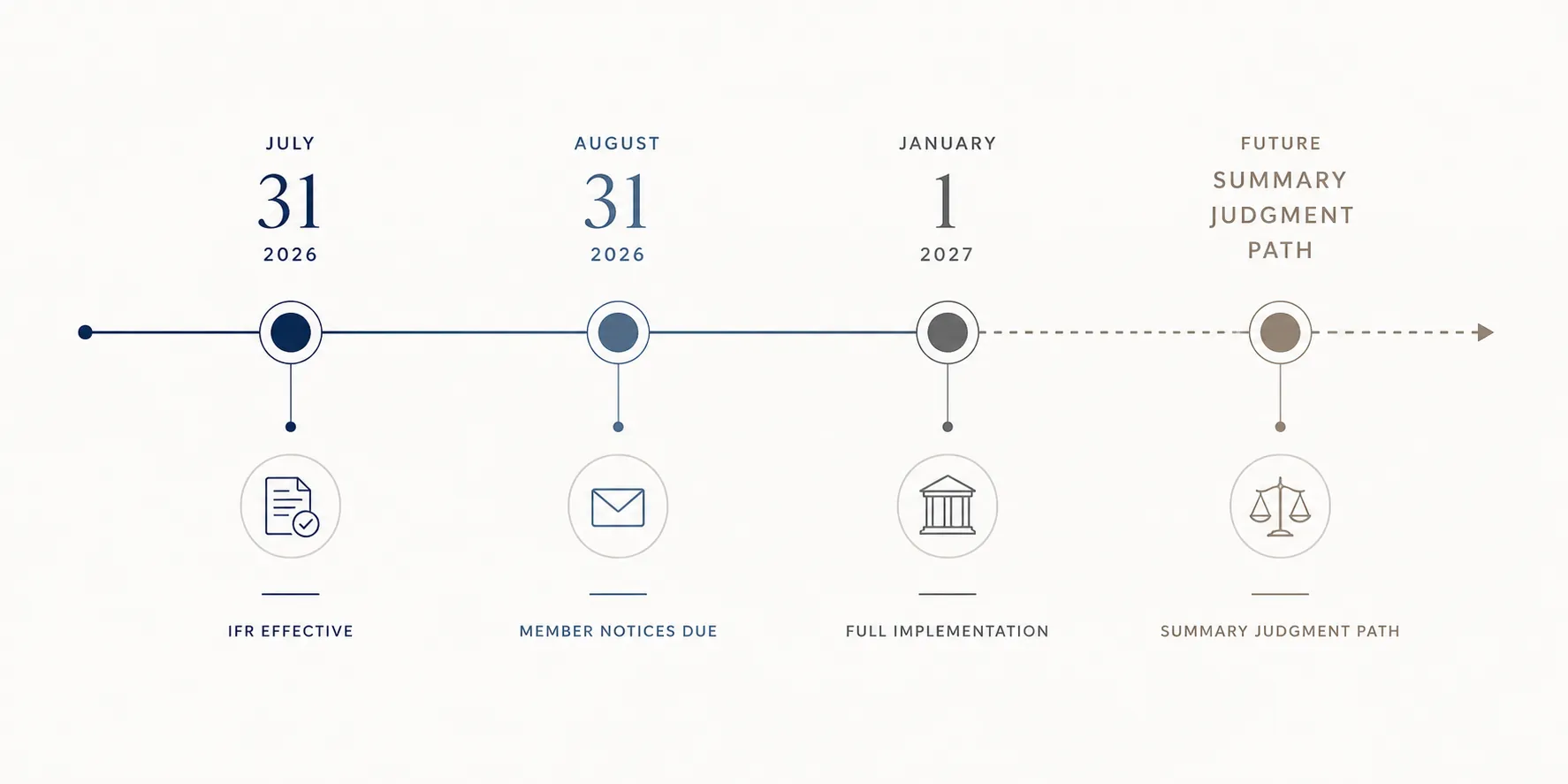
The implementation schedule is now the practical center of the case. The IFR took effect July 31, 2026. The comment period closed the same day. States must issue member notices by August 31, 2026. Full implementation is due January 1, 2027. The court expects an expedited summary-judgment path before year-end.[1][3]
| Date | Event | Operational consequence |
|---|---|---|
| July 31, 2026 | IFR effective date and comment-period closure | Rule is in effect while the merits remain unresolved. |
| August 31, 2026 | Member notices due | States must communicate requirements before final merits adjudication may occur. |
| Before year-end 2026 | Expected expedited summary-judgment track | Merits briefing becomes the next meaningful litigation event. |
| January 1, 2027 | Full implementation deadline | Eligibility systems and compliance processes must be ready unless later court action changes the rule. |
Those dates are not background. They explain the order’s practical effect. The court declined to stop implementation now, but it also signaled that delay in merits adjudication could change the injunction analysis if the plaintiffs are not responsible for the delay.[1] That gives both sides a reason to move quickly and gives state counsel a reason to document any schedule slippage carefully.
The August 31 notice date is particularly awkward. Member notices must go out while the legal status of the medical-frailty definition and related claims remains unsettled. That does not mean notices must become litigation briefs. It does mean agencies should be careful about finality language, appeal-right explanations, exemption descriptions, and the records they keep showing how contested standards were applied.
Coverage Stakes, Kept In Their Proper Boxes
CMS’s IFR estimates 2.3 million fewer Medicaid enrollees in FY 2027 and a $350.3 billion reduction in federal Medicaid spending over 10 years.[3] Those are official agency projections embedded in the rulemaking materials, not findings by the district court.
Independent policy estimates are separate. CBPP projected up to 7 million coverage losses by 2028.[5] That figure should not be blended with CMS’s FY 2027 estimate or treated as the court’s view of likely harm. The lawsuit is procedurally about emergency relief and merits review; the coverage estimates explain practical stakes, not the legal holding. For a patient-facing treatment of those stakes, see What the Medicaid work requirements lawsuit means for patients.
This separation is more than citation hygiene. CMS projections, outside estimates, and judicial findings answer different questions. A coverage-loss estimate does not prove irreparable harm for every plaintiff. A finding of insufficient irreparable harm does not make projected coverage loss irrelevant to policy, administration, or later merits briefing.
What Counsel Should Not Infer
- Do not infer that CMS won on the APA claims; the order did not decide them.
- Do not infer that the Spending Clause claim was rejected; it remains available for summary judgment.
- Do not infer that the medical-frailty definition is secure; the statutory-interpretation dispute remains open.
- Do not infer that implementation risk disappeared; the August 31 and January 1 dates still require action.
- Do not infer that a renewed injunction motion is unavailable; the court preserved that path if merits timing becomes unreasonable through no fault of the plaintiffs.
The sounder reading is narrower and more useful: the states lost the first injunction round because they did not prove irreparable harm. The merits claims remain intact. The court recognized difficult statutory questions without deciding them. Agencies still have to notice, build, and document under the current IFR while preserving flexibility for a merits ruling that could arrive before full implementation.
References
- Order on Plaintiffs’ Motion for Preliminary Injunction, Georgetown Litigation Tracker, July 29, 2026.
- Complaint, Commonwealth of Massachusetts et al. v. Oz et al., New York Attorney General, June 29, 2026.
- Medicaid Program; Community Engagement Requirements, Federal Register, June 3, 2026.
- Medicaid Waiver Tracker: Approved and Pending Section 1115 Waivers by State, KFF, updated June 29, 2026.
- House Budget Bill’s Medicaid Work Requirement Would Cause Millions to Lose Coverage, Center on Budget and Policy Priorities, June 3, 2026.
Operationalizing workflow
No workflow has been explicitly linked to this obligation yet. See Workflows generally.
Illustrative cases
No illustrative case is currently tracked for this obligation. See Risk Digest for documented incidents generally.
← Back to RegulationReport a correction or tip
Spotted an outdated figure, a misstated fact, or a ruling this regulation entry should reflect? Public comments are disabled for this content given the professional cost of a misreported case outcome, penalty amount, or rule text — use the structured correction channel instead.
Report a correction or tip for this record →