
The Children's Coverage Collapse Behind the MediKids Act
- Authority
- U.S. Congress
- Rule type
- proposed legislation
- Jurisdiction scope
- US federal
- Source text
- Read primary rule text ↗
Would require enrollment from birth, continuous eligibility through age 26, eligibility regardless of immigration status, and a 100% federal match.
The children’s-coverage problem behind Andy Kim’s MediKids Act is easy to blur because the public numbers sit close together. They should not be treated as the same number. The 4.4 million figure, the common 4.5 million shorthand, Georgetown’s 4.6 million ACS reading, and the Census Bureau’s roughly 4.7 million count are different source-vintage readings of the same worsening problem.
| Figure | What it is measuring | Why it matters |
|---|---|---|
| 4.4 million uninsured children | The figure used by Sen. Andy Kim’s MediKids page, alongside an underinsurance claim of 23 million children, or about one in three kids. [1] | A bill-advocacy figure, not the only available national estimate. |
| 4.5 million uninsured children | A rounded shorthand used in coverage of S. 5037, including NOTUS’s bill coverage. [2] | Useful as a public-facing approximation, but too rounded to carry the evidentiary load by itself. |
| 4.6 million uninsured children / 6.0% | Georgetown CCF’s 2024 American Community Survey analysis; Georgetown reported the child uninsured rate rising from 5.1% in 2022 to 6.0% in 2024, an 18% increase, equal to 716,000 more uninsured children. [3] | The most useful trend reading because it shows direction and magnitude from 2022 to 2024. |
| Roughly 4.7 million uninsured children / 6.1% | The Census Bureau’s official 2024 report, P60-288. [4] | The official Census report reading; close to Georgetown’s ACS estimate, but not interchangeable with it. |

That reconciliation is not bookkeeping trivia. If the question is whether the MediKids Act responds to a real coverage collapse, the answer should not depend on rounding a child population into a speech line. The defensible claim is narrower and stronger: multiple 2024 readings place the uninsured-child count in the mid-four-millions, and the trend data show child coverage worsening after the pandemic-era coverage protections ended.
The underinsurance figure belongs in a different box. Kim’s office says 23 million children are underinsured, approximately one in three children. [1] That is not the same problem as being uninsured. A child with a high-deductible family plan, thin provider access, or unaffordable out-of-pocket exposure may be underinsured while still counted as insured. The MediKids debate becomes muddier when those categories are collapsed, because the legal and administrative failures are not identical.
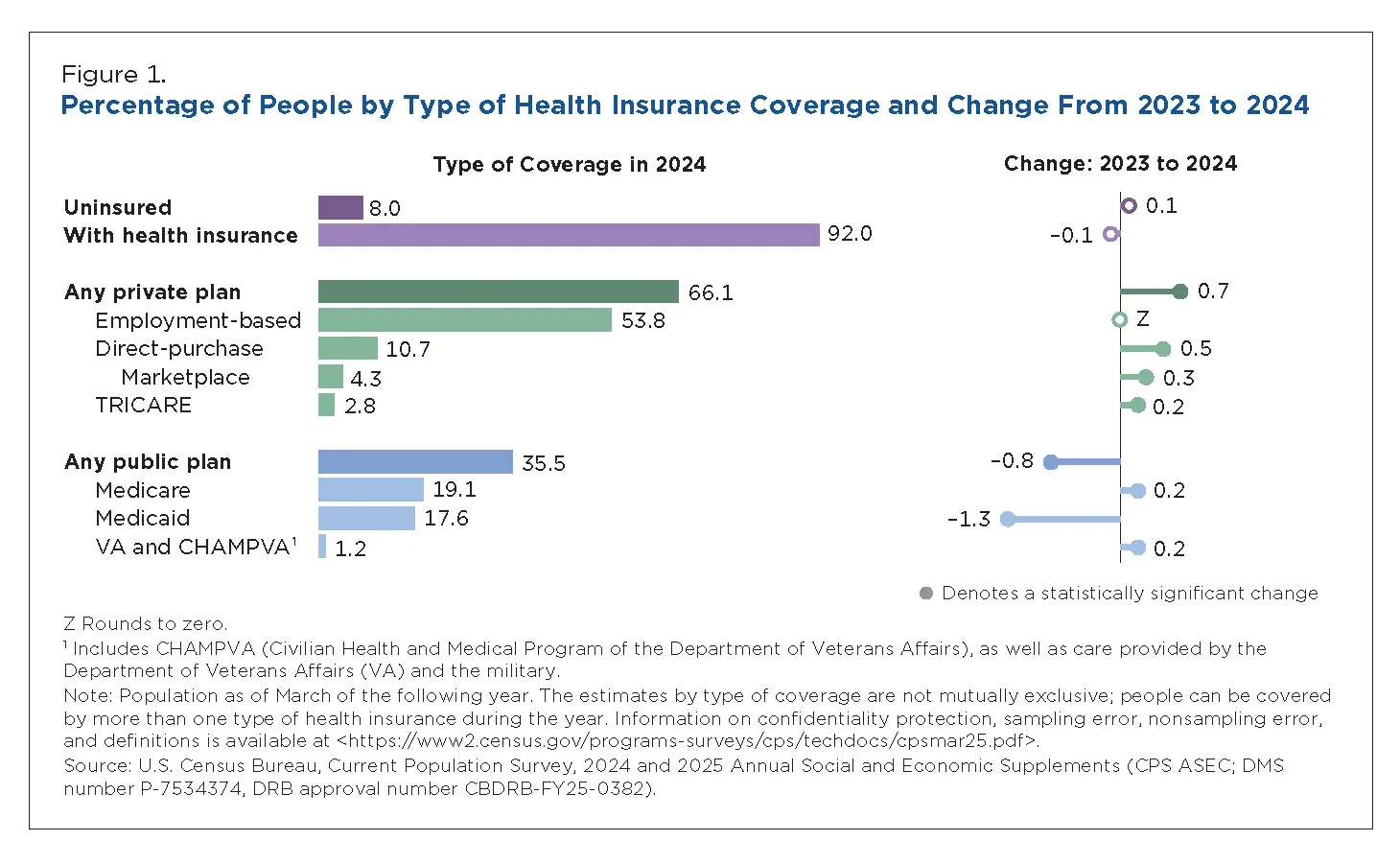
The uninsured count is the snapshot; enrollment loss is the motion underneath
The national uninsured count shows how many children were outside coverage at a point in the data. The enrollment data show how families got pushed toward that point. Georgetown CCF’s enrollment tracking reported more than 2 million fewer children in Medicaid and CHIP since January 2025, with the ten states experiencing the largest absolute declines accounting for 67% of the losses. [5]
That matters because Medicaid and CHIP are not marginal programs for children. CMS snapshot data cited by the Annie E. Casey Foundation showed Medicaid and CHIP covering nearly 37 million children ages 0–18 as of September 2025. [6] A decline of more than 2 million children in those programs is not a rounding artifact. It is a large movement inside the main public coverage architecture for children.
The post-pandemic redetermination period is the obvious administrative backdrop. Families who remain financially eligible can still lose Medicaid or CHIP when notices go to the wrong address, forms are not returned on time, verification systems fail, or a parent cannot navigate a state portal before a deadline. The child does not become less in need of preventive visits, asthma medication, vaccines, dental care, or developmental screening because a household missed a piece of mail.
The state data keep the crisis from becoming a national average
National figures are necessary, but they hide the distribution of harm. Georgetown’s ACS analysis found Texas with the highest child uninsured rate, 13.6%, representing about 1.1 million uninsured children and roughly one-quarter of the national total; Texas was up from 10.9% in 2022. Massachusetts had the lowest child uninsured rate, 2.1%. Georgetown also identified 22 states with statistically significant increases in child uninsured rates, while New Hampshire was the only state that improved. [3]
The enrollment tracking points to the same unevenness. Indiana’s child Medicaid and CHIP enrollment decline was reported at 19.8%, while Florida had 43,000 CHIP coverage losses. [6] These state figures are not interchangeable with the ACS uninsured-rate estimates; they measure enrollment movement in specific programs, not the total uninsured population. But read together, they show why a national coverage proposal cannot be evaluated only by its national promise. State systems are where renewal notices are sent, call-center backlogs happen, navigator capacity disappears, and children lose coverage through procedure.
The concentration of losses also makes state fiscal incentives central. A state that faces budget pressure, political pressure to narrow Medicaid rolls, or operational pressure from redetermination backlogs can make choices that look modest in an agency memo and enormous when aggregated across children. The harder-hit states are not just locations on a map; they are evidence that administrative design and state incentives shape whether an eligible child stays insured.
How the MediKids mechanisms map onto the documented failure points
The bill details matter here only insofar as they answer the coverage failure. For a fuller status-and-mechanics treatment of S. 5037, including EPSDT, auto-enrollment, opt-out structure, federal financing, cosponsors, and counsel monitoring issues, see the site’s MediKids Act explainer for lawyers. The coverage-collapse question is more specific: do the bill’s mechanisms match the ways children are losing or missing coverage?

| Documented pressure point | MediKids design response |
|---|---|
| Redetermination churn and paperwork losses | Continuous eligibility through age 26, reducing repeated renewal points where eligible children can be dropped. [8] |
| Coverage gaps at the start of life | Enrollment from birth, so a newborn does not depend on a parent successfully completing a separate coverage process after delivery. [8] |
| Chilling effects and eligibility exclusions tied to immigration status | Eligibility without regard to immigration status, removing a category-based barrier and reducing fear-driven avoidance. [8] |
| State fiscal reluctance or uneven state capacity | A 100% federal medical assistance percentage, changing the state incentive from cost-sharing hesitation to federally financed coverage. [8] |
Continuous eligibility is the most direct answer to churn. If a family must repeatedly prove eligibility, every renewal cycle becomes a failure point. A parent may be working irregular hours, sharing housing, changing addresses, caring for a sick child, or trying to satisfy several public-benefits systems at once. A continuous-eligibility design does not require anyone to pretend that every family has limitless administrative capacity. It removes the recurring drop-off point from the child’s coverage path.
Birth enrollment addresses a different gap. Coverage systems often assume that a parent can convert a birth into an insurance enrollment event cleanly and quickly. That assumption is least safe for families already stretched by medical recovery, unstable work, language barriers, transportation problems, or housing insecurity. Enrollment from birth treats the child’s arrival as the coverage trigger, rather than making coverage depend on a separate administrative performance by the parent.
Immigration-status-neutral eligibility responds to both legal exclusion and behavioral avoidance. When families believe applying for coverage could expose a household member to immigration consequences or data-sharing risk, some will stay away even from benefits for which a child may be eligible. The coverage record identifies ICE data-sharing chilling effects as part of the coverage environment. The MediKids design answers that by making immigration status irrelevant to eligibility, instead of asking navigators to persuade frightened families that a complicated system is safe.
The 100% federal match is the state-incentive piece. States administer Medicaid and CHIP under real fiscal constraints, and state officials can be reluctant to expand or maintain coverage when the state must carry part of the cost. A full federal match does not solve every administrative problem. It does, however, remove one predictable objection: that covering children more completely will fall partly on the state budget. In a crisis where the top ten declining states account for two-thirds of the reported enrollment losses, the federalism design is not secondary. [5]
Work-reporting rules and navigator cuts belong in the same coverage story
The MediKids Act is also being proposed against the background of broader Medicaid retrenchment. First Focus Campaign for Children relayed a Congressional Budget Office projection that nearly 3 million children would lose Medicaid under the 2025 One Big Beautiful Bill Act, which it described as cutting more than $1 trillion from the program. [7] That is an advocate-relayed CBO estimate, not a final measured enrollment outcome, and it should be described that way.
Work-reporting rules are often described as adult accountability measures, but children can be affected when a parent’s paperwork failure destabilizes household coverage or when state systems become more complex for everyone passing through them. A child does not control whether an adult can upload documents, interpret reporting instructions, or get through to a caseworker. When coverage design routes children through adult administrative compliance, the child bears risk without agency.
Navigator capacity is the other practical piece. The cited coverage record identifies a 90% navigator funding cut as part of the same environment in which families are losing coverage. [6] That fact is easy to underweight because it sounds like an implementation detail. It is not. For a parent facing a renewal notice, a language barrier, a broken online account, or uncertainty over immigration consequences, navigator help can be the difference between a fixable problem and a terminated child’s coverage.
What not to overclaim
There are several places where the record does not support a cleaner story. Adoption is not effectiveness. Introducing S. 5037 does not prove that birth enrollment or continuous eligibility would be implemented cleanly across every state. A structural match between problem and mechanism is not the same as a measured post-enactment outcome.
Cost claims also need separation from the coverage evidence. Kim’s Senate page says government almost doubles its return on every dollar invested in children’s health care, while a First Focus account of Kim’s Washington Post argument refers to roughly $4 saved for every $1 invested. [1][7] Those are not the same ROI claim. The case for taking MediKids seriously does not require blending them. The coverage data are strong enough to stand without smoothing inconsistent return-on-investment language into one advocacy statistic.
The bill’s fiscal picture is also incomplete. NOTUS reported no Congressional Budget Office score for S. 5037 as of July 30, 2026. [2] A GovTrack prognosis, including a pessimistic model reading, is not a CBO score and is not an official congressional assessment. It may be useful for readers trying to understand legislative odds, but it should not be mistaken for evidence about how many children are uninsured, why enrollment is falling, or whether the bill’s design targets the documented failure points.
One search-confusion note is worth clearing away. This article is discussing the federal MediKids Act, S. 5037, introduced by Sen. Andy Kim. It is not the Florida KidCare program component that uses the MediKids name, and it is not the earlier federal MediKids Health Insurance Act from a prior Congress. Similar names do not make the programs legally or operationally identical.
The careful conclusion from the current record
As of the available 2024 ACS and Census data, the 2025 CMS snapshot context, and the 2026 Georgetown enrollment tracking, the children’s-coverage problem is not speculative. The exact uninsured-child figure depends on source and vintage, but the direction is consistent: child coverage has worsened, Medicaid and CHIP enrollment has fallen sharply, and losses are concentrated in states where administrative and fiscal design choices matter.
That is why the MediKids Act is best understood as a structural response to documented child-coverage losses rather than a symbolic health-care slogan. The bill’s birth enrollment, continuous eligibility, immigration-status-neutral access, and 100% federal match each correspond to a specific failure mode in the record. The picture should be revisited when 2025 ACS data arrive and if CBO publishes a formal score for S. 5037.
References
- MediKids — Office of U.S. Senator Andy Kim
- Andy Kim MediKids Act — NOTUS — 2026-07-30
- U.S. and State-by-State Child Health Coverage Trends — Georgetown CCF — 2025-09-12
- Health Insurance in the United States: 2024 — U.S. Census Bureau — 2025
- Children are losing health insurance at alarming pace — Georgetown CCF — 2026-06-10
- Uninsured Children in America — Annie E. Casey Foundation
- Every Child Guaranteed Health Care Under New Proposal — First Focus Campaign for Children
- Senator Kim Introduces Bill to Cover All Children and Young Adults — Georgetown CCF — 2026-07-28
Operationalizing workflow
No workflow has been explicitly linked to this obligation yet. See Workflows generally.
Illustrative cases
No illustrative case is currently tracked for this obligation. See Risk Digest for documented incidents generally.
← Back to RegulationReport a correction or tip
Spotted an outdated figure, a misstated fact, or a ruling this regulation entry should reflect? Public comments are disabled for this content given the professional cost of a misreported case outcome, penalty amount, or rule text — use the structured correction channel instead.
Report a correction or tip for this record →