
Meta's Teen App Settlement Pressures TikTok and YouTube
- Authority
- State attorneys general
- Rule type
- consent judgment
- Jurisdiction scope
- US state
- Source text
- Read primary rule text ↗
Meta withholds about 30% of payment unless TikTok and YouTube adopt one-hour daily limits, Night Mode, age assurance, and matching payments.
The important part of Meta’s proposed teen-app settlement is not the headline payment. It is the tranche that Meta says it will not pay unless TikTok and YouTube adopt a one-hour daily limit, Night Mode, and age assurance—and each make a matching payment. Meta describes that contingent amount as roughly 30% of the settlement.[1]
The settlement is not final, and its dollar totals and participating-state counts vary by source. The companion record, Meta’s $16.7 billion settlement is not final yet, is the better place for that accounting. The more consequential question here is what the conditional design does to platforms that never signed the consent judgment.
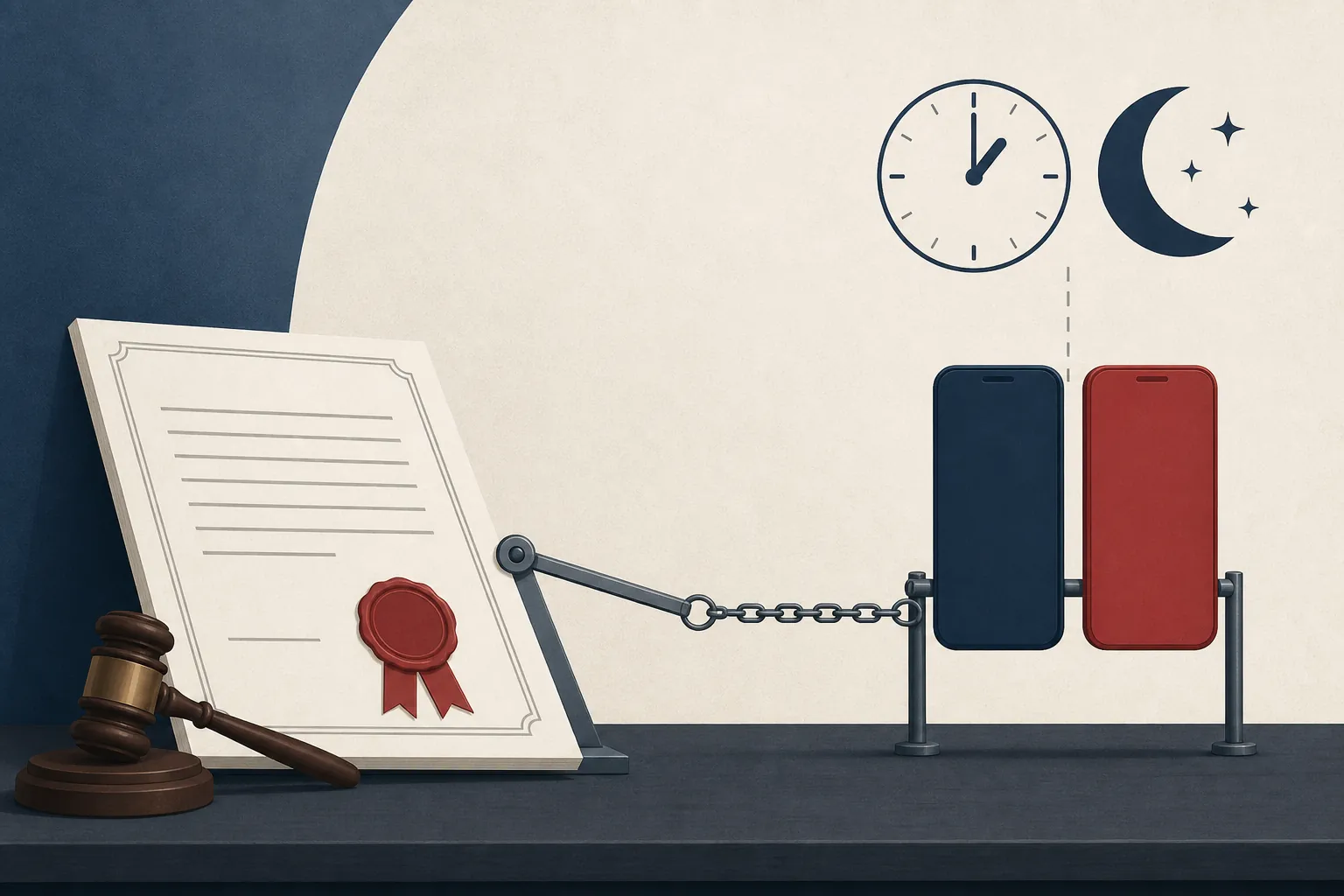
A settlement with an external trigger
The basic mechanism is unusually direct. Meta’s payment has a guaranteed component and a conditional component. The conditional portion becomes payable only if TikTok and YouTube implement the specified safeguards and pay matching amounts. In the District of Columbia attorney general’s description, a broader version of the escalation also contemplates Snapchat, TikTok, and YouTube adopting comparable terms.[2]
If the relevant rivals join, Meta’s own obligations tighten. Its daily limit falls from two hours to one hour per app; Night Mode expands from midnight–6 a.m. to 10 p.m.–7 a.m.; and the time-limit and Night Mode commitments extend from five years to ten. The DC attorney general describes the fullest outcome as a 60-minute limit lasting ten years when the named platforms adopt comparable terms.[2]

That makes the rivals’ conduct part of the settlement’s operating logic even though they are not parties to it. Meta has also issued an open invitation for TikTok and YouTube to adopt the framework. C.J. Mahoney, Meta’s chief legal officer, said the framework “will only work if all our peers join us.”[1][3] The invitation is therefore more than public-relations language: participation changes the obligations Meta itself must perform and the payment it must make.
What joining could buy—and what refusing could create
TikTok and YouTube now face a choice that is legal and operational at the same time. Joining could provide a record that the platform adopted safeguards recognized in a highly publicized settlement: a measurable daily limit, defined overnight restrictions, and an age-assurance program. In later litigation, counsel could point to that record when arguing that the platform took reasonable steps.
That would not create immunity. Adoption is evidence of a control, not proof that the control is effective, properly implemented, or causally sufficient to defeat a claim. A platform would still need to show how its limit operates across devices and accounts, how Night Mode is enforced, how age assurance performs, and who reviews exceptions and failures.
Refusal carries a different kind of exposure. Plaintiffs or regulators could argue that the platform knew about a concrete package of safeguards and chose not to adopt it. That argument would not establish negligence or liability by itself, but it could become part of a narrative about notice, reasonableness, and the cost of inaction. Yahoo Finance’s analysis frames the same two-sided calculus: joining may strengthen future defenses, while refusing may invite accusations that a platform ignored sensible safety practices.[5]

As of the available reporting, neither TikTok nor YouTube had publicly committed to the framework.[4] That silence does not reveal whether either company is negotiating, declining, or simply waiting for the final consent judgment. It does leave the central choice unresolved, while Meta has made the benchmark public and repeatable.
A de facto standard, not a new statute
Calling the arrangement a de facto industry standard requires precision. TikTok and YouTube are not legally bound merely because Meta settled. The settlement cannot, by itself, impose a common rule on companies that did not sign it. Sacha Haworth of the Tech Oversight Project made the opposing institutional point: protections applying across platforms should come from Congress, not from a private settlement.[4]
But formal binding effect is not the only way a settlement can influence product risk. A consent judgment can supply a publicly documented benchmark that plaintiffs’ lawyers, state attorneys general, experts, and platform counsel will all be able to examine. The benchmark becomes more consequential when the defendant’s payment depends on rivals adopting it and when the obligations are expressed in operational terms rather than broad promises.
The practical result resembles an industry framework: not a rule that automatically applies, but a set of controls against which nonparticipants may be asked to explain themselves. The question for a product team is no longer only whether a safeguard is legally mandatory. It is whether declining a visible safeguard will later require a defensible explanation.
That is also why the age-assurance and recommendation-system details matter more than the ceremonial language surrounding the deal. They are the parts that can become engineering requirements, audit metrics, exception logs, and remediation tickets. The comparison with algorithm-liability disputes is developed in What the Outrage Study Shows About Algorithm Liability.
Why the pressure is unlikely to disappear
The rival platforms are making this decision against a continuing litigation backdrop. A second federal trial involving 25 states was scheduled for later in 2026.[6] New Mexico separately obtained jury penalties totaling approximately $942 million—$375 million in March and $567 million in August 2026—and the first U.S. addiction-trial verdict in February 2026 ordered Meta and YouTube to pay $6 million.[7][8]
Those proceedings do not prove that the settlement’s controls are legally required, nor do they establish that adopting them would prevent future liability. They do explain why a platform would treat the choice as a risk-allocation problem rather than a symbolic endorsement of Meta’s deal.
The monetary descriptions themselves should not be collapsed into one supposedly definitive number. Meta describes an approximately $18 billion total, with roughly 70% guaranteed and 30% conditional.[1] The DC attorney general describes at least $12.1 billion plus up to $5 billion; California refers to a settlement of up to $17 billion; and Reuters reported a maximum of $16.68 billion.[2][9][10] Those figures reflect different descriptions of the payment structure, and the executed consent-judgment PDF was not available for term-level verification here.
Approval and final entry also remain pending as of August 28, 2026, despite reports that the judge was inclined to grant approval or had described the agreement favorably.[6][8][10] The same caution applies to the number of participating attorneys general: Meta lists 52, while the California and District of Columbia releases list 51; New Mexico and Florida are excluded, and Texas’s status is reported inconsistently.[1][2][9]
For counsel benchmarking platform risk, the usable conclusion is narrower. Meta’s proposed settlement does not formally bind TikTok or YouTube, and it has not yet been finally entered. Its conditional payment design nevertheless forces those companies to confront a public package of teen-safety controls with consequences on both sides: joining may support a later reasonableness defense, while refusing may leave a more difficult record when plaintiffs or regulators ask why widely publicized practices were not adopted. That makes the arrangement an obligations signal beyond Meta, but not proof that an industry standard already exists.
References
- Agreement with State Attorneys General Supporting Teens — Meta, 2026
- Attorney General Schwalb Announces Meta Will Pay — Office of the Attorney General for the District of Columbia, 2026
- Meta agrees to sweeping changes to restrict kids’ access to its apps as part of settlement with states — TechCrunch, August 26, 2026
- Meta reaches landmark $18 billion settlement with states in trial over teen social media addiction — Associated Press via FOX8, 2026
- Meta’s settlement is a challenge to TikTok and YouTube — Yahoo Finance, 2026
- Meta agrees to landmark settlement over social media addiction cases — Courthouse News Service, 2026
- Meta social media addiction trial settlement — The Guardian, August 26, 2026
- Meta social media addiction trial settlement — BBC, 2026
- Attorney General Bonta Secures Transformative $17 Billion Settlement with Meta — California Department of Justice, 2026
- The clause in Meta’s settlement designed to cost TikTok and YouTube $5.3 billion — Trending Topics, 2026
Operationalizing workflow
No workflow has been explicitly linked to this obligation yet. See Workflows generally.
Illustrative cases
No illustrative case is currently tracked for this obligation. See Risk Digest for documented incidents generally.
← Back to RegulationReport a correction or tip
Spotted an outdated figure, a misstated fact, or a ruling this regulation entry should reflect? Public comments are disabled for this content given the professional cost of a misreported case outcome, penalty amount, or rule text — use the structured correction channel instead.
Report a correction or tip for this record →