
Where does the Missouri property tax cap ruling stand?
- Authority
- Cole County Circuit Court
- Rule type
- court case
- Jurisdiction scope
- US state
- Source text
- Read primary rule text ↗
August 2026 rate-setting must proceed even though SB 3 caps are not yet in force.
Last verified: August 1, 2026, 00:00 UTC. The Missouri property tax cap ruling in Cole County Circuit Court Case No. 25AC-CC07281 has not issued. Judge Christopher Limbaugh heard the SB 3 challenge on July 29, gave the lawyers one week to file proposed findings, and said he would rule quickly because local boards must hold August public hearings to set 2026 tax rates before notices go out.[1][2]
That is the operative status for anyone preparing an August rate-setting calendar: the caps approved by voters in April are still not in force, but the local timetable has not stopped for the litigation. Even if the Cole County order arrives within the window the judge described, the constitutional question will remain appeal-risked, and a parallel challenge is already set for Missouri Supreme Court argument on September 1, 2026.[1]

The timing problem is already here
The July 29 trial did not produce an immediate ruling. It produced a compressed post-trial schedule. Proposed findings are due within one week of the hearing, and the court has signaled speed because boards across Missouri need to set rates in August for this year’s tax notices.[1] That is not the same thing as a final, administrable statewide rule.
| Date or window | What is on the calendar | Why it matters for local boards |
|---|---|---|
| July 29, 2026 | Cole County trial on the SB 3 constitutional challenge | The trial closed the evidentiary/argument phase, but no ruling issued that day.[1] |
| One week after trial | Proposed findings due from counsel | The ruling window begins while August rate hearings are already approaching.[1] |
| August 2026 | Local public hearings to set 2026 tax rates | Counties, school districts, and other taxing districts may have to act before appellate review is complete.[1] |
| September 1, 2026 | Missouri Supreme Court argument in the parallel Moon/Wolfin/Calzone appeal | A Cole County ruling may guide the immediate tax year, but it will not necessarily be the last word.[1] |
For rate counsel, the uncomfortable part is not just whether the caps survive. It is who must rely on what, and when. A board may have to publish, notice, hear, and adopt a rate while the trial court order is fresh, absent, stayed, appealed, or only partly clarifying the statute. That is a different risk profile from a clean pre-season decision issued before rate worksheets begin moving.

What SB 3 was supposed to do
SB 3 did not apply one uniform cap to every Missouri county. It divided the state into categories. UMB’s summary describes 22 “freeze” counties, 75 “cap” counties where annual property-tax increases would be capped at the greater of 5% or inflation as measured by CPI, and 17 excluded jurisdictions, including Jackson County, St. Louis County, St. Louis City, and Greene County. In all, 97 of Missouri’s 114 counties were required to put the question to voters on April 2026 ballots.[3]
The reported April results are the reason this litigation has immediate operational weight. The Post-Dispatch reported that 61 counties approved property-tax limits: 14 freeze counties and 47 counties under the 5% cap structure. It also reported 12 rejections, Texas County’s earlier November 2025 approval, and 23 directed counties that did not vote.[1] Those figures are useful for exposure mapping, but they should not be converted into a county implementation chart without checking each local canvass and the current docket posture.
The fragmentation matters more than the statewide headline. A taxing district with property in more than one county may face one county preparing to apply a cap, another excluded by statute, and another waiting for judicial direction or local implementation capacity. School-district counsel cannot solve that by reading the April vote total alone.
The pleaded constitutional issues remain live
The Cole County challenge is not a single-issue tax protest. The reported claims attack the SB 3 structure under several provisions of the Missouri Constitution, including the local-or-special-law restriction in Article III, Section 40; the homestead-exemption restitution requirement in Article X, Section 6(a); the uniformity and subclassification limits in Article X, Section 4(b); and a Hancock Amendment theory tied to the cost of mandated county elections.[1][4]
The local-or-special-law theory goes to SB 3’s county classifications. The practical question is whether the legislature permissibly sorted counties into freeze, cap, and excluded groups, or whether the law draws constitutionally impermissible lines around particular localities. KCTV5 reported that the state defended the population-based classifications and also argued that some challenges amounted to generalized grievances rather than claims the court should entertain.[4]
The homestead-exemption and uniformity theories are different problems. They ask whether the cap mechanism functions like a constitutionally regulated exemption or creates a subclassification that Missouri’s property-tax uniformity rules do not permit. Those are merits questions for the court, not facts established by the April vote.
The Hancock Amendment theory adds an implementation layer. If counties were required to conduct elections without constitutionally adequate state funding, the burden is not abstract for clerks and county commissions. It shows up as a mandated ballot event, election administration work, and then a rate-setting problem if the election result is later treated as legally defective.
None of these theories should be written as if Judge Limbaugh has accepted them. The trial has occurred; the pleaded issues and reported defenses are before the court; the ruling is pending.
Do not overstate the county-party structure
The case has been described in public reports as involving a taxpayer from excluded St. Louis, a taxpayer from Warren County, seven taxing districts, and county commissions from 43 counties.[1] Governing, however, described the 43-county litigation structure differently, in a way that could be read as a separate suit with its own timing.[5] That conflict matters if a lawyer is trying to determine who is bound by what order, which pleadings control, or whether a particular county commission is a party, intervenor, or participant in another procedural posture.
Before treating the 43-county participation as joinder in Case No. 25AC-CC07281, counsel should verify the current CaseNet entries and filings, not rely on a secondary description.[2] This article treats the county-participation point as reported but not independently resolved beyond the docket reference available for the Cole County case.
Uneven implementation is not hypothetical
Several reported county responses already show why a fast ruling will not automatically produce settled administration for the 2026 tax year. Jefferson County voted in January 2026 not to implement the cap until 2028. Stone County reportedly did not put the required measure on the ballot. Franklin County said it could not be ready before 2027.[1]
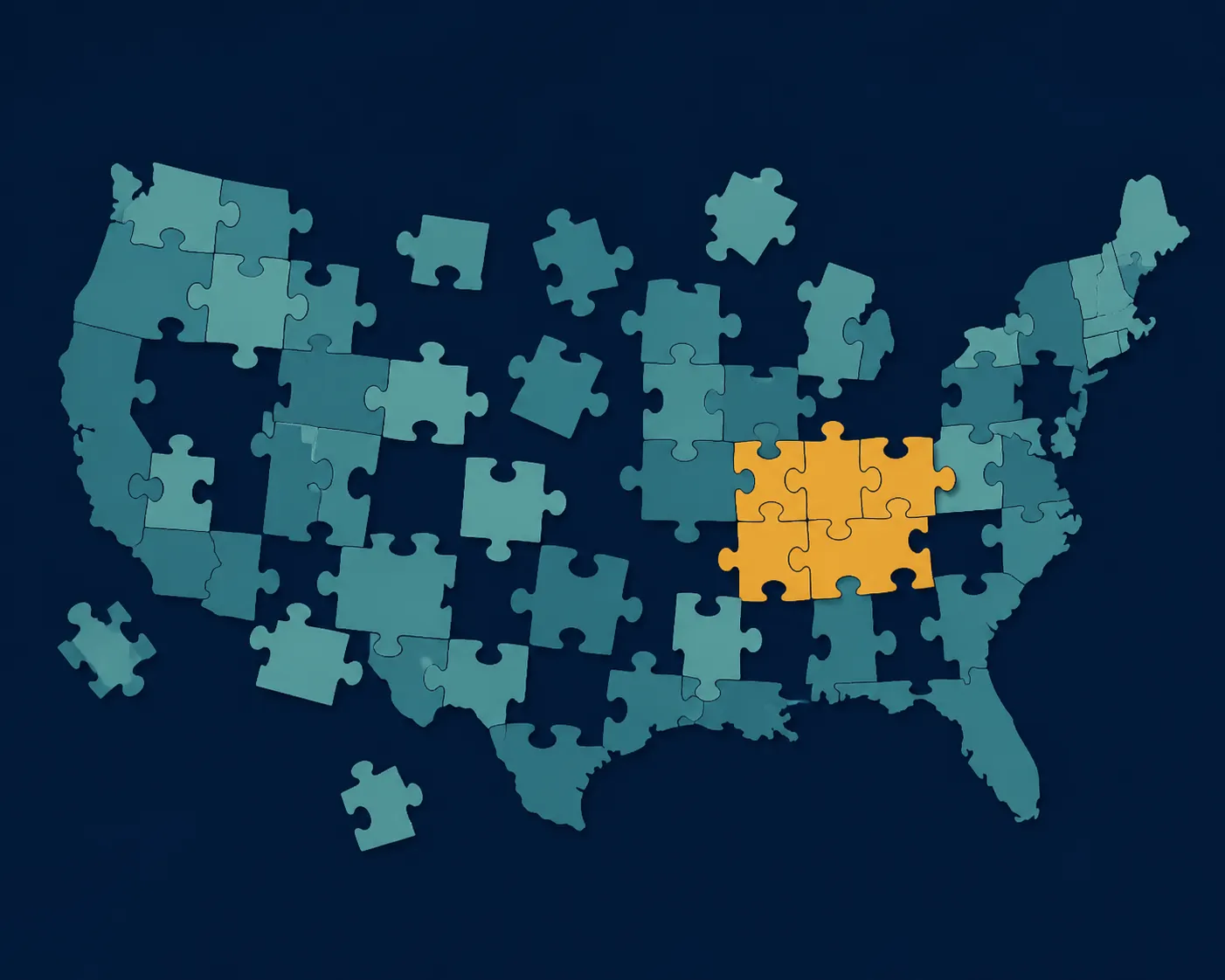
Those are not stray local anecdotes. They are evidence of the administrative problem the court calendar now collides with: statutory categories, election results, county capacity, and constitutional review are not moving on the same schedule. Governing separately reported implementation uncertainty after the voter approvals, reinforcing that the hard part began after the ballots were counted.[5]
The risk for taxing districts is especially plain where a district spans county lines or depends on county-level assessment and collection offices to apply the same legal premise on the same billing cycle. A district may know its levy ceiling but still not know whether the county’s cap calculation is valid, delayed, enjoined, or subject to correction after appellate review.
The September 1 Supreme Court argument keeps the question open
The parallel Moon/Wolfin/Calzone appeal began from a January 2026 standing dismissal in a challenge connected to the stadium-funding legislation context, and it is set for Missouri Supreme Court argument on September 1, 2026.[1] The stadium background may explain how SB 3 became politically visible, but for August tax administration the important fact is simpler: the state’s highest court has a related constitutional challenge on its calendar after local boards must begin acting.
That sequence limits what any Cole County ruling can safely be said to do. A trial-court order may tell counties what to do next, and it may be the only judicial direction available when August hearings occur. It will still sit inside a broader litigation field that includes appellate argument the following month.
What local counsel should treat as verified now
- The Cole County SB 3 ruling had not issued as of August 1, 2026.
- The July 29 trial is complete, and proposed findings were ordered on a one-week schedule.
- The judge has said he will rule quickly because August rate-setting hearings are approaching.
- The April 2026 caps approved in 61 counties are not yet in force.
- At least some counties have already delayed, missed, or questioned implementation timing.
- The Missouri Supreme Court argument in the related Moon/Wolfin/Calzone appeal remains set for September 1, 2026.
The practical filing posture follows from those points. A county clerk preparing notices, a school-district lawyer reviewing levy assumptions, or a board lawyer drafting hearing materials should preserve the distinction between a voter-approved cap, an implemented county calculation, and a constitutionally valid cap. They are not interchangeable statuses.
This is also the kind of record where verification habits matter more than narrative neatness. The same discipline that applies in pending-ruling implementation windows and verification-before-filing workflows applies here: do not turn an expected ruling into a ruling, do not turn a trial-court order into final appellate law, and do not turn a reported county tally into a verified local implementation instruction.
Lex Machina Review will update this record when the Cole County ruling posts, when CaseNet reflects a material docket change, or when the Missouri Supreme Court calendar changes the September 1 argument posture.
References
- Judge promises quick ruling on Missouri property tax caps — St. Louis Post-Dispatch, July 30, 2026.
- Case No. 25AC-CC07281 — Missouri Courts CaseNet.
- Property tax reform provisions in Missouri Senate Bill 3 — UMB Bank Capital Markets.
- Missouri judge weighs constitutionality of property tax cap law connected to Royals stadium incentives — KCTV5, July 29, 2026.
- Missouri Voters Approved Property Tax Caps. Now Comes the Hard Part. — Governing/TNS.
Operationalizing workflow
No workflow has been explicitly linked to this obligation yet. See Workflows generally.
Illustrative cases
No illustrative case is currently tracked for this obligation. See Risk Digest for documented incidents generally.
← Back to RegulationReport a correction or tip
Spotted an outdated figure, a misstated fact, or a ruling this regulation entry should reflect? Public comments are disabled for this content given the professional cost of a misreported case outcome, penalty amount, or rule text — use the structured correction channel instead.
Report a correction or tip for this record →