
What Nvidia CEO's testimony refusal means for AI regulation
- Authority
- U.S. Senate Committee on Banking, Housing, and Urban Affairs
- Rule type
- regulation
- Jurisdiction scope
- US federal
- Source text
- Read primary rule text ↗
The useful starting point for AI-regulation tracking is not Jensen Huang’s demeanor, because there was no testimony to read. The record starts with a June 4, 2026 invitation from Sen. Elizabeth Warren asking Huang to appear before the Senate Banking Committee and testify about “NVIDIA’s views on U.S. export control laws and regulations and NVIDIA’s business in China.”[1] NBC News reported on June 8 that Huang declined the invitation and that it could not locate any record of Huang previously testifying before Congress.[2] The June 11 hearing then went forward without him, with outside witnesses rather than a company witness able to answer Nvidia-specific questions.[3]
That is the record-shaped hole that matters for lawyers. Declining a voluntary invitation is not unlawful. It is also not the same thing as answering under oath, building a committee record, or forcing senators to put company-specific questions to a witness who can answer them. By late July, Huang was back on Capitol Hill in a different posture: not as a hearing witness, but as an industry executive pressing lawmakers on the shape of AI regulation, including a reported meeting with Sen. Ted Cruz and a reported message that federal AI rules should preempt state laws.[4][5]
The evidence trail before the inference
The sequence from June 4 through July 31 is more useful than the personality coverage around it. It shows one kind of congressional engagement being declined and another being pursued. The compliance consequence is not that any obligation has already changed; it is that Nvidia’s preferred regulatory architecture is now easier to identify.
| Date | Record event | Why it matters for legal-risk tracking |
|---|---|---|
| June 4, 2026 | Warren invited Huang to testify on Nvidia’s export-control views and China business.[1] | The invitation defined the subject as company-specific oversight, not a general AI panel. |
| June 8, 2026 | NBC reported Huang declined and said it could not locate a prior congressional testimony record for him.[2] | The point is a negative inference from available records, not proof that no closed-door or otherwise unlocated engagement ever occurred. |
| June 11, 2026 | The Senate Banking hearing proceeded with four outside witnesses: Michael Flynn, Dan Feith, Ian Rinehart, and Darrell West.[3] | The hearing record developed without Huang or another Nvidia witness answering for Nvidia’s own practices. |
| July 27–28, 2026 | Huang’s Capitol Hill push included a reported Cruz meeting and secondary-source reporting that he supported federal AI rules preempting state regulation.[4][5] | This is a lobbying signal, not enacted law. |
| July 31–Aug. 1, 2026 | CNBC reported that a Trump administration AI executive-order framework faced a 60-day deadline on Aug. 1.[6] | The timing compressed the federal-rulemaking debate just as industry pressure for a national framework intensified. |
Why a declined invitation still matters
A Senate invitation is not a subpoena. A refusal to appear voluntarily does not establish evasion, liability, or hidden misconduct. It does, however, separate two procedural tracks that business coverage often blends together: oversight by invitation and oversight by compulsion.
For a general counsel briefing the issue on August 3, 2026, the safe statement is narrow. Huang was asked to testify at a Senate Banking Committee hearing. The request named Nvidia’s export-control views and China business. NBC reported that he declined and that it could not locate prior testimony. The committee then held the hearing without him. Anything beyond that needs a different source or a different procedural event.
The “no prior testimony” point is useful precisely because it is concrete, but it should not be overstated. NBC’s formulation supports a negative inference from the records it reviewed; it does not rule out every possible closed-door briefing, informal meeting, document production, or other non-testimonial congressional contact.[2] The same caution applies to the absence from the June 11 witness table. It leaves a public hearing record without Nvidia-specific answers; it does not prove what Nvidia would have said if Huang had appeared.
That distinction matters because the June 11 hearing was not a minor technology showcase. Its title—“AI and the American Dream: Promoting Innovation, Affordability, and American Dominance”—put AI policy, market structure, affordability, and national competition into the same proceeding.[3] Warren’s invitation added the more concrete layer: export controls and China. Those are not abstract innovation themes. They are the places where future obligations can become licensing rules, transaction reviews, customer diligence, end-use controls, board-level risk reports, and enforcement exposure.
China chip controls were the stated oversight question
The China issue should not be treated as scenery around a larger AI regulation story. It was the stated reason Warren wanted Huang in the room. Her invitation asked for testimony on Nvidia’s views on U.S. export-control laws and regulations and Nvidia’s business in China.[1]
For compliance teams, that is a different kind of signal from a generic debate over whether AI should be regulated. Export controls are already a legal operating environment, not a future white paper. They shape which chips can move, which licenses may be needed, which representations a seller can rely on, and how much internal escalation is required when a customer, distributor, or end user sits near a restricted geography or restricted use case.
The site’s separate AI chip export licensing regime tracker is the more practical place to follow the licensing mechanics. The Huang record is narrower. It shows that Senate scrutiny of Nvidia’s AI position was tied directly to export-control policy and China exposure, and that the public hearing record did not include Huang’s answers on those topics.
The July lobbying push points toward federal preemption
The July posture was different. Nextgov reported that Huang was expected to meet with Sen. Ted Cruz on AI on July 28.[4] CryptoBriefing, relying on reporting around the Capitol Hill push, described Huang’s message as support for federal AI regulation that would preempt state laws and reported the warning that state-by-state rules could “drag the industry to a halt.”[5] That quote should be handled as secondary-source reporting, not as a transcript-quality primary quotation.
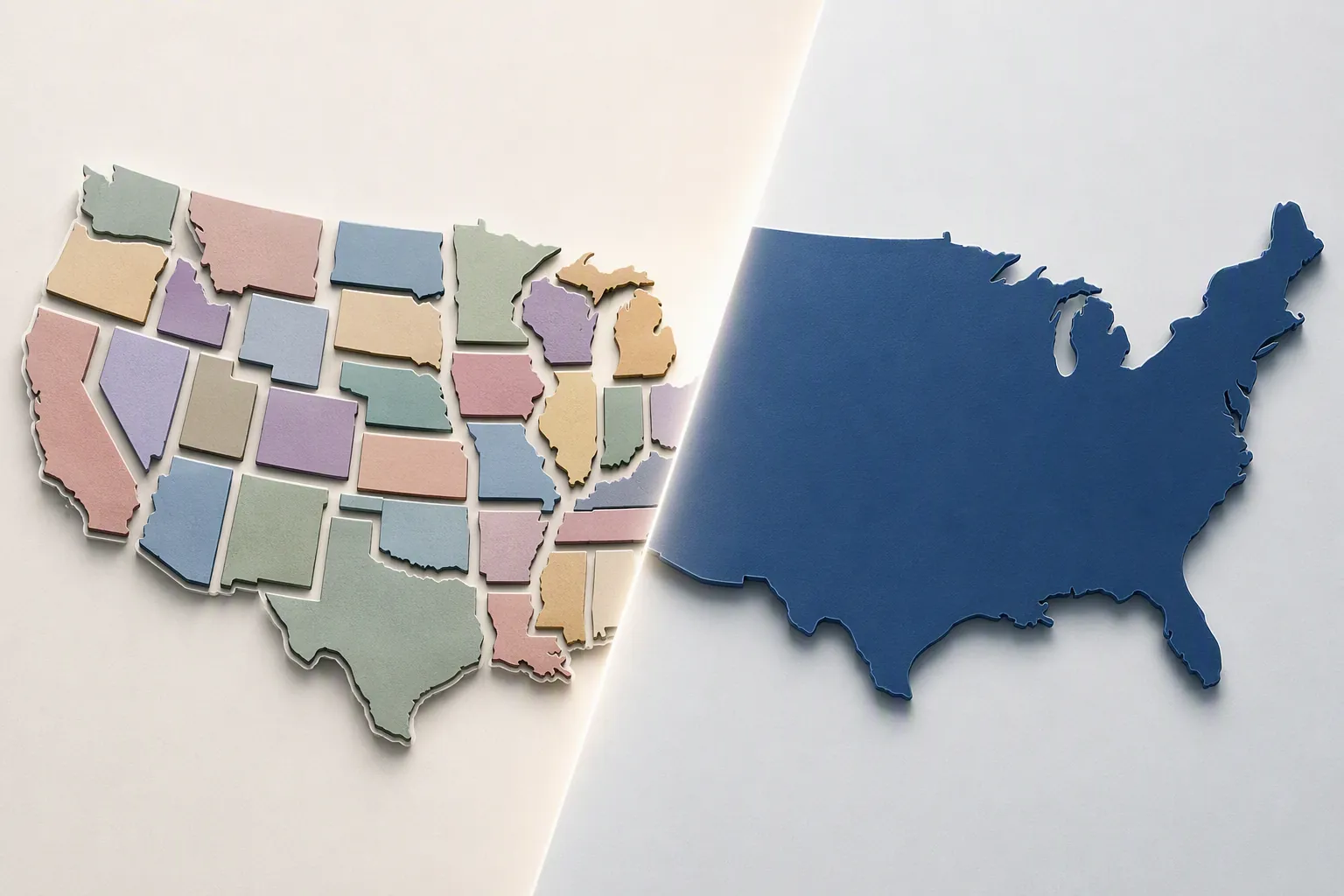
Even with that caveat, the direction is legible. Huang’s reported message fits the same compliance problem that has been building across the AI bar: a state-by-state matrix can become hard to administer before anyone has resolved the core liability questions. A single federal framework is easier to brief, easier to operationalize, and easier to map against product release, procurement, incident response, model governance, and disclosure workflows.
Easier is not the same as inevitable. Federal preemption would have to survive the political process. The Senate vote problem remains real, as discussed in the site’s piece on why federal AI preemption bills need 60 votes. The state-law pressure is also not theoretical; the site’s analysis of the Trump AI Action Plan and state-law compliance problem tracks why a national plan does not automatically erase state obligations.
The compressed federal timing matters, too. CNBC reported on July 31 that the Trump administration’s AI executive-order framework was approaching a 60-day deadline on Aug. 1.[6] That does not enact preemption. It does put industry lobbying, agency framework development, and congressional preemption arguments into the same short window.
Open-weight access is the second concrete fault line
Preemption is the architecture question. Open-weight access is one of the places where that architecture would allocate risk. CryptoBriefing reported that Huang’s July 2026 debut X post urged against premature restrictions on open-weight AI models and described a broader industry alignment involving Microsoft, Meta, Palantir, and Nvidia.[5] The useful point for lawyers is not the social-media novelty. It is the coalition signal.

Open-weight models force a risk-allocation question that state patchworks are poorly suited to answer cleanly. If model weights are broadly available, who carries responsibility for downstream misuse: the model developer, the deployer, the modifier, the distributor, the hosting provider, or the enterprise that integrated the system into a regulated workflow? Different state answers would create not only different compliance duties, but different litigation positions.
That is why the open-weight issue links naturally to the preemption fight. A federal rule could set a baseline for disclosures, safety testing, documentation, downstream restrictions, or liability shields. A state-law model could produce overlapping duties that are hard to reconcile for companies releasing or using the same model across jurisdictions. The site’s coverage of the Nadella open-weight coalition and the separate analysis of who bears risk for open-weight AI models are the better places to go deeper on that liability problem.
What counsel can safely brief as of August 3, 2026
The cleanest briefing point is also the least dramatic one: Huang’s refusal to testify does not settle U.S. AI law, and it does not prove wrongdoing. It does show that when the Senate sought company-specific testimony on export controls and China, the public hearing record developed without Nvidia’s CEO. Weeks later, the available reporting places Huang on Capitol Hill advocating a federal approach that would displace state-by-state AI regulation.
- Firmly on the record: Warren’s June 4 invitation identified export controls and Nvidia’s China business as testimony subjects; the June 11 hearing proceeded without Huang.[1][3]
- Useful but limited: NBC’s “no prior testimony” point supports a negative inference from available records, not an absolute historical finding.[2]
- Directional but not dispositive: the July Capitol Hill push points toward federal preemption as Nvidia’s preferred compliance architecture, but the vivid “drag the industry to a halt” language rests here on secondary-source reporting.[5]
- Most likely compliance fault lines: open-weight model access and China chip export controls, because those are where high-level AI policy becomes operational risk allocation.
So the obligation map has not changed yet. The trajectory to track is federal preemption, not because it has already won, but because that is where the strongest industry pressure is now visibly being applied. The two issues most likely to determine what future compliance actually requires are open-weight access and China-facing chip controls. One determines how responsibility travels after model release; the other determines how national-security restrictions attach to AI infrastructure before deployment.
References
- Warren Calls on NVIDIA President and CEO Jensen Huang to Testify at Upcoming Committee Hearing on AI and the American Dream, Senate Banking Committee, June 4, 2026
- Nvidia CEO Jensen Huang declines Warren Senate invite to testify at AI hearing, NBC News, June 8, 2026
- AI and the American Dream: Promoting Innovation, Affordability, and American Dominance, Senate Banking Committee, June 11, 2026
- Nvidia CEO to meet with Sen. Cruz on AI, Nextgov, July 2026
- Nvidia Huang Capitol Hill AI Regulation, CryptoBriefing, July 2026
- Trump AI executive order nears key deadline as regulation debate heats up, CNBC, July 31, 2026
Operationalizing workflow
No workflow has been explicitly linked to this obligation yet. See Workflows generally.
Illustrative cases
No illustrative case is currently tracked for this obligation. See Risk Digest for documented incidents generally.
← Back to RegulationReport a correction or tip
Spotted an outdated figure, a misstated fact, or a ruling this regulation entry should reflect? Public comments are disabled for this content given the professional cost of a misreported case outcome, penalty amount, or rule text — use the structured correction channel instead.
Report a correction or tip for this record →