
Why State AGs Can Block the Paramount-WBD Merger the DOJ Cleared
- Authority
- State Attorneys General
- Rule type
- statute
- Jurisdiction scope
- US state
- Effective date
- Jul 13, 2026
- Source text
- Read primary rule text ↗
State AGs may independently challenge mergers under Clayton Act §7 even after federal clearance, requiring transaction teams to model parallel enforcement risk and delay costs.
On June 12, 2026, the DOJ Antitrust Division closed its investigation of the Paramount Skydance-Warner Bros. merger after an 8-month review, more than 2 million documents, and materials from more than 80 custodians. It required no divestitures, no behavioral commitments, and no other concessions, and said the transaction would not substantially lessen competition in subscription video on demand, linear television, or theatrical film distribution.[1] One month later, on July 13, 12 states sued under Clayton Act §7 to stop the same deal.[2]
That is the useful entry point for antitrust legal analysis of the Paramount-Warner Bros. merger. The matter belongs in regulation-ethics not because it offers a clean morality play about federal passivity or state activism, but because it shows how regulatory authority gets fragmented and then priced. As of July 31, 2026, the litigation is ongoing, with a preliminary-injunction fight pending in the Northern District of California before Judge Araceli Martínez-Olguín.[2]
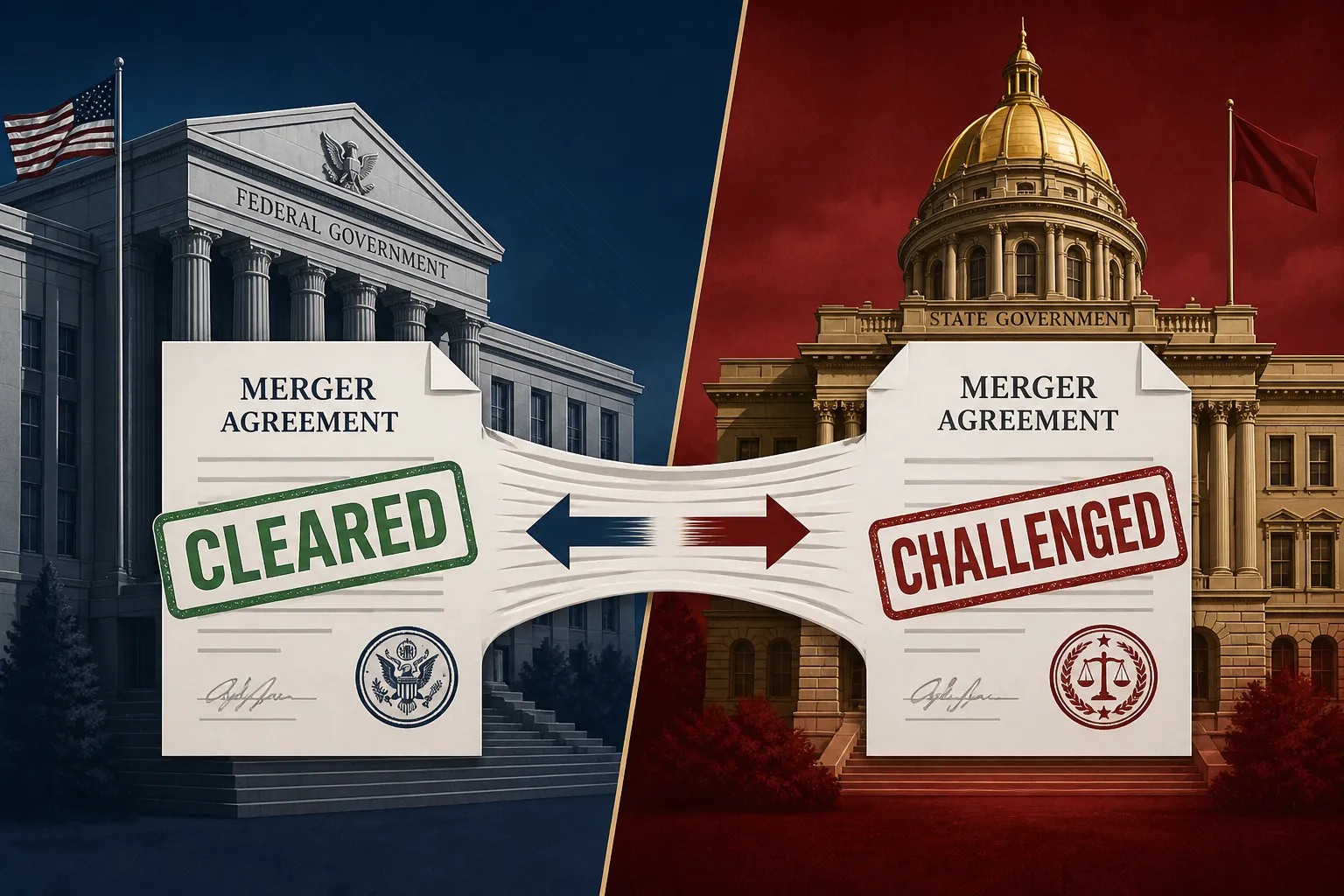
The hard question is not whether the DOJ mattered. It did. Federal clearance remains a major closing condition, a financing milestone, and a board-level event. The harder question is who carries the risk when federal clearance is not the last enforcement gate.
What the DOJ Cleared
The DOJ’s June statement is unusually important because it gives deal counsel the cleanest version of the federal position. The Antitrust Division said it had examined whether the merger would harm competition in SVOD, linear television, and theatrical film distribution, and then closed the investigation without requiring any remedy.[1] That is not a consent decree. It is not a conditional clearance. It is a federal decision not to proceed.
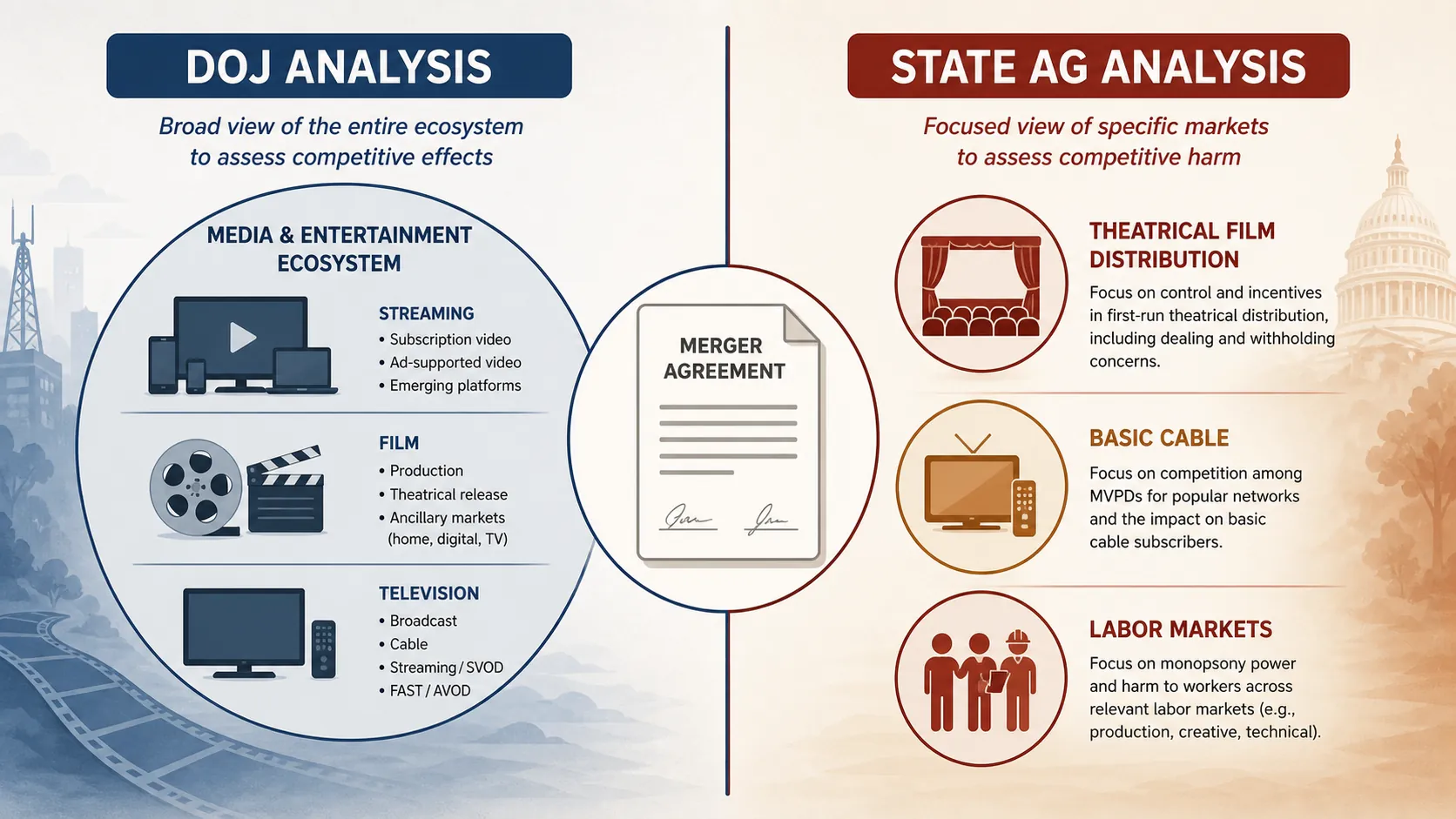
The DOJ framed the transaction against a broader media and entertainment environment. That framing matters because market definition often decides how much overlap actually counts. If the relevant competitive field includes a wide set of streaming, studio, television, and entertainment substitutes, the merged firm’s position can look less threatening than it does inside narrower product markets.
For a transaction team, that federal conclusion would ordinarily move several workstreams at once: lender communications, integration planning, public-company disclosure, board reporting, and closing mechanics. The problem in Paramount-WBD is that the DOJ’s no-action decision did not bind the states.
What the States Say the DOJ Missed
The 12-state complaint, led by California Attorney General Rob Bonta, takes a narrower view of the competitive problem. The states allege harm in theatrical film distribution, basic cable, consumers, and workers, and their theory depends on markets more focused than the DOJ’s broader entertainment-ecosystem approach.[2][3]
Those positions can coexist legally. A federal declination does not function as a national antitrust release. State attorneys general can bring their own Clayton Act claims, and the available materials for this dispute identify Supreme Court precedent recognizing state standing even after federal non-action, together with the doctrine often described as special solicitude for state enforcers. The practical consequence is simple: a buyer can clear the DOJ and still face a sovereign plaintiff with its own complaint, venue, injunction request, and settlement leverage.
The legal fight will not be resolved by saying “streaming changed everything” or “Hollywood consolidation is bad.” The outcome will turn on market definition, competitive effects, evidence of likely harm, and the procedural burden at the preliminary-injunction stage. For deal planning, however, counsel does not need to know the final merits answer to recognize that the risk is live.
The Moment Clearance Became a Deal-Economics Problem
The cleanest way to understand the transaction risk is to put the litigation events next to the contract economics.
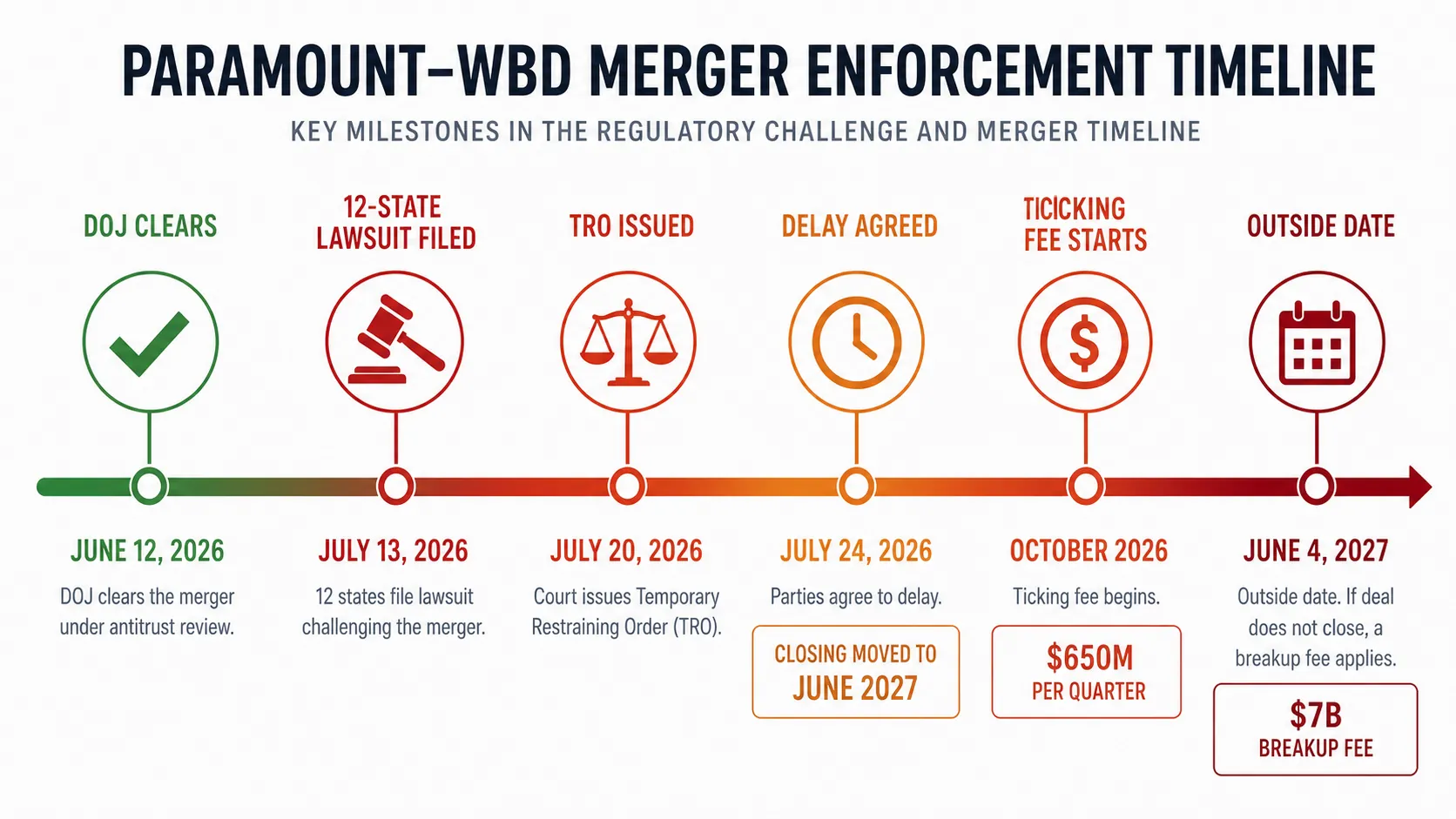
| Date or trigger | Event | Why it matters to the deal |
|---|---|---|
| June 12, 2026 | DOJ closes investigation with no remedies | Federal antitrust clearance risk appears resolved |
| July 13, 2026 | 12 states file Clayton Act §7 suit | A second sovereign enforcement track becomes an independent closing threat |
| July 20, 2026 | 14-day TRO is issued | Closing cannot be treated as merely administrative while the injunction fight proceeds |
| July 24, 2026 | Paramount agrees to delay closing until June 2027 | Regulatory timing moves directly into the closing calendar |
| October 2026 | $650 million per quarter ticking fee begins | Delay becomes a recurring cash cost |
| June 4, 2027 | Merger agreement expiration and $7 billion breakup-fee framework come into view | The state case can affect walk rights and termination economics |
Those terms are not background color. CNBC reported that after the July TRO, Paramount agreed on July 24 to delay closing until June 2027, with a $650 million per quarter ticking fee beginning in October 2026.[4] Variety reported the related $7 billion breakup fee and the June 4, 2027 expiration date in the merger agreement.[5]
That is where the case becomes more useful than another debate over entertainment-market boundaries. The states do not need to win final judgment immediately to alter the economics. A TRO, a preliminary-injunction schedule, and a litigation-driven closing delay can move value between buyer and seller before the merits are fully tried.
A $650 million quarterly ticking fee is a visible cost allocator. It answers a question the merger agreement could not leave sentimental: if the deal is still alive but cannot close because of regulatory delay, who pays for the time? The answer affects negotiation leverage, financing assumptions, and the board’s tolerance for continuing to litigate. The $7 billion breakup fee plays a different role. It is not just a penalty number; it is part of the bargaining architecture around failure, delay, and exit.
The June 4, 2027 expiration date is equally important. Outside dates look far away at signing and much closer once a court schedule starts absorbing months. If a state challenge can push the transaction close to the outside date, then the states’ leverage is not limited to courtroom probability. It includes time.
The counsel problem after federal clearance
The board update after June 12 would have been straightforward: the DOJ had completed a lengthy investigation and imposed no remedy. The board update after July 13 is different. Counsel now has to explain why “cleared” did not mean unchallengeable, why a state injunction request can still block closing, and how much delay the agreement can absorb before the economics change.
That explanation cannot be left to a generic antitrust-risk paragraph. It requires a closing calendar, a budget for litigation, a state-by-state theory of harm, and a contract readout showing which party pays for each month the case remains unresolved.
Why Parallel Enforcement Survives a Federal No-Action Decision
Parallel enforcement survives because antitrust review is not a single integrated administrative vote. The DOJ can decide that, on its record and theory, it will not seek to block a transaction. State AGs can decide that their markets, evidence, state interests, and litigation posture justify filing anyway.
Paramount-WBD illustrates the point through market definition. The DOJ’s closure statement says it considered SVOD, linear television, and theatrical film distribution and found no substantial lessening of competition requiring action.[1] The states’ case, as described in the available materials, presses narrower theories involving theatrical film distribution, basic cable, consumers, and workers.[2][3]
Neither framing can be dismissed just because the other exists. A broad market can make substitution look robust. A narrower market can make lost competition look concentrated and immediate. Labor theories can also change the frame because the affected parties are not only viewers choosing among entertainment options; they may be workers negotiating against a smaller set of buyers for their services.
This is why the states’ lawsuit is not merely an appeal from the DOJ inside another forum. It is a separate enforcement action using its own theory. For transaction planners, the relevant lesson is not that the states’ theory is automatically stronger. It is that a broad federal market-definition win may leave narrower state theories unpriced if the agreement treats DOJ clearance as the practical end of antitrust risk.
The Precedent Pattern Is Directional, Not Mechanical
Kroger-Albertsons, Live Nation/Ticketmaster, Nexstar-Tegna, and Paramount-WBD are often grouped together because they show state AGs acting with real enforcement capacity. That grouping is useful only up to a point. Each case has its own market, remedy posture, evidentiary record, and procedural history.
The available record identifies Kroger-Albertsons as a 2024 transaction in which states prevailed where the DOJ had cleared with conditions. It identifies Live Nation/Ticketmaster as a 2026 monopolization verdict after a prior DOJ settlement, and Nexstar-Tegna as a matter in which states obtained a temporary block where federal enforcers did not block. The Live Nation result also fits the broader pattern discussed in our analysis of the $1.72 ticket-overcharge finding.
Those matters do not forecast that the Paramount-WBD challenge will succeed. They do show that state AG litigation should not be treated as a press-release risk or a remote tail event once federal enforcers stand down. In consolidating industries, including adjacent technology and platform markets under antitrust scrutiny, state enforcement belongs in the same early risk register as federal agency review; that broader environment is also visible in our coverage of NVIDIA and OpenAI antitrust foreclosure concerns.
How to Price State AG Risk Before the Complaint Arrives
The Paramount-WBD sequence points to several structuring implications without requiring anyone to predict the pending preliminary-injunction motion.
- Run state-specific antitrust diligence before signing, especially where the transaction affects employment, distribution, procurement, or consumer markets concentrated in politically active states.
- Treat state AG outreach as its own workstream, not as a derivative task that begins only after the DOJ or FTC process becomes difficult.
- Draft cooperation covenants to cover parallel state investigations, document productions, witness access, settlement authority, and litigation strategy.
- Model outside dates against realistic injunction schedules, not only federal second-request timelines.
- Use ticking fees, reverse termination fees, and extension rights to allocate delay risk expressly rather than negotiating under injunction pressure.
The diligence point is often the one that gets shortchanged. Federal review materials do not automatically answer whether a coalition of states can plead a narrower market with enough local, labor, or distribution facts to obtain emergency relief. A state-specific risk memo should identify likely plaintiff states, their past enforcement priorities, affected local constituencies, and the parts of the deal story that look different under a narrower market.
The covenant point is where litigation risk becomes operational. If a complaint is filed after federal clearance, the parties need to know who controls the defense, who can settle, whether divestitures or conduct remedies are mandatory or optional, and how far each party must go to preserve the deal. A generic “reasonable best efforts” clause may not answer the question that matters most under a TRO: what must be done this week, and at whose cost?
Economic provisions need the same specificity. A ticking fee can compensate the seller for delay, but it can also become a pressure device as each quarter passes. A reverse termination or breakup fee can allocate failure risk, but only if the triggers distinguish federal denial, state injunction, outside-date expiration, and voluntary abandonment. Extension rights can buy time, but they are worth less if financing, shareholder approvals, or business deterioration are not synchronized with the extended regulatory calendar.
The case does not make federal clearance irrelevant. It makes federal clearance incomplete as a risk model. For megamergers in consolidating industries, state enforcement has to be modeled at signing, priced in the agreement, and monitored as an independent closing threat.
References
- Statement of the Department of Justice Antitrust Division on the Closing of Its Investigation of the Merger of Paramount Skydance and Warner Bros. — Department of Justice, June 12, 2026 — link
- Will 12 states block the $111B Paramount-Warner Bros. merger? — Harvard Law School — link
- Paramount-Warner Bros. merger — The Guardian, July 17, 2026 — link
- Paramount-WBD merger delay — CNBC, July 24, 2026 — link
- Paramount antitrust lawsuit block Warner Bros. deal dismiss reply — Variety — link
Operationalizing workflow
No workflow has been explicitly linked to this obligation yet. See Workflows generally.
Illustrative cases
No illustrative case is currently tracked for this obligation. See Risk Digest for documented incidents generally.
← Back to RegulationReport a correction or tip
Spotted an outdated figure, a misstated fact, or a ruling this regulation entry should reflect? Public comments are disabled for this content given the professional cost of a misreported case outcome, penalty amount, or rule text — use the structured correction channel instead.
Report a correction or tip for this record →