
Do you qualify for Sweet v. McMahon borrower defense relief?
- Authority
- U.S. Department of Education
- Rule type
- settlement agreement
- Jurisdiction scope
- US federal
- Effective date
- Nov 16, 2022
- Source text
- Read primary rule text ↗
Confirm the borrower defense application filing date and Exhibit C school-list status through official StudentAid.gov records before classifying Sweet v. McMahon relief.
| Record field | Current entry |
|---|---|
| Placement | Regulation & Ethics / regulation-ethics |
| Use | Eligibility and status-verification record for Sweet v. McMahon borrower defense student loan forgiveness eligibility |
| Last verified | 2026-08-02 UTC |
| Legal-background review | Marisol Vega |
| Primary materials checked | Settlement agreement; Exhibit C school list; StudentAid.gov settlement page; PPSL class-member guidance; Ninth Circuit case materials |
Non-advice disclaimer: This record is for eligibility sorting and status verification. It is not legal advice, does not create an attorney-client relationship, and should not replace review by a qualified attorney or an official determination from the U.S. Department of Education.
This is an obligations-style record in the site’s Regulation & Ethics tracker format: start with the controlling record, classify the person, then verify through official channels before anyone spends money or relies on a third-party promise.

The eligibility test is already locked
For Sweet v. McMahon borrower defense relief, the first question is not whether a borrower “may qualify” in some general sense. The settlement turns on two fixed historical facts: when the borrower defense application was filed, and whether the school tied to that application appears on Exhibit C. The settlement agreement fixes the coverage framework, PPSL explains class and post-class implementation, StudentAid.gov hosts the official settlement page, and Exhibit C is the school-list document borrowers must check against their own records.[1][2][3][4]
Those facts cannot be changed in 2026. A borrower who did not file a borrower defense application before final approval on November 16, 2022 cannot newly enter the Sweet settlement now. That borrower may still have other borrower-defense rights under current Department of Education processes, but not Sweet settlement coverage.
| Controlling fact | What to verify | Why it matters |
|---|---|---|
| Borrower defense application date | The filing date shown in the official StudentAid.gov borrower defense record or Department notice | It places the borrower in the class, the post-class group, or outside the settlement. |
| School status | Whether the school tied to the borrower defense application appears on Exhibit C | It determines whether automatic Full Settlement Relief applies for covered class members and helps classify post-class implementation issues. |
| Loan and applicant identity | Which federal loans and which borrower filed the application, including any Parent PLUS borrower | Relief follows the application and the covered federal loans; a related borrower may need a separate record. |
Run the date test before arguing about the school
A school name on a list is not enough if the application date is wrong. Put the borrower into one of these date groups first, then layer on the Exhibit C check.
| Borrower defense filing date | Settlement position | Immediate consequence |
|---|---|---|
| On or before June 22, 2022 | Class member, assuming the other class requirements are met | Move to the Exhibit C check and the class-member relief rules. |
| June 23, 2022 through November 15, 2022 | Post-class applicant | Covered by post-class processing protections, not the same automatic class relief formula. |
| On or after November 16, 2022 | Outside the Sweet settlement | No Sweet settlement entry is available today; use ordinary borrower defense channels if applicable. |
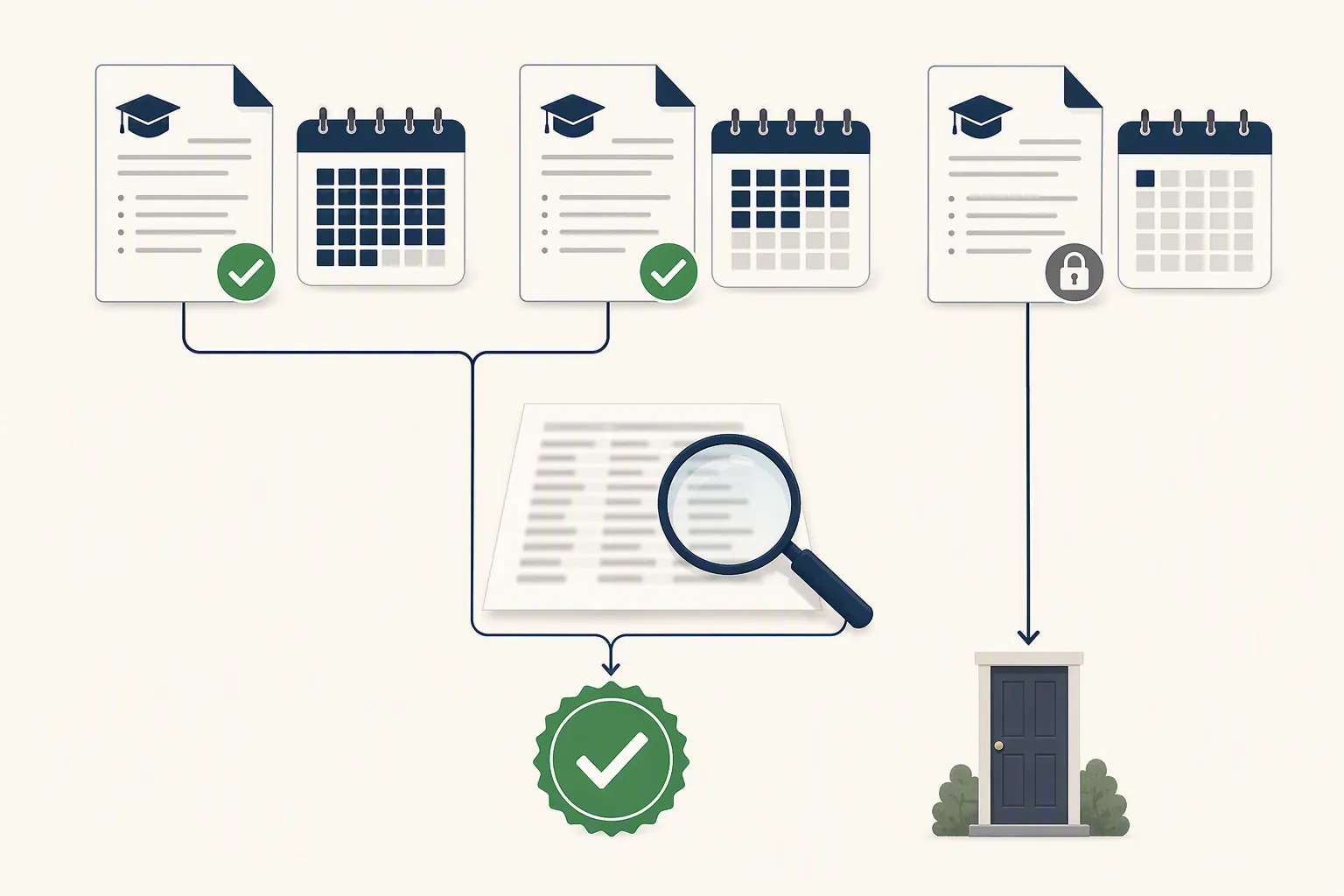
Applications filed on or before June 22, 2022
This is the class-member window. For a borrower in this group, the next intake question is whether the relevant school is on Exhibit C. PPSL describes Full Settlement Relief for covered Exhibit C class members as discharge of the relevant federal student loans, refunds of amounts paid to the Department of Education on those discharged loans, and deletion of the related credit tradeline.[2]
Do not skip the word “relevant.” The borrower defense application, the school, the loan, and the borrower identity have to match. If a student had loans for more than one school, or if a parent borrowed Parent PLUS loans, sort each borrower and loan set against the record instead of assuming one notice clears everything.
If the class member’s school is not on Exhibit C, the borrower is still not thrown out of the settlement merely because the school is absent from the list. The settlement agreement created decision groups and deadlines for non-Exhibit C class applications. That is a different track from automatic Exhibit C Full Settlement Relief, and the borrower’s status should be checked against Department records and notices rather than inferred from the school list alone.[1]
Applications filed June 23 through November 15, 2022
This is the post-class window. These borrowers are not class members receiving the same automatic class formula just because they filed before final approval. They are, however, inside the settlement’s post-class processing structure. PPSL identifies this group as borrowers who filed borrower defense applications after June 22, 2022 and before final approval on November 16, 2022.[2]
For post-class applicants, the practical issue in 2026 is often the missed-deadline trigger. Forbes reported in January 2026 that student loans could be discharged and refunded automatically for about 200,000 people as a key decision deadline passed.[8] PPSL later described more than 170,000 post-class Exhibit C borrowers affected by the July 2026 Ninth Circuit ruling, while CNBC described the affected group as nearly 200,000 borrowers.[7][9] Those figures are not intake rules; they are scale markers. The borrower still needs the application date, school, and official status record.
Where a post-class borrower qualifies for automatic relief because the Department missed the applicable decision deadline, the next question becomes delivery: when the debt is actually cleared, what refund is issued, and whether credit reporting is corrected. Tate & Associates summarizes the one-year delivery rule and identifies June 15, 2027 as the latest date to clear debt under that implementation timeline.[5]
Applications filed on or after November 16, 2022
This group is outside the Sweet settlement. November 16, 2022 matters because it was the final approval date. A borrower who filed on or after that date may still have a borrower defense application, and may still need help with that application, but the Sweet settlement does not provide a new doorway into coverage after final approval.[1][2]
That is the point at which many bad consumer pitches become dangerous. A paid “relief specialist” cannot move a 2024 borrower defense filing into a 2022 settlement window. A fee can buy confusion, not settlement eligibility.
Use Exhibit C as a document check, not a memory test
Exhibit C is the settlement’s listed-school document. The StudentAid.gov PDF identifies 151 schools for the Exhibit C check.[4] Use the document, not a borrower’s half-remembered campus name, an old marketing name, or a screenshot from a relief company’s website.
- Match the school name used in the borrower defense application to the Exhibit C list.
- Check whether the borrower attended a brand, campus, or corporate school name that appears differently in records.
- Keep a copy of the Exhibit C page or entry used for the classification.
- If the match is uncertain, do not treat the borrower as Exhibit C until the official record, Department notice, or counsel confirms it.
For class members, Exhibit C status is the difference between automatic Full Settlement Relief and a different settlement decision track. For post-class applicants, Exhibit C status has been central to the 2026 automatic-discharge implementation disputes, but it still operates together with the filing date and the Department’s record.
What Full Settlement Relief does, and what it does not do
Full Settlement Relief is not a general cash settlement for every education-related debt. PPSL describes the relief components as discharge of covered federal student loans, refund of payments made to the Department on those discharged loans, and deletion of the credit tradeline for those loans.[2]
| Issue | Operational rule |
|---|---|
| Federal discharge | Applies to the federal loans covered by the borrower defense application and settlement category. |
| Refunds | Refunds are tied to qualifying federal payments; PPSL notes limits for commercially held FFEL payments unless the loans were consolidated into Direct Loans. |
| Credit reporting | Full Settlement Relief includes deletion of the associated federal-loan tradeline. |
| Private loans | Private student loans are outside the federal borrower defense settlement. |
| Parent PLUS loans | A Parent PLUS borrower may need a separate borrower defense application and status record. |
The refund point is where borrowers are often misled. A federal loan discharge does not automatically mean every payment ever made to any holder comes back. PPSL flags the commercially held FFEL refund limitation, and CNBC separately reports practical refund issues including federal-payment refunds, Parent PLUS application separation, private-loan exclusion, and official notice details.[2][9]
Refunds may also be hard to recognize. CNBC reported that borrowers should watch for U.S. Treasury payments that may not be labeled in a way that plainly says “Sweet” or “borrower defense,” and that payments may arrive in more than one installment.[9] That is an accounting problem, not a reason to hand bank access or a processing fee to a third party.
Status verification: the record should come before the phone call
The cleanest verification path starts with the borrower’s own StudentAid.gov account. Look for the borrower defense application record, the filing date, the school tied to the application, any decision or discharge notice, and the federal loans connected to the claim. If the borrower only has screenshots, old emails, or a servicer statement, treat those as leads until they line up with the official account or Department notice.
- Log in to StudentAid.gov and locate the borrower defense application or related activity record.
- Record the filing date exactly as shown.
- Record the school named in the application and compare it to Exhibit C.
- Check federal loan details, including whether the loans are Direct Loans, FFEL, Parent PLUS, or another federal loan type.
- Save Department notices, servicer messages, refund records, and credit-report changes in one file.
- If the official record is missing or inconsistent, contact the Department at [email protected] or use PPSL’s Sweet status survey rather than paying a private service.
PPSL tells borrowers to watch for official Sweet notices and provides guidance on recognizing Department communications, including notices from [email protected]. CNBC likewise identified [email protected] as the official sender borrowers should watch for in this context.[2][9]
If an email asks for a fee, bank credentials, an FSA ID password, or payment to “activate” settlement relief, stop. The settlement categories are fixed by old dates and official records. No private company can add a borrower to the class, move a filing date, or make a non-Exhibit C school appear on Exhibit C.
The litigation history matters only enough to explain the caption and deadlines
The case name changed because the Secretary of Education changed. Borrowers may see Sweet v. DeVos, Sweet v. Cardona, or Sweet v. McMahon in older notices, pleadings, news reports, and settlement materials. Those captions point to the same settlement framework for this eligibility exercise; the operative question remains the filing date and the school-list status.
For scale, PPSL describes Sweet v. McMahon as covering about 450,000 borrowers and at least $23 billion in relief, calling it the largest settlement against the U.S. government.[6][7] Those numbers explain why so many borrowers have partial information, delayed notices, or confusion across servicers. They do not create additional eligibility categories.
The 2026 appellate materials are verification background, not a new intake window. The March 25, 2026 stay-denial opinion and the July 17, 2026 memorandum disposition should be read as part of the implementation history; PPSL’s July 23, 2026 release attributes the July ruling to relief for more than 170,000 post-class Exhibit C borrowers.[7]
Different public figures measure different things. PPSL’s case page and news release, Forbes’ automatic-discharge reporting, CNBC’s nearly-200,000-borrower framing, and Department implementation figures reported at different points should not be forced into a single master count.[6][7][8][9] For an individual borrower, the record either sorts into a settlement category or it does not.
Caveats that change the next task, not the eligibility test
Tax treatment is one of those issues. PPSL discusses federal tax treatment, including the end of the American Rescue Plan Act student-loan discharge exclusion window on December 31, 2025 and IRS Revenue Procedure 2015-57, while also warning that state treatment can vary.[2] That is a tax-review question after classification, not a reason to reclassify settlement eligibility.
Servicer records can also lag behind Department action. A borrower may receive a Department notice before all balances, credit reporting, and Treasury refund activity line up. Conversely, a servicer balance change without an official borrower defense record is not enough to classify the borrower. Keep the documents in order: Department record first, servicer implementation second, refund tracing third.
For uncertain files, the safest answer is usually not a guess. Confirm the StudentAid.gov record, contact [email protected] when the official record is incomplete, use PPSL’s survey if PPSL is collecting implementation problems, or get legal help. Do not pay anyone who says they can still get a borrower into Sweet v. McMahon settlement coverage.
References
- Sweet v. Cardona Settlement Agreement — U.S. Department of Education
- Sweet v. McMahon Class Members — Project on Predatory Student Lending
- Sweet v. Cardona Settlement — Federal Student Aid
- Sweet v. Cardona School List — Federal Student Aid
- Sweet v. McMahon Settlement Update — Tate & Associates
- Sweet v. McMahon — Project on Predatory Student Lending
- Landmark Borrower Defense Case Sweet v. McMahon Becomes Largest Ever Settlement Against the US Government — Project on Predatory Student Lending, July 23, 2026
- Student Loans May Get Discharged And Refunded Automatically For 200,000 People As Key Deadline Passes — Forbes, January 30, 2026
- Sweet v. McMahon student loans borrower defense — CNBC, July 31, 2026
Operationalizing workflow
No workflow has been explicitly linked to this obligation yet. See Workflows generally.
Illustrative cases
No illustrative case is currently tracked for this obligation. See Risk Digest for documented incidents generally.
← Back to RegulationReport a correction or tip
Spotted an outdated figure, a misstated fact, or a ruling this regulation entry should reflect? Public comments are disabled for this content given the professional cost of a misreported case outcome, penalty amount, or rule text — use the structured correction channel instead.
Report a correction or tip for this record →