
What Are the Constitutional Theories for a Third Trump Term?
- Authority
- United States Congress
- Rule type
- statute
- Jurisdiction scope
- US federal
- Source text
- Read primary rule text ↗
A twice-elected president cannot be directly elected again under current constitutional text.
The July 25, 2026 clip did what such clips are designed to do: Trump put on a “Trump 2028” hat at the White House Correspondents’ Dinner and joked about a “fourth term,” sending people back to the Constitution with a practical question rather than a clean search query. If the query is “trump 2028 constitutional term limits fourth amendment,” the relevant issue is not the Fourth Amendment’s search-and-seizure rule. It is presidential term limits, a “fourth term” joke, and the 22nd Amendment’s bar on being elected president more than twice. [1]
This article is a legal-risk reference, not legal advice. It treats the question the way a litigator or knowledge-management lawyer would need to treat it under time pressure: identify the current constitutional text, separate direct election from succession theories, and avoid converting untested litigation posture into either certainty or panic. For a narrower treatment of the vice-presidential theory alone, see Trump 2028 Term Limits: The VP Loophole Examined.
The short answer before the theories start
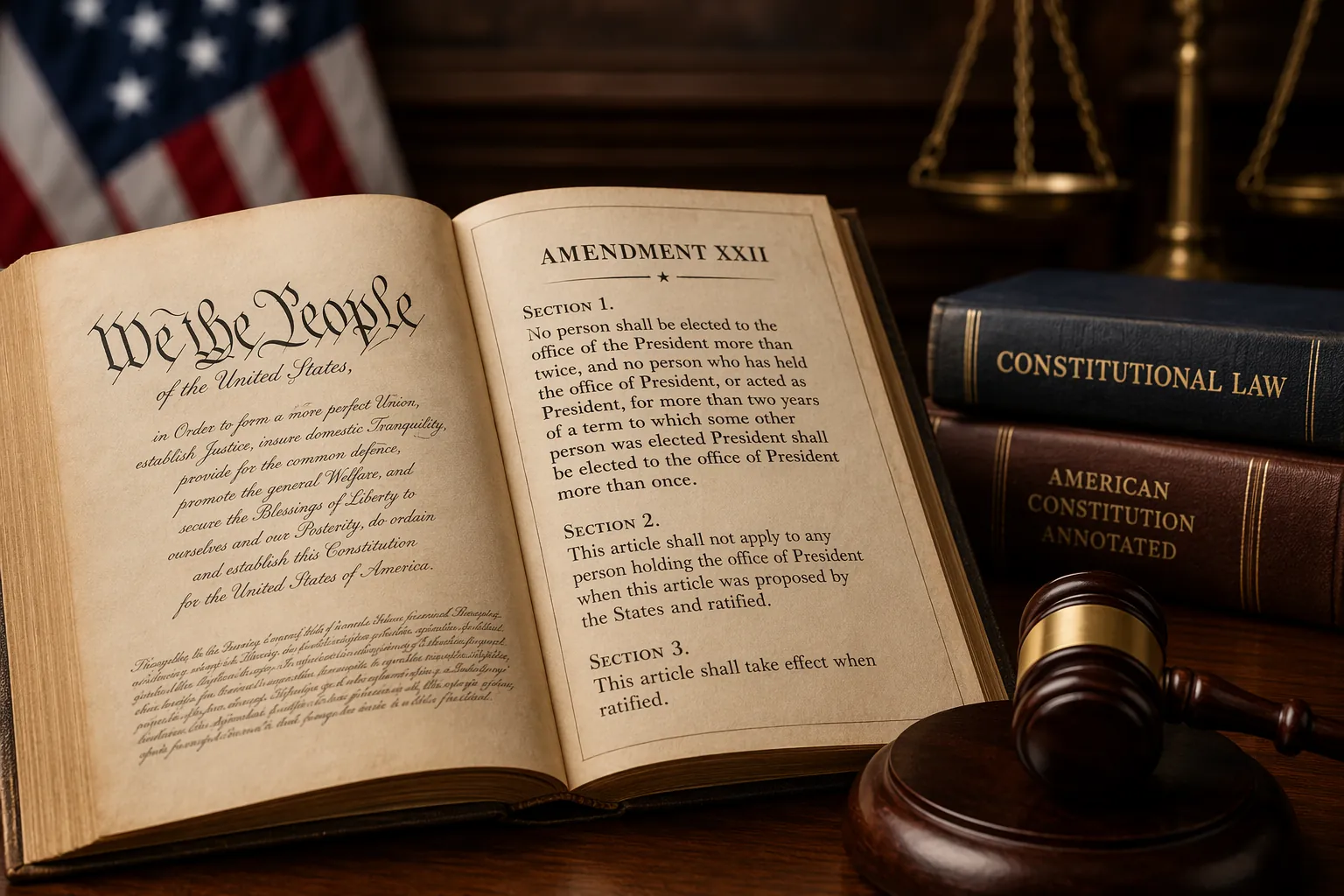
- Direct re-election is barred. The 22nd Amendment says: “No person shall be elected to the office of the President more than twice.” It was ratified in 1951 after Franklin D. Roosevelt’s four elections, with 41 state legislatures voting to ratify. [2]
- The vice-presidential succession theory exists because the 22nd Amendment uses “elected,” not “serve” or “hold.” But the 12th Amendment says no person constitutionally ineligible to the presidency is eligible to be vice president, and leading scholars across ideological lines largely treat the loophole as implausible.
- The House Speaker route is more remote. It depends on a twice-elected former president becoming Speaker, then reaching the presidency through the Presidential Succession Act after vacancies or incapacity ahead of him.
- The Ogles Amendment is the cleanest formal route because Article V can change the Constitution. It is also the route with the most visible arithmetic problem: two-thirds of both houses of Congress and ratification by 38 states.
- No court has directly decided the VP or Speaker succession theories. That matters for litigation posture. It does not make the theories operationally credible under current law.
For practitioners, this sits less in campaign commentary than in constitutional-risk monitoring: the same discipline that separates primary law, commentary, institutional statements, and speculation in other Regulation & Ethics work. The question is not whether someone can say the words “third term.” The question is whether any route could survive ordinary constitutional interpretation, Article V procedure, and judicial review well enough to matter.
Everything starts with “elected”
The direct-election point is the easy part. A twice-elected president cannot be elected president again under the current 22nd Amendment. The operative language does not require much elaboration: “No person shall be elected to the office of the President more than twice.” [2]
That text also explains why succession theories keep appearing. The amendment does not say, in those words, that no person may “serve” as president more than twice, or “hold” the office after two elected terms. It bars being “elected” to the office. That drafting choice is the root fact from which the vice-presidential and Speaker theories branch.
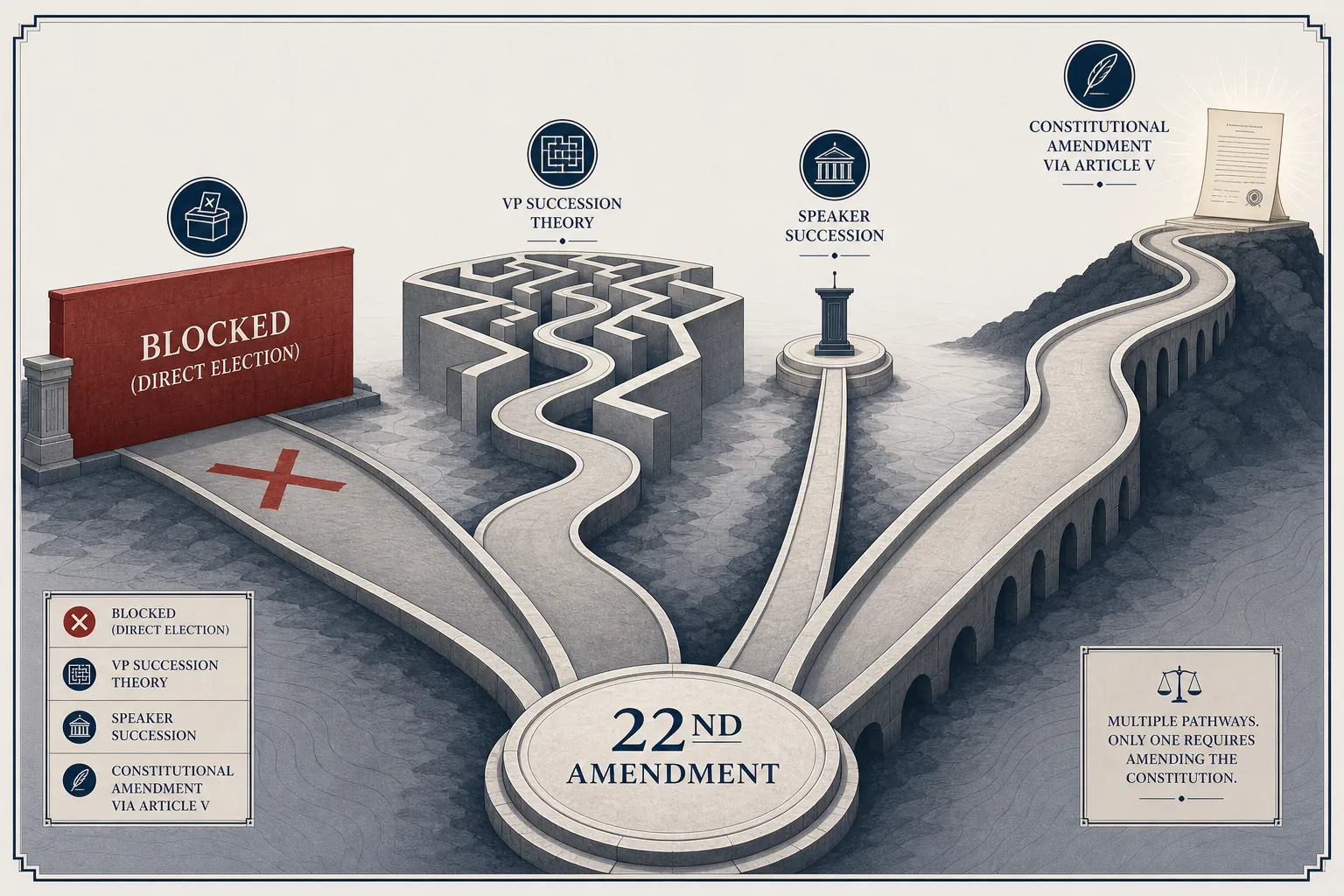
| Route | What the theory needs | Main constitutional obstacle | Practical legal-risk assessment |
|---|---|---|---|
| Direct presidential run | A twice-elected president appears on the presidential ballot and wins | 22nd Amendment: no person shall be elected president more than twice | Barred under current text |
| Vice president, then succession | A twice-elected president becomes VP, then succeeds under the 25th Amendment or ordinary succession mechanics | 12th Amendment eligibility clause plus 22nd Amendment purpose | Untested but widely viewed as implausible |
| House Speaker, then succession | A twice-elected former president becomes Speaker, then reaches the office under the Presidential Succession Act | Eligibility to act as president after two elected terms, plus multiple contingencies | Even more remote and procedurally dependent |
| Ogles Amendment | The Constitution is amended to permit a nonconsecutive third elected term | Article V supermajorities and 38-state ratification requirement | Formally lawful as a proposal; politically and procedurally steep |
The table is useful because it prevents a common analytical mistake: treating all “third term” talk as the same theory. It is not. Direct election, vice-presidential succession, legislative succession, and constitutional amendment each fail or proceed for different reasons.
The VP succession theory has the most law to discuss
The vice-presidential route is the only succession theory with a sustained academic pedigree. In a 1999 Minnesota Law Review article, Bruce G. Peabody and Scott E. Gant argued that a twice-elected president could, as a textual matter, serve as vice president and then succeed to the presidency because the 22nd Amendment prohibits being elected president, not serving after succession. [3]
The counter-text is the last sentence of the 12th Amendment: “no person constitutionally ineligible to the office of President shall be eligible to that of Vice-President.” The hard question is what “constitutionally ineligible” incorporates. One lawyerly reading says it refers only to the original Article II qualifications: natural-born citizenship, age, and residency. The stronger and more conventional reading says a person barred by the 22nd Amendment from being elected president is constitutionally ineligible for the presidency in a way that also blocks vice-presidential eligibility.
That is where the theory loses most of its practical force. FactCheck.org reported in April 2025 that Georgetown law professor David Super called the vice-presidential loophole “implausible,” Northwestern professor Tonja Jacobi said it “defeats the clear intent of the 22nd Amendment,” and University of Chicago professor William Baude said there is “no wiggle room.” [4]
The same cluster of commentary is careful about uncertainty. Michigan State professor Brian Kalt told NPR that “everywhere there are term limits, there are vulnerabilities,” while NYU professor Stephen Gillers said, “Trump will make the argument.” Those statements are useful not because they make the route likely, but because they mark the distinction between an argument’s existence and its expected reception in court. [5]
The National Constitution Center’s analysis likewise frames the issue around the interplay between the 12th and 22nd Amendments, not around any direct Supreme Court holding that has already disposed of the precise scenario. [6] That distinction should remain in the memo. A court has not directly tested a Trump-as-VP succession plan. But absence of a direct holding is not the same as an open lane.
Operationally, the VP theory is monitorable but not plausible under the weight of current authority. It would require a campaign, party, or state election official to accept a reading that many leading scholars regard as contrary to the 12th Amendment’s eligibility command and the 22nd Amendment’s purpose. It would then invite immediate litigation over ballot access, certification, or succession.
The Speaker route is not the same loophole in different clothes
The House Speaker theory starts somewhere else. The Presidential Succession Act of 1947 places the Speaker of the House in the line of presidential succession after the vice president. The Constitution does not require the Speaker to be a sitting member of the House, and commentators have pointed to a gap: neither the 12th nor the 22nd Amendment directly addresses whether a former two-term president may serve as Speaker. [7]
That observation is not enough to produce a credible plan. The theory would need several things to happen before the eligibility question even became ripe: a twice-elected former president would need to become Speaker, the presidency and vice presidency would need to be vacant or otherwise trigger succession, and the former president would need to be treated as eligible to act as president notwithstanding the 22nd Amendment.
The better way to brief this theory is to keep it narrow. It is more remote than the VP theory because it is not a ballot route to the presidency at all. It is a legislative-succession route that depends on institutional choices and vacancies before the constitutional issue appears in justiciable form. If it ever did appear, the same underlying question would return: whether the 22nd Amendment merely bars a third election, or whether a twice-elected president is constitutionally ineligible to occupy the presidency through succession.
The Ogles Amendment is legally clean and politically brutal
The Ogles proposal is different in kind. Representative Andy Ogles announced H.J.Res.29 on January 23, 2025, proposing to amend the 22nd Amendment so that a president could be elected to a third term if the person had not been elected to two consecutive terms. The design was openly Trump-specific: Trump’s 2016 and 2024 victories were nonconsecutive, while a president elected to two consecutive terms would remain barred. [8]
As constitutional mechanics, this is the clean route. Article V permits constitutional amendments. If the Constitution is amended, the 22nd Amendment can be changed. There is no need to squeeze “elected” through a succession theory or ask whether the 12th Amendment incorporates the 22nd Amendment.
The obstacle is the Article V math. The proposal would need approval by two-thirds of both the House and the Senate and ratification by three-fourths of the states, which means 38 states under the current 50-state structure. CNBC’s January 2025 coverage also noted a competing Democratic resolution by Representative Dan Goldman, H.Res.1570, reaffirming that the 22nd Amendment applies to “two terms in the aggregate.” [9]
That is why the Ogles route should not be dismissed as legally unserious in the same way as a strained succession loophole. It is lawful to propose an amendment. It is also why the practical assessment remains severe: a Trump-specific carve-out would have to clear supermajority thresholds in Congress and a 38-state ratification barrier in a polarized environment.
Why serious institutions are still tracking the issue
The existence of weak theories can still matter. Citizens for Responsibility and Ethics in Washington reported in June 2026 that it had filed FOIA requests and litigation seeking Office of Legal Counsel records related to presidential term limits, and it published an SSRN paper arguing that the 22nd Amendment is “ironclad,” with publication forthcoming in the Kentucky Law Journal in 2027. [10]
That kind of monitoring is not an endorsement of the loopholes. It is a recognition that repeated constitutional claims can become relevant to agency records, election administration, party planning, ballot litigation, investor-risk questions, and client communications even when the claims are unlikely to prevail.
Comparative constitutional scholarship gives one reason not to treat term-limit evasion as a purely academic topic. Mila Versteeg and Timothy Horley found in a 2020 Columbia Law Review article that roughly one-third of term-limited presidents attempt to overstay, and that 67% of those attempts succeed. Their work is not evidence that U.S. succession theories are legally viable; the United States has a high amendment bar and strong judicial review. It is evidence that term-limit pressure is a recurring constitutional-risk pattern worth recognizing. [11]
The defensible bottom line is therefore narrow. Under current constitutional text, a twice-elected president cannot be directly elected again. The vice-presidential route has never been squarely adjudicated, but leading scholars largely treat it as blocked by the 12th Amendment and the purpose of the 22nd. The Speaker route is even more contingent. The amendment route is formally available and procedurally forbidding. None supplies a credible current-law path; all are worth watching only because repetition of a constitutional theory can itself become a legal-risk signal.
References
- Donald Trump dons ‘Trump 2028’ hat and jokes about fourth term – video, The Guardian, July 25, 2026
- Twenty-Second Amendment: Presidential Term Limits, Constitution Annotated
- The Twice and Future President, Minnesota Law Review, 1999
- Legal Scholars Dispute Constitutional ‘Loophole’ for a Third Trump Term, FactCheck.org, April 2025
- Is Trump running for a third term?, NPR, March 31, 2025
- The 22nd Amendment and presidential service beyond two terms, National Constitution Center
- The 22nd Amendment Doesn’t Say What You Think It Says, Cornerstone Law
- Rep. Ogles Proposes Amending 22nd Amendment to Allow Trump to Serve Third Term, Office of Rep. Andy Ogles, January 23, 2025
- Trump third-term amendment proposed by GOP congressman, CNBC, January 23, 2025
- Presidential term limits and the 22nd Amendment, Citizens for Responsibility and Ethics in Washington, June 2026
- The Law and Politics of Presidential Term Limit Evasion, Columbia Law Review, 2020
Operationalizing workflow
No workflow has been explicitly linked to this obligation yet. See Workflows generally.
Illustrative cases
No illustrative case is currently tracked for this obligation. See Risk Digest for documented incidents generally.
← Back to RegulationReport a correction or tip
Spotted an outdated figure, a misstated fact, or a ruling this regulation entry should reflect? Public comments are disabled for this content given the professional cost of a misreported case outcome, penalty amount, or rule text — use the structured correction channel instead.
Report a correction or tip for this record →