
US walkout at UN signals AI-governance shift, not new law
- Authority
- United Nations General Assembly
- Rule type
- resolution
- Jurisdiction scope
- International
- Effective date
- Mar 21, 2024
- Source text
- Read primary rule text ↗
Nonbinding UNGA AI resolution remains in force; the July 2026 U.S. walkout did not amend or repeal it.
| Record lane | Status |
|---|---|
| Regulation & Ethics | Obligations record for cross-border AI, procurement, and legal-risk briefing |
| Last verified | Aug. 4, 2026, 00:00 UTC |
| Legal-background review | Reviewed by Lena Ortiz, J.D., for source hierarchy and legal-status framing |
| Legal advice | This record is for legal-information and compliance-triage use only. It is not legal advice and does not create an attorney-client relationship. |
Short answer for counsel asking whether the U.S. walkout at the UN over France’s remarks changed international-law obligations: no binding obligation changed on July 27, 2026. The walkout was a diplomatic protest after the July 24 UN General Assembly vote extending Volker Türk’s term as UN High Commissioner for Human Rights, not a legal act that repealed, amended, ratified, denounced, or triggered an international instrument. The legally relevant development is narrower and still important: the United States publicly signaled that it may reassess engagement, participation, and funding in the human-rights institutions that feed international AI-governance norms, while hard obligations that already attach by other routes remain in place.
What happened, and what legal work it does not do
The event starts three days before the walkout. On July 24, 2026, the General Assembly approved a second term for Volker Türk by a vote reported as 144 in favor, 10 against, and 13 abstentions; the United States voted no, alongside states including Russia, North Korea, Israel, Nicaragua, and Mali in the reported opposition group [1][2]. U.S. diplomat Jonathan Bartos warned after the vote that “there will be consequences” and that the United States would “immediately reassess our engagement, participation and funding” [1][2].
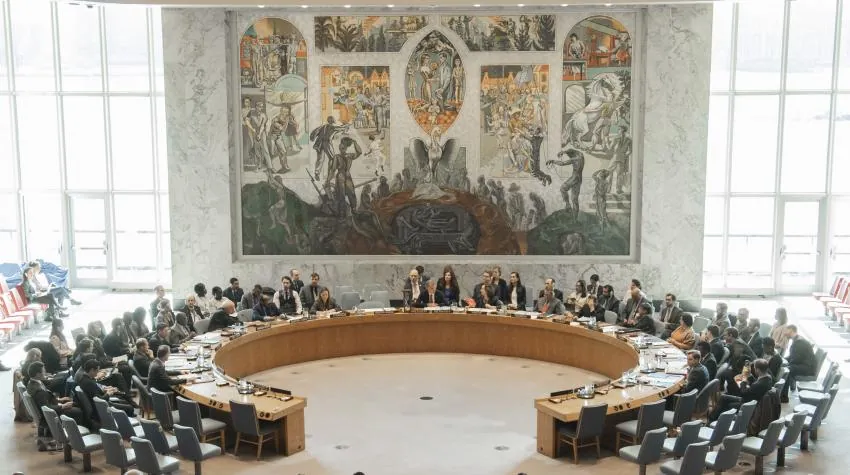
On July 27, U.S. diplomats walked out during France’s remarks at a UN Security Council meeting. Wire coverage described the protest as a response to France’s criticism of the U.S. human-rights record and to France’s support for Türk’s reappointment [3][4]. TIME and AP reported the U.S. objection in the language of permanent Security Council members, though the exact wording of one U.S. statement should be checked against the UN Web TV recording before any quotation is used in a filing or client alert [3][5].
That distinction matters. A walkout can be public, attributable, and institutionally hostile without being a source of law. It does not change the text of the UN Charter. It does not withdraw the United States from a treaty. It does not ratify an instrument the Senate has not ratified. It does not suspend EU-market compliance obligations for U.S.-linked AI vendors, deployers, or customers. It is evidence of posture, not an operative legal mechanism.
The available event reports also do not say the walkout was about AI regulation. They describe a dispute over human-rights leadership, France’s criticism, and the U.S. response to Türk’s reappointment [1][3][4][5]. The AI-governance significance in this record is therefore analysis, not a reported motive: OHCHR, UN human-rights language, the 2024 UN General Assembly AI resolution, the Global Digital Compact, and the Council of Europe AI convention sit in the institutional architecture that later shapes AI norms.
The obligation map: binding instruments on one side, institutional posture on the other

| Instrument or channel | Legal status for a U.S. firm or client after July 27, 2026 | What the walkout changes |
|---|---|---|
| UN Charter assessed contributions, including Article 17 mechanics | A state-level Charter obligation remains on the books. It is not a private AI compliance duty, but it is legally operative for UN membership and funding questions. | Nothing directly. Funding posture may become a watch item, but the walkout itself does not amend the Charter. |
| EU AI Act | Binding for covered EU-market activity, including relevant providers, deployers, importers, distributors, and product-linked actors depending on role and use case. | Nothing. U.S. diplomatic disagreement with UN human-rights institutions does not displace EU law for EU-facing activity. |
| Council of Europe Framework Convention on AI, Human Rights, Democracy and the Rule of Law, CETS 225 | Signed by the United States on Sept. 5, 2024, but not ratified in the status materials reviewed for this record [8]. Signature alone is not the same as full domestic implementation. | Nothing formally. It remains a signed-not-ratified hard-law test case to re-check before publication or briefing. |
| UN General Assembly resolution A/78/L.49 on artificial intelligence | Nonbinding General Assembly resolution. The United States helped lead it, and the General Assembly adopted it in March 2024 [6]. | No legal repeal. The walkout may signal less U.S. investment in the human-rights and consensus channels that gave the resolution practical weight. |
| Global Digital Compact | Nonbinding UN digital-governance framework addressing digital cooperation, data, AI, and related rights language [7]. | No formal withdrawal from a treaty obligation. The practical risk is reduced U.S. alignment with UN-centered norm development. |
| OHCHR and human-rights engagement around AI | Institutional and normative, not a private black-letter compliance code by itself. | The strongest change is here: public U.S. disengagement from the human-rights forum that influences later AI-governance vocabulary. |
For companies, the most common mistake would be to treat the Security Council scene as if it loosened operational AI duties. It did not. A U.S. vendor selling into the EU, a law firm procuring an AI system for EU matters, or a multinational deploying a high-risk AI use case still has to analyze EU AI Act exposure on its own terms. For the EU-facing compliance route, see the related record on EU AI Act pressure as a de facto compliance framework for U.S. firms and the in-force-clock discussion in EU AI Act Article 73 notification rules.
The same point applies to deal structure. If a U.S.-linked AI deal touches EU-market deployment, model integration, product placement, or regulated use, the relevant question is not whether the United States approved of Türk’s second term. It is which actor is provider, deployer, importer, distributor, product manufacturer, or downstream user under the EU framework. The practical version of that issue is covered in the record on Microsoft-Mistral and EU AI obligations.
Why nonbinding AI instruments still matter
Nonbinding does not mean useless. The 2024 General Assembly AI resolution urged global cooperation on safe, secure, and trustworthy AI and was adopted as a landmark AI text through the General Assembly process [6]. The Global Digital Compact likewise supplies a UN-centered vocabulary for digital cooperation and AI governance, including rights-oriented commitments even where it does not create directly enforceable private duties [7].
For a compliance team, those materials usually operate one step upstream from black-letter obligations. They influence procurement questionnaires, board-risk language, public-sector contract expectations, multilateral development-bank terms, human-rights due-diligence narratives, and the way regulators later describe “trustworthy” or “rights-respecting” AI. The July 27 walkout does not erase those instruments, but it makes U.S. commitment to that institutional channel less predictable.
That matters most where U.S. and EU policy lines are already diverging. The EU AI Act remains an enforceable route for covered activity; U.S. political resistance to European digital regulation is a separate track. For adjacent divergence records, see the tracker on Republican criticism of the EU Digital Services Act and the analysis of EU AI Act high-risk border obligations.
What to watch without overstating the present legal effect
The strongest forward-looking signal is Bartos’ funding and participation warning, not the physical act of leaving the room. If the United States later reduces participation in OHCHR-adjacent processes, stops funding particular UN human-rights activities, or pursues formal withdrawal from additional international entities, those later acts may need separate legal analysis. The July 27 record should not be made to carry those consequences in advance.
Funding is also a live institutional risk, but it should be stated carefully. Human Rights Watch described a UN funding crisis affecting human-rights work in July 2026 [9]. Separately, Article 19 exposure from arrears is a direction-of-travel issue, not a date-certain event in the materials reviewed here. Partial payments and arrears calculations can affect timing, and the available research did not support a specific date on which General Assembly voting rights would be lost.
Withdrawal-framework commentary from Opinio Juris, Verfassungsblog, and CSIS is useful for identifying legal questions: Which body can withdraw? Is notice required? Is the instrument binding or institutional? Are funding commitments statutory, treaty-based, or discretionary? That commentary should not be treated as proof that the July 27 walkout itself changed any obligation. It frames possible next moves; it does not supply the operative act.
CETS 225 deserves particular care because it looks like the hard-law bridge between AI and human rights. The United States signed the Council of Europe Framework Convention on AI on Sept. 5, 2024, according to the status materials reviewed through CAIDP, but the record available for this update did not establish U.S. ratification [8]. Before relying on that status in a legal memo, re-check the Council of Europe signature-and-ratification chart directly; the primary chart and related pages returned technical errors during research for this record.
Update checklist for counsel and KM teams
- Confirm whether any later U.S. statement moved from “reassess engagement, participation and funding” to a specific legal act, appropriation decision, notice of withdrawal, or treaty position.
- Re-check the Council of Europe CETS 225 signature-and-ratification chart before publication or client delivery; treat “signed but not ratified” as a status that can change.
- Verify the exact Negrea wording against UN Web TV before quoting it, especially the reported P5/E5 discrepancy.
- Re-run the USUN statement page and UN General Assembly transcript path for Bartos’ remarks; the current record relies on secondary wire coverage for those quotations.
- Do not convert Article 19 arrears risk into a fixed loss-of-vote date unless a primary UN record or reliable budget source supports that date.
- For AI procurement, keep the compliance analysis instrument-specific: EU AI Act obligations, contract terms, sector rules, and human-rights due-diligence commitments do not rise or fall with the walkout.
The defensible briefing line is therefore limited but useful: July 27 changed institutional atmosphere, not binding law. The compliance file should stay open for later U.S. funding, participation, withdrawal, or ratification acts; it should not be rewritten as though a Security Council walkout had already done that work.
References
- UN human rights chief wins second term despite opposition from US, Israel and Russia — AP News
- How Volker Turk won new UN rights chief term despite US, Israel opposition — Al Jazeera
- US walks out on France at UN meeting to protest ally's criticism of America's human rights record — AP News
- US walks out of UN Security Council meeting during France's remarks — BBC News
- Why U.S. Walked Out In Protest During France's United Nations Address — TIME
- General Assembly adopts landmark resolution on artificial intelligence — UN News, March 21, 2024
- Global Digital Compact — United Nations
- International AI Treaty — Council of Europe Framework Convention (CETS 225) — CAIDP
- Q&A: The UN Funding Crisis and Human Rights Work — Human Rights Watch, July 20, 2026
Operationalizing workflow
No workflow has been explicitly linked to this obligation yet. See Workflows generally.
Illustrative cases
No illustrative case is currently tracked for this obligation. See Risk Digest for documented incidents generally.
← Back to RegulationReport a correction or tip
Spotted an outdated figure, a misstated fact, or a ruling this regulation entry should reflect? Public comments are disabled for this content given the professional cost of a misreported case outcome, penalty amount, or rule text — use the structured correction channel instead.
Report a correction or tip for this record →