
The legal implications of AI screen time limits in schools are no longer a hypothetical procurement question. In two 2025 federal lawsuits involving Gaggle, students are challenging what happens when a school safety platform does more than alert adults to imminent danger: it allegedly scans student files continuously, interprets ambiguous expression, deletes or exposes student speech, and feeds disciplinary decisions before anyone has understood the context.
The Lawrence, Kansas case starts with student journalism. Student journalists allege that Gaggle’s AI monitoring system flagged and deleted drafts, photographs, and artwork as “indecent exposure,” interfering with materials prepared for publication. The claim is not simply that the school used software students disliked. It is that school-controlled technology allegedly removed expressive material before publication, which is why the First Amendment prior-restraint theory matters. In Marana, Arizona, the collision is different but just as legally sharp: a student allegedly received a 10-day suspension after Gaggle flagged an unsent draft email, written as a joke, as a threat. That case puts due process and student-speech protections beside the Fourth Amendment question of whether continuous, suspicionless monitoring can be treated like ordinary school supervision. Both lawsuits remain developing cases, with no reported trial or summary judgment rulings in the research materials; the claims are colorable, not proven.[1]
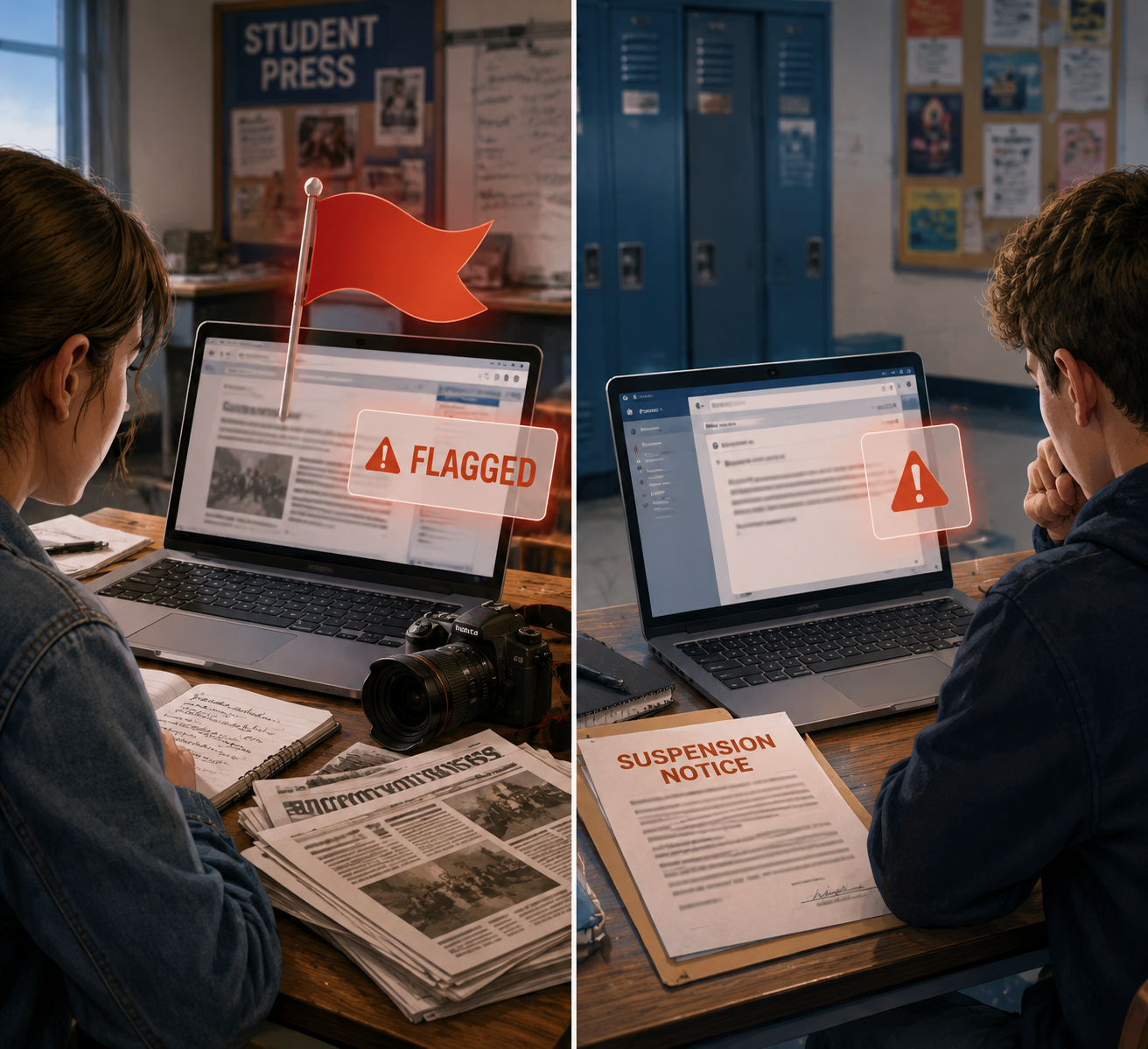
That procedural posture should make lawyers more careful, not less attentive. Early-stage litigation is where pleadings test whether old doctrine can stretch across new facts. A teacher seeing a threatening note passed in class is one legal setting. A platform scanning documents, drafts, photos, and possibly off-campus activity around the clock is another. The school’s duty to protect students is real in both settings. The constitutional analysis does not disappear because the software was purchased under a safety label.
The constitutional issue is the trigger, not the tool
Most school districts will not defend AI monitoring as “screen time enforcement” in isolation. They will describe suicide prevention, violence prevention, self-harm alerts, cyberbullying detection, and compliance with acceptable-use rules. Those are serious interests. A district that ignores a credible threat or self-harm signal may face legal, ethical, and political consequences far beyond a difficult board meeting.
The harder question is what the district does after the system flags something. If an alert routes a student in crisis to a trained adult who reviews context and contacts the right support team, the legal risk looks different from a workflow in which the same infrastructure deletes journalism files, exposes private drafts, or initiates discipline for an ambiguous joke. The constitutional pressure point is not the mere presence of AI. It is the use of algorithmic flags as enforcement triggers.
| Monitoring use | Legal pressure point |
|---|---|
| Targeted safety review after a credible self-harm or threat signal | Whether the school response is reasonable, documented, and connected to student safety |
| Continuous scanning of all school-device activity, including drafts and files | Whether the search is suspicionless, overbroad, or insufficiently tied to the school environment |
| Deletion or blocking of student-newspaper materials before publication | Whether the action operates as prior restraint or viewpoint-sensitive suppression |
| Discipline based on an AI interpretation of ambiguous expression | Whether the student received meaningful notice, context review, and a fair chance to respond |
That distinction matters for counsel reviewing AI device-management tools. Procurement language may say “student safety,” while the deployed workflow may perform school discipline, speech suppression, screen-time enforcement, and record creation. Courts tend to care about function. A platform that operates as a discipline engine will be judged by what it does to students, not only by the risk categories in a vendor deck.
Prior restraint becomes concrete when files disappear
The Lawrence allegations are important because they move the First Amendment issue from abstract monitoring to alleged suppression before publication. Student-speech doctrine already gives schools more room to regulate school-sponsored speech than government generally has in public forums. But even in the school setting, the legal analysis changes when journalism drafts, photographs, or artwork are allegedly flagged and deleted before editors can make publication decisions.[1]
For a district, the strongest defense is likely to emphasize the school-controlled environment: school accounts, school devices, school systems, and a safety-oriented acceptable-use framework. That framing will matter. Yet the students’ theory has force because prior restraint concerns are not limited to old-fashioned censorship boards. If a technical system blocks or removes student-newspaper material before publication, and if school officials rely on the platform without adequate review, the suppression can happen faster than any adult can ask whether the material is newsworthy, educational, artistic, or constitutionally protected.
The “indecent exposure” label also illustrates a recurring problem in school AI monitoring: category words can look more settled than the underlying context. A photograph for a health article, an art assignment, an abuse-related investigation, and an inappropriate image may all pass through similar technical filters. The constitutional problem is not that schools must ignore potentially harmful material. It is that automated classification can turn context-dependent student speech into a violation before the student, adviser, or editor has a meaningful chance to explain what the file is.
The Fourth Amendment problem is continuous scanning
School-search doctrine has long allowed more flexibility than ordinary law-enforcement searches. Administrators must maintain order and safety in institutions full of minors. But the traditional cases generally assume a human decision: a search of a backpack, a locker, a phone, or a student’s belongings after some school-related concern arises. Continuous AI monitoring alters the factual baseline.
A system that scans every keystroke, document, and unsent draft on a student device is not just a more efficient hall monitor. It is a different architecture of observation. The search may begin before suspicion exists, continue after school hours, and capture material that is neither disruptive nor dangerous. If the monitoring reaches off-campus activity, the district must also explain why school authority follows the student into that context and why the scope remains reasonable.
This is where the safety rationale does important but incomplete work. Suicide prevention and threat detection are legitimate governmental interests. They may justify some monitoring that would be harder to defend if the only purpose were enforcing device-use norms. But proportionality still matters. A court evaluating continuous, suspicionless scanning will likely ask what is monitored, when it is monitored, who can see the results, how long records are retained, whether students and parents received notice, and whether alerts are separated by severity before discipline begins.
The uncomfortable fact for districts is that the same infrastructure can serve more than one purpose. A system purchased after a self-harm incident may later be used to police profanity, sexual content, journalism files, jokes, personal messages, or screen-time rules. Once those lower-stakes enforcement uses become routine, the district’s strongest constitutional justification may no longer fit the full monitoring practice.
Due process depends on more than a human clicking approve
The Marana allegations put procedural fairness at the center. A student allegedly wrote an unsent draft email as a joke; Gaggle allegedly flagged it as a threat; the school allegedly imposed a 10-day suspension.[1] The due process concern is not solved by saying a human administrator ultimately issued the suspension. The legally important question is whether the student had a meaningful opportunity to contest the interpretation before the sanction affected the student’s record and education.
Threat assessment is difficult even for trained adults. Tone, audience, prior conflict, disability-related communication differences, and adolescent exaggeration can all affect meaning. An algorithmic flag may help a school move quickly when delay is dangerous. It should not become a substitute for asking basic questions: Was the message sent? Who could see it? Was there a target? Was there a plan? What did the student say when asked? What contrary evidence was reviewed?
In discipline workflows, speed can become its own procedural hazard. The more a district treats AI outputs as presumptively reliable, the more it risks building a record around a label rather than the underlying facts. A “threat” flag may travel through emails, student-information systems, parent notices, and suspension paperwork before anyone has written down why the expression was actually threatening under the school’s policy. That paper trail may later become evidence of reasoned review, or evidence that review never happened.
The lawsuits are not isolated signals
The 2025 Gaggle cases would matter even if they stood alone, but the available national survey data suggests the underlying discipline risk is broader. In a CDT survey fielded in 2023, two-thirds of teachers reported that students had gotten in trouble because of AI-driven monitoring. CDT also reported disproportionate effects on students with IEPs or 504 plans and on LGBTQ+ students.[2]
That survey does not prove that every monitored discipline decision was unlawful. It does not measure constitutional violations. It does, however, undercut the idea that AI monitoring is merely passive background infrastructure. If teachers are reporting discipline flowing from monitoring systems, then counsel should treat these tools as part of the student-discipline apparatus, not just as IT security or wellness software.
The disparate-impact warning is especially important for districts already managing disability-rights and civil-rights obligations. The Office for Civil Rights has identified at least 21 scenarios in which AI use in schools may violate civil rights laws based on race, color, national origin, sex, or disability.[3] Those scenarios are broader than the Gaggle pleadings, but they point in the same practical direction: when automated tools affect access, discipline, surveillance, or educational opportunity, civil-rights analysis follows.

Adjacent edtech litigation should not be collapsed into the Gaggle claims
The broader litigation environment is widening. The EdTech Law Center maintains an active-cases archive that includes current litigation involving edtech companies such as Google, Curriculum Associates, PowerSchool, and IXL.[4] Reuters reported on May 22, 2026, on the center’s litigation strategy and a small Texas firm bringing classroom-technology disputes into court.[5]
Those cases are useful context, but they should not be treated as interchangeable. Product-liability theories about Chromebook use, addiction-style claims, or vendor immunity defenses raise different questions from direct constitutional claims against public school districts. Section 230 may matter in some platform cases, especially where plaintiffs seek to hold a technology provider liable for third-party content or platform design. The Gaggle lawsuits described here focus more directly on state action: what public schools allegedly did with monitoring outputs and whether those actions burdened speech, privacy, or discipline rights.
State-level screen-time and device-use measures, including recent activity around Utah HB 273 and Iowa HF 2676, add another layer of compliance pressure. They do not answer the federal constitutional questions in the Gaggle cases. A state rule may require or encourage districts to manage devices more aggressively, but constitutional limits still govern how public schools search, censor, retain records, and discipline students.
What becomes evidence now
For school district attorneys, the immediate task is not to predict whether plaintiffs will win. It is to identify which documents and workflows will become constitutional evidence if a monitoring dispute reaches litigation. Courts will not look only at board-level assurances that the district cares about student safety. They will look at how the system actually operates.
- Procurement records: whether the platform was purchased for safety, discipline, screen-time management, content filtering, or all of those functions.
- Acceptable-use policies: whether students and parents received clear notice that drafts, files, photos, and off-campus activity may be scanned.
- Alert-routing rules: whether high-risk safety alerts are separated from lower-stakes conduct, profanity, or device-use alerts.
- Human review procedures: who reviews flagged material, what context they must examine, and when a student can respond.
- Retention and access controls: how long flagged material is stored, who can view it, and whether it becomes part of a disciplinary or educational record.
- Discipline workflows: whether an AI label can initiate suspension, removal, referral, or deletion before an adult makes an independent judgment.
For edtech counsel, the risk is similar but framed through product design and customer use. Vendor contracts that describe monitoring as advisory may not be enough if the product interface encourages schools to treat alerts as validated misconduct. Audit logs, confidence indicators, escalation labels, deletion functions, and default retention settings may all matter when plaintiffs argue that the system foreseeably converts ambiguous student expression into discipline.
For civil rights litigators, the strongest cases will likely be concrete. A student journalist whose files allegedly disappeared before publication. A student with a disability whose language is interpreted as threatening without context. An LGBTQ+ student whose private expression is exposed to adults because a filter reads identity-related language as sexual content. The legal theories may be constitutional, statutory, or both, but the harm will usually turn on a specific workflow that transformed monitoring into official action.
The boundary courts are being asked to draw
The Gaggle lawsuits matter because they ask whether public schools may treat AI monitoring as an always-on extension of ordinary supervision. Districts have strong reasons to monitor for self-harm and credible threats. They also have constitutional obligations when monitoring reaches protected speech, private drafts, off-campus activity, and disciplinary records.
The emerging line is not between caring about safety and ignoring safety. It is between bounded, reviewable safety intervention and continuous enforcement infrastructure that scans first, labels quickly, and leaves students to challenge the consequences afterward. If courts require tighter limits, the effect will reach beyond Gaggle. AI tools used for device management, content filtering, screen-time enforcement, wellness alerts, and classroom-platform compliance may all need more precise policies, narrower defaults, stronger human review, and cleaner separation between safety support and discipline.
References
- Constitutional Challenges to AI Monitoring Systems in Public Schools, AALRR EdLawConnect Blog, link
- New Survey: Students and Teachers Say Tech Use in Schools is Still Threatening Privacy & Civil Rights, CDT.org, link
- From Data Privacy to Discrimination: Examining the Legal Ramifications of AI in Schools, Public Interest Privacy Center, link
- Active Cases Archive, EdTech Law Center, link
- Parents may hate screens in schools. But can they sue?, Reuters, May 22, 2026, link
Comments
Join the discussion with an anonymous comment.