
California's AI Ethics Rulemaking: How Six Proposed Rule Amendments Would Make 'Should' Into 'Must'
Why May 2026 Is a Turning Point for California Attorney AI Ethics
Three separate California AI developments converged in May 2026, and taken together they mark a threshold that no California attorney or law firm compliance officer can treat as background noise.
On May 4, 2026, the 45-day public comment period closed on six proposed amendments to the California Rules of Professional Conduct — amendments that would convert the advisory language of the 2023 Practical Guidance into binding obligations carrying disciplinary authority. Ten days later, on May 14, 2026, the Board of Trustees approved an updated version of that Practical Guidance — adding explicit coverage of agentic AI tools and establishing itself as the current operative standard of care. And threading through both developments, SB 574 had already cleared the California Senate 39–0 and was advancing toward an Assembly deadline of August 31, 2026.
Each of these developments matters on its own. Together, they signal that California has moved further than any other state toward a comprehensive, enforceable framework governing attorney AI use — and that practitioners who are still operating on the 2023 Practical Guidance as their complete compliance picture are working with an incomplete map.
The Regulatory Arc: From Advisory Guidance to Proposed Binding Rules
California's regulatory trajectory on attorney AI ethics is unlike any other state's, and understanding it requires following the sequence of events rather than treating any single document as the definitive source.
In November 2023, the State Bar published its Practical Guidance for the Use of Generative Artificial Intelligence in the Practice of Law — a non-binding living document that addressed competence, confidentiality, disclosure, and supervision. It used aspirational language throughout: attorneys 'should' consider disclosure, firms 'should' establish policies, lawyers 'should' review AI output. The document was significant as a signal of where obligations were heading, but it carried no disciplinary force.
The regulatory escalation came from an unexpected direction. On August 22, 2025, the California Supreme Court sent a letter to the State Bar directing it to consider incorporating the Practical Guidance's principles into the formal Rules of Professional Conduct — and specifically to address agentic AI tools that 'can enable systems to autonomously perform tasks or workflows without human prompting.' No other state's Supreme Court has issued a comparable directive. The court's letter transformed what had been a bar-initiated guidance exercise into a court-ordered rulemaking.
COPRAC responded at its March 13, 2026 meeting by approving proposed amendments to six existing Rules of Professional Conduct for a 45-day public comment period. Critically, the committee chose not to draft a standalone AI rule. Instead, it wove new language into Rules 1.1, 1.4, 1.6, 3.3, 5.1, and 5.3 — reflecting the view that AI sharpens existing ethical duties rather than creating entirely new categories of obligation.
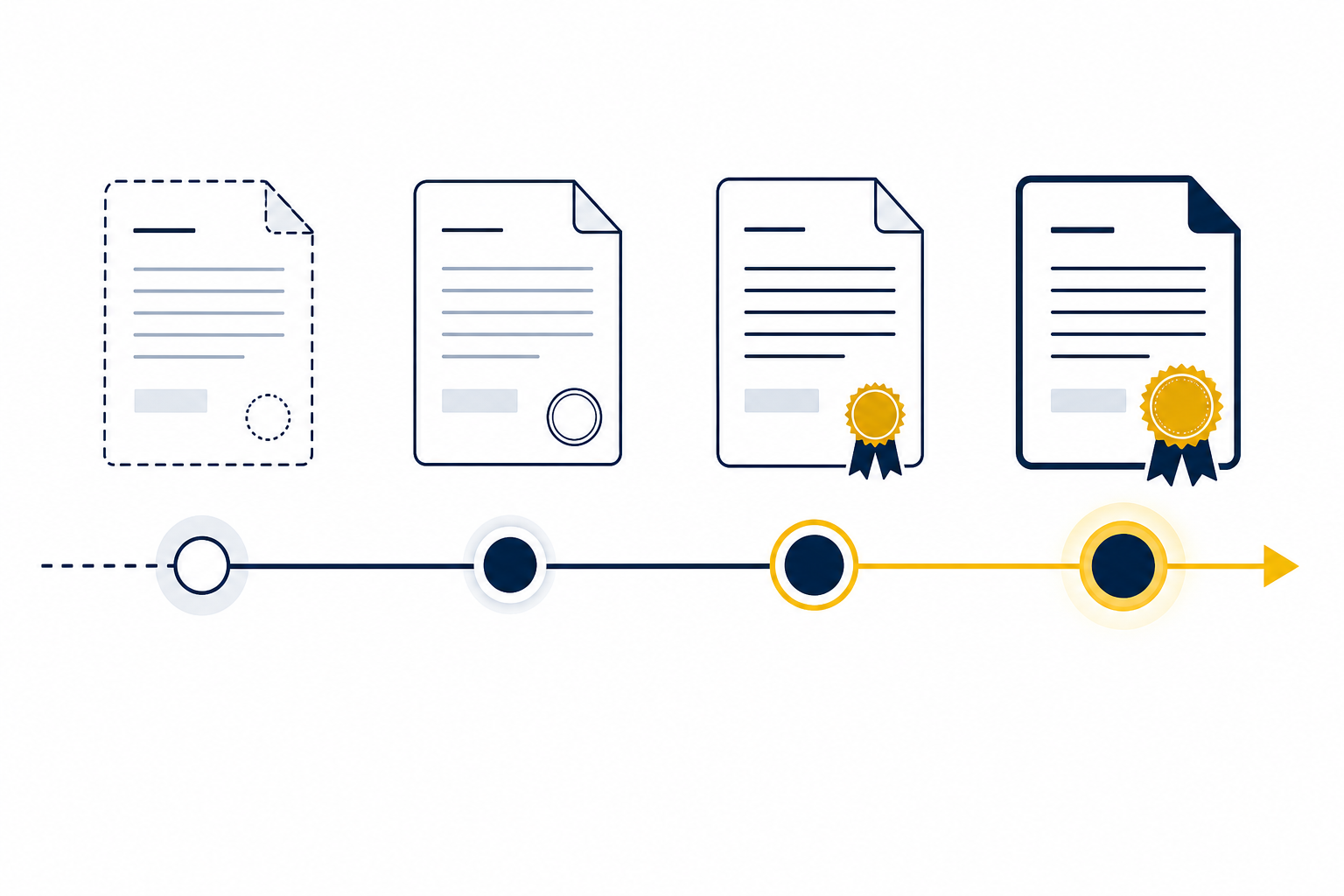
The May 4, 2026 comment period close and the May 14, 2026 Board of Trustees approval of the updated Practical Guidance — which added agentic AI coverage — complete the current chapter of this arc. The proposed amendments are now under COPRAC review. Readers who want the structured regulatory record of the 2023 baseline document can consult the site's companion tracker entry, California State Bar AI Ethics Guidance: What Attorneys Must Know; this article focuses on what has changed since and what the proposed amendments would mean in practice.
What Is Already Binding vs. What Is Still Pending
One of the most consequential errors a California attorney can make right now is conflating the layers of this regulatory stack. The binding layer and the pending layer are genuinely different in their legal force, their scope, and their enforcement mechanisms.
| Instrument | Status | Effective Date | Scope | Enforcement Mechanism |
|---|---|---|---|---|
| May 2026 Updated Practical Guidance (State Bar) | In effect — non-binding living document | May 14, 2026 (Board of Trustees approval) | All California attorneys using AI in practice | Operative standard of care; informs disciplinary proceedings but not itself a binding rule |
| California Rule of Court 10.430 and Judicial Council Standard 10.80 | Binding — in effect | September 1, 2025 | Judicial officers and court staff only (not attorney-facing) | Court rule; courts required to adopt internal AI policies by December 15, 2025 |
| Proposed amendments to Rules 1.1, 1.4, 1.6, 3.3, 5.1, 5.3 | Proposed — pending COPRAC review, Board of Trustees action, and California Supreme Court approval | Comment period closed May 4, 2026; adoption date TBD | All California attorneys | If adopted: binding Rules of Professional Conduct with full disciplinary authority |
| SB 574 (proposed B&P Code § 6068.1; CCP §§ 128.7, 1282.1) | Pending — passed Senate 39–0; Assembly deadline August 31, 2026 | Not yet enacted; governor signature uncertain | California attorneys and arbitrators | If enacted: statutory duty enforceable through State Bar discipline and court sanctions |
Rule by Rule: The 'Should-to-Must' Shifts and Their Compliance Implications
The six proposed amendments follow a consistent internal logic: each takes an obligation that the 2023 Practical Guidance expressed as aspirational — something a careful attorney 'should' do — and converts it into an affirmative duty that a California attorney must satisfy or face potential discipline. The shift is not merely semantic. It changes the enforcement posture, the standard of review in disciplinary proceedings, and the baseline against which malpractice exposure is assessed.
Rule 1.1 — Competence: Independent Verification of Any AI Output
The 2023 Practical Guidance told attorneys they should scrutinize AI output and treat it as a starting point. The proposed new Comment [2] to Rule 1.1 is more exacting: a lawyer must 'independently review, verify, and exercise professional judgment regarding any output generated by the technology that is used in connection with representing a client.'
Two aspects of this proposed language matter for compliance planning. First, there is no carve-out for routine or low-stakes tasks. The obligation applies to 'any output' — a first draft of a cover letter and a brief filed in the Ninth Circuit are treated identically. Second, the word 'independently' signals that relying on a colleague's review of AI output, or on the AI system's own confidence indicators, does not satisfy the obligation. The attorney using the output must personally verify it.
Rule 1.4 — Communication: Disclosure Becomes a Duty, Not a Consideration
The 2023 Practical Guidance said attorneys 'should consider' disclosing AI use to clients. The proposed new Comment [5] to Rule 1.4 converts this into an affirmative communication duty: attorneys 'must communicate' AI use when it 'presents a significant risk or materially affects the scope, cost, manner, or decision-making process of representation.'
The proposed comment identifies four calibration factors: novelty of the AI application, risk level of the matter, scope of AI's role in the work product, and client sophistication. These factors do not create a safe harbor — they are analytical inputs into the disclosure determination, not a checklist that, if satisfied, eliminates the duty.
In practical terms, this is likely the proposed amendment with the most immediate daily-practice impact. Engagement letters, matter-opening communications, and billing practices may all need to be reviewed against the 'must communicate' standard before the amendments are adopted, not after.
Rule 1.6 — Confidentiality: 'Reveal' Now Includes AI Data Exposure
The 2023 Practical Guidance focused on reviewing vendor terms of service to identify third-party data sharing risks. The proposed new Comment [2] to Rule 1.6 operates at a more foundational level: it redefines 'reveal' to include 'exposing confidential information to technological systems, including AI tools, where such exposure creates a material risk of unauthorized access, retention, or use.'
The practical consequence is significant. Under the proposed definition, inputting client confidential information into an AI tool — even without any intent for third parties to see it — can constitute a revelation of confidential information under Rule 1.6 if a material risk exists that the system could access, retain, or use that data. This shifts the compliance question from 'does the vendor share data with third parties?' to 'does the system architecture create any material risk of unauthorized access or retention?'
For law firms evaluating cloud-based AI tools, this proposed standard demands a more rigorous vendor vetting process — one that examines system architecture, data retention policies, model training practices, and access controls, not merely the vendor's contractual representations about third-party sharing.
Rule 3.3 — Candor: An Explicit Hallucination-Prevention Duty
The 2023 Practical Guidance required review of AI output for accuracy. The proposed new Comment [3] to Rule 3.3 goes further: it adds an affirmative duty to verify that cited authorities are not 'fabricated, misstated, or taken out of context,' and explicitly includes AI-generated citations within the scope of this verification obligation.
This is the proposed amendment most directly targeting the hallucination problem that has produced dozens of California sanctions cases. The distinction from the 2023 Guidance is the addition of an existence-verification requirement: it is not enough to check whether a cited case stands for the proposition cited. The attorney must verify that the case exists at all.
Rule 5.1 — Supervisory Lawyers: Firm AI Governance Becomes a Binding Obligation
The 2023 Practical Guidance said firms 'should establish clear policies' for AI use. The proposed modification to Comment [1] of Rule 5.1 elevates this: managerial lawyers 'must make reasonable efforts to establish internal policies' governing AI use firm-wide.
If adopted, this would mean that a managing partner or general counsel who has not established written AI governance policies — covering at minimum tool approval, data handling, verification requirements, and supervision protocols — is personally exposed to a Rule 5.1 violation. The obligation runs to managerial lawyers individually, not just to the firm as an entity.
Rule 5.3 — Nonlawyer Supervision: AI Use by Staff Is Within Scope
The proposed update to Rule 5.3's comment extends supervisory obligations to nonlawyer staff AI use. This addresses a gap that the 2023 Guidance did not close clearly: when a paralegal or legal assistant uses an AI tool to generate research, draft correspondence, or process documents, the supervising attorney's existing Rule 5.3 obligations apply to that AI-assisted work product.
In practical terms, a firm cannot satisfy its AI governance obligations by training attorneys on AI verification practices while leaving nonlawyer staff to use AI tools without equivalent oversight. The proposed Rule 5.3 comment closes that gap explicitly.
| Rule | 2023 Practical Guidance Language | Proposed Comment Language (If Adopted) | Core Compliance Shift |
|---|---|---|---|
| Rule 1.1 (Competence) | 'Should' scrutinize AI output; treat as a starting point | Must 'independently review, verify, and exercise professional judgment regarding any output' | No carve-out for routine tasks; personal verification required |
| Rule 1.4 (Communication) | 'Should consider' disclosing AI use | Must communicate AI use when it 'presents a significant risk or materially affects' scope, cost, or decision-making | Disclosure converts from internal discretion to affirmative duty |
| Rule 1.6 (Confidentiality) | Review vendor terms of service for third-party sharing | 'Reveal' includes AI data exposure where 'material risk' of unauthorized access, retention, or use exists | Stricter vetting baseline; system architecture scrutiny required |
| Rule 3.3 (Candor) | Review AI output for accuracy | Must verify cited authorities are not fabricated, misstated, or taken out of context; explicitly includes AI citations | Adds existence-verification duty beyond accuracy review |
| Rule 5.1 (Supervisory Lawyers) | Firms 'should establish' AI policies | Managerial lawyers 'must make reasonable efforts to establish internal policies' | Firm AI governance becomes a personal disciplinary obligation |
| Rule 5.3 (Nonlawyer Supervision) | General supervision principles applied contextually | Supervisory obligations explicitly extend to nonlawyer staff AI use | Staff AI use within scope of attorney supervision duty |
Agentic AI: What the May 2026 Updated Practical Guidance Adds
The California Supreme Court's August 2025 letter did not merely ask COPRAC to codify existing guidance — it specifically flagged agentic AI tools as requiring attention. The court described these as systems that 'can enable systems to autonomously perform tasks or workflows without human prompting,' signaling that the existing framework, built around a human reviewing discrete AI outputs, was not designed for tools that complete multi-step processes without continuous attorney involvement.
The May 14, 2026 updated Practical Guidance — the version currently serving as the operative standard of care — responds to this gap directly. It extends verification and supervision duties to autonomous multi-step AI workflows, not just to discrete outputs reviewed at a single point in a process.
For firms deploying AI agents in document review pipelines, legal research workflows, compliance monitoring, or contract processing, this matters practically. The updated Guidance does not permit an attorney to deploy an agentic workflow, receive the final output, and apply a single review at the end. The verification and supervision obligations attach to the workflow itself — including the intermediate steps and decision points that an autonomous system navigates without human prompting.
SB 574: The Legislative Layer and Its Uncertainties
Running parallel to the COPRAC rulemaking is a separate legislative track. SB 574 passed the California Senate 39–0 and is pending Assembly action, with an August 31, 2026 deadline to reach the governor. It would add three distinct statutory obligations that operate alongside — not instead of — the Rules of Professional Conduct.
- Proposed B&P Code § 6068.1 would make it an attorney's statutory duty to ensure that confidential client information and personal identifying information are 'not entered into a public generative artificial intelligence system.' This is a categorical prohibition on prompting public AI tools with client data — stricter in scope than the proposed Rule 1.6 comment's material-risk standard.
- Proposed amendment to CCP § 128.7 would require that all citations in filed documents have been 'personally read and verified' by the attorney responsible for submitting the pleading — regardless of whether AI was used. The 'personally' language potentially prevents delegation of citation verification to junior attorneys or paralegals, even under attorney supervision.
- Proposed CCP § 1282.1 would prohibit arbitrators from delegating decision-making to AI, addressing a concern that AI tools could be used to generate arbitral awards without meaningful human deliberation.
The governor's signature is not assured. Governor Newsom vetoed SB 1047 in 2024 — a broad AI safety bill — citing concerns about overregulation of AI development in California. SB 574 is narrower in scope, targeting attorney-specific obligations rather than AI development broadly, but the veto precedent creates genuine uncertainty that practitioners and compliance planners should factor into their timelines.
California vs. the ABA and Other States: Why This Rulemaking Is Different
On July 29, 2024, the ABA's Standing Committee on Ethics and Professional Responsibility published Formal Opinion 512 — the ABA's first formal opinion addressing generative AI. Opinion 512 covers competence, confidentiality, communication, candor, supervision, and fees under the ABA Model Rules. It is a significant document, but it is advisory and persuasive only. No state is bound by ABA formal opinions, and Opinion 512 carries no disciplinary authority in any jurisdiction.
Most states that have addressed attorney AI use have done so through the same advisory ethics opinion format — documents that inform the standard of care and may influence disciplinary proceedings, but that do not themselves create binding obligations. California's proposed approach is structurally different in two ways.
First, the proposed amendments would embed AI obligations directly into the text of existing Rules of Professional Conduct as binding comments. A violation of a rule comment is a violation of the rule — subject to the full range of State Bar disciplinary responses. Second, the rulemaking was initiated by the California Supreme Court itself, not by the bar acting on its own initiative. That origin gives the resulting rules a different institutional weight than a committee-issued ethics opinion.
| Jurisdiction / Body | Instrument | Legal Force | Disciplinary Authority |
|---|---|---|---|
| ABA (national) | Formal Opinion 512 (July 29, 2024) | Advisory; persuasive only | None — advisory opinions carry no disciplinary authority |
| Most U.S. states | Ethics opinions from state bar ethics committees | Advisory; informs standard of care | Indirect — may influence disciplinary proceedings but not binding rules |
| California (proposed) | Amendments to Rules 1.1, 1.4, 1.6, 3.3, 5.1, 5.3 (if adopted) | Binding Rules of Professional Conduct | Full State Bar disciplinary authority if adopted |
| California (current) | May 2026 Updated Practical Guidance | Non-binding; operative standard of care | Informs but does not itself constitute a binding obligation |
Enforcement Is Already Real: Key Sanctions Cases Under Current Rules
A practitioner waiting for binding amendments to take compliance seriously is misreading the enforcement landscape. California courts have already imposed sanctions for AI-related failures under existing rules — before any of the proposed amendments take effect.
More than 57 AI hallucination sanctions cases have been tracked in California. Three stand out for their firm-level significance:
- Lacey v. State Farm General Insurance Co. (C.D. Cal., May 2025): A $31,100 sanction was imposed jointly on K&L Gates and Ellis George after a research-to-draft handoff proceeded without citation verification. The case directly illustrates the failure pattern that the proposed Rule 1.1 independent verification comment is designed to prevent — a workflow where AI output moves from one attorney to another without either independently verifying the citations.
- Noland v. Land of the Free (Cal. Ct. App., September 2025): A $10,000 sanction and a State Bar referral — making this California's first published appellate opinion sanctioning AI-fabricated citations. The appellate posture means this decision carries precedential weight that trial court sanctions orders do not.
- United States v. Hayes (E.D. Cal., January 2025): The court found the attorney's conduct 'tantamount to bad faith' after a motion cited a non-existent case. The 'bad faith' characterization, rather than negligence, signals judicial impatience with AI citation failures that courts view as foreseeable and preventable.
Compliance Actions California Attorneys Should Take Now
The most durable compliance strategy for California attorneys is one built against the May 2026 updated Practical Guidance — the current operative standard of care — while anticipating the proposed rule amendments. Firms that build their practices to satisfy the proposed 'must' standards now will not need to rebuild when the amendments are adopted.
- Audit AI vendor agreements against the proposed Rule 1.6 'reveal' standard. Review system architecture, data retention policies, model training practices, and access controls — not just contractual non-disclosure terms. The proposed standard asks whether a material risk of unauthorized access, retention, or use exists, not merely whether the vendor has signed a confidentiality agreement.
- Draft written AI governance policies now. The proposed Rule 5.1 comment would make firm AI governance policies a binding obligation for managerial lawyers. A written policy covering tool approval, data handling, verification requirements, and supervision protocols satisfies both the current Practical Guidance and the proposed rule standard.
- Build citation-verification workflows that satisfy proposed Rule 3.3's existence-verification duty. Verification workflows should confirm not just that a cited case supports the proposition for which it is cited, but that the case exists and has not been reversed or distinguished. This step should be performed by the attorney responsible for the filing, not delegated entirely to support staff.
- Review client communication practices against the proposed Rule 1.4 'must communicate' trigger. Engagement letters and matter-opening communications should address AI use when it will materially affect scope, cost, or decision-making. Waiting for clients to ask is not a compliant posture under the proposed standard.
- Extend AI supervision policies to nonlawyer staff. Paralegals, legal assistants, and contract reviewers using AI tools in client matters are within the scope of the proposed Rule 5.3 supervisory obligation. Training programs and verification checklists should cover staff AI use, not only attorney AI use.
- Review agentic AI deployments against the May 2026 updated Practical Guidance. Any multi-step autonomous AI workflow — document review pipelines, research agents, compliance monitoring tools — should be assessed for intermediate verification and supervision touchpoints, not just end-point review.
- Monitor SB 574's Assembly progress and prepare for the B&P Code § 6068.1 prohibition. If enacted, the prohibition on entering confidential or personal identifying information into any public AI system would be a categorical rule requiring immediate workflow changes for any attorney currently using public AI tools with client data. The August 31, 2026 Assembly deadline means this could become law before the proposed rule amendments are finalized.
Operationalizing workflow
No workflow has been explicitly linked to this obligation yet. See Workflows generally.
Illustrative cases
No illustrative case is currently tracked for this obligation. See Risk Digest for documented incidents generally.
← Back to RegulationReport a correction or tip
Spotted an outdated figure, a misstated fact, or a ruling this regulation entry should reflect? Public comments are disabled for this content given the professional cost of a misreported case outcome, penalty amount, or rule text — use the structured correction channel instead.
Report a correction or tip for this record →