
Compliance teams are being asked to use AI for regulatory compliance at the same time they are being asked to prove that those AI systems are governed. The same tool that summarizes a new rule, scores a control gap, routes an obligation to an owner, or reviews policy text may also need to be inventoried, classified, restricted, monitored, and evidenced under AI-specific rules.
That is the operating problem. It is not solved by keeping “AI governance” in one program and “compliance automation” in another. The boundary breaks down as soon as a compliance workflow depends on a model, a vendor workflow embeds AI, or an employee uses an unsanctioned tool to accelerate a regulatory task.

The pressure is already visible. Optro’s 2026 summary reports that 78% of enterprises remain unprepared for EU AI Act obligations, while 85% have integrated AI into core operations and only 25% have comprehensive visibility into employee AI use. Optro characterizes that visibility gap as the largest source of downstream compliance incidents.[1] Gartner reported in February 2026 that organizations using dedicated AI governance platforms were 3.4 times more likely to achieve high governance effectiveness, while also projecting AI governance platform spending at $492 million in 2026; that spending figure is an analyst projection, not audited market data.[2] Governance Intelligence, citing Diligent, reported that 61% of compliance teams face regulatory complexity and resource fatigue.[3]
Those numbers point in the same direction, but they do not prove that buying a platform solves compliance. Adoption is not effectiveness. Visibility is not control. A vendor dashboard is not an audit record unless it captures the right scope, ownership, decisions, exceptions, and timestamps. The useful lesson is narrower: AI-enabled compliance work needs to be governed inside the same operating system that manages regulatory obligations.
This article is current as of Q3 2026 and is informational only. It is not legal, compliance, or regulatory advice. Specific obligations should be reviewed with qualified counsel in the relevant jurisdictions.
The dual burden is now a control-design problem
AI is no longer confined to pilot projects in many compliance functions. RegTech Analyst, discussing 4CRisk.ai’s 2026 view of the market, describes the highest-value applications as regulatory change management and control harmonization.[4] That matches where the workload hurts: monitoring source updates, mapping requirements to policies and controls, finding duplicative control language, triaging impact, and preparing evidence for review.
But once AI enters those workflows, the compliance team inherits two linked questions. First: is the AI output reliable enough for the task? Second: what obligations apply to the AI system itself? A model used to summarize public regulatory updates carries a different risk profile from a system used to assess employee conduct, rank customer complaints, or support decisions affecting individuals. A vendor feature embedded in an existing GRC platform may be just as relevant as a standalone AI tool.
For a deeper market distinction between tools that help compliance teams manage obligations and tools that help govern AI systems, see the internal buyer’s guide on AI compliance software in 2026. For jurisdiction-by-jurisdiction regulatory movement, use the regulatory tracker covering the EU AI Act high-risk deadline, U.S. state law patchwork, and federal preemption battle as a companion reference. The operational question here is how to keep those strands from splitting into parallel, inconsistent workstreams.
| Operating question | What the compliance team needs to prove |
|---|---|
| What AI systems are in scope? | Approved tools, embedded vendor AI, employee use, model purpose, data exposure, and jurisdictions touched |
| How risky is each use? | A documented classification tied to regulatory obligations, internal policy, affected users, and decision impact |
| Which controls apply? | Workflow restrictions, approval gates, human review, access limits, testing, and exception handling |
| What evidence exists? | Audit trails, classifications, reviews, vendor documentation, testing outputs, policy exceptions, and timestamps |
| What changes trigger review? | New laws, model behavior changes, vendor updates, new data uses, incidents, and expansion into new jurisdictions |
Inventory: start where incidents usually start
Inventory is the least glamorous part of AI governance and the one most likely to determine whether the rest of the program survives review. If the organization cannot say which AI systems are being used, where they sit, what data they process, who owns them, and which workflows rely on them, classification and controls become educated guesses.
A useful inventory does not stop at “approved AI tools.” It should include AI functions embedded in systems the compliance team already uses: contract review tools, matter management platforms, hotline analytics, GRC suites, policy management systems, e-discovery tools, customer complaint systems, procurement platforms, and productivity software. The relevant question is not whether the product is marketed as AI governance software. The question is whether an AI capability affects a compliance process, a regulated decision, an employee workflow, a customer interaction, or evidence used by legal, risk, audit, or compliance.
- System name, vendor, business owner, technical owner, and compliance owner
- Purpose of the AI use, including whether it supports compliance work or is itself part of a regulated business process
- Data categories processed, including personal data, confidential business information, regulated records, and privileged or sensitive legal material
- User groups, affected individuals, jurisdictions, and business units in scope
- Model or feature type, vendor disclosures, integration points, logging capability, and whether outputs are retained
- Current approval status, restrictions, exceptions, last review date, and next review trigger
Employee use belongs in the same inventory conversation. The Optro-reported gap between broad AI integration and limited visibility into employee AI use is the kind of mismatch that creates avoidable incidents: a staff member pastes regulatory correspondence into an unapproved tool, a team uses a public model to draft control language, or a business unit quietly relies on AI scoring without compliance review.[1] The issue is not employee enthusiasm. It is unmanaged use without ownership, logging, review, or a defensible policy basis.
Inventory also needs to distinguish between two roles a system may play. An AI tool may help manage compliance obligations, such as summarizing regulatory updates or mapping controls. The same or another AI system may be subject to AI regulation because of its use case, data, jurisdiction, or decision impact. Some systems will fall into both categories. Those are the systems where ownership often becomes blurred, because the compliance team is both user and governor.
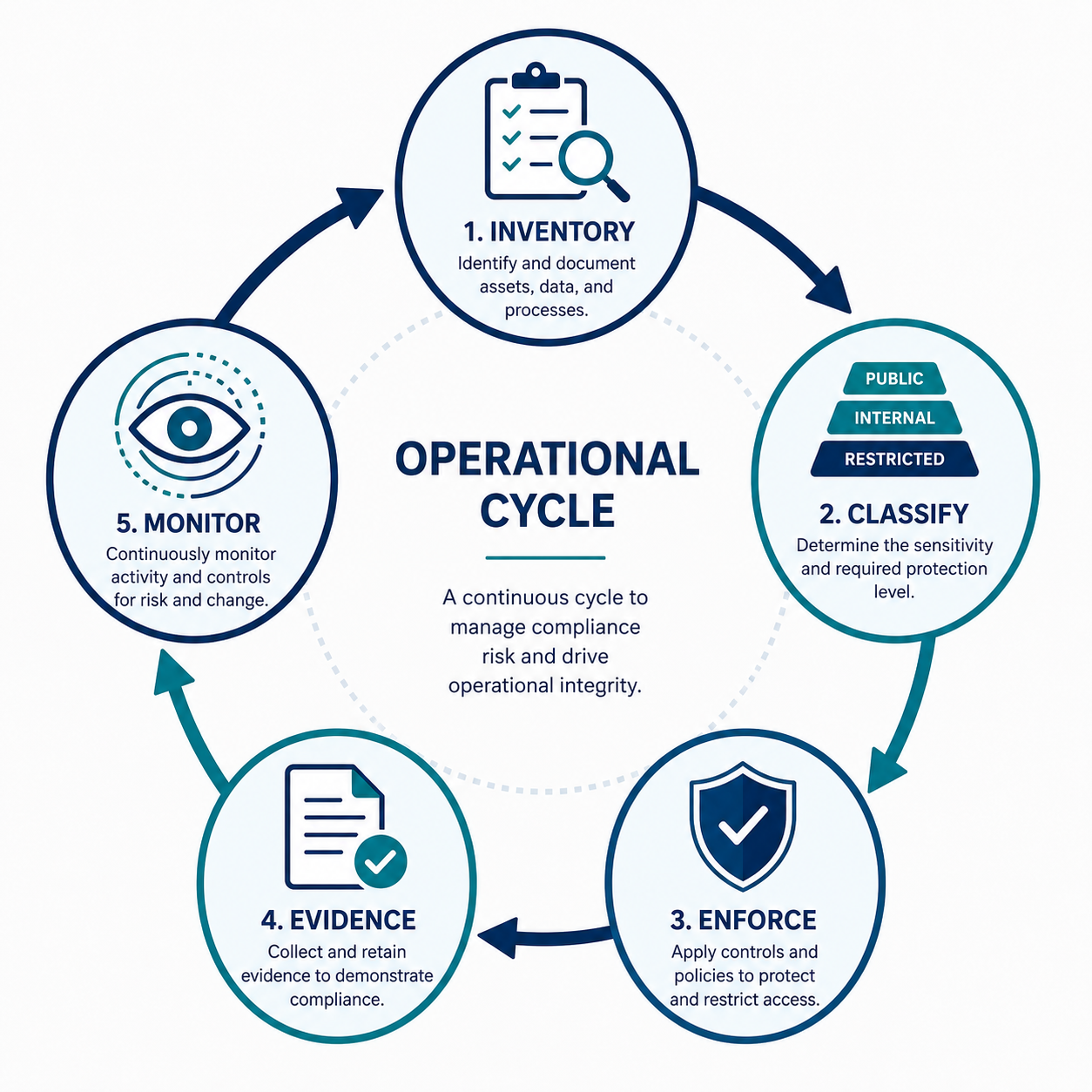
Classify systems by use, obligation, and consequence
Classification should not be a generic high-medium-low exercise detached from legal obligations. A classification that cannot explain why a system sits in a risk tier will not help when the law changes, a regulator asks for evidence, or internal audit challenges the control design.
The classification should connect four things: the AI use case, the people or entities affected, the regulatory regimes that may apply, and the consequence of a wrong or unsupported output. A regulatory change monitoring tool that summarizes public materials may need accuracy testing, human review, and source traceability. An AI system used to prioritize investigations, screen applicants, assess performance, or support decisions affecting access to services may require more formal governance, documentation, notice, human oversight, bias controls, or impact assessment depending on the jurisdiction and use.
| Classification factor | Why it matters |
|---|---|
| Use case | Regulatory obligations often turn on what the AI system does, not only what technology it uses |
| Decision impact | Systems affecting individuals, rights, employment, credit, access, investigations, or enforcement usually need closer review |
| Data exposure | Sensitive, personal, confidential, privileged, or regulated data changes both legal and operational risk |
| Jurisdiction | The same system may face different obligations in the EU, U.S. states, and sector-specific regimes |
| Human role | A tool that drafts, recommends, ranks, or acts autonomously creates different oversight needs |
Classification must be reviewable. If a system is classified as low risk because it only summarizes public regulatory text, the record should say that. If the same tool later receives internal incident reports, customer complaints, or employee data, the classification should not remain unchanged because the original intake form said “document analysis.”
Enforce controls inside the workflow
Controls work best when they sit where the decision or handoff occurs. A policy that tells employees not to enter sensitive information into unapproved AI tools is necessary, but it does not substitute for access controls, approved alternatives, workflow prompts, data loss prevention rules, review queues, and escalation paths.
For AI used in regulatory compliance, enforcement usually starts with source discipline. If a system summarizes legal or regulatory changes, the workflow should preserve source links, jurisdiction, publication date, confidence limits where available, and the human reviewer who accepted or rejected the summary. If a tool maps obligations to controls, the mapping should route to the control owner and retain the basis for the proposed linkage. If a model drafts policy language, the approval workflow should make clear that the accountable owner approved the final policy, not the model.
- Restrict unapproved AI tools for regulated, confidential, privileged, or personal data
- Require human review before AI output changes an obligation, control, risk rating, policy, or regulatory response
- Route higher-risk AI uses through legal, privacy, security, compliance, and business-owner approval
- Define exception paths with expiration dates, compensating controls, and named owners
- Prevent production expansion until classification, testing, documentation, and evidence requirements are complete
This is also where procurement and vendor management become part of AI governance. Vendor claims about accuracy, explainability, security, and regulatory readiness should be converted into contract terms, documentation requirements, service commitments, audit rights where appropriate, and operational controls. A vendor’s marketing statement should not become the organization’s evidence unless the organization has tested, reviewed, or contractually anchored it.
Evidence is where governance becomes defensible
Many AI governance programs look reasonable until someone asks for evidence. The control exists in a slide. The risk tier exists in a spreadsheet. The vendor said the model is safe. The policy was approved, but no one can show which systems it covered at the time, which exceptions were open, or whether the control operated after deployment.
Evidence should be designed before the first audit request. For each in-scope AI system, the record should show why the system is in scope, how it was classified, which controls apply, who approved the use, what testing occurred, what vendor documentation was reviewed, what exceptions exist, and when the next review is due. If the system supports regulatory compliance work, the evidence should also preserve how AI output flowed into compliance decisions.
- Inventory record with system owner, business purpose, jurisdiction, data categories, vendor, and integration points
- Risk classification record with rationale, applicable obligations, decision impact, and reviewer approval
- Human review logs for AI-generated summaries, mappings, recommendations, risk scores, policy drafts, or control outputs
- Vendor documentation, including model or feature descriptions, security materials, data-use terms, subcontractor information, and change notices
- Control testing results, issue remediation records, exception approvals, compensating controls, and expiration dates
- Last-reviewed timestamp, next scheduled review, and event-based triggers for reassessment
The evidence burden is heavier for systems that sit close to legal interpretation, regulated decisions, or individual impact. A tool that flags likely regulatory relevance may only need sampling, reviewer confirmation, and source traceability. A tool that helps rank complaints for investigation may need stronger documentation around data inputs, fairness considerations, escalation, human override, quality testing, and monitoring. The distinction matters because over-controlling low-risk systems wastes capacity, while under-documenting consequential systems creates the kind of gap that becomes visible only after an incident.
Evidence should also be useful to the people operating the control, not only to auditors. If a regulatory change management tool proposes that a new obligation maps to three existing controls, the control owner should see the source text, the AI-generated rationale, prior mappings, the reviewer’s decision, and any open implementation task. If that information is scattered across email, a ticketing system, a vendor interface, and a spreadsheet, the governance design may be technically present but operationally weak.
Monitor for legal change and system change
AI governance monitoring has two moving targets. The law changes, and the system changes. A compliance team that monitors only one will miss the other.
Legal-change monitoring should identify new or amended AI obligations, effective dates, enforcement guidance, court challenges, agency interpretations, and state-level developments. System-change monitoring should capture vendor releases, model updates, new features, new data uses, expanded user groups, workflow changes, performance drift, incidents, and exceptions nearing expiration.
The review trigger is the practical link. A new jurisdiction, a new AI feature, a new use of employee or customer data, a vendor change notice, a failed control test, or a regulatory deadline should trigger reassessment of inventory, classification, controls, and evidence. Without those triggers, the program depends on people remembering that a once-approved system no longer matches the facts that justified approval.
Boundary conditions that should change the operating plan
The operating cycle has to survive regulatory uncertainty. In 2026, that means treating several high-profile developments as live boundary conditions rather than settled background.
EU timing remains urgent, but not perfectly settled
The EU AI Act continues to drive board-level urgency because of its staged obligations and prohibited-practices penalties of up to €35 million or 7% of global annual turnover. Compliance teams should treat the August 2, 2026 high-risk deadline as operative unless and until formal legal change says otherwise. At the same time, the spring 2026 Digital Omnibus agreement has created uncertainty because it has not been formally enacted. The right operational response is not to freeze work; it is to keep records granular enough that deadline, scope, or documentation changes can be mapped to systems and controls without rebuilding the program.
Colorado changed, so stale summaries are risky
U.S. state AI governance cannot be managed from old summaries. VerifyWise’s 2026 state-law update states that Colorado’s SB 24-205 was repealed in May 2026 and replaced by SB 26-189.[5] Any compliance inventory, tracker, or legal memo that still treats SB 24-205 as the current Colorado framework needs review. This is exactly why monitoring should connect legal-change alerts to affected systems, policies, and control owners.
Federal preemption is not an escape hatch
Federal signals matter, including funding conditions and policy statements that may pressure state approaches. But unresolved federal preemption is not the same thing as invalidated state law. State obligations remain in force unless changed by legislation, regulation, or a successful court challenge. Operationally, that means compliance teams should track federal developments as a risk factor while continuing to manage applicable state obligations.
Vendor statistics need source discipline
Vendor and analyst materials are useful, but they should not be treated alike. Gartner’s 3.4x effectiveness figure is an analyst conclusion reported by Gartner.[2] Optro’s visibility statistics appear in vendor-authored governance content and should be attributed accordingly.[1] Governance Intelligence’s resource-fatigue figure is tied to Diligent reporting.[3] These sources can inform planning, but they should not replace internal evidence about the organization’s own systems, use cases, incidents, and controls.
Agentic AI needs review before it becomes ordinary workflow
Agentic AI raises the stakes because the system may not merely summarize, draft, or recommend. It may plan, call tools, take steps across systems, or move work forward with less direct human prompting. Even where deployment remains planned rather than mature, the governance question is already practical: what actions can the agent take, what systems can it access, what approvals are required, what logs are retained, and when must a human stop or confirm the action?
The same five-part cycle still applies, but the inventory and evidence requirements become more demanding. A compliance team needs to know not only what the agent says, but what it can do. For example, a hypothetical agent that monitors regulatory updates and opens implementation tasks would need source traceability, task-creation logs, routing rules, human approval before obligation changes, and restrictions on which systems it can modify. The point is not to ban automation. It is to prevent silent authority from appearing inside a workflow that was originally approved for assistance.
What embedded governance looks like in practice
A workable model does not require every compliance team to build a separate AI bureaucracy. It does require existing compliance machinery to recognize AI as part of the control environment.
| Compliance operating function | AI governance embedded into the function |
|---|---|
| Regulatory change management | AI tools that monitor or summarize changes are inventoried, source-linked, reviewer-approved, and reassessed when jurisdictions or use cases expand |
| Control management | AI-generated mappings are routed to control owners, supported by rationale, and tested before being treated as authoritative |
| Policy management | AI-drafted language remains subject to accountable owner approval, version control, and exception tracking |
| Third-party risk | Vendor AI features are reviewed for data use, documentation, auditability, change notice, subcontractors, and contractual commitments |
| Issue management | AI-related incidents, failed tests, overrides, and exceptions are logged with remediation owners and due dates |
| Board and committee reporting | Reporting distinguishes adoption, visibility, control effectiveness, open exceptions, and unresolved legal uncertainty |
This is where compliance teams can make AI for regulatory compliance useful without pretending the risk disappears. The operating model should let a reviewer move from a board question to a system record, from a system record to its classification, from the classification to the controls, from the controls to the evidence, and from the evidence to the next review trigger. If that path cannot be followed, the program is not yet auditable in the way legal, risk, and compliance teams will need it to be.
The strongest programs will not be the ones with the most impressive AI demonstrations. They will be the ones where ownership is visible, exceptions expire, vendor claims are checked, high-risk uses receive proportionate scrutiny, and legal-change monitoring actually changes the controls applied to systems in production.
AI governance does not eliminate regulatory risk, and no framework can make unsettled law settled. It can reduce the dual burden when it becomes part of the ordinary compliance operating system: the same inventory, controls, evidence, review cadence, and escalation paths used to manage regulatory obligations also govern the AI systems helping manage them.
References
- AI Governance Statistics, Optro, 2026.
- Gartner Global AI Regulations Fuel Billion Dollar Market for AI Governance Platforms, Gartner, February 17, 2026.
- How AI Will Redefine Compliance, Risk and Governance in 2026, Governance Intelligence, 2026.
- How AI is Reshaping Regulatory Compliance Strategies in 2026, RegTech Analyst, 2026.
- State of AI Governance Regulations United States 2026, VerifyWise, 2026.
Comments
Join the discussion with an anonymous comment.