
The latest Endangered Species Act shock did not arrive as a slow-moving policy memo. On July 14, 2026, the federal wildlife agencies published a Federal Register action rescinding the regulatory definition of “harm,” the term that has long carried much of the practical weight in disputes over habitat modification and prohibited “take” under the ESA.[1] The same day, public reporting documented a lawsuit filed by Earthjustice in the Western District of Washington challenging the change.[2] By July 15, additional litigation activity involving environmental and Tribal plaintiffs had turned the rescission from a regulatory event into a live docket-management problem.
For law firm leaders, that timing matters. A rule change may generate a client alert. A rule change followed immediately by litigation generates something broader: project teams asking whether pending biological opinions need to be revisited, agencies defending records drafted under unstable standards, developers trying to price delay, environmental groups testing venue and remedy, and government-relations teams reading the same statutory language through a legislative lens.
This is an economic-impact analysis for legal-market purposes, not legal advice and not a prediction about the merits of pending ESA disputes. The narrower question is whether the 2025–2026 sequence has created credible demand signals for law firms. On the available public record, the answer is yes — but the evidence is mostly indirect. There are no public law firm financial statements breaking out ESA-specific revenue. The useful measurement is therefore not “dollars booked,” but the combination of visible litigation, consultation volume, agency reversals, fee-award history, firm-alert behavior, and legislative activity.

The Whiplash Sequence Is the Business Fact
The ESA has always produced litigation and permitting work. What is different in the current cycle is the compression. In less than a year, regulated entities, agencies, and advocacy groups have had to respond to proposed regulatory reversals, a court vacatur of consultation rules, an unusual national security exemption for Gulf drilling, a rescission of the “harm” definition, and active congressional reform proposals.
| Date | Event | Why it matters to legal demand |
|---|---|---|
| November 2025 | Federal wildlife agencies proposed ESA regulatory amendments reversing course from prior rules. | Clients needed early readouts on which planning assumptions might change before final rules or litigation arrived. |
| December 2025 | Additional firm commentary focused on proposed changes that would narrow the scope of consultation. | The proposal stage itself became counseling work because projects already in planning could not wait for finality. |
| March 2026 | A federal court vacated four Section 7 consultation provisions in Center for Biological Diversity v. Burgum. | Agencies and project proponents had to reassess consultation standards and the defensibility of pending records. |
| March 2026 | The God Squad national security exemption was invoked for Gulf drilling. | A rarely used statutory mechanism became a new advisory and litigation-risk topic with little precedent. |
| July 14, 2026 | The agencies rescinded the ESA “harm” definition. | The change immediately triggered litigation and reopened take, habitat, and project-risk analysis. |
| 2025–2026 | H.R. 1897 and bipartisan permitting-reform work kept Congress active on ESA changes. | Clients needed legislative interpretation, lobbying strategy, and scenario planning alongside litigation advice. |
Holland & Knight’s November 2025 alert treated the administration’s proposed ESA amendments as a reversal of regulatory direction, not a routine technical update.[6] BBK’s December 2025 alert similarly flagged proposed changes including narrowed consultation scope.[7] Those alerts are useful less because of any single firm’s view than because they show market behavior: firms saw enough client relevance to publish substantive guidance before the rules were final.
Then March 2026 moved the issue from proposed-rule counseling into remedial uncertainty. The Center for Biological Diversity announced that the Northern District of California had overturned Trump-era ESA rules by vacating four Section 7 provisions in Center for Biological Diversity v. Burgum.[3] Courthouse News independently reported the same ruling, giving the event broader litigation-market visibility beyond advocacy-group communications.[4]
By July, the “harm” rescission created a separate public conflict track. The Federal Register action supplied the formal agency trigger; the same-day lawsuit coverage supplied the market signal that the trigger would not sit quietly while regulated parties adjusted.[1][2]
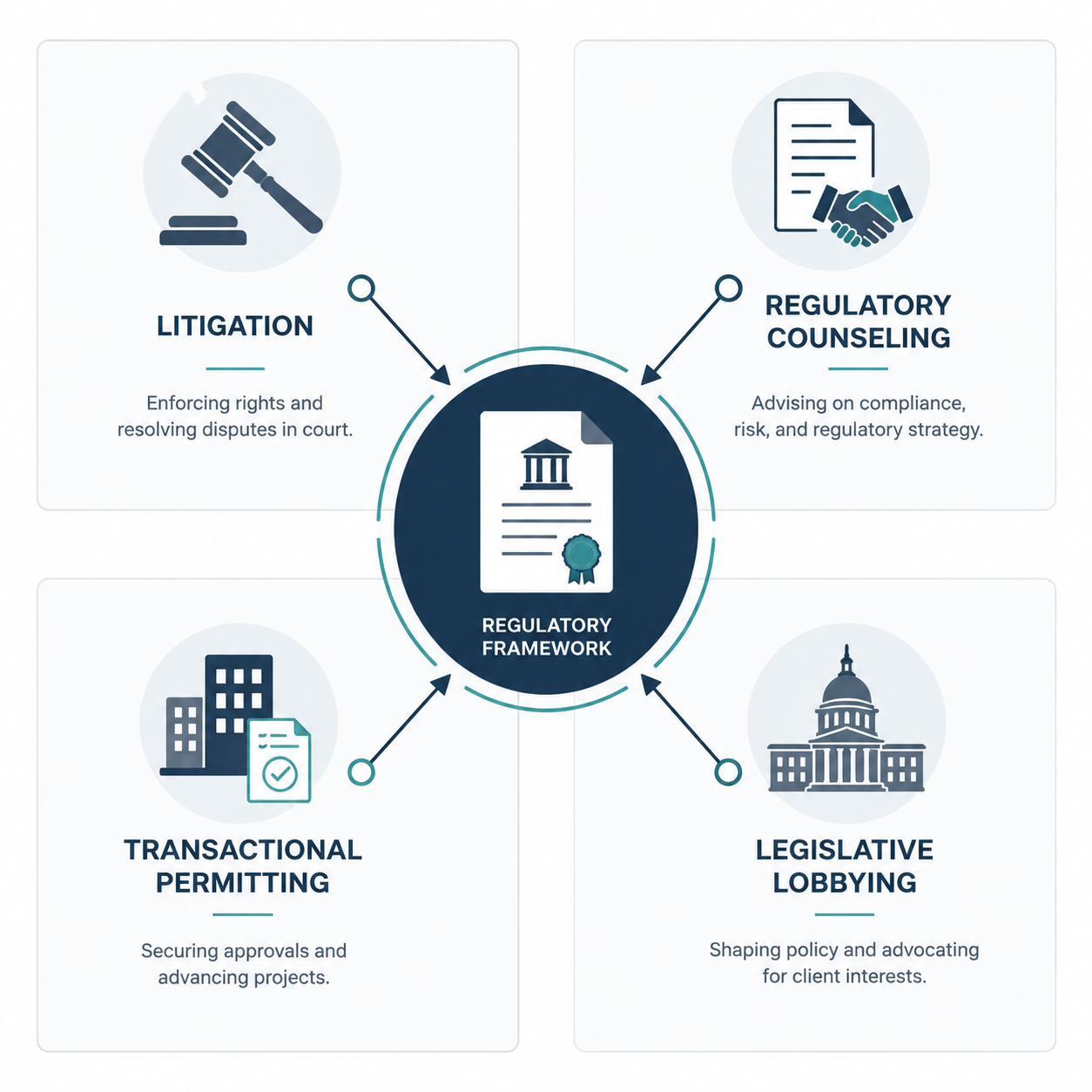
How One ESA Reversal Becomes Four Work Streams
Litigation is the easiest work stream to see because filings are public. It is not necessarily the largest or most durable. The business case for ESA investment is stronger than a docket-count story because each public challenge tends to force private work elsewhere: a memo on whether a client’s project record is still defensible, a permitting schedule update, a board-level risk note, a comment letter, a lobbying meeting, or a settlement assessment.
Litigation: Public Proof of Conflict
The July 2026 “harm” rescission immediately produced litigation attention. NPR reported on July 14 that the Trump administration faced lawsuits over the ESA change, including an Earthjustice-filed case in the Western District of Washington.[2] The available sources also identify July 14–15 litigation activity involving Earthjustice, EPIC, and Tribal suits, plus still-pending challenges to Biden-era 2024 ESA rules. That combination matters because it means firms are not staffing one isolated case theory; they are monitoring overlapping procedural postures and potentially inconsistent judicial outcomes.
A visible ESA lawsuit can generate work for both sides of the caption and for clients who are not parties. Regulated companies may ask whether to intervene, submit amicus support, preserve administrative-record arguments, or change transaction timing. Environmental plaintiffs may need administrative-law strategy, fee analysis, and remedy briefing. Agencies and project proponents may need to defend or distinguish biological opinions that were drafted under a regulatory interpretation now under attack.
Counseling: The Memo Before the Filing
Counseling demand rises when clients cannot wait for courts to settle the law. Hunton Andrews Kurth’s post-vacatur analysis is especially important on this point. The firm wrote that FWS had resumed consultations under reinstated 2018 language while applying “more cautious or qualified effects analyses,” a posture the alert described as likely to generate future legal disputes.[5] That is the kind of sentence that changes staffing assumptions. It turns one court order into repeated client questions across active consultations.
The phrase “more cautious or qualified effects analyses” is not dramatic. It is, however, operational. It suggests that an agency may be using reinstated regulatory text while hedging how confidently it applies that text to effects, causation, and the scope of review. For a project lawyer, that creates a drafting problem. For a litigator, it creates a record problem. For a client, it creates a timing and budget problem.
That is why the counseling work should not be treated as a soft add-on to litigation. When standards move, clients call before they sue. They ask whether a pending biological assessment should be revised, whether a consultation record can survive if the agency uses transitional language, whether a habitat issue that looked manageable last quarter now affects financing, and whether the safest legal path is delay, redesign, intervention, or a narrower permit request.
Permitting and Transactions: Consultation Volume Gives the Issue Scale
The permitting channel is where ESA changes create work that law firms can staff against, because the underlying consultation system is not small. FWS testimony cited approximately 1,002 formal consultations per year, with an average duration of 118 days, and approximately 11,123 informal consultations per year, with an average duration of 35 days.[9] Those figures do not measure law firm matters. They do measure the number of agency-facing processes that can be disrupted when the legal standard shifts.
The same testimony reported a 20% staff reduction between 2003 and 2022.[9] Again, that is not a revenue number. But it helps explain why legal work can expand when rules change. If agency capacity is strained, project teams need more help preparing complete records, anticipating questions, translating new standards into engineering or site-design choices, and managing schedule risk when review timelines become harder to predict.
The March 2026 vacatur of Section 7 provisions is particularly relevant to this channel because Section 7 consultation sits directly in the path of federal permits, funding, and approvals. A developer, energy company, infrastructure sponsor, water district, or public agency does not need to be ideologically invested in ESA reform to care about whether a consultation must be re-run, supplemented, or defended under a standard that changed after the project team built its schedule.
Transactional lawyers also get pulled in because ESA uncertainty affects diligence and closing conditions. A buyer assessing a project with federal approvals may need to know whether the biological opinion remains durable. A lender may ask whether litigation could stop construction. A seller may need disclosure language that does not overstate certainty. These are not headline lawsuits, but they are repeatable advisory tasks.
Legislative and Lobbying Work: Reform Is Still Moving
The legislative track gives the current cycle another revenue channel. H.R. 1897, the ESA Amendments Act of 2025, covers nine reform areas, including listing procedures, critical habitat, Section 7 consultation, the 4(d) blanket rule, fee-shifting alignment with the Equal Access to Justice Act, and private land conservation.[11] That breadth is why the bill matters to law firm economics even if its ultimate path is uncertain. A bill with multiple operational reform areas creates multiple client constituencies.
The Bipartisan Policy Center’s April 2026 work also shows that ESA permitting reform is not confined to one partisan memo. Its roundtable included 49 experts across the political spectrum, identified nine distinct ESA reform options, and reported five areas of “strong consensus.”[8] For firms with lobbying, regulatory, and environmental practices under the same roof, that creates a natural cross-sell: explain the bill, compare it with agency action, draft comments or Hill materials, and keep project teams informed about which changes are plausible enough to affect planning.
The broader political language should be handled carefully. ConservAmerica’s January 2026 framing described the ESA as “weaponized” against energy infrastructure.[12] That phrase helps explain why energy and infrastructure clients may be attentive to reform proposals, but it is advocacy framing, not a neutral measurement of project delay or legal spend. The practical point is narrower: when industry groups, agencies, plaintiffs, and Congress are all moving at once, clients need counsel who can read across forums.
The Demand Proxies Are Stronger Than the Revenue Data
No public source in the available record discloses ESA-specific law firm revenue for 2025 or 2026. That caveat should stay near the center of the analysis. It is easy to write that ESA changes are “driving revenue growth” and harder to prove the booked revenue line. The better-supported claim is that the rule reversals are creating measurable demand proxies across several channels at once.
| Demand proxy | What it supports | What it does not prove |
|---|---|---|
| Immediate July 2026 lawsuit activity | A live litigation market around the “harm” rescission | Total law firm revenue from those cases |
| Roughly 1,002 formal and 11,123 informal consultations per year | A large base of agency-facing processes exposed to rule changes | That every consultation uses outside counsel |
| Published alerts from multiple law firms | Firms are investing in client education and positioning around ESA reversals | The amount each firm has billed |
| Historical ESA fee-award data | ESA litigation has had meaningful fee economics in prior periods | Current 2026 fee volume |
| H.R. 1897 and bipartisan reform work | Legislative and lobbying demand has a substantive policy object | Whether Congress will enact reform |
The consultation-volume proxy is the most useful for practice planning because it speaks to repeatability. FWS testimony’s annual consultation figures suggest a broad pipeline of matters that may need updated legal assumptions when rules change.[9] Even a small percentage of affected projects can generate significant advisory work because each consultation connects legal analysis to biology, engineering, agency process, and project finance.
Fee-award history is relevant but should not be overstated. A House Natural Resources Committee report described more than 570 ESA lawsuits and more than $15 million in attorney-fee awards, including rates above $500 per hour and individual attorneys receiving more than $2 million.[10] Those figures come from a 2012 committee report. They show that ESA litigation has historically supported meaningful fee recovery, not what firms or advocacy counsel are earning in the 2025–2026 cycle.
Firm-alert activity is another imperfect but useful signal. The available sources identify at least eight firms — Holland & Knight, Hunton Andrews Kurth, Nossaman, Holland & Hart, BBK, Beveridge & Diamond, Baker Botts, and Van Ness Feldman — publishing substantive ESA alerts within the past 12 months. Alerts do not prove paid matters. They do show that firms believe the changes are concrete enough to justify partner time, client education, and search-visible positioning.
Why Instability Can Be More Valuable Than a Stable Win
A stable pro-development regime would produce permitting work and some challenges. A stable pro-conservation regime would produce compliance counseling and some challenges. The 2025–2026 ESA cycle is different because clients cannot confidently build a single planning model around either direction. That instability forces parallel work.
A project sponsor may need litigation monitoring because the “harm” rescission is in court, consultation counseling because Section 7 standards were vacated, permitting strategy because agency practice may be cautious under reinstated language, and lobbying support because Congress is considering reforms touching consultation, critical habitat, and fee shifting. A plaintiffs’ organization may need the same sequence from the other side: challenge the rescission, defend prior rules, participate in legislative debate, and evaluate fee recovery. An agency-facing public entity may need outside counsel simply to keep the administrative record coherent while standards move.
The God Squad national security exemption illustrates the same point in a narrower way. Its March 2026 use for Gulf drilling created a new tool with little precedent base for interpretation. That does not mean it will become common, and the available record does not support treating it as a major recurring revenue category by itself. Its significance is that it adds another advisory question to the current cycle: when, if ever, can a client invoke or challenge an exemption path that has not yet developed a reliable body of case law?
That is the staffing question underneath the doctrine. A firm does not need to assume a permanent ESA boom to justify attention. It needs to decide whether demand is broad enough to support more environmental litigation capacity, more regulatory counseling depth, better integration with project finance and real estate teams, or a stronger handoff to government relations. The public record supports that conversation. It does not support pretending that ESA-specific revenue is already visible in firm financial disclosures.
A Practical Investment Lens for Firm Leaders
The firms best positioned for this cycle are not necessarily the ones with the loudest view of ESA policy. They are the ones that can connect four desks quickly: litigators who understand administrative records, regulatory lawyers who can counsel during uncertainty, project lawyers who can translate ESA risk into financing and schedule consequences, and legislative professionals who can explain whether proposed reforms are moving or merely circulating.
The work also rewards timing. Client alerts published after the November 2025 proposals captured one wave of questions. Post-vacatur analysis in March 2026 captured another. The July 2026 “harm” rescission created a fresh round of litigation and counseling demand. Firms that treat each event as a standalone update may miss the more durable opportunity: maintaining an ESA-change tracker that can be turned into matter intake, client briefings, board memoranda, comment strategies, and litigation-risk reviews.
The final judgment should stay disciplined. The 2025–2026 ESA reversals appear to create a broader law firm opportunity than any single stable regulatory regime would, because instability itself causes clients to litigate, re-counsel, re-permit, and lobby in parallel. That is a credible demand-proxy case for practice investment. It is not a disclosed-revenue measurement, and it should not be sold internally as one.
References
- Endangered and Threatened Wildlife and Plants; Rescinding the Regulatory Definition of “Harm” Under the Endangered Species Act, Federal Register, July 14, 2026.
- Trump administration faces lawsuits over change to Endangered Species Act, NPR, July 14, 2026.
- Court overturns Trump ESA rules, Center for Biological Diversity, March 31, 2026.
- Judge invalidates Trump ESA changes, Courthouse News, March 31, 2026.
- Court Resets Key ESA Section 7 Consultation Standards, Hunton Andrews Kurth.
- Reversing Course for Endangered Species Act: Administration Proposes ESA Regulatory Amendments, Holland & Knight, November 2025.
- Federal Wildlife Agencies Propose ESA Changes Including Narrowing the Scope of Consultation, BBK, December 2025.
- Endangered Species Act: Permitting Options for Congress, Bipartisan Policy Center, April 2026.
- ESA at 50: The Destructive Cost of the ESA, U.S. Fish and Wildlife Service testimony.
- Millions of Taxpayer Dollars Spent on ESA Litigation and Attorney Fees, House Natural Resources Committee, 2012.
- H.R.1897 - ESA Amendments Act of 2025, 119th Congress, 2025.
- Powering America Through Endangered Species Act Reform, ConservAmerica, January 2026.
Comments
Join the discussion with an anonymous comment.